

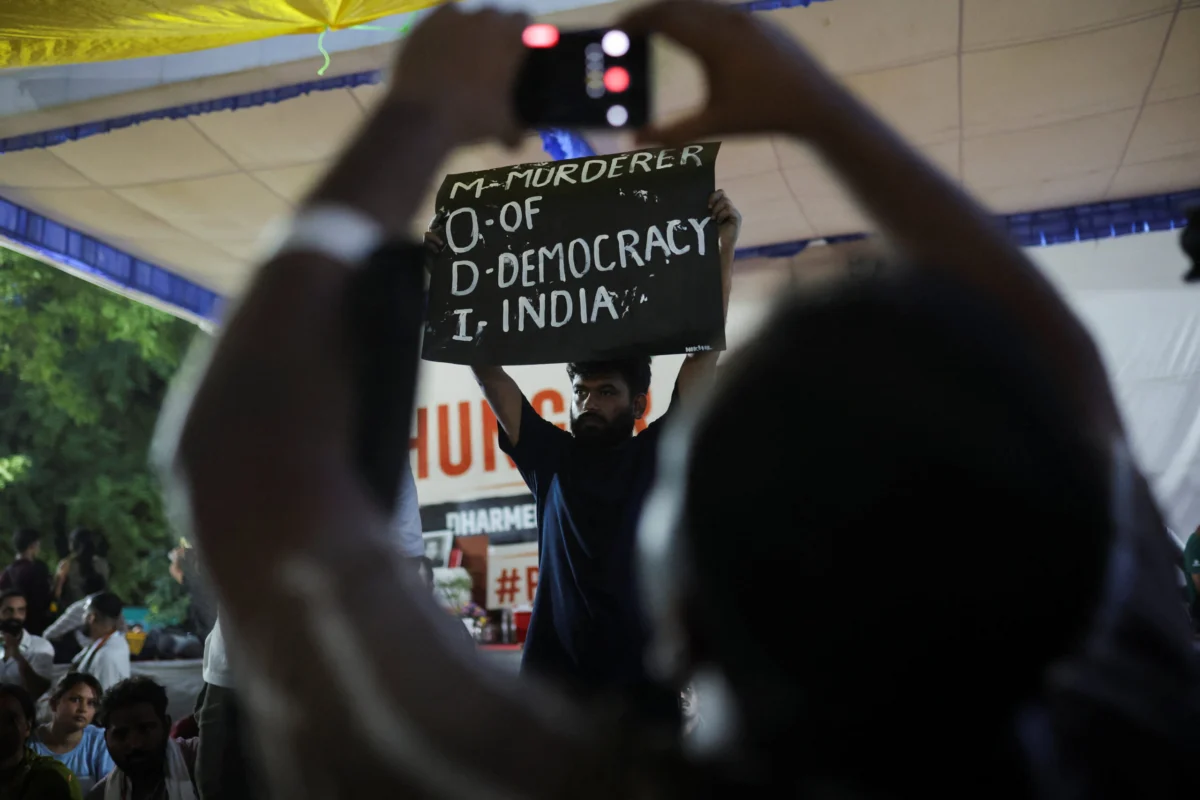
The volatile landscape of Indian political activism has reached a critical juncture with the forceful removal and hospitalization of renowned educator-activist Sonam Wangchuk from a sit-in protest at Delhi’s Jantar Mantar observatory. The incident, occurring on the 21st day of Wangchuk’s indefinite hunger strike, marks a significant escalation in the burgeoning movement spearheaded by the ‘Cockroach Janta Party’ (CJP). The CJP, a satirical yet potent youth collective, has rapidly gained national prominence by channeling widespread public anger over systemic issues, particularly rampant university entrance exam leaks and persistent youth unemployment.
Escalation at Jantar Mantar: A Defining Moment
On a recent Saturday, law enforcement officials intervened at the protest site, taking Sonam Wangchuk into custody and subsequently to a hospital, reportedly against his will, citing health concerns arising from his prolonged hunger strike. Wangchuk, a vocal advocate for educational reform and environmental protection, had joined the CJP’s demonstrations to amplify demands for accountability within India’s competitive examination system. His forced removal has galvanized supporters, with protesters rallying at Jantar Mantar and CJP founder Abhijeet Dipke commencing his own hunger strike in solidarity. The demonstrators have declared their intention to march towards the Indian Parliament on Monday, demanding the resignation of Education Minister Dharmendra Pradhan over the recent spate of exam leaks that have sparked nationwide outrage. Beyond the immediate issue, the movement targets broader failures of accountability in India’s high-stakes education sector, with some voices even calling for the resignation of Prime Minister Narendra Modi.
The Genesis of the ‘Cockroach Janta Party’
The ‘Cockroach Janta Party’ emerged in mid-May following controversial remarks by Chief Justice Surya Kant. During a judicial proceeding, Justice Kant reportedly referred to unemployed youth as "cockroaches," a comment that ignited a firestorm of indignation across the nation. This seemingly innocuous, yet deeply insulting, analogy served as an unexpected catalyst, transforming a moment of judicial disdain into a powerful symbol of resistance.
Almost overnight, the "party" — which is not a registered political entity but a socio-political movement – garnered an immense online following, primarily among India’s vast youth demographic. Social media platforms became the primary conduits for its rapid spread, with memes, satirical content, and calls to action resonating deeply with millions. From virtual outrage, the CJP swiftly transitioned to tangible action, staging massive protests in various cities, demonstrating its capacity to mobilize beyond the digital realm.
A Deeper Dive into the ‘Cockroach’ Metaphor
The "cockroach" label, initially intended as an insult, has been defiantly reclaimed by the movement’s adherents. To be called a cockroach, as articulated by the movement, signifies being perceived as dirty, dispensable, and best kept out of sight. It evokes the image of a despised, subaltern creature, yet one that is remarkably resilient, hard to kill, and thrives in the cracks of polite society. The cockroach survives poison, darkness, and disgust, appearing when a house is not as clean as its owners claim.
For millions of young Indians, particularly those grappling with the harsh realities of chronic unemployment, recurring exam-paper leaks, and the ever-rising cost of living, the chief justice’s insult captured an unspoken sentiment they already harbored. The CJP masterfully turned this humiliation into visibility, effectively stating: "If this is how power sees us, then let us speak in that name." What began as a pejorative term has been transformed into a badge worn proudly, a defiant symbol of collective frustration and overlooked existence. This is not merely revolutionary politics; it possesses a tragicomic, almost farcical, quality, because the cockroach, in this context, stands for an India where vast dreams of upward mobility, fostered by decades of aspirational narratives, have come to naught for a significant portion of its youth.
The Economic and Social Undercurrents
The rise of ‘cockroach politics’ cannot be isolated from India’s complex socio-economic landscape. The country, despite its impressive headline GDP growth, struggles with profound structural issues that disproportionately affect its youth.
Youth Unemployment and Jobless Growth: India’s youth unemployment rate remains a critical concern. According to data from the Centre for Monitoring Indian Economy (CMIE), the overall unemployment rate has fluctuated, often hovering around 7-8%, but for graduates and those aged 15-29, it can be significantly higher, sometimes exceeding 15-20% in urban areas. The phenomenon of "jobless growth," where economic expansion does not translate into a commensurate increase in quality employment opportunities, has left millions of educated youth disillusioned. They have invested heavily in schooling and higher education, only to find a scarcity of dignified, stable work that matches their qualifications and aspirations.
The Exam Scam Epidemic: The recurring scandal of exam-paper leaks is a particularly egregious symptom of systemic rot. Recent high-profile cases, such as the alleged irregularities in the National Eligibility-cum-Entrance Test (NEET) for undergraduate medical courses and the cancellation of the UGC-NET examination for junior research fellowships and assistant professorships, have impacted millions of students. The NEET exam alone saw over 2.4 million candidates in 2024. These leaks represent more than just administrative failures; they are a profound betrayal of trust. For middle-class families, an exam is not merely a test; it is a wager on social mobility. Parents save, borrow, sell land, and pay exorbitant coaching fees—often hundreds of thousands of rupees—for the possibility that a child might secure respectable salaried work. When an exam is compromised, the betrayal is intimate and deeply personal, mocking the sacrifice of millions of families and shattering years of diligent preparation.
Economic Disparity and Welfare Dependency: In the aftermath of the COVID-19 pandemic, which plunged the Indian economy into recession, more than 800 million Indians continue to depend on government food handouts. While this welfare floor tackles hunger and keeps households afloat, making the state visible in everyday life, it simultaneously reflects a failure to address the structural precarities exposed during the pandemic. At the other end of the spectrum, wealth concentration has sharpened dramatically. Reports, including those by Oxfam, indicate that the richest 1 percent in India now claim a share of income and wealth not seen in the past century. This stark dichotomy—welfare dependency at the bottom, monopoly capital at the top, and a tightly squeezed middle class—defines the contemporary political economy, plagued by jobless growth and a pervasive sense of blocked aspirations.
Political Context and State Response
The ‘cockroach politics’ phenomenon has emerged at a time when Prime Minister Modi’s Bharatiya Janata Party (BJP) maintains a formidable electoral machine, characterized by vast resources, ideological discipline, and a proven capacity to convert welfare initiatives, Hindu nationalism, and opposition fragmentation into votes. However, the BJP’s mandate, paradoxically, remains that of a very large minority. In the 2024 general election, the party secured the support of just over a third of voters nationally, meaning two-thirds of those who voted did not endorse the BJP’s re-election bid. The regime’s power, therefore, rests not on an empirical majority but on aggregation: regional and caste alliances, opposition defections and splits, and the steady shrinkage of India’s ‘third space’ between dominant national parties.
The state’s initial response to the CJP was one of "calibrated containment": permitting protests within narrow limits, policing their reach, and waiting for the coalition to fragment. This strategy aimed to treat the CJP as another ephemeral viral storm in India’s crowded and volatile politics—a satirical youth outfit born on social media, briefly visible on the street, and destined to fade. However, the escalation surrounding Sonam Wangchuk suggests that the CJP has unnerved those in power, indicating that its influence extends beyond a transient online trend.
Statements and Reactions (Inferred)
- Police Authorities: Officials likely stated that Sonam Wangchuk was removed and hospitalized purely on health grounds, emphasizing the state’s responsibility to prevent self-harm. They would reiterate the importance of maintaining public order and ensuring the safety of all citizens, including protesters. Any forceful action would be justified as necessary to uphold the law and prevent escalation.
- Education Minister Dharmendra Pradhan: The minister would likely acknowledge the gravity of the exam leak situation, express regret for the distress caused to students, and pledge swift and stringent action against those responsible. He would emphasize ongoing investigations by agencies like the CBI and commitments to reform the examination system, including the formation of high-level committees, but would likely resist calls for his resignation, citing his commitment to resolving the crisis.
- Prime Minister’s Office (PMO): While not directly addressing the CJP, the PMO might issue general statements reaffirming the government’s commitment to youth welfare, employment generation, and transparent governance. They might highlight existing schemes for skill development and entrepreneurship, subtly attempting to counter the narrative of widespread disillusionment without explicitly validating the protest movement.
- CJP Founder Abhijeet Dipke and Protesters: Dipke and other CJP leaders would condemn Wangchuk’s forceful removal as an authoritarian act, further solidifying their resolve. They would reiterate their demands for ministerial resignations, comprehensive structural reforms to prevent future exam leaks, and a more equitable economic system. Their statements would likely emphasize the symbolic power of the "cockroach" and the collective voice of the marginalized youth.
Broader Impact and Implications
The CJP’s emergence highlights a profound disjunction: electoral politics appears settled from above, yet it feels increasingly untrustworthy from below. Young people are not just angry about a lack of jobs and botched exams; they are entering politics at a time when traditional democratic channels—parties, elections, media, and independent institutions—look increasingly vulnerable to distortion and manipulation.
The "cockroach" symbol carries immense weight because it speaks directly to those caught between aspiration and contempt: the graduate without work, the small entrepreneur squeezed by taxes and weak demand, the gig worker perpetually online but never secure, and the student whose years of preparation can be rendered meaningless by a leaked exam paper. The cockroach is the citizen who survives without being honored for surviving.
The Modi era has, arguably, mastered electoral conversion without achieving genuine social reconciliation. It has not adequately answered the existential question haunting millions of young Indians: What future remains for those outside inherited privilege, monopoly capital, or the option of a global exit?
The CJP, in its current form, may not offer a definitive answer to this complex question. It is, by its very nature, fragile, open, and vulnerable to the forces it mocks. Its very incoherence is its truth. It symbolizes not so much the arrival of a new, organized political party as the exhaustion of older political languages and forms of expression. A joke that travels this far, that mobilizes thousands and unnerves the powerful, need not necessarily evolve into a fully-fledged political movement to reveal a deep-seated malaise. It need not defeat the BJP or articulate a pure, coherent ideology to be profoundly politically meaningful.
This is the deeper meaning of ‘cockroach politics.’ It suggests that the democratic spirit in India, while perhaps diminished in its traditional forms, undeniably survives. It speaks through satire and symbolism because ordinary speech, within existing political frameworks, feels blocked. It appears as a meme and social media phenomenon because organized, traditional politics seems too risky or too co-opted. And it laughs, defiantly, because humor in dark times often emerges as the last public form of courage, a powerful, disarming tool for those who feel unheard and unseen.
The cockroach, to disappoint those who seek revolutionary heroes, is no such figure. It is a humble, resilient creature that appears precisely when the house is not as clean, as orderly, or as just as its owners claim. Its continued visibility is a stark, uncomfortable reminder of the cracks in the foundations of the world’s largest democracy.
