

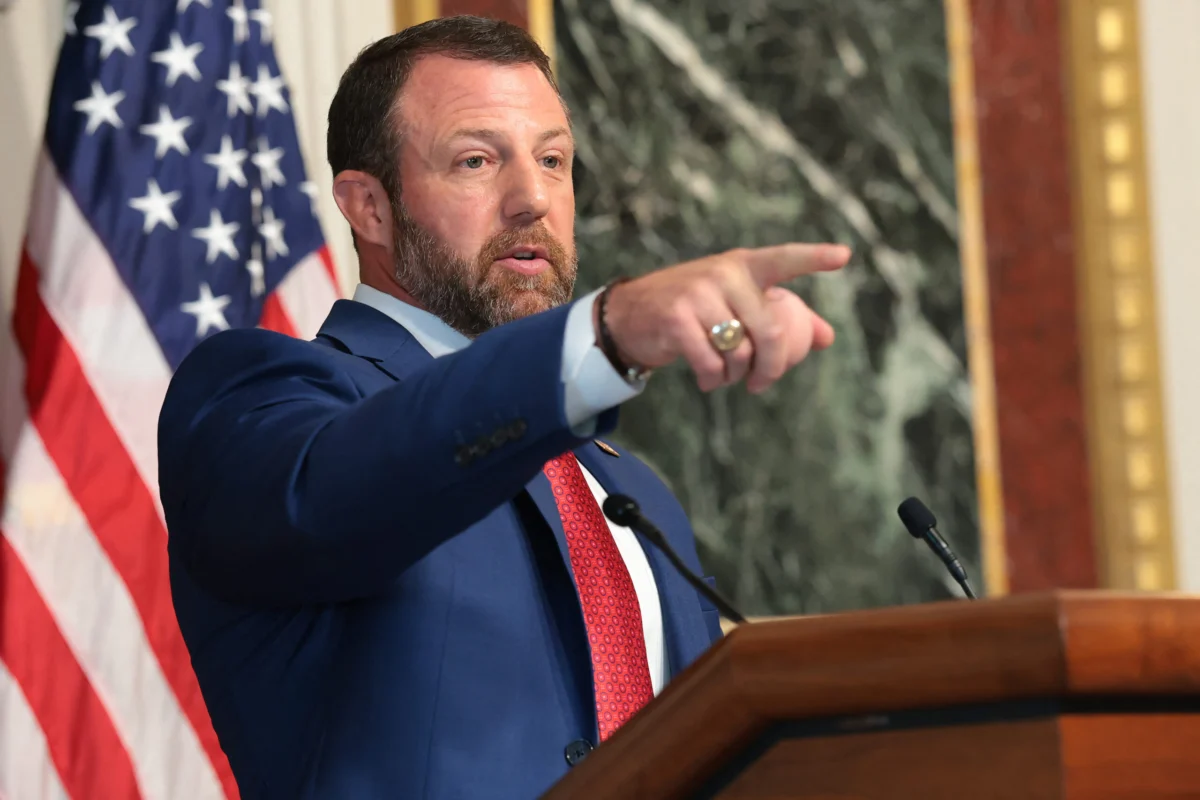
Homeland Security Secretary Markwayne Mullin has emphatically reinforced threats initially articulated by United States President Donald Trump against states that do not comply with the administration’s demands for sweeping election reforms. In a notable speech delivered on Friday, Secretary Mullin largely echoed the sentiments and specific proposals President Trump had outlined the preceding night, signaling a determined and hardline agenda aimed at fundamentally reshaping the administration and security of U.S. elections. The pronouncements have immediately ignited concerns regarding federal overreach, states’ rights, and the integrity of democratic processes, particularly with the 2026 midterm elections on the horizon.
The Administration’s Stance on Election Reform and "Maximum Pressure"
Secretary Mullin’s address introduced a potent phrase borrowed directly from President Trump’s foreign policy lexicon: "maximum pressure." Mullin pledged that his department would deploy a campaign of maximum pressure to ensure states adhere to the federal government’s directives concerning election security and voter registration. This strategy, previously associated with international diplomacy and economic sanctions against adversarial nations, now appears to be repurposed for domestic policy, targeting states perceived as resistant to the administration’s election agenda. The use of such terminology underscores the perceived gravity and uncompromising nature of the administration’s approach.
The core of the administration’s push for reform stems from President Trump’s long-standing, and repeatedly debunked, assertions that the 2020 presidential election was marred by widespread fraud, leading to his false claim of victory. While Secretary Mullin stated, "This isn’t about rehashing the 2020 election. This is just exposing what took place and to make sure it never happens again," the explicit focus on past alleged irregularities and the stated goal of preventing their recurrence inextricably links the current reform efforts to the disputed outcome of the previous election cycle. This framing, critics argue, serves to legitimize unfounded claims and erode public trust in electoral systems.
Targeting Individuals and Institutions: Accountability for Alleged Misconduct
Beyond state-level compliance, Mullin also hinted at severe repercussions for individuals whom President Trump has accused of misleading the American public during the 2020 election cycle. He specified that his department is actively scrutinizing individuals within the intelligence community and the administration of former President Joe Biden as potential targets for accountability. "Everybody that purposely misled the American people, abused their power and their authority and decided not to continue doing their job will be held accountable," Mullin asserted.
This declaration suggests a potential expansion of the administration’s focus beyond election mechanics to include punitive actions against former government officials. The implications of such an undertaking are significant, raising questions about political weaponization of federal agencies and the potential chilling effect on civil servants and intelligence professionals. Critics quickly pointed out the lack of concrete evidence for such widespread malfeasance and the dangerous precedent of using federal power to investigate political opponents based on unsubstantiated claims. The intelligence community, for instance, has consistently affirmed the integrity of the 2020 election, rejecting claims of systemic fraud.
The "Deep State" Allegations and Lack of Substantiation
During his primetime speech on Thursday, President Trump had extensively alleged a "deep state" cover-up regarding purported election vulnerabilities. He claimed that declassified documents released by his White House would expose this conspiracy and substantiate his sweeping claims of fraud. However, upon their release, these documents largely failed to provide any concrete evidence to support the President’s assertions, a fact quickly noted by independent analysts and news organizations. The narrative of a "deep state" — a shadowy network of unelected government officials working to undermine the democratically elected leadership — has been a recurring theme in Trump’s rhetoric, often used to explain away adverse outcomes or to discredit institutions. The absence of corroborating evidence in the declassified materials further amplified skepticism surrounding the administration’s claims.
States Under Pressure: A Focus on Swing States and Strongholds
Mirroring President Trump’s previous remarks, Secretary Mullin specifically identified four states as immediate targets for the administration’s intensified efforts: California, Pennsylvania, New Jersey, and Nevada. These states are strategically significant in the U.S. electoral landscape. California and New Jersey are generally considered left-leaning strongholds, while Pennsylvania and Nevada are critical swing states that can determine the outcome of presidential elections. All four are populous states, endowed with a substantial number of votes in the Electoral College, the indirect system that ultimately decides U.S. presidential contests. For context, the Electoral College comprises 538 electors, with a candidate needing 270 electoral votes to win the presidency. The combined electoral weight of these four states makes them crucial battlegrounds or significant vote reservoirs.
The Contested Claims of Non-Citizen Voting
A central tenet of Mullin’s and Trump’s rationale for intervention is the assertion of widespread non-citizen voting. Mullin claimed that these four targeted states combined have 250,000 non-citizens on their voting rolls, a statistic for which he offered no immediate basis or supporting documentation. He further reiterated President Trump’s broader claim that the government had uncovered nearly 278,000 foreign nationals in total who are registered to vote across the nation.
These figures have been met with immediate skepticism and strong refutations from election experts, civil rights organizations, and state election officials. There has been no indication from the Trump administration regarding the methodology used to arrive at these figures or the underlying data. Experts consistently warn that the mere presence of an individual on a voter registration list does not equate to that individual successfully casting a ballot. States employ rigorous screening processes to verify voter eligibility, including citizenship, often cross-referencing with other federal and state databases. Instances of non-citizen voting in U.S. elections are exceedingly rare, bordering on negligible.
For instance, a comprehensive analysis conducted by the Brennan Center for Justice, a non-partisan law and policy institute, examined 42 jurisdictions during the 2016 elections. This period marked President Trump’s first successful bid for public office and was also characterized by his initial claims of widespread voter fraud. The Brennan Center’s study concluded that non-citizen voting accounted for approximately 0.0001 percent of the ballots cast, an infinitesimally small figure that would have no material impact on election outcomes. Other academic studies and government analyses have similarly found extremely low rates of non-citizen voting. The National Conference of State Legislatures (NCSL) and the Election Law Journal have also published extensive research confirming the rarity of such occurrences.
Withholding Federal Funds: A Lever of Coercion
One of the most significant threats articulated by Secretary Mullin is the potential withholding of federal funds from states that do not comply with the administration’s mandates concerning election security. This represents a powerful and potentially coercive tool, as states rely heavily on federal grants for a wide array of programs, including those related to election administration. Mullin stated, "We are going to make our security enhancements mandatory, meaning that if these states want a grant and they want to be reimbursed to work or to run federal elections, they’re going to have to implement security issues." He clarified the specific demands: "Just security issues. We’re not trying to get into anything else, but we’re saying that the machines have to be secured and that your voter registration list needs to be scrubbed."
This threat immediately raises complex legal and constitutional questions, particularly concerning the principle of federalism, which delineates powers between the federal government and state governments. The U.S. Constitution grants states primary authority over the administration of elections. Historically, federal funding has been provided to states for election improvements, but typically with the understanding that states retain discretion over how to implement those improvements within federal guidelines, not under direct federal coercion tied to specific, unproven allegations. Legal scholars suggest that withholding funds based on unproven claims of fraud or for mandates that infringe on states’ constitutional authority could face significant challenges in federal courts. Such an action could be seen as an unconstitutional attempt to nationalize election administration, circumventing the Tenth Amendment, which reserves powers not delegated to the federal government to the states or the people.
Historical Context of Election Integrity Debates

President Trump’s current campaign for election reform is not an isolated event but rather a continuation of a long-standing pattern of questioning election outcomes. Even after his 2016 Electoral College victory, despite losing the popular vote by nearly three million ballots, Trump falsely claimed that millions of people "voted illegally." This historical precedent underscores a consistent narrative of election denial that predates his 2020 loss.
The claims of widespread voter fraud, particularly concerning non-citizen voting, have been consistently dismissed by election experts, bipartisan commissions, and courts across the country. These experts emphasize that while isolated instances of voter fraud can occur, they are not widespread or systematic enough to alter election results. The vast majority of alleged fraud cases are often attributed to clerical errors, misunderstandings, or accidental double-voting rather than malicious intent.
Electronic Voting and Mail-in Ballots: Persistent Concerns
A recurring theme in President Trump’s critiques of election systems has been his unsubstantiated concerns about the security of electronic voting machines. He has consistently advocated for a return to paper ballots, despite extensive audits and security protocols in place for electronic systems. Furthermore, he has pushed for restrictions on mail-in ballots, even though he himself has utilized this method to vote. Mail-in voting, which saw a significant increase during the COVID-19 pandemic, has been a particular target of his administration’s scrutiny, despite numerous studies confirming its security and minimal impact on fraud rates.
The Trump administration has also repeatedly pressured states to turn over their voter rolls to the federal government, ostensibly for cleaning and verification. However, several federal courts have blocked these efforts, citing states’ constitutional authority over election administration and concerns about privacy and data security. The administration’s proposed tool for consolidating voter information, the Systematic Alien Verification for Entitlements (SAVE) database, has also drawn criticism. The SAVE system, primarily used to verify the immigration status of applicants for federal benefits, has been flagged by civil rights groups and immigration advocates for its potential to erroneously flag foreign-born citizens as non-citizens, thereby disenfranchising eligible voters.
Earlier this month, the Trump administration reportedly sent letters to election officials nationwide, threatening prosecution if non-citizen voters were found in their states. These letters, devoid of specific evidence, have been widely interpreted as an attempt to intimidate state officials and exert federal control over traditionally state-run processes.
Constitutional Scrutiny and State Resistance
Critics have uniformly accused President Trump of seeking to nationalize election administration, a move that directly challenges the U.S. Constitution’s allocation of election organizing powers to the individual states. This fundamental principle of federalism is a cornerstone of American governance.
Leaders in several states have already responded forcefully to Mullin’s remarks, hinting at impending legal action. California Governor Gavin Newsom, a prominent Democrat, publicly challenged the administration’s threats, writing on his social media feed, "California has free, fair, and secure elections and we will fight for them. Try us." He linked to a video of Mullin’s Friday speech, signaling a direct confrontation. Similar sentiments are expected from other state attorneys general and election officials who view the federal demands as an infringement on their constitutional authority. Organizations like the American Civil Liberties Union (ACLU) and state-level voter protection groups are also poised to challenge any federal mandates or funding cuts that they deem unconstitutional or discriminatory.
The Media Clash: Threats to Broadcast Licenses
Adding another layer of controversy, Secretary Mullin also directly criticized major television networks that opted not to broadcast President Trump’s primetime speech live on Thursday. The White House had formally requested airtime for the address, the contents of which were kept largely under wraps beforehand. However, many critics, including media ethics watchdogs and political commentators, urged networks to refrain from providing an unfiltered platform for what they anticipated would be baseless election claims, arguing such broadcasts could further undermine public confidence in the upcoming 2026 midterm elections.
Ultimately, prominent networks such as ABC, NBC, and CNN chose not to air the half-hour speech in its entirety on their main channels. Other outlets, like Fox News, did broadcast it, though often with immediate fact-checking and caveats from their anchors. President Trump used his primetime slot to denounce the channels that opted out, accusing them of being part of a larger "plot." "They and others in the media are part of a plot. They want to continue this fraud for whatever reason. They want to keep it going," Trump asserted, adding, "You can’t have a great country without free and fair elections. Fraud like this should mean a revocation of their licences."
Mullin echoed this assessment when questioned about Trump’s threat, labeling the networks’ decision "shameful" and implying their actions were part of a broad cover-up. "What are they trying to cover up? Why wouldn’t they want to inform the American people? Why are they calling themselves a news outlet if they’re not actually trying to get the news out there?" Mullin asked, seemingly challenging the networks’ journalistic integrity.
This is not the first instance of the Trump administration threatening to revoke broadcast licenses from channels perceived as critical. Such threats were made last September amidst a public feud with late-night comedian Jimmy Kimmel. These remarks consistently draw condemnation from free press advocates and constitutional experts.
In light of President Trump’s latest remarks, Anna Gomez, the sole Democratic commissioner on the Federal Communications Commission (FCC), publicly rejected the threat as unconstitutional. She took to social media, stating, "The FCC has no authority to punish a station for refusing to air a blatantly political speech. This is a naked attempt to bully broadcasters, and the FCC should have no part in it." Gomez further clarified, "It is ridiculous to call for broadcasters to lose their license simply for making the same editorial decisions they’ve made under presidents of both parties, especially when the remarks were still available to anyone who wanted to watch them online." The First Amendment of the U.S. Constitution provides robust protections for free speech and the news media, making any attempt to revoke licenses based on editorial decisions highly problematic and likely unconstitutional. The FCC’s role is generally limited to technical regulations and ensuring stations operate in the public interest, not to dictate content or punish for political views.
Broader Implications for Democracy and Federalism
The confluence of these federal pronouncements—threats to states, unsubstantiated claims of fraud, and attacks on media outlets—presents a significant challenge to established democratic norms and the delicate balance of power in the United States. The administration’s aggressive posture on election reform risks eroding public confidence in the electoral system, even as election security experts emphasize the resilience and integrity of U.S. voting processes.
The implications for federal-state relations are particularly profound. Should the administration proceed with withholding federal funds, it would trigger unprecedented legal battles and deepen partisan divisions, potentially disrupting essential state services and election preparations. The proposed reforms, if implemented under duress, could lead to a patchwork of election rules, further complicating the administration of federal elections.
Furthermore, the attacks on media organizations, coupled with calls for license revocation, raise serious concerns about press freedom and the role of an independent media in a democracy. Such actions, even if legally untenable, can have a chilling effect on journalistic inquiry and public discourse. As the nation approaches the 2026 midterm elections, the administration’s "maximum pressure" campaign appears poised to define the political landscape, setting the stage for continued clashes over election integrity, states’ rights, and the foundational principles of American democracy.
