

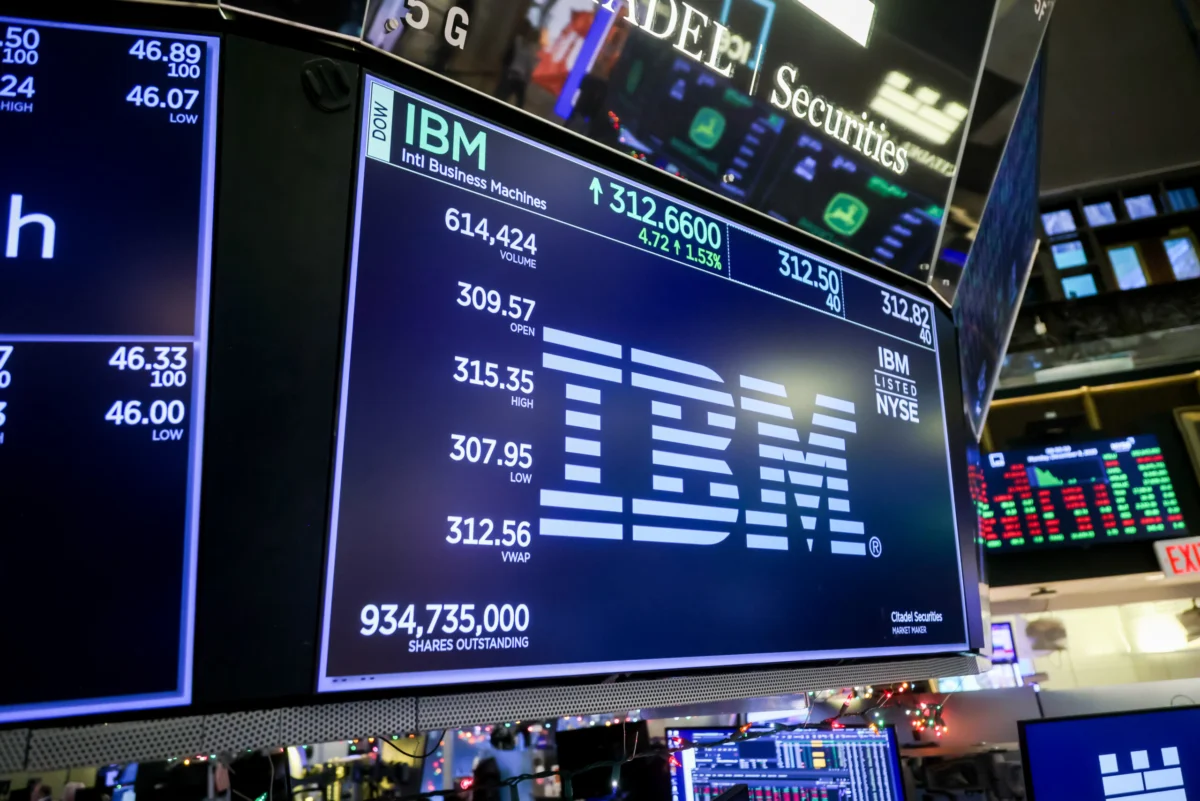
On Tuesday, CNBC’s "Mad Money" host Jim Cramer issued a stern cautionary note regarding International Business Machines (IBM), suggesting that the legacy technology giant has found itself on the disadvantageous side of a transformative shift in corporate spending. Following a precipitous decline in IBM’s share price, Cramer argued that the fundamental landscape of information technology (IT) investment has changed, leaving IBM struggling to maintain its footing as businesses pivot toward specific high-growth sectors.
The market reaction was swift and severe. IBM shares plummeted approximately 25% after the company issued a pre-announcement regarding its second-quarter financial results, which significantly underperformed Wall Street’s expectations. This rare pre-earnings warning, coming just a week before the scheduled full report, signaled deep-seated issues in the company’s ability to close critical deals in a rapidly evolving technological environment.
The Anatomy of the Second-Quarter Shortfall
The preliminary financial data released by IBM painted a challenging picture for the Armonk, New York-based firm. The company reported that revenue, earnings per share (EPS), and software revenue growth all failed to meet the benchmarks previously set by analysts. Perhaps most concerning was the admission from CEO Arvind Krishna that several large-scale customer contracts, which were expected to be finalized within the quarter, remained unsigned.
Krishna acknowledged that the company "faltered" during the period, attributing the miss to a shifting macroeconomic environment where clients are becoming increasingly selective about where they allocate their capital. While the company expressed hope that these deals were merely delayed rather than canceled entirely, the market’s reaction indicated a lack of confidence in that distinction.
Cramer highlighted that this shortfall is not merely a localized execution error but a symptom of a much broader trend. According to his analysis, the shortfall serves as one of the clearest indicators to date that global corporations are aggressively reshuffling their IT budgets. As the fervor for artificial intelligence (AI) continues to dominate boardroom discussions, the "old guard" of technology services is being cannibalized to fund the "new guard" of generative AI and specialized infrastructure.
The Three Pillars of Modern IT Spending
Central to Cramer’s thesis is the identification of three specific areas where corporate IT managers are concentrating their financial resources. He argued that in the current climate, any technology firm not firmly entrenched in these three sectors faces an uphill battle for relevance and revenue.
- Cybersecurity: As digital threats become more sophisticated—often powered by AI themselves—corporations view security not as an optional upgrade but as a foundational necessity. Spending in this sector remains resilient, even in the face of broader economic belt-tightening.
- Hardware Infrastructure: The physical components required to run large-scale AI models, particularly high-end GPUs and specialized server clusters, have become the primary focus of capital expenditure. This has benefited companies like Nvidia and specialized server manufacturers while draining funds from general-purpose hardware.
- AI Tokens and Consumption-Based Costs: This refers to the ongoing costs associated with utilizing large language models (LLMs) and AI platforms. As businesses integrate AI into their daily operations, they are shifting budgets toward the "consumption" of AI intelligence, often billed by the "token" or by usage volume.
Cramer pointed out that while IBM has attempted to position itself as a leader in the AI space with its Watsonx platform, a significant portion of its sprawling portfolio remains tied to "other types of spending." These legacy categories, which include traditional consulting, middleware, and non-AI-centric software services, are increasingly being viewed as discretionary or secondary by Chief Information Officers (CIOs).
A Chronology of Strategic Transformation
To understand IBM’s current predicament, one must look at the company’s decade-long effort to reinvent itself. Under previous leadership, IBM struggled with stagnating revenue as the world moved toward the public cloud—a transition largely dominated by Amazon Web Services (AWS), Microsoft Azure, and Google Cloud.
When Arvind Krishna took the helm in April 2020, he accelerated a "hybrid cloud" strategy, anchored by the $34 billion acquisition of Red Hat. The goal was to provide a bridge for large enterprises to manage data across various cloud environments and on-premise servers. For several years, this strategy appeared to be bearing fruit, providing IBM with a more predictable, recurring revenue stream.
However, the sudden and explosive rise of generative AI in late 2022 and throughout 2023 changed the calculus. The "hybrid cloud" narrative, while still relevant, has been partially eclipsed by the urgent demand for AI-ready infrastructure. The timeline of IBM’s recent struggles suggests that the company may have been caught between two eras: the hybrid cloud transition it was finally mastering, and the AI-first revolution that is now demanding immediate capital.
Market Reaction and Financial Indicators
The 25% drop in IBM’s stock price represents a significant loss of market capitalization, reflecting investor fears that the company’s growth engines are stalling. Despite the decline, IBM remains a cornerstone of many institutional portfolios, largely due to its commitment to returning value to shareholders.

Currently, the stock yields more than 3%, a figure that typically attracts value investors seeking steady income. Cramer acknowledged this "attractive long-term" aspect of the business and praised Krishna for his transparency and willingness to take responsibility for the quarterly miss. However, he cautioned that a high dividend yield can sometimes be a "value trap" if the underlying business fundamentals are eroding.
"I’m too worried about these trends to say that IBM’s now safe to buy," Cramer remarked. He noted that the timing is particularly precarious because IT managers are currently drafting their budgets for 2027. If the three priorities—cybersecurity, hardware, and AI consumption—continue to dominate those budgetary discussions, IBM’s non-core offerings may continue to see deal delays or cancellations.
Broader Implications for the Technology Sector
IBM’s "faltering" is being closely watched as a bellwether for other legacy technology firms. If a company with IBM’s deep enterprise relationships and massive R&D budget is struggling to navigate the AI pivot, it suggests that other "legacy" giants like Oracle, SAP, or Cisco may face similar pressures to defend their share of the corporate wallet.
The phenomenon is being described by some analysts as the "AI Tax." To afford the massive investments required for AI implementation—ranging from hiring data scientists to paying for expensive compute cycles—companies are forced to find savings elsewhere. Often, those savings come from the "maintenance and operations" budgets that traditionally supported IBM’s software and services divisions.
Furthermore, the "delayed deals" mentioned by Krishna suggest a paralysis in corporate decision-making. CIOs may be hesitant to sign long-term contracts for traditional services if they fear those services will be rendered obsolete by AI-driven automation in the near future. This creates a "wait-and-see" environment that is toxic for companies relying on large, multi-year enterprise agreements.
Fact-Based Analysis: Can IBM Pivot in Time?
The critical question for investors is whether IBM can successfully tilt its portfolio more heavily toward the three pillars identified by Cramer. IBM has made strides in cybersecurity through its "QRadar" suite and various AI-driven security services, but it faces stiff competition from "cloud-native" security firms like CrowdStrike and Zscaler.
In terms of AI, IBM’s Watsonx is designed to help enterprises build and deploy their own AI models while maintaining data sovereignty—a key concern for highly regulated industries like banking and healthcare. If IBM can prove that Watsonx is an essential tool for "AI consumption," it may yet capture the "token" spending Cramer highlighted.
However, the 25% stock decline suggests that the market believes the transition is not happening fast enough. For a company of IBM’s size, moving the needle on revenue requires more than just a few successful AI pilots; it requires a wholesale shift in how thousands of global clients perceive the company’s value proposition.
Conclusion and Outlook
Jim Cramer’s refusal to recommend IBM, even at a lower valuation, underscores a fundamental shift in investment philosophy regarding the tech sector. The era where a "diversified" tech portfolio was a safe bet may be ending, replaced by a "winner-takes-most" dynamic centered on AI infrastructure and security.
As IBM prepares to release its full second-quarter earnings report next week, analysts will be looking for more than just numbers. They will be seeking a clear roadmap for how the company intends to re-engage with clients who are currently obsessed with AI. Until IBM can demonstrate that its products are "must-haves" in the new AI-centric budget, the stock may continue to face headwinds.
For now, the message to investors is one of extreme caution. While the 3% dividend yield offers some cushion, the structural shifts in how corporations spend their money represent a formidable challenge. As Cramer concluded, "I hope that IBM truly is just seeing its deals get delayed, and not canceled. But I can’t tell you to buy a stock because I hope something is true." The burden of proof now rests squarely on IBM to show that it can adapt to the "new reality" of the digital economy.
