

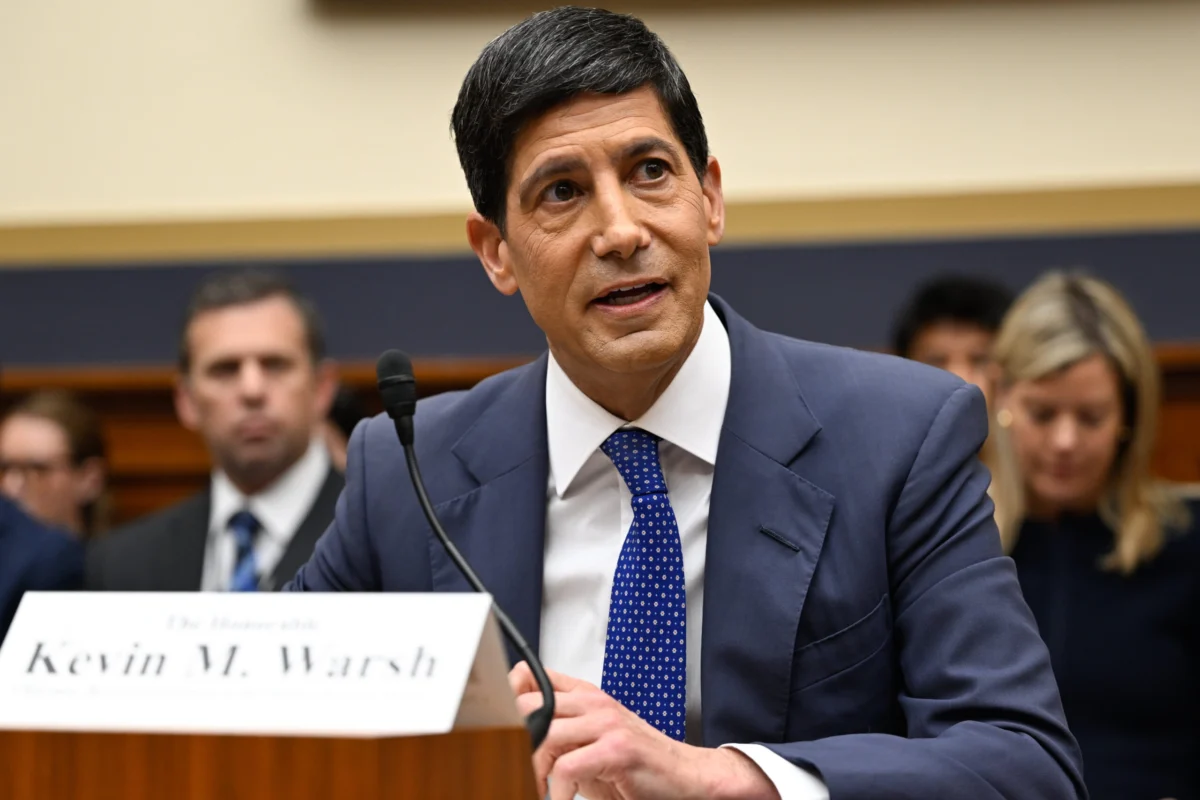
Federal Reserve Chairman Kevin Warsh on Tuesday delivered a resolute commitment to dismantling persistent inflation, labeling it an "unfair burden" on the American populace and business community. Speaking before the House Financial Services Committee, and poised to address the Senate Banking Committee on Wednesday, Chairman Warsh reiterated his call for a fundamental "regime change" within the central bank, promising that the inflation surge of the past five years would soon be "a thing of the past." His remarks, delivered just two months into his tenure, signal an aggressive pivot in monetary policy, aiming to restore price stability through comprehensive reforms and a re-evaluation of the Fed’s operational framework.
A New Era at the Federal Reserve: The Mandate for "Regime Change"
Chairman Warsh wasted no time in articulating his vision for a revitalized Federal Reserve, declaring inflation a "tax on the American people and businesses" that his administration plans to eliminate. This ambition, he clarified, necessitates not merely minor adjustments but a profound "regime change" in policy and a critical reassessment of existing practices, distinguishing between those that have proven effective and those that have fallen short. His pronouncements echo sentiments expressed during his confirmation hearing earlier this year, where he famously called inflation "a choice" and pledged an unwavering focus on curbing the cost of living. The concept of "regime change" itself was first publicly introduced by Warsh during a CNBC interview last summer, foreshadowing the hawkish stance he would adopt upon assuming the Fed’s helm.
To spearhead this transformation, Warsh has initiated five distinct task forces, each charged with scrutinizing a critical dimension of the Fed’s operations. These panels are delving into the central bank’s communications strategy, its technological infrastructure, the composition and management of its vast balance sheet, the economic data it employs for decision-making, and its fundamental approach to analyzing and forecasting inflation. These initiatives, he stated, are designed to collectively advance his overarching goal of remaking the central bank from the ground up. "In six weeks, we have caused, I think, a sea change in new thinking—the beginning of a set of reforms that are going to be put in place across at least five dimensions in monetary policy," Warsh asserted, underscoring the rapid pace of change since his arrival. He emphasized the importance of utilizing this "opportunity wisely" to cement lasting structural improvements.
A Retrospective on Past Policy: The FAIT "Mistake"
Central to Chairman Warsh’s reform agenda is a pointed critique of the Federal Reserve’s prior policy framework, specifically the flexible average inflation targeting (FAIT) strategy adopted in August 2020. This policy represented a significant departure from the Fed’s traditional approach, allowing for periods of inflation to run "moderately above" the 2% target after periods of undershooting, with the explicit aim of achieving maximum employment. The underlying rationale was to compensate for past shortfalls and anchor longer-term inflation expectations more firmly at 2%. However, Warsh unequivocally branded this strategy a "mistake," contending that it failed to achieve its objectives and inadvertently contributed to the very inflationary pressures it sought to manage.
"That central bank wasn’t the first central bank to ask for a little more inflation and end up with a lot more," Warsh remarked, highlighting what he perceives as a historical pattern of misjudgment. He noted with satisfaction that his predecessors had "cast [the framework] aside" even before his arrival, tacitly acknowledging its shortcomings. Since 2021, the U.S. has indeed experienced inflation rates consistently exceeding the Fed’s 2% mandate, reaching multi-decade highs. The Personal Consumption Expenditures (PCE) price index, the Fed’s preferred inflation gauge, has often hovered well above the target, eroding purchasing power and creating economic uncertainty. For instance, in 2022 and 2023, PCE inflation frequently surpassed 5-6% on an annual basis before showing signs of moderation, a stark contrast to the pre-2020 era where the Fed struggled to even reach its 2% target. This prolonged period of elevated prices, Warsh argued, underscored the critical flaw in a policy that deliberately sought to allow for higher inflation.
The FAIT framework, while theoretically designed to provide greater policy flexibility and address imbalances in the labor market, ultimately proved challenging to implement amidst unprecedented global supply chain disruptions, robust consumer demand fueled by fiscal stimulus, and geopolitical events that sent energy prices soaring. Critics argued that by signaling a willingness to tolerate higher inflation, the Fed inadvertently loosened inflation expectations, making the subsequent task of reining in prices even more arduous. Warsh’s repudiation of FAIT signals a return to a more traditional, symmetrical inflation targeting regime, where the 2% target is treated as a ceiling as much as a floor, emphasizing the paramount importance of price stability.
Economic Resilience and the AI Catalyst
Despite the significant challenge posed by inflation, Chairman Warsh painted an optimistic picture of the broader U.S. economy, characterizing it as "expanding at a solid pace" and demonstrating "resilience in the face of recent developments." A key driver of this strength, according to Warsh, is robust business investment, which he described as "the most striking feature" of the current economic landscape. This surge in capital expenditure, he explained, is largely propelled by the burgeoning artificial intelligence (AI) sector.
"The rapid pace – which appears to be accelerating – reflects, in large part, the construction of data centers and the immense demand for the AI-related equipment and software that fill them," Warsh elaborated. This investment wave, encompassing everything from advanced semiconductors and specialized servers to sophisticated algorithms and cloud infrastructure, is fundamentally reshaping various industries and boosting productivity. Warsh believes that this "AI buildout" will inevitably lead to a significant productivity boom, which he expects to be disinflationary in nature. His hypothesis suggests that increased efficiency and innovation driven by AI will lower production costs, enhance supply chains, and ultimately exert downward pressure on prices across the economy.
However, this premise is not universally accepted, with "some economists as well as his fellow Fed policymakers" having challenged the notion that AI will be inherently disinflationary. Skeptics argue that the initial investment costs could be inflationary, or that increased demand for skilled labor and energy could offset productivity gains. Furthermore, the economic impacts of transformative technologies often unfold over longer time horizons, making immediate predictions difficult. Nonetheless, Warsh remains confident in the long-term benefits, predicting that what is currently termed "AI investment" will soon simply be called "investment," signifying its complete integration into the economic fabric and its fundamental role in future growth. This technological optimism underscores a key component of Warsh’s broader economic outlook, suggesting that while the Fed tackles demand-side inflation through monetary policy, supply-side improvements from AI could provide a complementary disinflationary force.

Challenges and Implications for Warsh’s Federal Reserve
Warsh’s decisive stance on inflation and his ambitious reform agenda come at a critical juncture for the U.S. economy and the Federal Reserve. The "persistently high inflation levels" of recent years have indeed imposed "an undue burden on American households and businesses," as acknowledged by both Warsh and his predecessor, Jerome Powell. Families have grappled with higher costs for necessities like food, housing, and transportation, while businesses have faced increased input prices and wage pressures. The latest surge, in particular, has been partly attributed to soaring energy prices, exacerbated by global geopolitical instability.
The task of restoring price stability is complex, requiring a delicate balance of tightening monetary conditions without stifling economic growth. Warsh’s pledge that "the Fed’s number one objective is to get monetary policy right – or as near to it as we possibly can" highlights the immense responsibility resting on the Federal Open Market Committee (FOMC). His commitment to "restoring price stability" is "resolute," a clear signal to markets and the public that the Fed will prioritize its price stability mandate. This hawkish shift is likely to be met with expectations of continued interest rate hikes or at least a sustained period of higher rates, potentially influencing bond yields, equity markets, and the cost of borrowing for consumers and businesses. Reports prior to his term had already suggested markets were anticipating a "much more hawkish Warsh Fed than expected," indicating that the financial community had already begun to price in a more aggressive approach to inflation.
Notably, Warsh has adopted a more conciliatory tone towards the Fed’s staff since taking office. While he previously faulted "incumbents" for institutional problems, he now speaks of the "privilege to return to the Fed and to work again with so many talented and dedicated people I’m fortunate to call my colleague." This shift suggests an effort to foster internal cohesion and cooperation as he steers the institution through a period of significant change. The successful implementation of his five task forces and the broader "regime change" will hinge not only on his leadership but also on the collective expertise and buy-in from the Fed’s vast network of economists, researchers, and policymakers.
Chronology of Key Events Leading to Warsh’s Tenure:
- August 2020: The Federal Reserve formally adopts the Flexible Average Inflation Targeting (FAIT) framework, committing to allow inflation to run "moderately above" 2% after periods of undershooting.
- 2021-2026: Inflation consistently exceeds the Fed’s 2% target, marking a sustained period of elevated price pressures across the U.S. economy.
- Summer (Prior Year): Kevin Warsh, then a prominent economist and former Fed Governor, first publicly pledges to pursue "regime change" at the Federal Reserve in an interview with CNBC, signaling his critical stance on current policy.
- Early 2026: During his confirmation hearings before Congress, Warsh emphasizes the urgent need to bring down the cost of living, repeatedly calling inflation "a choice" that the Fed must address decisively.
- May 2026: Kevin Warsh officially begins his term as the Chairman of the U.S. Federal Reserve, succeeding Jerome Powell.
- June 2026: Warsh establishes five distinct task forces to conduct a comprehensive review of the Fed’s operations, focusing on communications, technology, the balance sheet, economic data, and inflation assessment. He also ramps up his "tough talk on inflation" in public statements.
- July 14, 2026 (Tuesday): Chairman Warsh delivers his monetary policy report and testifies before the House Financial Services Committee, outlining his strategy for combating inflation and reforming the central bank.
- July 15, 2026 (Wednesday): Warsh is scheduled to appear before the Senate Banking Committee to further elaborate on the Fed’s monetary policy outlook and answer legislators’ questions.
Broader Context: The Federal Reserve’s Role and Historical Parallels
The Federal Reserve, as the central bank of the United States, operates under a dual mandate from Congress: to achieve maximum employment and maintain price stability. These two objectives, while often complementary, can at times present trade-offs, requiring careful calibration of monetary policy. The challenge Warsh now faces is not unprecedented in the Fed’s history. Past chairmen, from Paul Volcker in the late 1970s and early 1980s who famously broke the back of runaway inflation with aggressive rate hikes, to more recent leaders grappling with deflationary pressures and then inflationary surges, have all confronted unique economic landscapes.
Warsh’s assertion that "underlying inflation over longer time horizons is determined largely by monetary policy" underscores a core tenet of central banking. While monthly price fluctuations can be influenced by exogenous shocks – such as supply chain disruptions, geopolitical conflicts, or volatile energy markets – the sustained trend of inflation is fundamentally a monetary phenomenon. The Fed’s control over the money supply, interest rates, and financial conditions ultimately dictates the long-term trajectory of prices.
The concept of "price stability" is crucial for economic well-being. It allows businesses and consumers to make informed decisions without the distortion of rapidly eroding purchasing power or unpredictable future costs. It fosters confidence in the currency, encourages long-term investment, and ensures that wages retain their value. When inflation becomes entrenched, it can lead to a vicious cycle of rising prices and demands for higher wages, making it even harder to control. Warsh’s emphasis on price stability as "the star we steer by" indicates a return to what many consider the Fed’s primary responsibility, a focus that some argue was diluted during the FAIT era.
The global economic environment, characterized by ongoing geopolitical tensions, shifts in trade patterns, and the lingering effects of the pandemic, adds layers of complexity to the Fed’s task. Energy markets remain volatile, and the potential for new supply shocks persists. In this "unsettled world," the Fed’s ability to communicate its policy intentions clearly and maintain credibility is paramount. Warsh’s emphasis on reforming communications, alongside other operational aspects, suggests a recognition of this critical need.
Conclusion
Chairman Kevin Warsh’s inaugural months at the helm of the Federal Reserve have been marked by a clear and forceful commitment to eradicating inflation and implementing sweeping institutional reforms. His unequivocal condemnation of past policies, particularly Flexible Average Inflation Targeting, combined with his optimistic yet cautious assessment of the AI-driven economy, charts a new course for the central bank. As he navigates this "hinge point in history," the success of his "regime change" will ultimately be measured by the Fed’s ability to deliver on its promise: to make the inflation surge of the last five years "a thing of the past" and restore enduring price stability, thereby reinforcing the foundations of American economic prosperity. The journey ahead is fraught with challenges, but Warsh’s resolute commitment signals a new, more hawkish era for U.S. monetary policy.
