

The global landscape for wearable technology has entered a period of rapid acceleration, characterized by a high-stakes race to integrate artificial intelligence and augmented reality into everyday eyewear. As tech giants like Meta and Snap pivot their focus toward "face-worn" computing, a new contender has emerged from the hardware hub of Shenzhen to challenge the status quo. Even Realities, a three-year-old startup founded by former Apple engineers, recently announced the successful closing of a $150 million pre-Series B funding round. This significant capital injection, led by Chinese internet conglomerate Meituan and social media titan Tencent, has propelled the startup to a $1 billion valuation, marking its official entry into the ranks of global tech "unicorns."
The funding comes at a pivotal moment for the industry. Last month, Meta and Snap both debuted their latest iterations of smart glasses, signaling a consensus among Big Tech firms that the future of personal computing lies in devices that place a camera and an AI assistant directly onto the user’s face. However, Even Realities is carving out a distinct niche by rejecting the industry’s obsession with content capture. While its rivals focus on cameras and social media integration, Even Realities is betting on a "display-first" philosophy that prioritizes privacy, professional utility, and high-end optical performance.
The Genesis of Even Realities: From Cupertino to Shenzhen
Even Realities was established in 2023 with a clear mission: to create a wearable device that feels less like a gadget and more like a sophisticated piece of eyewear. The company’s leadership brings a pedigree of high-end consumer electronics and luxury design. Founder and CEO Will Wang previously served at Apple, where he contributed to the development of the Apple Watch and the iPhone—two products that defined their respective categories.
Wang did not transition alone. The startup’s founding team includes several ex-Apple engineers and veterans from the tech industry. Crucially, the company also recruited talent from the luxury eyewear sector, including designers from Lindberg, the Danish brand known for its minimalist, high-end frames. This fusion of Silicon Valley engineering and European luxury aesthetics has allowed Even Realities to move at an unprecedented pace.
In 2024, only a year after its inception, the company launched its debut product, the Even G1. At the time, Wang described the G1 as the lightest waveguide smart glasses on the market. The device served as a proof of concept, demonstrating that digital information could be projected into a wearer’s field of vision without the bulk typically associated with augmented reality (AR) hardware. The G1 exceeded internal expectations, moving past its initial 10,000-unit sales target and making Even Realities the first startup in the category to achieve such volume at a premium price point.
A Divergent Strategy: Privacy and the Camera-Free Approach
The central tension in the smart glasses market currently revolves around the use of integrated cameras. Meta’s Ray-Ban smart glasses and Snap’s Spectacles rely heavily on cameras to facilitate hands-free photography, video recording, and "visual AI" features that allow the device to "see" what the user is seeing. While these features appeal to creators and younger demographics, they have sparked significant privacy concerns and social friction.
Even Realities has taken a diametrically opposed path. Its latest flagship, the Even G2, which hit the market in November, completely omits the camera. According to Will Wang, this is a deliberate philosophical choice. "Smart glasses are probably the most personal computing device people will ever wear," Wang told reporters. "Because they are worn on the face all day, they must be comfortable not just for the wearer, but also for those around them."
By removing the camera, Even Realities aims to eliminate the "creepy" factor that has plagued smart glasses since the days of Google Glass. The company argues that true privacy must be baked into both the hardware and software architecture. For instance, the G2’s voice features, such as real-time translation, are designed to transcribe audio into text locally or through encrypted channels rather than storing long-term audio recordings. Furthermore, the company has built its data infrastructure to comply with the European Union’s General Data Protection Regulation (GDPR), which is widely considered the global gold standard for digital privacy.
Technical Innovation: Even HAO and the R1 Control Ring
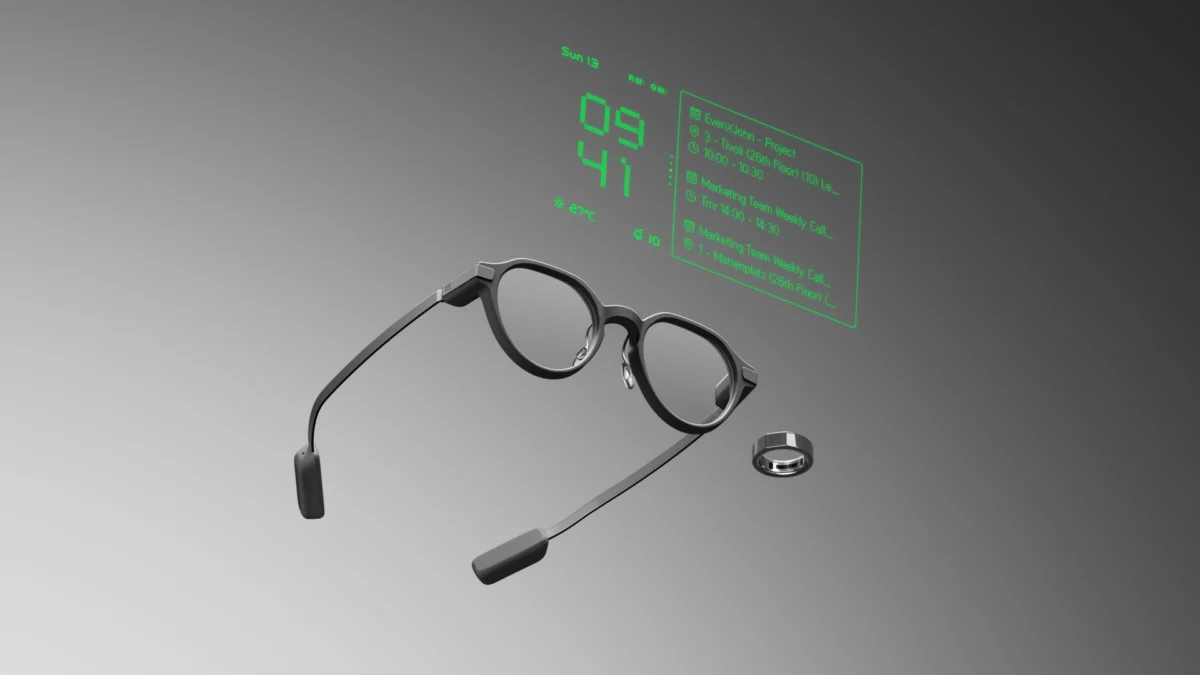
Despite the lack of a camera, the Even G2 is a sophisticated piece of hardware. The device utilizes a heads-up display (HUD) built directly into the frames, which "beams" information into the wearer’s line of sight. Unlike traditional smartphones or smartwatches that use OLED or LCD screens, smart glasses require a specialized technology stack known as waveguides.
To maintain its competitive edge, Even Realities developed a proprietary technology called Even HAO (Holistic Adaptive Optics). This end-to-end design integrates the microchip, the optical waveguide, and prescription lens support into a single, cohesive unit. In traditional AR manufacturing, these components are often designed separately and then "cobbled together," leading to bulkier frames and inferior visual clarity. By designing the system holistically, Even Realities has managed to keep its frames slim enough to pass for standard prescription glasses.
To navigate the interface without the need for awkward gestures in the air or voice commands in public, the company introduced the Even R1. The R1 is a companion smart ring that users wear on their finger. By tapping or swiping the ring, users can discreetly scroll through notifications, manage their calendar, or interact with the device’s AI assistant.
Professional Utility: The "Conversate" Copilot
Even Realities has found a particularly strong product-market fit among white-collar professionals. A core feature of the G2 is "Conversate," an AI-driven copilot designed for real-time meetings and networking. Conversate listens to a conversation and provides the wearer with a live transcription and contextual assistance. If a speaker uses unfamiliar industry jargon, the AI can provide a brief definition in the wearer’s field of vision. It can also suggest follow-up questions or provide reminders about the person the user is speaking with, syncing a full summary of the interaction to the user’s smartphone afterward.
This focus on productivity has influenced the company’s user demographics. Internal surveys conducted by Even Realities indicate that most customers are male professionals between the ages of 30 and 50. Approximately one-third of the user base consists of company executives. This demographic is less interested in capturing TikTok videos and more focused on "ambient computing"—the ability to access information seamlessly while remaining present in the physical world.
Market Performance and Global Expansion
The financial health of Even Realities appears robust, a rarity for hardware startups in the pre-Series B stage. The company’s flagship frames retail for approximately $599. However, when factoring in prescription lenses and the R1 control ring, the average order value often reaches $1,000. Despite this high price point, the company claims it is already operating profitably, a feat attributed to its lean manufacturing processes in Shenzhen and its high-margin direct-to-consumer model.
Interestingly, while Even Realities is headquartered and manufactures its products in China, it does not yet sell its devices in the Chinese domestic market. The United States is currently the startup’s largest and fastest-growing market, accounting for more than half of its total user base and the majority of its developer community. Other key markets include Japan, South Korea, the Middle East, and Europe.
"The demand in these regions is significant," Wang noted. "We want to ensure we are fully prepared with localized software and support before we expand our footprint into the Chinese market."
Chronology of Key Events
- Early 2023: Even Realities is founded in Shenzhen by Will Wang and a team of ex-Apple and luxury eyewear veterans.
- Late 2023: The company secures initial backing from high-profile investors, including Sequoia China.
- Mid-2024: Launch of the Even G1, the company’s first waveguide smart glasses.
- September 2024: Even Realities surpasses 10,000 units sold, exceeding initial targets and proving market demand.
- November 2024: The flagship Even G2 and the R1 smart ring are released, emphasizing a camera-free, privacy-first design.
- Early 2025: The company scales its workforce from under 40 employees to nearly 400.
- June 2026: Even Realities announces a $150 million pre-Series B round led by Meituan and Tencent, reaching a $1 billion valuation.
Analysis of Implications: The Future of Ambient Computing
The rise of Even Realities highlights a significant split in the future of wearable technology. On one side, companies like Meta are doubling down on the "Social AR" model, where the glasses serve as an extension of the camera and the social feed. On the other side, Even Realities is championing "Functional AR," where the glasses serve as a discreet layer of information that enhances professional and personal productivity.
Industry analysts suggest that the success of Even Realities may force larger players to reconsider their hardware designs. If a significant portion of the high-spending executive market prefers camera-free devices for privacy reasons, Meta and Snap may eventually need to offer "pro" or "privacy" versions of their hardware that omit recording capabilities.
Furthermore, the involvement of Meituan and Tencent as lead investors is telling. While both companies are primarily known for their software ecosystems—Meituan in local services/delivery and Tencent in social media/gaming—their investment in Even Realities suggests a strategic hedge. As the industry moves toward a post-smartphone era, owning the hardware platform that controls the user’s line of sight will be critical.
The $150 million funding will likely be used to further refine the "Even HAO" optical technology and expand the developer ecosystem. For smart glasses to become truly mainstream, they require a robust library of third-party applications. By attracting developers in the U.S. and Europe, Even Realities is positioning itself not just as a hardware manufacturer, but as a platform holder in the emerging world of ambient computing.
As the "war for the face" intensifies, Even Realities has proven that there is a lucrative path forward for startups that prioritize design, privacy, and specialized utility over the "all-in-one" approach favored by the giants of Silicon Valley. With a $1 billion valuation and the backing of China’s most powerful tech entities, the company is well-positioned to remain a dominant force in the next generation of personal electronics.
