

Sylvie Andrews and her partner did not merely lose a physical structure when the Eaton Fire swept through Altadena, California, in January 2025. They lost a decade of labor, the financial fruit of ten years of sacrifice, and the literal foundation of their lives in their hometown. The house they had helped build with their own hands was reduced to ash in a matter of hours. "We put a lot of blood, sweat, and tears into it," Andrews said, reflecting on the ruins. "That’s what we lost in the fire."
While Andrews and thousands of other residents in Los Angeles County were fleeing for their lives, a different kind of activity was unfolding in the digital realm. On Polymarket, the world’s largest decentralized prediction market platform, the destruction of California’s communities was being treated as a financial asset. Traders were not mourning the loss of life or property; they were placing high-stakes bets on how many acres would burn, whether the flames would reach Santa Monica, and the exact date containment would be reached. This emergence of disaster-based speculation has sparked a fierce debate among ethicists, fire officials, and survivors over the commodification of tragedy and the potential for dangerous real-world consequences.
The Mechanics of Disaster Betting
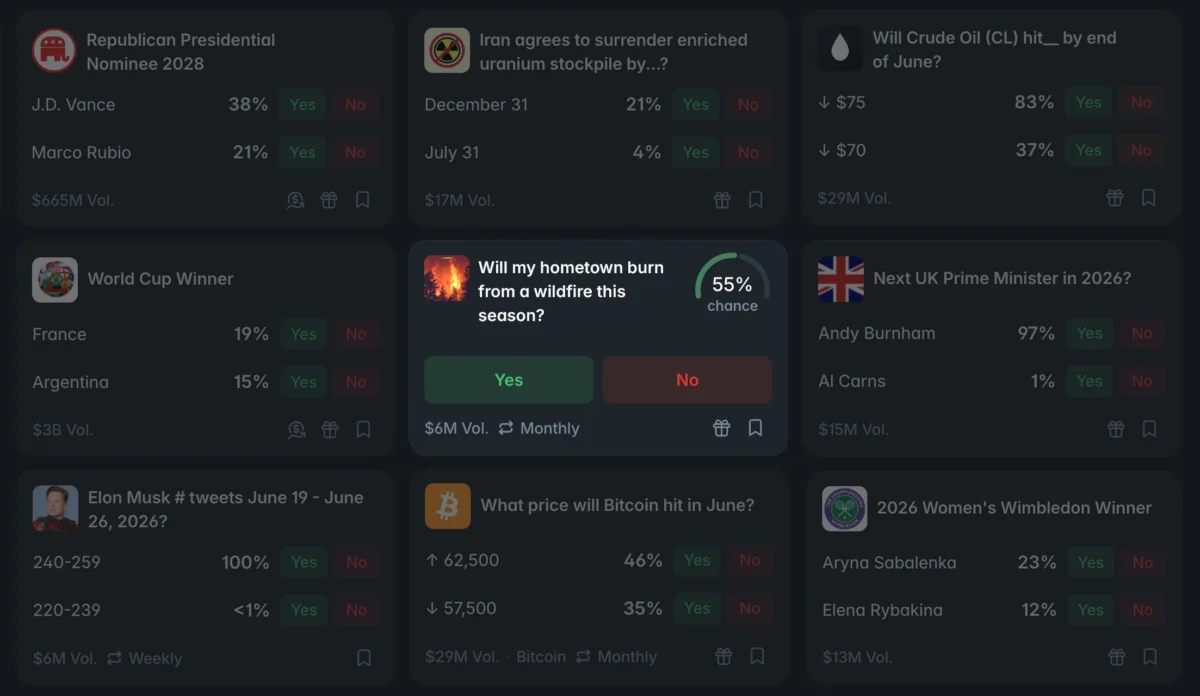
Prediction markets are exchange-traded platforms where individuals bet on the outcome of future events. Unlike traditional sports betting, these markets cover a vast array of topics, ranging from geopolitical conflicts and election results to economic indicators and public health crises. The markets typically operate on a binary "yes" or "no" system. Contracts are priced between $0.00 and $1.00; if a trader believes there is a 70% chance an event will occur, they might pay 70 cents for a "yes" contract. If the event occurs, the contract pays out $1.00. If it does not, the contract becomes worthless.
In January 2025, as the Eaton and Palisades fires converged to create one of the most destructive periods in Southern California history, Polymarket’s "markets team" curated nearly 20 specific questions related to the disaster. These included:
- How many acres will the Palisades Fire burn by Friday?
- Will the Palisades Fire spread to Santa Monica by Sunday?
- When will the Palisades Fire be 50 percent contained?
- Will all Los Angeles wildfires be fully contained before February?
According to data reported by Aeon Magazine, approximately $1.2 million was wagered on these specific queries. For platforms like Polymarket, which charge fees on transactions, the escalating scale of the disaster represented a significant revenue opportunity. For survivors like Andrews, the realization that strangers were profiting from her displacement was staggering. "My first take is that it’s morally reprehensible," she said. "The fact that someone would feel okay doing that flabbergasts me."
A Chronology of the 2025 Wildfire Crisis
The fires of January 2025 were anomalous both in their timing and their ferocity. Traditionally, California’s peak fire season occurs in late summer and autumn, but shifting climate patterns and late-season offshore winds created a "perfect storm" for winter conflagrations.
- January 7, 2025: The Palisades Fire ignites on a Tuesday afternoon. Fueled by dry brush and high winds, it moves rapidly toward densely populated neighborhoods in Pacific Palisades and Malibu.
- January 9, 2025: The Eaton Fire breaks out near Altadena. Within 24 hours, it jumps containment lines, forcing the evacuation of thousands and destroying the home of Sylvie Andrews.
- January 10–12, 2025: Betting volume on Polymarket peaks. As the fires approach Santa Monica, the "Yes" contracts for the fire reaching city limits see massive price fluctuations, reflecting real-time panic and satellite data analysis by traders.
- January 20, 2025: Firefighting agencies gain the upper hand as winds die down.
- End of January 2025: The final toll is tallied: 31 people dead and over 16,000 structures destroyed. The economic damage is estimated in the billions of dollars, while prediction market traders settle their contracts, some walking away with significant profits.
The Perverse Incentive: Arson and Insider Trading
The primary concern for public safety officials is not just the "crassness" of the betting, as survivor Susan Sherman described it, but the tangible danger of perverse incentives. Unlike a hurricane or an earthquake—events that are currently impossible for a single human to initiate or significantly alter—a wildfire can be manipulated.
The specter of arson hangs heavily over these markets. If a trader has a million-dollar "Yes" position on a fire reaching a certain acreage or a specific neighborhood, they have a direct financial incentive to ensure that outcome occurs. Susan Sherman, who lost her childhood home in the Palisades Fire, expressed this fear directly. "That’s what has me nervous," she said. "Systems that tie financial gain to wildfire outcomes risk encouraging misuse."
This concern is shared by the United States Forest Service (USFS). A spokesperson for the agency emphasized that any system linking profit to fire growth is fundamentally "not compatible" with their mission of life safety. Beyond arson, there is the risk of "insider trading." Firefighters, incident commanders, or meteorologists with access to non-public data regarding wind shifts or suppression strategies could theoretically use that information to front-run the markets.
Ann Skeet, the senior director of leadership ethics at the Markkula Center for Applied Ethics at Santa Clara University, warns that these markets diminish the perceived value of human life. "When you start gambling on somebody’s potential death or harm, you’re really diminishing the value that you’re placing on human life," Skeet noted. She categorized these as "dangerous markets" that could empower bad actors to interfere with emergency response efforts.

The Rise of Wyldfyre and Specialized Platforms
The trend toward disaster speculation is accelerating. A new platform called "Wyldfyre" recently launched with the tagline: "You can’t predict wildfire. But you can trade on it." Unlike general-purpose platforms, Wyldfyre focuses exclusively on California fire risks, utilizing NASA hotspot data and National Interagency Fire Center (NIFC) perimeters to provide real-time "risk pricing" for specific cities and counties.
While Wyldfyre currently only offers simulated trading, its developers have stated that real-money wagering is "coming soon." The platform justifies its existence through the "wisdom of the crowd" theory—the idea that financial markets are the most efficient way to aggregate information and forecast outcomes. Proponents argue that if a market accurately predicts a fire will reach a town, that town can use the "market signal" to evacuate earlier.
However, state and federal agencies are flatly rejecting this premise. Phillip SeLegue, staff chief of Cal Fire’s intelligence program, stated unequivocally that the agency does not use market-derived data for operational decision-making. "Our modeling is deterministic and physics-based; it is not informed by markets, wagering systems, crowd predictions, or any other form of prediction-market mechanism," SeLegue said. Cal Fire relies on automated programs that process 911 calls through sophisticated algorithms accounting for topography, fuel moisture, and resource availability—tools they argue are far more reliable than the whims of speculative traders.
Legislative and Regulatory Responses
The rapid growth of prediction markets has caught the attention of lawmakers in Washington D.C. and state capitals. In March 2025, a bipartisan group of representatives from Utah and California introduced federal legislation aimed at curbing the most extreme forms of event-based betting. The proposed bill would prohibit contracts related to "terrorism, assassination, war, gaming, or illegal activity."
A companion bill introduced by a California senator goes further, seeking to explicitly ban "death and war prediction contracts." While these bills do not currently name wildfires specifically, the language regarding "illegal activity" could potentially be used to target markets that might incentivize arson.
On the state level, Minnesota has taken the most aggressive stance, becoming the first state to outlaw the hosting or advertising of prediction markets. However, this move has already sparked a legal battle, with the federal government suing the state for overstepping its regulatory authority over interstate commerce and commodity trading.
The Human Cost of Data Points
As the 2025 fire season gives way to the next, the survivors of the Eaton and Palisades fires remain the most vocal critics of these platforms. For them, the "data points" traded on Polymarket represent the loss of heirlooms, the death of neighbors, and the trauma of evacuation.
The psychological impact of knowing that one’s suffering is a source of entertainment or profit for others cannot be understated. Susan Sherman described the practice as "heartless," a sentiment echoed by many in the Altadena and Pacific Palisades communities.
Sylvie Andrews offered a potential path for reconciliation, though she remains skeptical of the industry’s ethics. "If someone won money in gambling with our fate, I would hope that they might be ashamed of themselves and take that money and donate it directly to fire survivors," she said.
As the technology behind prediction markets continues to evolve, the tension between financial innovation and human ethics will only tighten. For California, a state increasingly defined by its vulnerability to climate-driven disasters, the question is no longer just how to stop the fires, but how to stop the exploitation of the flames. The 2025 wildfire season may have ended, but the debate over the "wild west" of disaster betting is only just beginning.
