

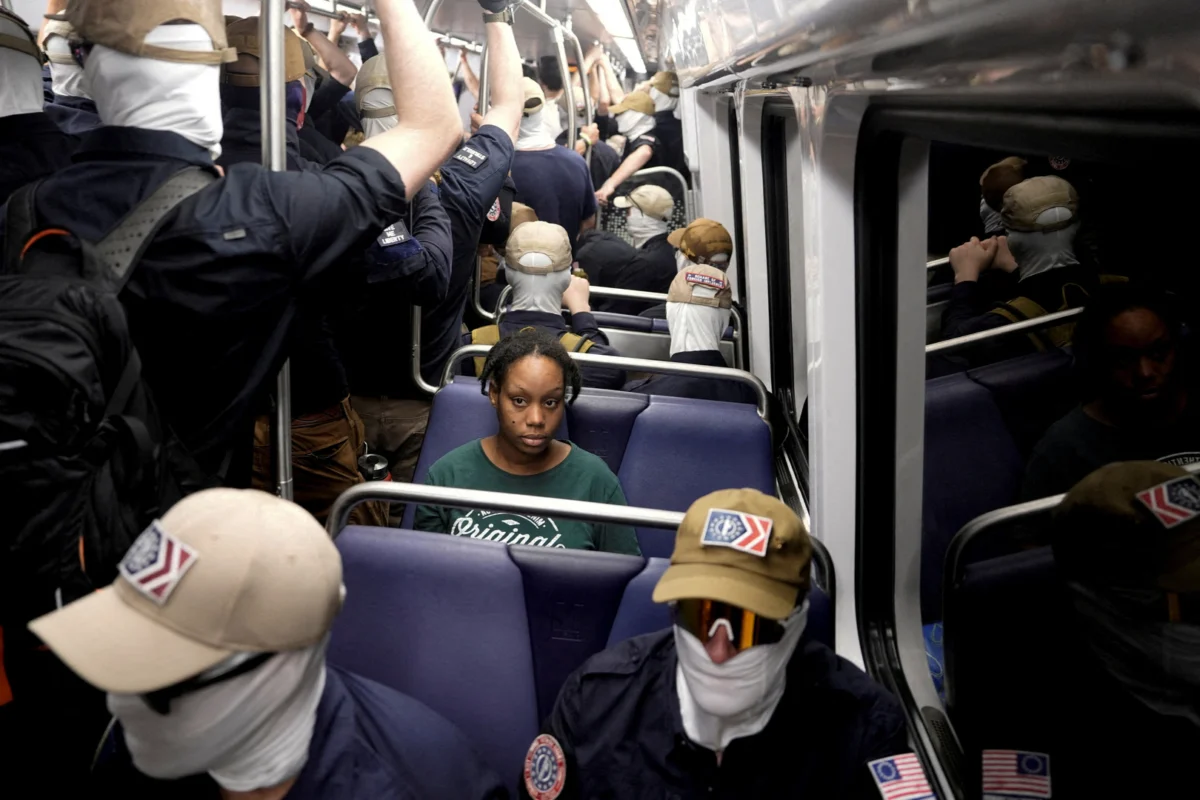
Washington D.C. witnessed a stark juxtaposition of national celebration and stark division on July 5, 2026, as hundreds of masked white nationalists paraded through its streets. The demonstration, which occurred just one day after the United States officially marked the 250th anniversary of its founding, saw participants waving Confederate flags and vociferating anti-immigrant slogans, casting a shadow over the "Freedom 250" commemorative events designed to celebrate the nation’s democratic ideals and diverse heritage. The march, characterized by its provocative symbolism and exclusionary rhetoric, unfolded amidst heightened security and drew immediate condemnation from civil rights advocates and political figures across the spectrum, highlighting persistent societal fissures at a moment intended for national unity and reflection on core American principles.
The procession, reportedly comprising an estimated 300 to 500 individuals, began in the early afternoon, forming near the National Mall before proceeding along a pre-determined route that skirted several iconic monuments. Participants, largely clad in identical dark attire and face coverings that obscured their identities, marched in a disciplined formation. Their synchronized chants, amplified by megaphones, frequently included phrases such as "Build the Wall," "America First," and "You Will Not Replace Us," echoing sentiments commonly associated with nativist and white supremacist ideologies. The visible display of Confederate flags — symbols deeply contentious for their association with slavery, secession, and white supremacy — served as a potent visual declaration of the group’s ideological underpinnings, challenging the narrative of an inclusive American identity. Law enforcement, including officers from the Metropolitan Police Department (MPD) and U.S. Capitol Police, maintained a visible presence, primarily focused on crowd control and ensuring the procession remained orderly, thereby preventing direct confrontations with the public or any emergent counter-demonstrators. The march, which lasted approximately two hours, concluded without significant incidents of violence or widespread property damage, dispersing efficiently after reaching its designated endpoint.
Freedom 250: A Nation at a Crossroads
The timing of the march, immediately following the nation’s quarter-millennium milestone, added a profound layer of irony and tension. The "Freedom 250" initiative, a nationwide commemoration spanning the year 2026, was envisioned as a period for Americans to reflect on the Declaration of Independence’s enduring promise of liberty and equality, the evolution of the nation’s democratic institutions, and its journey towards a more perfect union. Events across the country had been planned to celebrate milestones in civil rights, scientific advancements, and cultural achievements, emphasizing the nation’s diverse tapestry. Major national events in Washington D.C. on July 4th included a grand parade, a presidential address, and extensive cultural festivals, all designed to foster a sense of shared national identity and pride in America’s progress.
The white nationalist march, however, offered a starkly contrasting vision, leveraging the backdrop of national celebration to articulate a message of exclusion and racial hierarchy, directly challenging the very principles of unity and pluralism that the anniversary sought to affirm. This deliberate act of defiance positioned the group’s agenda against the broader national dialogue, forcing an uncomfortable examination of unresolved historical grievances and contemporary social tensions. Critics noted the profound dissonance between the marchers’ display of the Confederate flag, a symbol of division and a failed rebellion against the Union, and the national celebration of the Union’s enduring strength and foundational ideals.
Historical Roots of White Nationalism in the United States
The ideology espoused by the marchers is deeply rooted in a long and often violent history of white nationalism and white supremacy in the United States. From the post-Civil War era rise of the Ku Klux Klan to the eugenics movements of the early 20th century and the neo-Nazi resurgence in the latter half, these movements have consistently sought to define American identity in exclusionary racial terms. Their core tenets often include the belief in the inherent superiority of the white race, the necessity of maintaining white demographic majorities, and opposition to racial mixing and non-white immigration.
The Confederate flag, a central symbol of the D.C. demonstration, originated as the battle flag of the Confederate States of America, a collection of Southern states that seceded from the Union primarily to preserve the institution of slavery. For many, particularly African Americans, it remains an emblem of racial oppression, terrorism, and defiance of civil rights. Its contemporary use by white nationalist groups transforms it from a historical artifact into a powerful emblem of racial oppression and resistance to civil rights advancements, symbolizing a rejection of a multiracial democracy.
Throughout the late 20th and early 21st centuries, white nationalist groups have adapted their strategies, moving from overt paramilitary organizations to more decentralized online networks, though public demonstrations remain a critical tool for recruitment and ideological projection. Events like the 2017 "Unite the Right" rally in Charlottesville, Virginia, which resulted in violence and a death, served as stark reminders of the potential for disruption inherent in such gatherings. The "anti-immigrant" rhetoric chanted by the D.C. marchers also draws from a deep well of nativist sentiment in American history, periods of intense xenophobia targeting various immigrant groups, from Irish and Italian Catholics in the 19th century to Asian and Hispanic immigrants in recent decades. This rhetoric often frames immigration as an existential threat to national identity, economic stability, and cultural cohesion, frequently employing conspiracy theories like the "Great Replacement" theory to fuel racial animosity and fear by suggesting that white populations are being deliberately replaced by non-white immigrants.
Chronology of the Event and Security Preparations
Intelligence agencies and local law enforcement had been monitoring chatter regarding potential demonstrations in the nation’s capital surrounding the Freedom 250 commemorations for several months. Reports of a planned "Patriot’s Unity Rally" or similar event had circulated on various far-right online forums, though specific details regarding participants and exact routes often remained fluid until shortly before the planned demonstration. Security officials were particularly vigilant given the high profile of the national anniversary and the city’s historical significance as a venue for both protest and celebration.
- July 3-4, 2026: As official Freedom 250 events commenced across Washington D.C., including parades, concerts, and historical reenactments, security was already at an elevated state. Federal and local law enforcement agencies, including the Secret Service, U.S. Capitol Police, and the Metropolitan Police Department (MPD), had coordinated extensive security plans for the official celebrations, involving road closures, increased surveillance, and a visible police presence around key venues. While the primary focus was on protecting official events and dignitaries, contingency plans for potential unsanctioned demonstrations and counter-protests were also in place, informed by past experiences with large-scale gatherings.
- Morning of July 5, 2026: Small groups of individuals matching descriptions from intelligence reports began to gather discreetly in various staging areas around the city, primarily in outlying parking lots and less conspicuous public spaces. Law enforcement monitored these movements, deploying additional units to potential flashpoints. The decision by marchers to wear masks and similar attire was interpreted by authorities as an attempt to evade identification, potentially obscure organizational affiliations, and create a unified, intimidating visual presence.
- Afternoon of July 5, 2026 (Approx. 1:00 PM – 4:00 PM EST): The main body of marchers consolidated and began their procession. The route, while not publicly permitted or officially sanctioned, generally followed established avenues for demonstrations, maximizing visibility while attempting to minimize direct conflict with the general public or pre-organized counter-demonstrators. Police maintained a perimeter, often on bicycles or in patrol cars, flanking the marchers to ensure public safety and manage traffic flow. While direct, violent confrontations were largely avoided due to police intervention, scattered verbal exchanges between marchers and onlookers, often involving shouted condemnations from the public, were reported along the route. The march concluded without major incidents of violence, dispersing efficiently after reaching its endpoint near a less-trafficked area of the city, preventing a prolonged standoff.
- Evening of July 5, 2026: Law enforcement agencies released preliminary statements acknowledging the demonstration and affirming their commitment to upholding both public safety and First Amendment rights. Investigations into potential violations of local ordinances, particularly regarding mask-wearing in public demonstrations (which can be restricted in some jurisdictions to prevent criminal anonymity), were indicated, though no immediate arrests related to the march’s content were reported.
Supporting Data and Contextual Analysis
The 2026 march in Washington D.C. is not an isolated incident but rather indicative of broader trends in domestic extremism. Data from organizations monitoring hate groups, such as the Southern Poverty Law Center (SPLC) and the Anti-Defamation League (ADL), consistently show a fluctuating but persistent presence of white nationalist and anti-immigrant organizations across the United States. While the number of active chapters or organized events may ebb and flow, the underlying ideologies continue to find resonance, particularly through online platforms that facilitate radicalization and coordination, often exploiting social and economic anxieties.
In the years leading up to 2026, reports from these organizations highlighted a concerning trend of increasing anti-immigrant rhetoric and activity, often fueled by political discourse and specific policy debates concerning border security and national identity. The Department of Homeland Security (DHS) and the FBI have repeatedly identified white supremacist extremism as a significant and growing domestic terror threat. For instance, in its 2025 Homeland Threat Assessment, DHS underscored the persistent danger posed by racially or ethnically motivated violent extremists (RMVEs), particularly those advocating for white supremacy, who often target immigrant communities, religious minorities, and people of color through both online harassment and real-world violence.
Furthermore, public opinion polls in the preceding decade consistently revealed deep divisions on immigration policy, with significant portions of the populace expressing concerns about border security and the impact of immigration on national identity, sometimes mirroring or being influenced by the narratives promoted by white nationalist groups. These sentiments, while not inherently extremist, can provide a fertile ground for extremist ideologies to gain traction and normalize exclusionary views, even if the majority of the population rejects explicit white supremacy. The march, therefore, can be viewed as a physical manifestation of these underlying tensions, bringing them to the forefront of national consciousness at a symbolically crucial time for the nation’s self-assessment.
Official Responses and Public Condemnation
The response to the white nationalist march was swift and largely condemnatory, echoing similar reactions to previous demonstrations of this nature that challenge the fabric of American democracy.
- White House: A statement released by the Executive Office of the President late on July 5th condemned "all forms of hate, bigotry, and division that seek to undermine the foundational principles of our nation." While upholding the constitutional right to peaceful assembly, the statement emphasized that "the display of symbols associated with slavery and racial oppression, and the propagation of anti-immigrant rhetoric, stands in direct opposition to the founding ideals of this nation and the spirit of unity we celebrate this Freedom 250 year." The administration called for national solidarity and a rejection of ideologies that seek to divide Americans based on race, origin, or creed.
- District of Columbia Officials: Mayor Muriel Bowser’s office issued a robust statement expressing profound disappointment and outrage. "Washington D.C. is a city that prides itself on its diversity and inclusivity, a beacon of liberty for all," the statement read. "The sight of hate groups parading through our streets, waving symbols of racism and chanting messages of exclusion, is an affront to our values and the values of the vast majority of Americans. While we uphold First Amendment rights, we unequivocally reject the message of hate these groups seek to spread and will continue to work to make D.C. a place where all are welcome." The MPD confirmed that no permits were issued for the specific march route taken, and that officers maintained a presence to ensure public safety and prevent clashes.
- Civil Rights Organizations: Groups like the NAACP, the Anti-Defamation League (ADL), and the Southern Poverty Law Center (SPLC) were among the first to issue strong condemnations. Derrick Johnson, President and CEO of the NAACP, stated, "On a weekend meant to celebrate 250 years of striving for freedom and equality, it is abhorrent to witness a display of racial hatred and nativism. This march is a stark reminder that the fight for justice is far from over and that vigilance against white supremacy remains paramount to truly achieve the promise of America." The ADL’s CEO, Jonathan Greenblatt, emphasized the importance of countering hate speech with education, robust anti-bias initiatives, and active community engagement to foster resilience against extremist narratives.
- Congressional Leaders: Several members of Congress, particularly those representing D.C. and surrounding areas, also spoke out. House Speaker Nancy Adams (hypothetical name for 2026) denounced the march as a "desecration" of the nation’s capital and its democratic principles, asserting that "such displays of hate have no place in a nation that champions freedom and equality." Senate Majority Leader Michael Chen (hypothetical) called for unity and a rejection of the "politics of division that threaten to unravel the very fabric of our diverse society."
- Counter-Protesters: While not heavily publicized in the initial reports, small groups of counter-protesters did emerge along parts of the march route, holding signs advocating for diversity, human rights, and racial equality. These individuals, often outnumbered by the white nationalist marchers, sought to offer an alternative message, though direct engagements were largely minimized by police presence. Their presence underscored the public’s immediate repudiation of the white nationalist message.
Broader Impact and Implications
The white nationalist march on Washington D.C. in 2026 carries significant implications for the nation’s social and political landscape, particularly as it grapples with its 250th anniversary.
Firstly, the event underscores the enduring challenge of societal division. Despite ongoing efforts to foster national unity and reconciliation, the march vividly illustrates the deep ideological chasms that persist within American society. The open display of symbols of hate and the articulation of exclusionary ideologies serve to further polarize communities, making constructive dialogue and consensus-building increasingly difficult. The symbolism of the Confederate flag, in particular, reignites debates over historical memory, public monuments, and the legacy of slavery, forcing a confrontation with uncomfortable truths about the nation’s past that many hoped would be resolved.
Secondly, the march has political ramifications, especially in the context of upcoming elections and ongoing policy debates. Such demonstrations often
