

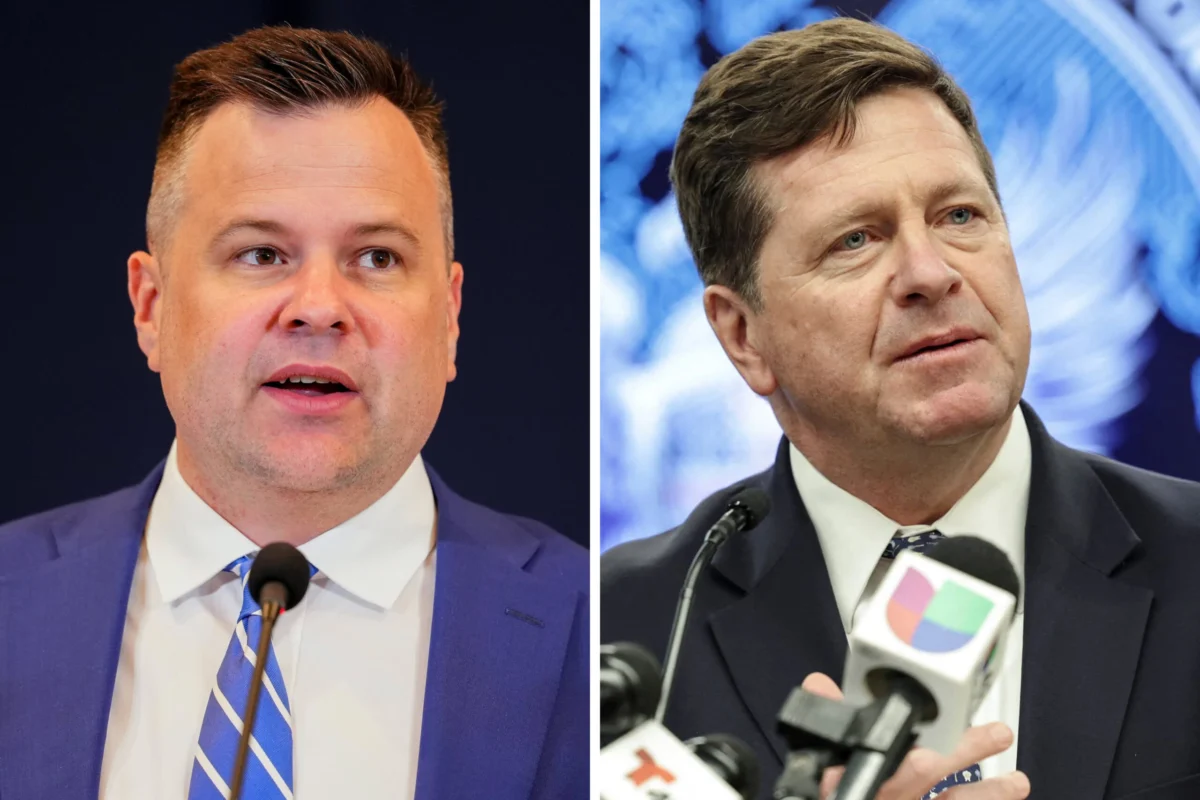
President Donald Trump on Wednesday ignited a significant political firestorm by abruptly announcing the cancellation of the confirmation hearing for Jay Clayton, his nominee to become the Director of National Intelligence (DNI). Clayton, currently the U.S. Attorney for the Southern District of New York (SDNY), was scheduled for a crucial Senate Intelligence Committee hearing Wednesday afternoon, a step widely seen as essential for restoring stability to the nation’s intelligence leadership and, critically, for reauthorizing a lapsed foreign intelligence surveillance authority. The sudden reversal, communicated via a social media post, immediately threw Washington into a state of confusion and heightened political tensions, with implications ranging from national security to the delicate balance of power between the executive and legislative branches.
Initial Disruption and Immediate Fallout
The President’s announcement came hours before Clayton was slated to appear before the Senate Intelligence Committee. In a series of posts on Truth Social, his preferred social media platform, Trump detailed a list of grievances and conditions for proceeding with the nomination. Central to his demands was the confirmation of Jamie McDonald as Clayton’s successor for the U.S. Attorney position in the SDNY. Furthermore, Trump explicitly stated that Bill Pulte, his controversial pick for Acting Director of National Intelligence, would remain in the role indefinitely until these conditions were met. "Regarding the approval of our Great Patriot, Jay Clayton, we are cancelling the Senate Hearing RE: DNI today, and will not be going forward until Jamie McDonald is approved to be U.S. Attorney," Trump wrote, adding, "In the meantime, Bill Pulte will remain as the Acting Director of National Intelligence."
The impact was immediate and profound. Senate Intelligence Committee Chairman Tom Cotton, R-Ark., who had been a vocal proponent of Clayton’s nomination and the scheduled hearing, confirmed the postponement with evident regret. "It’s regrettable that the president has directed Jay Clayton not to appear at his confirmation hearing today," Cotton stated in an X post. "Mr. Clayton is a patriot and a highly qualified nominee, as the president has said repeatedly. While today’s hearing is now unfortunately postponed, I look forward to proceeding with his confirmation in the near future." Cotton’s statement, while deferential to the President, underscored the disruption to the carefully orchestrated Senate process.
The Nominee and the Acting Director: Jay Clayton and Bill Pulte
Jay Clayton’s nomination for DNI was largely viewed as an effort to bring a measure of stability and non-partisanship to a critical national security role. As the U.S. Attorney for the Southern District of New York, Clayton commanded a highly respected and influential prosecutorial office. His background as a lawyer with extensive experience in financial regulation and white-collar crime was seen by some as a fresh perspective for the intelligence community, though he lacked traditional intelligence experience. His confirmation was expected to garner bipartisan support, given his professional credentials and the perceived need for a confirmed DNI.
Conversely, Bill Pulte’s tenure as Acting DNI has been steeped in controversy since his initial appointment. Pulte, who previously served as director of the Federal Housing Finance Agency (FHFA), has no discernible background in intelligence, national security, or foreign policy. Critics, particularly Democrats, have assailed his appointment, viewing him as a partisan operative rather than a non-political steward of the intelligence community. Concerns have been raised about his impartiality and potential for politicizing intelligence assessments. Democrats have explicitly stated their unwillingness to support the reauthorization of key intelligence authorities as long as Pulte remains in an acting capacity. The President’s insistence on keeping Pulte in the acting role, despite widespread opposition, has been a significant impediment to legislative progress on intelligence matters.
The third individual central to Trump’s demands, Jamie McDonald, is his proposed successor for Clayton’s SDNY U.S. Attorney post. However, sources familiar with the nomination process indicated that the White House had not yet formally sent McDonald’s nomination to the Senate, creating a procedural bottleneck. This suggests that even if the Senate were inclined to fast-track McDonald, the administration itself had not initiated the necessary steps, raising questions about the sincerity or feasibility of the President’s stated conditions.
The Critical Standoff: FISA Section 702 and National Security
The most immediate and potentially severe consequence of the canceled hearing and subsequent political stalemate is the continued lapse of Section 702 of the Foreign Intelligence Surveillance Act (FISA). This critical intelligence-gathering authority expired last week, meaning there is a current lapse in the government’s ability to conduct warrantless surveillance of communications involving non-U.S. persons located outside the United States, even if those communications incidentally involve U.S. persons.
FISA Section 702 is a cornerstone of U.S. national security operations, enabling the National Security Agency (NSA) and other intelligence agencies to collect foreign intelligence from non-U.S. persons abroad who are believed to possess or communicate foreign intelligence information. This collection is vital for counterterrorism, counterproliferation, and cybersecurity efforts. For instance, it allows intelligence agencies to track communications of foreign terrorists, hostile state actors, and cyber criminals operating overseas. The authority is considered indispensable by intelligence officials, who warn that its lapse creates significant blind spots and degrades the nation’s ability to detect and prevent threats.
However, Section 702 has also been a subject of intense debate and controversy, particularly concerning privacy protections for American citizens. Critics, including civil liberties advocates and some members of Congress from both parties, point to instances where U.S. persons’ communications have been incidentally collected and subsequently queried by the FBI without a warrant, leading to concerns about potential abuses and violations of Fourth Amendment rights. These concerns have fueled calls for reforms to Section 702, including more stringent oversight and limitations on U.S. person data queries, before its reauthorization. The ongoing political fight over the DNI nomination, and now the President’s new demands, are directly imperiling the timely and effective reauthorization of this critical, yet controversial, authority.
The Political Rider: The "SAVE America Act"
Adding another layer of complexity and partisan division, President Trump explicitly linked the reauthorization of FISA to the passage of a controversial piece of legislation known as the "SAVE America Act." This bill, focused on election integrity, primarily seeks to implement stricter voter identification requirements and other reforms to voting access.

"Therefore, to add a slight bit of intrigue but, for the Good of the Nation, and the People of our Country, I will not approve FISA without THE SAVE AMERICA ACT going along with it," Trump declared in his social media post.
The "SAVE America Act" is highly contentious. Republicans generally support such measures, arguing they are necessary to prevent voter fraud and ensure election security. Democrats, however, vehemently oppose these types of bills, contending that they disproportionately disenfranchise minority voters, elderly individuals, and low-income populations who may face greater hurdles in obtaining required identification. Attaching such a polarizing and unrelated legislative demand to a national security imperative like FISA reauthorization is an unprecedented move that further complicates an already fraught legislative landscape. Democrats have already signaled their unwavering opposition to the "SAVE America Act," making its attachment to FISA a likely non-starter for bipartisan agreement.
A Chronology of Contention
The sequence of events leading to Wednesday’s dramatic cancellation underscores the volatile nature of Washington politics during this period:
- Last Week: Section 702 of FISA officially expires, creating an urgent need for congressional action.
- Early This Week: Jay Clayton’s confirmation hearing for DNI is formally scheduled for Wednesday afternoon, signaling a potential path forward for intelligence leadership and FISA reauthorization.
- Wednesday Morning: President Trump issues a series of posts on Truth Social, unilaterally announcing the cancellation of Clayton’s hearing. He cites the need for Jamie McDonald’s confirmation as SDNY U.S. Attorney and the continued tenure of Bill Pulte as Acting DNI as conditions. He also explicitly links FISA reauthorization to the "SAVE America Act."
- Wednesday Hours Later: Senate Intelligence Chairman Tom Cotton confirms the postponement, expressing regret but emphasizing Clayton’s qualifications.
- Mid-Wednesday: Senator Mark Warner, the ranking member of the Intelligence Committee, condemns the President’s actions as an "extraordinary display of dysfunction," blaming the White House for the ongoing chaos.
- Ongoing: The White House has yet to formally send Jamie McDonald’s nomination to the Senate, further muddying the waters regarding the President’s stated conditions.
Congressional Reactions and White House Dynamics
The President’s intervention elicited a range of reactions across Capitol Hill, highlighting the deep divisions and frustrations within both parties. Senator Mark Warner, D-Va., lambasted the situation, stating, "The president’s latest intervention only underscores a simple reality: the biggest obstacle to resolving these issues has not been Senate Democrats or Senate Republicans. It has been the chaos and confusion coming from the White House itself." Warner further questioned the status of Clayton’s nomination, pondering whether it was merely postponed or effectively withdrawn.
Even some Republicans, generally staunch allies of President Trump, expressed dismay at the President’s impulsive decision-making. Sen. Kevin Cramer, R-N.D., a known Trump supporter, voiced his frustration: "Frankly, I was disappointed again that while Sen. Thune has very meticulously and skillfully managed a process that ends up with another Trump victory gets upended by an impulsive post of some sort. It’s frustrating, but it’s also not that abnormal these days." This sentiment underscores a growing weariness among some Republicans over the President’s tendency to disrupt carefully negotiated legislative strategies through unilateral pronouncements.
Senate Majority Leader John Thune, R-S.D., acknowledged the uncertainty, stating that the Senate would now "have to take it a day at a time til we get more clarity on kind of what the White House position is." This indicates a legislative body waiting for clear guidance from the executive branch, rather than actively steering its own course on critical matters.
Trump’s social media posts also included accusations against Democrats, claiming they had broken a "deal" to vote for FISA reauthorization if Pulte was removed. "[T]he Republicans moved so fast with the hearings of the Great Jay Clayton, current U.S. Attorney for the Southern District of New York, that Pulte would be gone before the Dumocrats would vote on FISA," he wrote. "Now, the Dumocrats are saying they will vote against FISA — So, the Republicans wound up having fulfilled their commitment, but Dumocrats broke the Deal." This narrative of a broken deal, however, did not align with public statements from Democrats, who had consistently tied FISA reauthorization to Pulte’s removal and broader reforms, not simply the scheduling of Clayton’s hearing.
Broader Implications for Governance and Intelligence
The President’s actions carry significant implications beyond the immediate political wrangling.
- National Security Deterioration: The prolonged lapse of FISA Section 702 directly impacts the ability of U.S. intelligence agencies to monitor and mitigate foreign threats. This creates vulnerabilities that hostile actors could exploit, potentially compromising national security. The longer the lapse, the more significant the intelligence gaps become.
- Erosion of Executive-Legislative Trust: Using a critical national security nomination as leverage for unrelated, highly contentious domestic legislation (the "SAVE America Act") further erodes trust between the executive and legislative branches. This tactic can set a dangerous precedent, making it more challenging to confirm future nominees and pass essential legislation.
- Instability in the Intelligence Community: The DNI position is crucial for coordinating the 18 agencies of the U.S. Intelligence Community. Having an acting director, particularly one lacking relevant experience and facing strong opposition, creates uncertainty and can hinder effective leadership, strategic planning, and morale within the intelligence apparatus.
- Increased Partisan Gridlock: The President’s demands have solidified an already entrenched partisan divide. Democrats are unlikely to concede on the "SAVE America Act" or withdraw their objections to Pulte without significant concessions. This creates a high-stakes standoff with no clear resolution in sight.
- Uncertainty for Nominees: The fate of Jay Clayton’s nomination remains unclear. Senator Warner’s question about whether he was postponed or withdrawn highlights the ambiguous position in which the nominee finds himself, a victim of executive-legislative infighting.
The Path Forward: Uncertainty Amidst National Imperatives
As Washington grapples with this latest twist, the path forward remains highly uncertain. For FISA Section 702 to be reauthorized, a consensus will need to emerge in Congress, likely requiring some form of reform to address privacy concerns. This legislative process is now inextricably linked to the DNI nomination, the fate of Bill Pulte, and the contentious "SAVE America Act."
The President’s strategy, while reflecting his characteristic approach to political bargaining, has created a complex web of interconnected issues that will demand significant political maneuvering to untangle. The imperative to safeguard national security through a fully functioning intelligence community and a reauthorized FISA Section 702 clashes directly with deeply held partisan positions on executive appointments and electoral reform. Until a resolution is found, the nation’s intelligence capabilities and the stability of its governing institutions will remain under a cloud of uncertainty.
