


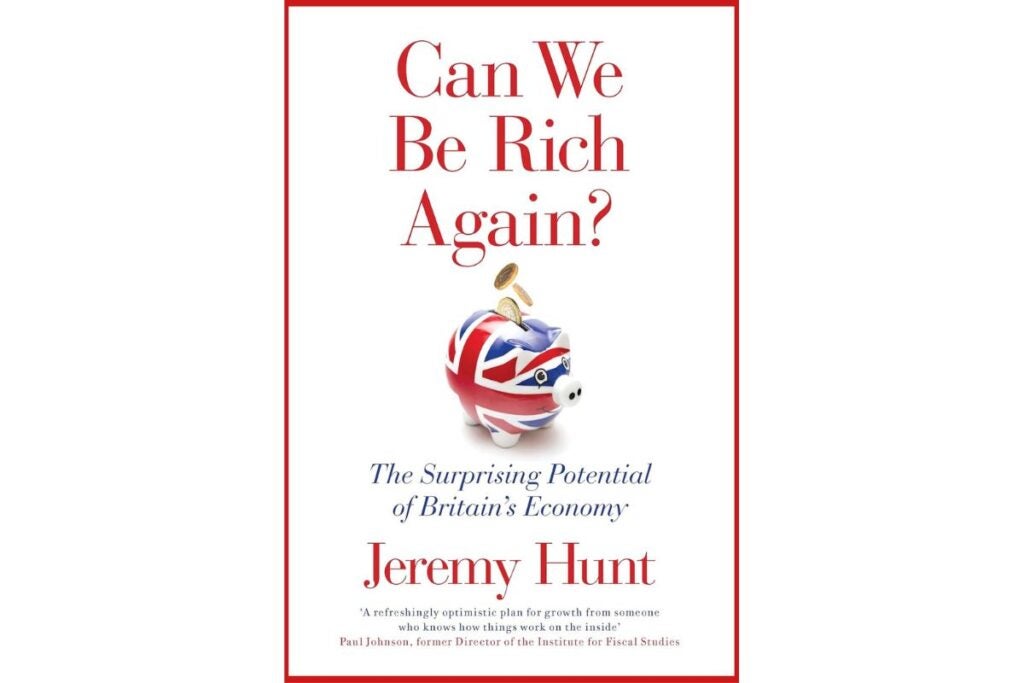
Jeremy Hunt, a figure who has occupied some of the most senior roles in British government, including a record-breaking tenure as Health Secretary, a stint as Foreign Secretary, and crucially, Chancellor of the Exchequer from October 2022 to July 2024, has emerged from the political fray with a new book. Titled “Can We Be Rich Again? The Surprising Potential of Britain’s Economy,” the work is presented not merely as a retrospective or a philosophical musing, but as a carefully constructed examination of the United Kingdom’s economic prospects and, implicitly, a potential manifesto for future leadership. This analysis delves into the substance of Hunt’s proposals, his assessment of Britain’s economic landscape, and the underlying narrative that suggests a strategic positioning for a potential return to the forefront of national politics.
The book itself is the second in a planned trilogy, following “Can We Be Great Again?” (2025), which explored Britain’s global standing, and preceding a third volume dedicated to “reforms necessary to improve the functioning of our democracy.” This structure positions “Can We Be Rich Again?” as a pivotal piece, bridging geopolitical considerations with the foundational elements of domestic prosperity. The core question it seeks to answer is twofold: could Hunt’s economic blueprint serve as a viable roadmap for governance, and does the book’s portrayal of its author resonate more effectively with the public than his established ministerial persona?

Hunt’s approach in the book is characteristically methodical. He openly acknowledges the collaborative nature of the work, thanking a broad spectrum of economic thinkers and former colleagues. However, the book’s structure, marked by clear statements of intent, crisp chapters replete with data, and concluding summaries, mirrors the disciplined and perhaps somewhat didactic style that characterized his public service. This analytical framework, while efficient, has been described as akin to an extended PowerPoint presentation, reflecting the approach often seen in high-level policy discussions within the Treasury.
The Core Economic Argument: Growth Precedes Tax Cuts
At the heart of Hunt’s economic thesis lies a fundamental assertion: nations with lower overall tax burdens tend to experience faster economic growth. This is a tenet familiar within conservative economic circles, emphasizing the role of fiscal policy in stimulating investment and productivity. However, Hunt tempers this assertion with a pragmatic acknowledgement of the UK’s current fiscal realities. He argues convincingly that significant tax reductions are not immediately feasible without risking further deterioration of the nation’s debt-to-GDP ratio. Therefore, the immediate imperative is not tax cutting, but rather achieving substantial economic growth.
The book outlines a multifaceted strategy designed to unlock this higher growth trajectory, which Hunt envisions as a precursor to a more favorable tax environment. These proposed avenues for growth are diverse and interconnected:

- Planning Reforms for Housing: Accelerating housebuilding is identified as a key lever for economic expansion. Streamlining planning regulations and encouraging development can boost construction activity, create jobs, and address the persistent housing shortage, which has broader economic implications for affordability and labor mobility.
- Welfare Reforms for Employment: Hunt advocates for reforms to the welfare system aimed at incentivizing work and ensuring that more individuals remain in employment. This includes exploring measures to enhance workforce participation and reduce reliance on state benefits, thereby boosting the active labor force and tax revenues.
- Public Sector Efficiency: Improving the operational efficiency of public services is presented as a means to free up resources and enhance the overall productivity of the economy. This could involve digital transformation, process optimization, and a critical review of service delivery models.
- Energy Policy: A dual approach is proposed for energy, involving lower energy bills for consumers and businesses, coupled with increased domestic oil and gas extraction from the North Sea. This strategy aims to bolster energy security, reduce costs, and potentially create new economic opportunities.
- Devolution of Power: Empowering elected mayors with greater fiscal and policy-making authority is a significant theme. Hunt suggests that devolving more power to local leaders can foster more responsive and tailored economic development strategies.
- Pension Fund Investment: A call is made for UK pension funds to direct a greater proportion of their capital towards domestic ventures and infrastructure projects. This aims to stimulate investment in British businesses and long-term national development.
- Entrepreneurial Ecosystem: Cultivating more fertile conditions for entrepreneurs is seen as crucial for innovation and job creation. This could involve reducing regulatory burdens, improving access to finance, and fostering a culture that supports risk-taking and new business formation.
- Educational Standards: Raising educational standards across the board is identified as a fundamental driver of long-term economic competitiveness and productivity.
While Hunt acknowledges that these proposals may not contain groundbreaking novelty, their strength lies in their integration. He posits that a government resolutely committed to addressing these interconnected policy areas, even with the inherent uncertainties of policy implementation, could achieve a cumulative growth boost of 10% over a decade.
Quantifying the Ambition: The Economic Impact of Growth
The economic implications of achieving such a growth target are substantial, according to Hunt’s projections. A 10% uplift over ten years would translate to an estimated £4,000 increase in living standards for the average family. Furthermore, this growth would generate an additional £120 billion in revenue for the Exchequer. This fiscal windfall, Hunt suggests, could then be strategically deployed by the Chancellor of the day to reduce national debt, lower taxes, or enhance public services, offering a virtuous cycle of economic improvement.
The author’s persuasive narrative is further enlivened by comparative analysis, drawing parallels between British and international economic performance. For instance, Hunt draws an intriguing comparison between Rachel Reeves, the Shadow Chancellor of the Exchequer, and Tate Reeves, the Governor of Mississippi. While seemingly disparate figures, Hunt uses this comparison to highlight the potential impact of fiscal policy. Governor Tate Reeves has overseen a significant reduction in personal taxes in Mississippi, leading to average annual growth of 3% since the pandemic, a stark contrast to the UK’s 1% growth during the same period. This serves as a data-driven argument for the potential benefits of a lower-tax environment, provided it is underpinned by sustainable economic policies.
Another compelling comparison is made between Andy Street, the former elected mayor of the West Midlands, and Steve Adler, the former mayor of Austin, Texas. Hunt highlights the disparity in the fiscal powers and resources available to these regional leaders. Street, despite his tenure from 2017 to 2024, was constrained by the UK’s predominantly centralized tax system, with public spending on local transport and infrastructure averaging a modest £800 per household. In contrast, Adler, as mayor of Austin, a city of comparable population, had control over a wider array of local taxes, enabling him to allocate approximately £8,000 per household towards similar initiatives. The outcome, Hunt notes, was a remarkable 53% economic growth in Austin during the seven years Street’s West Midlands region grew by only 3%. This analysis underscores Hunt’s belief in the transformative power of localized fiscal control and its potential to drive significant economic development.
Beyond Policy: Glimpses of the Man Behind the Plan
While the policy prescriptions form the backbone of “Can We Be Rich Again?”, the book also offers glimpses into Jeremy Hunt’s personal journey and character. These moments, though interspersed with the more analytical sections, serve to humanize the author and provide context for his political ambitions.
One such moment recounts a quiet evening with his wife, Lucia, and their Labrador, Poppy, strolling down the Downing Street staircase. The sight of the prime ministerial portraits lining the ascent, which “always made my heart miss a beat,” reveals a sense of awe and perhaps a lingering ambition. His recollection of being “petrified my lack of knowledge would be exposed” while sitting with David Beckham and Prince William during discussions for England’s 2018 World Cup bid, as Culture Secretary under David Cameron, showcases a relatable vulnerability. Perhaps the most poignant personal anecdote comes from his time as Health Secretary, when, upon hearing that support for a doctors’ strike remained solid, he “couldn’t hide the tears in my eyes.” The junior minister’s subsequent gesture of bringing in a pot plant to cheer him up adds a touch of poignant detail to a challenging period.

These personal reflections stand in contrast to his earlier entrepreneurial endeavors, which are recounted with a more spirited tone. His initial foray into business involved attempting to sell Frank Cooper’s Oxford Marmalade to Japan with a university friend. The venture, though ultimately unsuccessful in its initial aim, yielded a valuable lesson: “The Japanese, it turned out, loved English preserves but not for breakfast.” This was followed by the development of college guides for foreign students in London, and ultimately, the founding of Hotcourses, an online database of school and college courses. The sale of Hotcourses in 2017 made Hunt the wealthiest member of the Cabinet, a fact that undoubtedly informs his understanding of wealth creation and economic opportunity.
Implications for the Political Landscape
The publication of “Can We Be Rich Again?” at a time when Hunt is a backbencher, no longer holding ministerial office, strongly suggests a strategic positioning for a future political contest. His previous attempts to secure the Conservative leadership in 2019 and 2022, losing to Boris Johnson and Rishi Sunak respectively, were perhaps hampered by a perception of lacking charisma or public "stardust." This book, while retaining its analytical rigor, attempts to address this by weaving in more personal narratives and highlighting successful ventures from his past.
If Hunt is indeed preparing for another leadership bid, the advice embedded within the review itself is clear: he would be well-served to emphasize his entrepreneurial background and the lessons learned from building businesses, rather than solely relying on the more didactic, policy-heavy sections of his book. The "bullet points" approach, while effective for policy formulation, may not captivate a broader electorate seeking relatable leadership.

The book’s core message – that sustained economic growth is the prerequisite for fiscal improvement and enhanced living standards – resonates with a desire for national prosperity. Hunt’s detailed proposals, grounded in data and international comparisons, offer a tangible vision for how this growth might be achieved. The success of this vision, however, will depend not only on the persuasiveness of his economic arguments but also on his ability to connect with the public on a more personal and inspirational level. “Can We Be Rich Again?” is a significant step in that direction, signaling that Jeremy Hunt, despite his current parliamentary position, still views himself as a contender in the ongoing narrative of British political leadership. The book’s comprehensive analysis and underlying ambition suggest that his contributions to the economic debate are far from over.
