

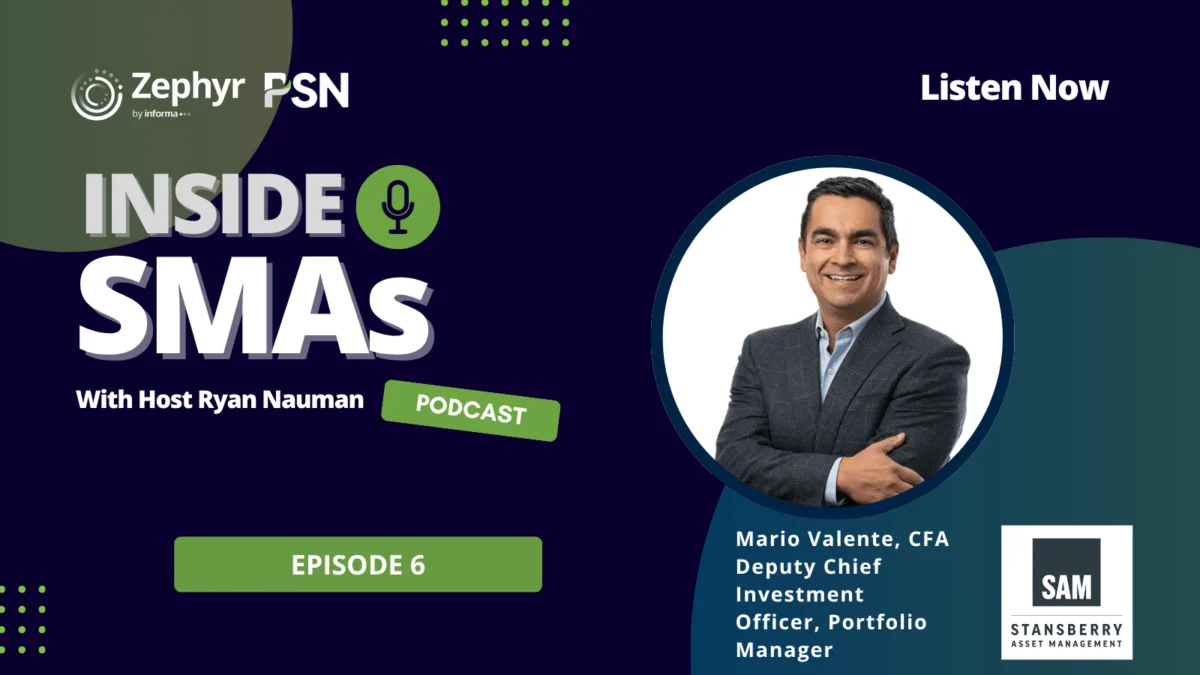
In a recent episode of the Inside SMAs podcast, powered by Zephyr’s PSN, host Ryan Nauman engaged in a comprehensive discussion with Mario Valente, Deputy Chief Investment Officer at Stansberry Asset Management. Valente provided an in-depth look into the firm’s investment philosophy, client focus, and the strategic role of Separately Managed Accounts (SMAs) in their offerings. Stansberry Asset Management, a Registered Investment Advisor (RIA) with over a decade of experience, manages nearly $1.4 billion in assets and operates offices in Dallas (headquarters), New York City, the San Francisco Bay Area, and Washington State.
The core of Stansberry Asset Management’s strategy, as articulated by Valente, revolves around capital preservation and the deployment of low-correlation model strategies. This approach is specifically tailored to meet the needs of retirement-age individuals and institutional clients, who often prioritize stability and risk mitigation in their investment portfolios. The firm’s commitment to these principles underscores a growing trend in the financial advisory landscape, where a more nuanced approach to risk management is becoming paramount, particularly in an environment marked by market volatility and economic uncertainties.
The Flagship All-Weather Strategy: A Cornerstone of Stability
Valente highlighted the firm’s flagship offering, the All-Weather strategy, co-managed with Chief Investment Officer Austin Root. This strategy is designed to perform consistently across a wide range of economic conditions, embodying a robust and diversified approach to investment. The All-Weather strategy is not a monolithic entity but rather a sophisticated structure composed of various "sleeves," each designed to capitalize on specific market opportunities while contributing to the overall resilience of the portfolio.
Among these crucial sleeves is merger arbitrage. This strategy involves profiting from the price difference between a target company’s stock price and the acquisition offer price. The success of merger arbitrage relies on the completion of announced mergers and acquisitions, a process that, while carrying its own set of risks, can offer attractive risk-adjusted returns when executed skillfully. Valente explained that Stansberry Asset Management’s expertise in this area allows them to navigate the complexities of deal structures and potential regulatory hurdles, aiming to generate alpha independent of broader market movements.
Another key component of the All-Weather strategy is the allocation to convertible bonds. Convertible bonds offer a hybrid investment opportunity, providing the fixed-income characteristics of traditional bonds while also possessing an embedded option that allows the holder to convert the bond into a predetermined number of shares of the issuer’s common stock. This dual nature offers a unique blend of downside protection (from the bond component) and upside potential (from the equity option), making them an attractive tool for portfolio diversification and risk management. The firm’s approach to convertible bonds likely involves careful selection of issuers and terms to maximize their effectiveness within the All-Weather framework.
The emphasis on these low-correlation strategies is a direct response to the evolving needs of sophisticated investors. In recent years, traditional asset allocations have shown increased correlation, diminishing their diversification benefits. Strategies like merger arbitrage and convertible bonds, when managed with a disciplined approach, can offer a degree of insulation from broad market downturns, a critical consideration for clients nearing or in retirement.
Tactical Select: A Complementary Approach to Market Inefficiencies
Beyond the All-Weather strategy, Stansberry Asset Management also offers the Tactical Select strategy. This approach adopts a more active stance, combining fundamental thematic analysis with technical selection. Valente elaborated that this strategy seeks to identify and capitalize on market inefficiencies by understanding the underlying economic and industry trends (fundamental themes) and then using technical analysis to pinpoint optimal entry and exit points for investments.
The integration of fundamental and technical analysis is a sophisticated methodology designed to capture opportunities that might be missed by a purely passive or purely fundamental approach. Fundamental analysis helps identify undervalued or overvalued assets based on their intrinsic worth, while technical analysis focuses on price patterns and trading volumes to predict future price movements. By blending these, Stansberry Asset Management aims to enhance their ability to generate returns while managing risk. This dual-pronged approach is particularly relevant in today’s dynamic markets, where rapid information dissemination and shifting investor sentiment can create short-term dislocations and opportunities.
The Role of Gold and Platform Availability
The conversation also touched upon the firm’s dedicated gold strategy. Gold has historically been viewed as a safe-haven asset, often performing well during periods of economic uncertainty, inflation, or geopolitical instability. Stansberry Asset Management’s inclusion of a gold strategy within their broader offering reflects a commitment to providing clients with a comprehensive suite of tools to navigate a complex economic landscape. This strategy likely focuses on efficient ways to gain exposure to gold, whether through direct ownership, futures, or related financial instruments, with an emphasis on risk management and capital preservation.
Valente also provided insights into the firm’s operational infrastructure, mentioning the availability of their strategies on platforms such as SmartX and Advizon. These platforms are crucial for the efficient delivery and management of SMAs, offering advisors and their clients streamlined access, reporting, and administrative capabilities. The choice of these platforms suggests a commitment to leveraging technology to enhance the client experience and operational efficiency.
Why Separately Managed Accounts (SMAs) are Key
A significant portion of the discussion centered on the advantages of SMAs. Valente articulated that SMAs offer several key benefits that align with Stansberry Asset Management’s client-centric approach:
- Customization: SMAs allow for a high degree of customization, enabling advisors to tailor investment portfolios to the specific needs, risk tolerances, and tax situations of individual clients. This stands in contrast to the more one-size-fits-all nature of traditional mutual funds.
- Transparency: Investors in SMAs have direct ownership of the underlying securities. This means they can see precisely what they own, providing a level of transparency that can be reassuring and facilitate better understanding of their investments.
- Direct Ownership: Direct ownership of securities in an SMA means clients hold the assets in their own brokerage accounts. This provides greater control and clarity, particularly regarding tax implications such as tax-loss harvesting opportunities, which can be managed more effectively at the individual account level.
The discussion highlighted how SMAs empower Stansberry Asset Management to deliver highly personalized investment solutions, fostering stronger client relationships built on trust and transparency. This aligns with the broader trend in the wealth management industry, where advisors are increasingly seeking flexible solutions that allow them to differentiate their services and meet the diverse needs of their clientele.
Market Context and Investor Sentiment
The insights shared by Mario Valente on the Inside SMAs podcast come at a time when investors are navigating a complex economic environment. Factors such as persistent inflation, rising interest rates, geopolitical tensions, and the ongoing evolution of global supply chains have created a landscape of heightened uncertainty. In such conditions, the emphasis on capital preservation and low-correlation strategies, as championed by Stansberry Asset Management, becomes increasingly relevant.
Data from industry sources, such as Cerulli Associates, consistently shows a growing demand for SMAs among financial advisors. A 2023 report indicated that a significant percentage of advisors plan to increase their use of SMAs, driven by the desire for greater customization, tax efficiency, and transparency. This trend underscores the strategic importance of firms like Stansberry Asset Management, which are well-positioned to meet this evolving demand.
Furthermore, the rise of institutional investors seeking to diversify their portfolios beyond traditional asset classes also plays a role. These investors are often looking for strategies that can provide uncorrelated returns and enhance risk-adjusted performance. The mention of Stansberry Asset Management serving institutional clients suggests their strategies are robust enough to meet the rigorous demands of this segment of the market.
Chronology of Stansberry Asset Management’s Approach
While a precise historical timeline of Stansberry Asset Management’s strategic evolution was not detailed in the podcast excerpt, the firm’s decade-plus tenure as an RIA and its current AUM of nearly $1.4 billion suggest a period of sustained growth and strategic refinement. The development of their flagship All-Weather strategy, in collaboration with CIO Austin Root, likely represents a culmination of years of research and market experience, aiming to create a resilient portfolio solution. The subsequent offering of the Tactical Select strategy, and the dedicated gold strategy, indicates a progressive expansion of their capabilities to address a wider spectrum of market conditions and client needs. Their choice to leverage platforms like SmartX and Advizon further points to a commitment to modernizing their operational framework to better serve their clients and advisors.
Broader Implications for the Investment Landscape
The discussion on Inside SMAs offers several key takeaways for the broader investment landscape:
- The Enduring Value of Diversification: In an era of increased market interconnectedness, strategies that actively seek low correlations remain crucial for effective risk management.
- The Rise of Sophisticated SMA Solutions: The growth of firms like Stansberry Asset Management, offering specialized SMA strategies, signifies a maturation of the SMA market and its increasing appeal to sophisticated investors and advisors.
- Client-Centricity as a Differentiator: The emphasis on customization, transparency, and direct ownership inherent in SMAs highlights how firms can differentiate themselves by prioritizing client needs and preferences.
- The Role of Technology in Wealth Management: The adoption of platforms like SmartX and Advizon underscores the integral role of technology in delivering efficient, scalable, and client-friendly investment solutions.
The insights provided by Mario Valente offer a valuable perspective on how a forward-thinking asset management firm is navigating the complexities of today’s financial markets. By focusing on capital preservation, low-correlation strategies, and the strategic advantages of SMAs, Stansberry Asset Management is positioning itself as a key player in providing tailored investment solutions for a discerning clientele. The firm’s approach serves as a testament to the ongoing innovation within the wealth management industry, where a deep understanding of client needs, combined with sophisticated investment strategies and robust technological infrastructure, is paramount to success.
For those seeking to explore the potential of SMAs in their investment portfolios, Zephyr’s PSN data offers a valuable resource to begin their research. Further information about Stansberry Asset Management and their investment strategies can be found on their official website.
