

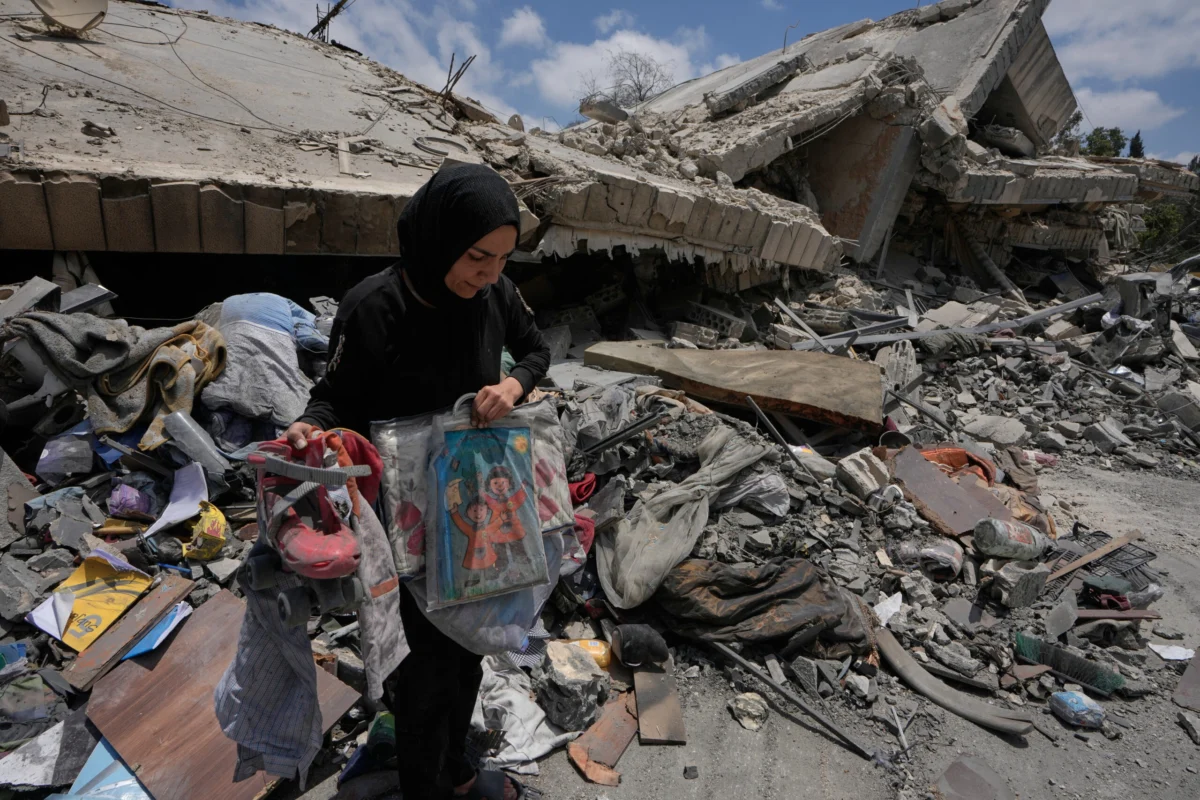
The precarious ceasefire between Israel and Hezbollah faced its most significant challenge on Tuesday as Israeli forces opened fire in southern Lebanon, resulting in the deaths of two individuals and the wounding of two others. The incident, reported by Lebanon’s National News Agency (NNA), marks the first reported fatalities since a United States-brokered truce was implemented earlier this week, raising urgent questions about the sustainability of the diplomatic arrangement and the potential for a renewed escalation of hostilities.
According to the NNA, the fatal encounter occurred in a town near the city of Nabatieh. The victims were reportedly standing near an excavator that was being used to clear debris and unblock a road when Israeli soldiers opened fire with machine guns. This area has been a focal point of recent military activity, and the sudden eruption of violence has disrupted a period of relative calm that had lasted for approximately forty-eight hours. The Lebanese armed group Hezbollah immediately condemned the incident, characterizing it as a "treacherous attack" and a "blatant violation" of the agreed-upon cessation of hostilities.
The Israeli military provided a differing account of the event, asserting that its troops "struck armed terrorists who posed an immediate threat" to soldiers operating in the Ali al-Taher ridge area. This region falls within what Israel has designated as a "security zone" in southern Lebanon—a buffer area where Israeli forces maintain a presence to prevent Hezbollah from re-establishing infrastructure near the border. The Israeli Defense Forces (IDF) maintained that their actions were defensive and consistent with their mandate to neutralize threats against their personnel.
Escalation and the Fragility of the Truce
The ceasefire, which began on Sunday, was intended to provide a 60-day window for the withdrawal of Israeli forces from southern Lebanon and the simultaneous retreat of Hezbollah fighters north of the Litani River. However, the deaths on Tuesday underscore the immense difficulty of enforcing a truce in a landscape where the lines of engagement are blurred and trust is non-existent.
Mahmoud Qamati, the deputy head of Hezbollah’s political council, issued a stern warning following the attack. Speaking to Iran’s Press TV, Qamati stated that the group remains "fully alert with its finger on the trigger" and will respond to any Israeli violation "in kind." He emphasized that Hezbollah would not accept a return to the status quo that existed before the current escalation, where Israeli forces conducted frequent strikes while Hezbollah adhered to a policy of restrained fire.
The rhetoric from the Israeli leadership has been equally uncompromising. In a joint statement issued on Tuesday, Prime Minister Benjamin Netanyahu, Defense Minister Israel Katz, and Chief of the General Staff Eyal Zamir affirmed that the military would continue to act with "determination" to neutralize threats. Netanyahu further clarified in a video statement that the Israeli military retains "full freedom of action" in Lebanon and intends to remain in the southern security zone for as long as deemed necessary to ensure the safety of northern Israeli communities.
A Chronology of Conflict: From October to the Present
The current crisis is the culmination of over a year of cross-border violence that began on October 8, 2023, when Hezbollah began firing rockets into northern Israel in a show of solidarity with Palestinians in Gaza. What followed was a slow-burn conflict that rapidly intensified into a full-scale military campaign in late 2024.
- October 2023 – August 2024: Low-intensity skirmishes characterized by rocket fire from Hezbollah and targeted airstrikes by the IDF. Thousands of civilians on both sides of the border were displaced during this period.
- September 2024: A dramatic escalation occurred following the detonation of thousands of handheld pagers and walkie-talkies used by Hezbollah members, an operation widely attributed to Israeli intelligence. This was followed by the assassination of Hezbollah’s longtime leader, Hassan Nasrallah, in a massive airstrike in Beirut.
- October 2024: Israel launched a limited ground operation into southern Lebanon, aimed at dismantling Hezbollah’s tunnel networks and weapons caches near the Blue Line.
- November 2024: Intensified diplomatic efforts led by US envoy Amos Hochstein sought to establish a framework for a long-term ceasefire based on the principles of UN Security Council Resolution 1701.
- December 2024: The ceasefire was formally announced, but its implementation has been marred by accusations of violations from both sides within the first 72 hours.
Humanitarian Impact and Supporting Data
The human cost of the conflict in Lebanon has been catastrophic. Data from the Lebanese Ministry of Health indicates that at least 4,106 people have been killed since the escalation began in early 2024. The displacement crisis is equally severe, with an estimated 1.2 million people—nearly a fifth of Lebanon’s population—forced to flee their homes. Many of these individuals are seeking refuge in overcrowded schools, public buildings, or with host families in Beirut and northern provinces.
On the Israeli side, the conflict has claimed the lives of at least 32 soldiers and four civilians. Tens of thousands of residents from northern Israeli towns remain in temporary housing, unable to return to their communities due to the persistent threat of anti-tank missiles and rocket fire.
The destruction of infrastructure has been particularly acute in Beirut’s southern suburbs, known as Dahiyeh, and in the border villages of the south. Entire residential blocks have been leveled, and essential services such as water and electricity have been severely disrupted. For many Lebanese citizens, the ceasefire offers little immediate relief as they have no homes to return to.
Diplomatic Maneuvering in Washington
As violence flared on the ground, high-level diplomatic talks commenced in Washington on Tuesday. The negotiations, mediated by US officials, aim to solidify the technical aspects of the ceasefire and establish a mechanism for monitoring violations. Lebanon is represented by Ambassador Nada Moawad, while the Israeli delegation is led by Ambassador Yechiel Leiter.
The primary points of contention remain the withdrawal of Israeli troops and the disarmament of Hezbollah. Lebanon is demanding a full Israeli withdrawal from the "buffer zone," which currently encompasses approximately 6 percent of Lebanese territory. Conversely, Israel insists on the complete removal of Hezbollah’s military presence south of the Litani River and has sought guarantees that the group will not be able to re-arm.
Hezbollah’s leadership has maintained that the talks should be limited to "mutual security" arrangements and has explicitly stated that the issue of its weaponry is not up for negotiation. This fundamental disagreement poses a significant hurdle to any long-term stability.
International Reactions and Regional Implications
The international community has watched the developments with growing alarm. Iran, a primary supporter of Hezbollah, has called on the United States to fulfill its obligations as a mediator. Iranian Foreign Ministry spokesman Esmaeil Baghaei stated that the US is obligated to force Israel to halt its "assaults" on Lebanon. "The obligation to put an end to the war in Lebanon is part and parcel of the previous and current arrangements," Baghaei said, adding that "final arrangements" are expected to be reached in the coming days.
Analysts suggest that the success of the Washington talks depends heavily on the empowerment of the Lebanese Armed Forces (LAF). Under the proposed framework, the LAF is expected to deploy thousands of troops to the south to act as the sole military authority in the region, alongside the UN Interim Force in Lebanon (UNIFIL). However, the LAF faces significant resource constraints and political challenges in asserting control over areas traditionally influenced by Hezbollah.
Fact-Based Analysis of Future Implications
The incident in Nabatieh serves as a stark reminder that the "security zone" established by Israel remains a volatile flashpoint. If Israel continues to operate within this zone to neutralize what it perceives as immediate threats, Hezbollah may feel compelled to retaliate to maintain its domestic credibility and its "finger on the trigger" posture.
The central risk is a "tit-for-tat" cycle of violence that could collapse the Washington talks before they reach a conclusion. Furthermore, the skepticism expressed by Lebanese civilians reflects a broader lack of faith in international guarantees. Without a robust, independent monitoring mechanism—one that both sides respect—the ceasefire is likely to remain a "truce in name only."
As the Washington negotiations continue through Thursday, the focus will be on defining the rules of engagement for the 60-day transition period. If a consensus cannot be reached on what constitutes a "threat" or a "violation," the relative calm of the past few days may prove to be a fleeting interlude in a much longer and more destructive conflict. The coming 48 hours will be critical in determining whether the diplomatic path can survive the harsh realities of the battlefield.
