

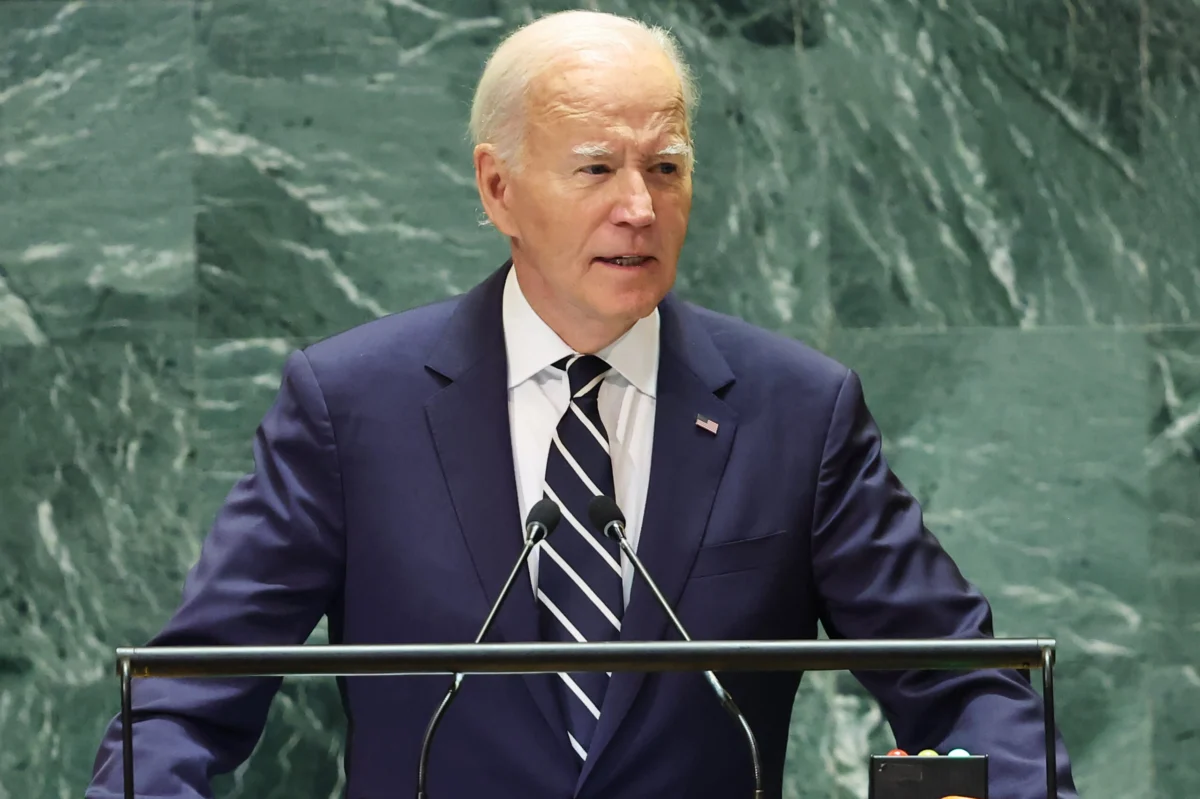
President Joe Biden stood before the 79th session of the United Nations General Assembly in New York on Tuesday to deliver his final major address to the world body, attempting to reconcile the ambitious diplomatic goals of his administration with a global landscape increasingly fractured by brutal conflicts in the Middle East, Eastern Europe, and East Africa. Speaking at a pivotal moment in both his presidency and international history, Biden sought to frame his four decades of public service as a testament to the power of collective action, even as the "rules-based international order" he has long championed faces its most severe challenges since the end of the Cold War.
“I know many look at the world today and see difficulties and react with despair,” Biden told the assembled heads of state and diplomats. “But maybe because of all I’ve seen and all we have done together over the decades, I have hope.” This sentiment of hard-won optimism served as the cornerstone of a speech that was as much a valedictory defense of his foreign policy legacy as it was a somber acknowledgement of the unfinished business that will be passed to his successor.
A Vision of Global Resilience Amidst Escalating Conflicts
The President’s address highlighted what the White House considers its most significant multilateral achievements. Chief among these was the revitalization of Western alliances in the wake of Russia’s February 2022 invasion of Ukraine. Biden emphasized that his administration’s swift mobilization of a global coalition was not merely a matter of regional security but a fundamental defense of the U.N. Charter’s principles regarding sovereignty and territorial integrity.
Beyond Ukraine, the President detailed efforts to manage the complex, competitive relationship with China, outlining a strategy of "de-risking" rather than "decoupling." He also pointed to the establishment of global principles for artificial intelligence—a burgeoning field that he argued could either accelerate human progress or deepen existing inequalities depending on the international community’s ability to regulate its ethical use.
However, the weight of current events loomed large over the General Assembly. Since Biden’s last appearance at this podium in September 2023, the geopolitical climate has deteriorated significantly. The ongoing war in Sudan has created the world’s largest displacement crisis, while the Middle East has been plunged into a cycle of violence that threatens to ignite a broader regional conflagration.
The Middle East: A Region on the Precipice
A significant portion of Biden’s address was dedicated to the volatile situation in the Middle East, which has reached a fever pitch following the October 7, 2023, Hamas attacks on Israel and the subsequent military campaign in Gaza. The President’s rhetoric reflected the delicate balancing act his administration has maintained: supporting Israel’s right to defend itself while increasingly criticizing the humanitarian toll on Palestinian civilians.
"Now is the time for the parties to finalize its terms, bring the hostages home, to secure security for Israel and Gaza free from Hamas’ grip, ease the suffering in Gaza, and end this war," Biden declared, referring to the ongoing, U.S.-backed ceasefire negotiations. He also took the opportunity to address the rising tide of settler violence in the West Bank, calling for an end to the "violence against innocent Palestinians" and reiterating his long-standing commitment to a two-state solution.
The urgency of Biden’s plea is underscored by staggering data from the region. In the eleven months since the conflict began, the death toll in Gaza has reportedly surpassed 41,000, according to local health officials, while the United Nations warns that nearly the entire population of the enclave faces acute food insecurity. Simultaneously, the conflict has expanded to Israel’s northern border, where escalating exchanges of fire with Hezbollah in Lebanon have displaced tens of thousands on both sides and brought the region to the brink of a full-scale war.
Ukraine: The Test of International Resolve
Turning to the war in Ukraine, which has now entered its third year, Biden offered a defiant defense of the decision to support Kyiv. He framed the conflict as a struggle for the very soul of the international system. "We could have stood by and merely protested, but Vice President Harris and I understood that that was an assault on everything this institution was supposed to stand for," he said.
Biden used the platform to celebrate the expansion of NATO, which saw Finland and Sweden join the alliance as a direct consequence of Russian President Vladimir Putin’s aggression. However, he also issued a stark warning to the international community against "fatigue." This message was particularly pointed given the domestic political climate in the United States, where a segment of the Republican Party has become increasingly vocal in its opposition to further military and economic aid for Ukraine.
To date, the United States has committed more than $55 billion in security assistance to Ukraine since the start of the invasion. Biden’s insistence that "we will not let up" serves as a commitment to the Zelenskyy administration, even as the path to a "just and durable peace" remains obscured by a grinding war of attrition in the Donbas and Kursk regions.
Sudan and the Forgotten Humanitarian Crises
While Ukraine and Gaza have dominated global headlines, Biden notably elevated the crisis in Sudan during his address. The civil war between the Sudanese Armed Forces (SAF) and the paramilitary Rapid Support Forces (RSF) has resulted in tens of thousands of deaths and a humanitarian catastrophe that many international observers say has been neglected by the West.

The President called on global powers to stop arming the rival generals and to prioritize the delivery of aid to millions of starving Sudanese. By including Sudan in his final UNGA address, Biden sought to project a foreign policy that is truly global in scope, addressing "forgotten" wars alongside those that carry higher geopolitical stakes for the Great Powers.
The Doctrine of Democracy: Transitioning Power
In a rare move for a diplomatic address, Biden touched upon his personal decision to withdraw from the 2024 U.S. presidential race. This moment was designed to provide a moral contrast to the world’s autocrats and those who cling to power at the expense of their nations’ stability.
"As much as I love the job, I love my country more. I decided, after 50 years of public service, it’s time for a new generation of leadership to take my nation forward," Biden said. He urged his fellow leaders to remember that "some things are more important than staying in power," a statement that resonated deeply in a hall filled with leaders ranging from democratic prime ministers to long-standing authoritarian rulers.
This portion of the speech served to bolster the "democracy vs. autocracy" theme that has defined much of his presidency. By voluntarily stepping aside, Biden aimed to lead by example, reinforcing the idea that the strength of a nation lies in its institutions and its people, rather than in a single individual.
A Diplomatic Marathon on the Sidelines
The General Assembly is as much about the public speeches as it is about the "sideline" diplomacy that occurs in the corridors of the U.N. headquarters. Biden’s final week in the global spotlight includes a packed schedule of high-stakes meetings designed to solidify his administration’s priorities.
Following his speech, Biden hosted a summit focused on the global synthetic drug crisis, specifically the trafficking of fentanyl, which remains a top domestic and foreign policy priority for the U.S. His week also includes a bilateral meeting with Vietnamese President Tô Lâm, highlighting the administration’s efforts to strengthen ties in Southeast Asia as a counterweight to Chinese influence.
On Thursday, Biden will return to Washington to host Ukrainian President Volodymyr Zelenskyy at the White House. This meeting is expected to be critical, as Zelenskyy is reportedly prepared to present a "victory plan" that requires further U.S. long-range weapons capabilities and sustained financial commitments.
The Shadow of the 2024 Election
Despite Biden’s presence in New York, the shadow of the upcoming U.S. election was inescapable. Foreign leaders are increasingly looking past the current administration to engage with the two figures who might lead the United States come January 2025: Vice President Kamala Harris and former President Donald Trump.
The diplomatic itineraries of visiting leaders reflected this reality. UAE President Mohamed bin Zayed Al Nahyan met separately with both Biden and Harris on Monday. Similarly, President Zelenskyy is expected to meet with Harris in Washington and has indicated a desire to meet with Trump, who has frequently claimed he could end the Ukraine war within 24 hours if re-elected.
The divergence between the Biden-Harris "internationalist" approach and Trump’s "America First" doctrine represents a significant source of anxiety for many U.S. allies. Biden’s speech was, in many ways, an attempt to reassure the world that the American commitment to global leadership is durable, even as the polls suggest a deeply divided American electorate.
Analysis: The End of an Era
Biden’s final UNGA address marks the end of an era for a leader who has spent half a century navigating the complexities of the international stage. When he took office in 2021, his message was "America is back." Four years later, the world he leaves behind is more interconnected yet more polarized than when he arrived.
His legacy will likely be defined by his success in reviving NATO and his role in preventing a total Russian victory in Ukraine. However, the ongoing carnage in Gaza and the stalled progress on climate change and global debt relief suggest the limits of American influence in a multipolar world.
As the President concluded his remarks, he returned to the theme of hope, urging the United Nations to return to its founding mission of "peace and security." Whether the international community can meet that challenge in the face of rising nationalism and regional conflict remains the central question of the post-Biden era. For now, the President has laid out his closing argument: that global cooperation is not a relic of the past, but the only viable path to a stable future.
