

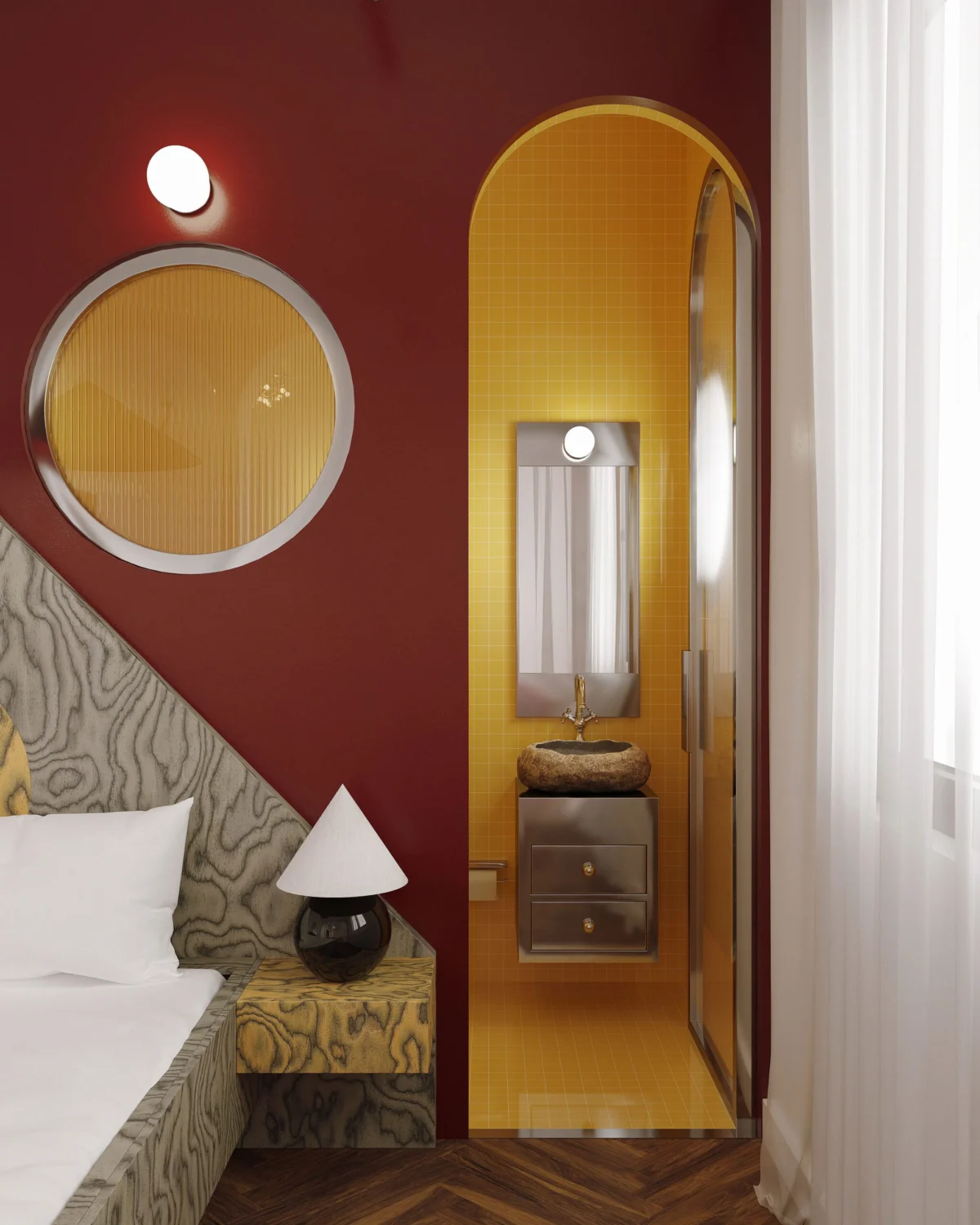
In the dense urban fabric of Paris, a city historically defined by its rigid Haussmannian boulevards and preserved 19th-century architecture, the adaptive reuse of industrial and artisanal spaces has emerged as a critical solution for modern residential needs. The conversion of a former ceramics studio into a highly functional, 462-square-foot residence represents a significant case study in small-scale architectural innovation. Located in the heart of the "City of Light," this project was spearheaded by Ömer Öztürk, an Istanbul-based interior architect known for his ability to synthesize historical context with postmodern aesthetics. The renovation prioritizes spatial fluidity and bold chromatic contrasts, moving away from the traditional compartmentalization that often characterizes small Parisian apartments. By retaining the "raw, utilitarian character" of the original ceramics workshop while introducing high-end contemporary elements, the project demonstrates how industrial heritage can be successfully reinterpreted for a 21st-century lifestyle.
Historical Context and the Evolution of the Parisian Atelier
The transformation of former production spaces into residential lofts is a trend rooted in the mid-20th-century shifts of the Parisian economy. Historically, neighborhoods such as the 10th and 11th arrondissements were hubs for small-scale manufacturing, including furniture making, textiles, and ceramics. As these industries moved to the periphery or transitioned to digital production, the physical structures they occupied—often characterized by large windows, high ceilings, and open floor plans—became highly sought-after by the creative class.

The studio in question served for decades as a space for ceramic production, a function that dictated its original layout and material palette. When Ömer Öztürk took on the project, the space was defined by its lack of a traditional residential flow. It was a singular, utilitarian volume. The architectural challenge lay in introducing the comforts of a home—privacy, kitchen facilities, and distinct living zones—without sacrificing the expansive feel that makes industrial conversions desirable. The project sought to "glaze" the space, a metaphorical nod to its ceramic history, by adding layers of texture, color, and light that reflect a sophisticated contemporary identity.
Strategic Spatial Reconfiguration and Fluid Transitions
The core architectural intervention involved the removal of rigid partitions to "push the boundaries of small-scale living." In a 462-square-foot (approximately 43-square-meter) footprint, every square inch must be optimized. Traditional walls often create visual "dead ends" that make small spaces feel cramped and reduce the penetration of natural light. To counter this, Öztürk implemented a system of fluid transitions.
The most notable feature of this strategy is the replacement of solid bedroom walls with a high-quality curtain system. This allows the inhabitant to modulate the level of privacy and light based on the time of day or the presence of guests. When open, the curtains allow for unobstructed airflow and a continuous visual line from the front of the studio to the rear, effectively doubling the perceived size of the living area.

Furthermore, the architect utilized bold architectural gestures, such as white archways, to frame transitions between zones. These arches serve as a psychological threshold rather than a physical barrier, guiding the eye through the apartment’s various functions while maintaining a sense of openness. The geometry of the space was further complicated by an awkward, non-linear floor plan in the bedroom area, which required a bespoke furniture solution to ensure functionality.
Bespoke Design and the Role of Custom Craftsmanship
In small-scale architecture, off-the-shelf furniture often fails to address the unique idiosyncrasies of a space. For this Paris studio, Öztürk’s firm designed a custom bed made with Alpi wood veneer, supported by minimalist metal legs. Alpi wood, a reconstituted wood veneer known for its consistency and sustainability, was chosen to provide a warm, organic contrast to the apartment’s more industrial elements.
The bed was designed to fit snugly into a specific corner characterized by an irregular angle. This sculptural piece does more than provide a sleeping surface; it incorporates a desk module that mirrors the bed’s design, creating a unified workspace and resting area. The use of deep burgundy walls in the bedroom, accented by touches of green leather on a Cassina stool, creates a cocoon-like atmosphere that contrasts sharply with the brighter, more social living room.

Chromatic Dissonance and Postmodern Aesthetics
One of the defining characteristics of Ömer Öztürk’s design philosophy is his interest in pairing "dissonant" colors. While many modern renovations lean toward a neutral or monochromatic palette to make spaces feel larger, this project embraces bold, high-contrast hues to define different functional zones and create emotional depth.
The living room serves as the primary stage for this color experimentation. A vibrant red velvet sofa acts as a central anchor, placed in direct opposition to a bright blue USM Haller modular storage unit. USM Haller, a staple of Swiss design since the 1960s, is celebrated for its modularity and industrial precision, making it an ideal choice for a space with an artisanal past. These primary colors are set against the rich, dark tones of walnut hardwood floors, which provide a grounding element to the room’s high-energy palette.
The kitchen continues this theme of unexpected combinations. Stainless steel cabinetry and fixtures—a material choice that reinforces the studio’s industrial roots—are tempered by vibrant blue and orange accents. The flooring in the kitchen and dining area features Otto Tiles, which provide a textured, geometric foundation for the space. A sculptural vase by DasPieces and an oval-shaped blown-glass art object by Marquisate London further emphasize the project’s commitment to sculptural, non-traditional forms.

Visual Continuity and the Circular Motif
Despite the use of contrasting colors and materials, the apartment maintains a sense of "visual resonance" through the repetition of shapes and subtle design cues. A key example of this is the circular window located in the bedroom wall, which provides a direct sightline into the bathroom.
The bathroom is entirely wrapped in glossy yellow tiles, a choice that maximizes light reflection in a windowless space. This yellow hue is mirrored in a small, stamped detail on the bed’s custom headboard, creating a visual link between the two most private areas of the home. According to Öztürk, these "spatial gestures" are essential for creating a cohesive environment where different rooms "resonate" with one another.
Lighting also plays a critical role in maintaining this continuity. Flos light fixtures were selected for their ability to provide both task lighting and atmospheric mood-setting. On the ceiling, these fixtures highlight the apartment’s volumes and emphasize the sculptural quality of the furniture and architectural interventions.

Analysis of Implications for Urban Living
The success of the 462-square-foot Paris studio renovation offers several insights into the future of urban residential design. As major global cities like Paris, London, and New York face increasing density and rising real estate costs, the ability to transform small, unconventional spaces into high-quality homes is becoming a vital skill for architects.
- Prioritization of Quality over Quantity: This project demonstrates that luxury and architectural significance are not dependent on square footage. By investing in custom furniture and iconic design pieces (Cassina, Flos, USM), the owner has created a space that feels curated and expansive despite its physical limitations.
- Flexible Architecture: The use of curtains instead of walls reflects a growing demand for flexible living environments. As the boundaries between work and home continue to blur, residents require spaces that can be easily reconfigured for different needs throughout the day.
- Preservation of Identity: Rather than stripping the studio of its industrial character, the renovation uses that history as a foundation. This approach to "artisanal postmodernism" preserves the soul of the neighborhood while providing modern amenities.
- Color as a Spatial Tool: The project challenges the notion that small spaces must be white or light-colored. Through the strategic use of deep burgundy, bright yellow, and primary blues and reds, the architect has successfully used color to define space and create a sense of grandeur.
Project Timeline and Development
The renovation of the Paris studio followed a rigorous timeline common to high-end European residential projects. The initial phase involved a detailed survey of the existing ceramics studio, identifying structural constraints and opportunities for opening the floor plan. Following the design approval, the "deconstruction" phase removed the previous utilitarian partitions.
The middle phase of the project focused on the custom fabrication of the furniture in Istanbul and its subsequent transport and installation in Paris. This cross-border collaboration highlights the global nature of modern interior architecture. The final phase involved the "glazing" of the space—the installation of the stainless steel kitchen, the tiling of the yellow bathroom, and the careful placement of lighting and art objects.

The completed project has since been recognized in major design publications, including AD France, serving as a benchmark for small-scale renovation. It stands as a testament to the idea that with intuitive design and a bold approach to color and material, even the most "raw and utilitarian" spaces can be transformed into immersive contemporary homes. The apartment remains a functional living space that honors its past as a place of creation while looking forward to a future of flexible, expressive urban living.
