

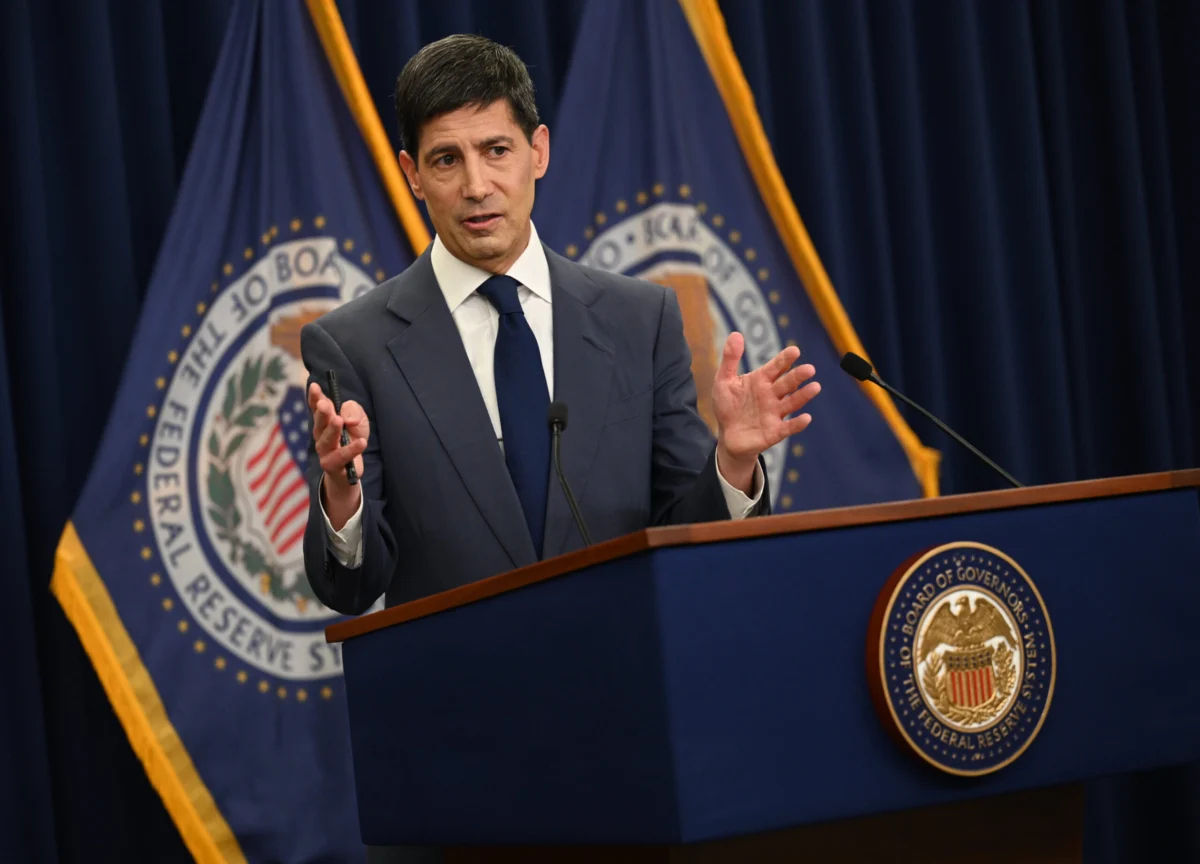
Federal Reserve Chairman Kevin Warsh’s forceful declaration on combating inflation on Wednesday sent immediate and significant ripples through global financial markets, with traders rapidly recalibrating their expectations for the central bank’s monetary policy trajectory. The assertive tone from the newly appointed Fed chief strongly suggested that a series of interest rate hikes could commence within a mere matter of months, marking a stark departure from previous market assumptions and a firm establishment of Warsh’s inflation-fighting credentials.
A New Era at the Federal Reserve: Warsh’s Inflation Mandate
Warsh, whose appointment by President Donald Trump had initially led some observers to anticipate a more dovish monetary policy stance given the President’s repeated public demands for lower interest rates, instead used his inaugural news conference to underscore the Federal Reserve’s unwavering commitment to price stability. He directly addressed the persistent challenge of inflation, which has consistently exceeded the Fed’s official 2% target for an extended period of five years, presenting a significant burden on American households and businesses.
"Persistently high prices are a burden for the American people, but the recent past need not be prologue," Chairman Warsh stated emphatically during the press briefing. "I am pleased to report that members of the Federal Open Market Committee [FOMC] are unambiguous and unanimous. This committee will deliver price stability." His remarks left no room for ambiguity, signaling a collective resolve within the Fed’s policymaking body to tackle inflationary pressures head-on. This unified front was particularly noteworthy, dispelling any notions of internal dissent or a reluctant embrace of tighter monetary policy. The emphasis on "unambiguous and unanimous" underscored the gravity of the Fed’s commitment and its intent to act decisively.
The pronouncements immediately resonated across financial landscapes. The 2-year Treasury yield, a highly sensitive barometer of short-term interest rate expectations and directly reflective of anticipated Fed moves, experienced a significant surge as Warsh delivered his speech. This sharp increase indicated that bond market participants swiftly priced in a more aggressive tightening cycle than previously forecast. Simultaneously, futures market traders began to adjust their bets on the timing and magnitude of future rate increases. The probability of an interest rate hike at the upcoming July 28-29 FOMC meeting quickly climbed from negligible levels to approximately 1 in 3, a substantial shift in expectations. Looking further ahead, the odds for a September hike spiked even more dramatically, reaching 67% around midday Thursday, according to the CME Group’s widely monitored FedWatch tool, illustrating a profound and rapid reassessment of the monetary policy outlook.
Dispelling the Dovish Narrative: A Hawkish Pivot
The immediate market reaction vividly illustrated how quickly the popular narrative surrounding Chairman Warsh was shattered. Prior to his confirmation and even leading up to his first FOMC meeting, a significant segment of financial analysts and investors had characterized Warsh as a potential "dove" – an official inclined towards lower interest rates to stimulate economic growth, potentially influenced by the White House’s known preference. This perception was partly fueled by his past writings and commentary, which at times highlighted the potential for technological advancements, such as artificial intelligence (AI), to boost productivity and economic growth while simultaneously exerting downward pressure on inflation.
However, Warsh’s 40-minute parley with reporters proved to be a masterclass in establishing a hawkish stance. The session, which alternated between moments of serious deliberation and lighter exchanges, was overwhelmingly dominated by the theme of inflation. Warsh’s repeated invocation of "price stability" – a phrase he uttered a dozen times throughout the briefing – served as a powerful rhetorical anchor, firmly aligning his chairmanship with the Fed’s primary mandate of maintaining stable prices. This strategic repetition underscored his singular focus and commitment, leaving no doubt about the FOMC’s immediate priorities.
Market veteran Ed Yardeni, head of Yardeni Research, articulated the widespread surprise, stating he was "blown away" by Warsh’s remarks. In an overnight note to clients, Yardeni reflected on the prior consensus: "We thought he was a dove who favored lowering the federal funds rate (FFR) because he believes that AI is boosting productivity and economic growth while keeping a lid on inflation. Instead, he hammered home a strict, orthodox message on inflation with a strong commitment to price stability." This sentiment was echoed across numerous financial institutions, as analysts scrambled to update their models and forecasts in light of the Fed’s decisive pivot.
The shift towards a hawkish stance by the Federal Reserve chairman had an immediate and palpable impact on equity markets. Stock market averages, including the Dow Jones Industrial Average, S&P 500, and Nasdaq Composite, experienced significant declines following Warsh’s comments, mirroring the spike in Treasury yields. Investors, initially unsettled by the prospect of higher borrowing costs and potentially slower economic growth, reacted by pulling capital from riskier assets. However, this apprehension proved to be relatively short-lived. By Thursday, as Wall Street had more time to digest the full implications of the FOMC meeting outcome, a sense of calm returned, and focus shifted to other positive developments. Reports of easing geopolitical tensions, particularly "positive developments in the Iran war," coupled with the prospect for lower energy costs, helped to buoy market sentiment. Consequently, stocks rallied, and Treasury yields stabilized, ending the day flat to lower, indicating a degree of market resilience and a nuanced interpretation of the Fed’s forward guidance.
Market Indicators and Future Rate Hike Probabilities
The immediate aftermath of Chairman Warsh’s press conference saw a significant repricing across various segments of the financial markets, particularly in instruments sensitive to monetary policy expectations. The 2-year Treasury yield, a key bellwether for short-term rate expectations, surged by approximately 15-20 basis points following the speech, reaching levels not seen in several months. This movement signaled a definitive market conviction that the Federal Reserve was poised to embark on a tightening cycle much sooner than previously anticipated.
Beyond the immediate horizon, traders also began to price in a largely tighter Fed policy extending well into the future. The CME Group’s FedWatch tool, which calculates probabilities of FOMC rate moves based on federal funds futures prices, became a focal point for analysis. Prior to Warsh’s remarks, the likelihood of a rate hike in July was minimal, barely registering above 10%. This quickly escalated to approximately 33%, reflecting a significant increase in the perceived immediacy of a policy change. For the September meeting, the probability of a hike, initially around 40%, soared to an robust 67%, indicating that a majority of market participants now expect at least one rate increase by early autumn.

The shift in expectations extended even further into the medium and long term. The odds of a second rate hike by September 2027, an admittedly distant projection, rose above 45%, suggesting that the market anticipates a sustained period of monetary tightening. More tellingly, the market-implied federal funds rate for May 2031 stood at 4.78%. This figure, when compared to the current target range of 3.50%-3.75%, implicitly suggests that traders are pricing in as many as five additional rate hikes over the next five years, each typically in 25-basis-point increments. This long-term outlook underscores a fundamental recalibration of market expectations regarding the terminal rate and the duration of the Fed’s tightening cycle.
Underlying Inflation Dynamics and Counterarguments
Despite the Fed’s hawkish posture, there remains a nuanced debate among economists and strategists regarding the actual trajectory of inflation. While popular inflation gauges, such as the Consumer Price Index (CPI) and the Personal Consumption Expenditures (PCE) price index, have indeed reached multi-year highs and consistently remained above the Fed’s 2% target, some underlying pressures appear to be easing. For instance, the core inflation rate, which strips out volatile food and energy components to provide a clearer picture of underlying price trends, reportedly rose by a modest 0.2% in May. This figure, while still contributing to overall inflation, suggests that some of the more persistent, demand-driven inflationary forces might be moderating.
Scott Clemons, chief investment strategist at Brown Brothers Harriman, presented a notable counter-argument to the market’s aggressive pricing of rate hikes. Clemons expressed skepticism about the Fed’s willingness to raise interest rates this year, despite the prevailing futures market sentiment. "Far be it for me to disagree with the futures market, but I would be surprised if the Fed raises interest rates this year," Clemons stated. His rationale centers on the current political climate, specifically highlighting that it is an election year. "This is already a hyper-politicized environment. There’s already concerns about politicization at the Fed. I’m not sure they want to feed that." Clemons’s perspective underscores the delicate balance the Fed must maintain between its economic mandate and the political sensitivities that inevitably surround its decisions, particularly in a presidential election cycle. Historically, the Fed has often shown a reluctance to make significant policy shifts in the immediate run-up to national elections, seeking to avoid any perception of influencing the political outcome.
Chairman Warsh himself has, in the past, articulated a philosophy that it is generally prudent for central banks to "look through" temporary supply disruptions that might cause fleeting price spikes. This historical perspective suggests that if the current inflationary pressures are predominantly driven by transient supply-side shocks rather than entrenched demand-pull inflation, the Fed might eventually adopt a more patient approach.
Geopolitical Factors and Commodity Price Dynamics
The global geopolitical landscape continues to play a critical role in shaping inflationary pressures, particularly through its impact on commodity markets. The recent "Iran war," while not explicitly detailed in its timeline or scope in the original context, evidently had an initial upward pressure on commodity costs. However, subsequent "positive developments" in the conflict appear to have contributed to a de-escalation of this pressure.
Commodity costs, as measured by the S&P GSCI index, have seen a significant retreat from their peaks. While they initially rose by approximately 6% since the war began in late February, they have since come off their May peak by some 17%. This notable decline indicates a significant easing in raw material prices, which is a crucial factor in the broader inflation outlook. A direct beneficiary of this trend is the energy sector, with gasoline prices notably dipping below $4 a gallon on Thursday, according to data from AAA. Such a reduction in energy costs directly impacts consumer spending power and reduces input costs for businesses, potentially alleviating one of the most visible and impactful drivers of inflation.
Should this trend of easing commodity prices continue, combined with a potential softening of the broader economy, it could provide the Federal Reserve with greater flexibility. A sustained retreat in inflationary pressures and signs of economic wobbling might allow the central bank to reconsider its hawkish posture, potentially shifting back towards an easing stance or at least pausing its rate hike cycle. This dynamic highlights the Fed’s data-dependent approach, where policy decisions are continuously re-evaluated based on incoming economic indicators and evolving global events.
Broader Economic Implications and The Path Forward
The implications of a hawkish Federal Reserve, as signaled by Chairman Warsh, extend far beyond financial markets, touching various facets of the American economy. Higher interest rates translate into increased borrowing costs for consumers, impacting everything from mortgage rates and auto loans to credit card interest. This can dampen consumer spending, a primary driver of economic growth. For businesses, higher rates mean more expensive capital, potentially leading to reduced investment, slower expansion, and a tempering of hiring plans. The housing market, particularly sensitive to interest rate fluctuations, could experience a slowdown as affordability decreases for prospective buyers.
The Fed’s dual mandate of achieving maximum employment and price stability often presents a challenging balancing act. While Warsh’s focus is squarely on price stability, an overly aggressive tightening cycle risks tipping the economy into a recession, thereby undermining the employment mandate. This delicate trade-off will be a central theme in the FOMC’s upcoming deliberations.
Steve Blitz, chief U.S. economist at TS Lombard, offered a insightful perspective on the market’s complex reaction to Warsh’s message. "For now, for the markets, Warsh’s message was comforting and unsettling," Blitz noted. He explained the dual nature of the response: "In declaring that inflation will be dealt with in no uncertain terms was comforting. By saying that markets will decide where to set rates rather than having them set with an eye to where the Fed wants them set was unsettling (to today’s traders, but this should, ultimately, prove comforting)." Blitz’s analysis highlights the short-term shock of an independent, data-driven Fed contrasting with the long-term benefit of a central bank committed to its mandate, even if it means allowing market forces to play a more significant role in price discovery for interest rates.
Looking ahead, the Federal Reserve under Chairman Warsh is set to navigate a complex economic landscape. The committee’s future actions will be heavily scrutinized, with every economic data release, from inflation reports to employment figures, influencing market expectations. The interplay between domestic economic trends, global geopolitical developments, and the Fed’s determined stance on price stability will define the monetary policy environment in the coming months and years. While the initial jolt of Warsh’s hawkish pivot has settled, the long-term ramifications of his resolute commitment to curbing inflation are only just beginning to unfold, promising a period of dynamic adjustments for investors, businesses, and consumers alike.
