

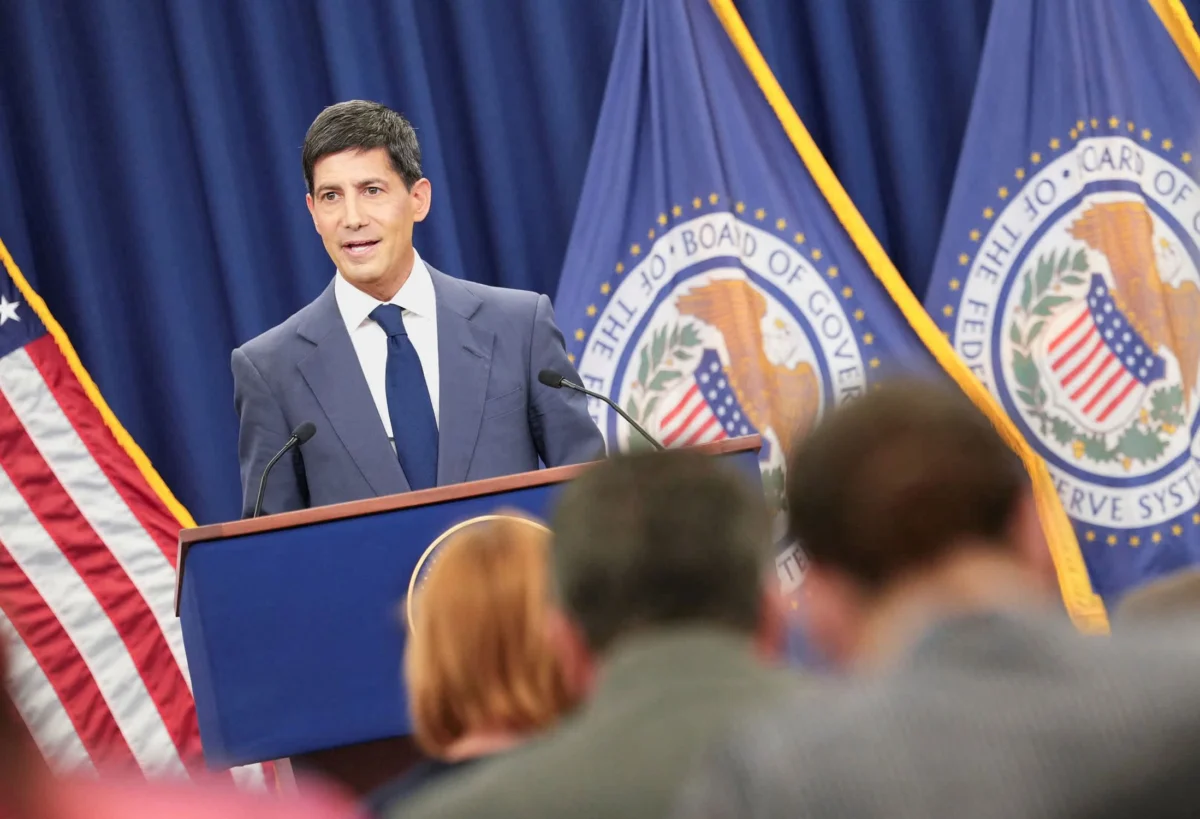
The U.S. Federal Reserve, under the nascent leadership of Chairman Kevin Warsh, signaled a profound shift in its communication strategy following the Federal Open Market Committee’s (FOMC) two-day policy meeting concluding on June 17, 2026. Warsh’s inaugural press conference and the accompanying FOMC statement unveiled a stark departure from the detailed, prescriptive language that characterized the central bank’s public pronouncements for over a decade, most notably during the tenure of his predecessor, Jerome Powell. The brevity and simplicity of the new statement immediately sparked extensive analysis among market participants, economists, and policymakers, heralding what many observers are calling a fundamental "regime change" in how the Fed engages with the public and financial markets.
A New Chairman’s Mandate: Simplicity and Clarity
Kevin Warsh, a former Federal Reserve Governor and a widely respected voice in economic policy circles, assumed the chairmanship with a clear mandate to re-evaluate and reform the central bank’s operational framework, particularly its communication protocols. Prior to his appointment, Warsh had been an outspoken critic of what he perceived as the Fed’s overly complex and often counterproductive reliance on extensive forward guidance and detailed economic projections. He argued that such an approach could inadvertently lead to policy errors, create undue market dependency on the Fed’s pronouncements, and potentially entangle the central bank in areas beyond its core mandate. His vision championed a return to a more concise, factual, and less prescriptive style of communication, allowing for greater policy flexibility and reducing the potential for misinterpretation by financial actors.
The June 17, 2026, FOMC statement, released after the committee’s deliberations, served as the definitive first step in implementing this new philosophy. Clocking in at approximately 130 words, it represented a dramatic reduction from the statements issued in recent meetings, which frequently exceeded 300 words. This deliberate curtailment was not merely a stylistic choice but a strategic recalibration, as Warsh himself acknowledged during his maiden press conference as chair. "It’s a bit shorter, a bit simpler and it dispenses with some older language," Warsh stated, emphasizing that "that statement just gives you the facts, as best we can judge it." This commitment to providing "just the facts" underscored a desire to strip away layers of interpretive language and focus solely on the immediate policy decision and the committee’s core assessment.
The Evolution of Fed Communication: A Brief Chronology
The Federal Reserve’s communication strategy has undergone significant evolution over its history, often in response to changing economic conditions and policy challenges.
- Pre-Greenspan Era (Pre-1987): FOMC statements were virtually non-existent or highly secretive. Policy shifts were often inferred from market operations or brief, opaque announcements.
- Greenspan Era (1987-2006): Alan Greenspan, while famously enigmatic, gradually introduced more public communication, including the release of FOMC statements after each meeting, though these were initially brief and focused primarily on the federal funds rate target.
- Bernanke Era (2006-2014): In the wake of the 2008 financial crisis and subsequent recession, Ben Bernanke’s Fed dramatically expanded its communication toolkit. This included explicit forward guidance (e.g., "exceptionally low for an extended period," calendar-based guidance, threshold-based guidance), quarterly Summary of Economic Projections (SEP) with "dot plots" indicating individual members’ interest rate forecasts, and regular press conferences after most FOMC meetings. The aim was to enhance transparency, manage expectations, and provide additional stimulus through communication when the federal funds rate was at the zero lower bound.
- Yellen Era (2014-2018): Janet Yellen continued and refined the enhanced communication strategy, further emphasizing clarity and predictability, particularly as the Fed began to normalize monetary policy.
- Powell Era (2018-2026): Jerome Powell’s chairmanship maintained the robust communication framework, albeit with some adjustments. His tenure saw continued detailed statements, regular press conferences, and the use of forward guidance to navigate periods of low inflation, the COVID-19 pandemic, and subsequent inflationary pressures. The average length of FOMC statements during this period often exceeded 300 words, providing detailed assessments of economic conditions, inflation outlooks, and potential future policy paths.
Leading up to Warsh’s first meeting, market analysts had widely anticipated a shift, though the extent of the change remained a subject of intense speculation. A CNBC Fed survey conducted earlier in June 2026 had indicated that while no immediate change to interest rates was expected, a significant retooling of the Fed’s communication was a distinct possibility. The committee’s unanimous decision to keep the federal funds rate unchanged was, therefore, less of a surprise than the manner in which it was communicated.
Dissecting the Abbreviated Statement: Key Removals and Refinements
The comparison between Wednesday’s statement and the one issued after the Fed’s previous policymaking meeting in April revealed several critical omissions and subtle yet significant refinements:
-
Elimination of Forward Guidance: Perhaps the most impactful change was the complete absence of any explicit forward guidance regarding the future path of monetary policy. Previous statements frequently contained phrases that hinted at the committee’s outlook for interest rates, asset purchases, or the conditions under which policy might change. Warsh explicitly stated that forward guidance was "not well suited for the current policy conjuncture." This suggests a belief that the economy has reached a point where such explicit hints are no longer necessary or, worse, might constrain the Fed’s ability to respond agilely to evolving data. The argument against forward guidance often centers on its potential to create "cliff effects" when conditions change, or to overpromise future policy, thereby reducing the central bank’s flexibility.
-
Removal of Individual Voting Records: Under former Chairman Jerome Powell, FOMC statements concluded with a detailed breakdown of how each committee member voted on the policy decision, noting any dissents. The June 17 statement, however, indicated only that there was a unanimous vote on the decision, omitting the individual names and their respective stances. While a unanimous vote itself simplifies the message, the removal of individual records could be interpreted in multiple ways. Some analysts suggest it fosters a stronger sense of committee cohesion and speaks with a single voice. Others might argue it reduces transparency by obscuring potential internal disagreements or differing economic views among members, which previously offered valuable insights into the breadth of thinking within the Fed.
-
Less "Color" on Inflation Trends: The latest statement contained significantly less detailed commentary on the Fed’s view of current inflation trends and its projected trajectory. Previous statements often delved into specific inflation metrics, the factors influencing them, and the committee’s confidence in reaching its 2% target. While the new statement affirmed the Fed’s commitment to stable prices, the reduced "color" means markets will have fewer explicit cues regarding the committee’s nuanced assessment of inflationary pressures. This could necessitate greater reliance on other data points and Warsh’s subsequent speeches for insights into the Fed’s inflation outlook.
-
Succinct Economic Characterization: The statement offered only a "cursory characterization of the economy as ‘expanding at a solid pace.’" This minimalist description stands in stark contrast to the more elaborate economic narratives often found in past statements, which might have detailed labor market conditions, consumer spending, business investment, and global economic headwinds. By boiling down the economic assessment to such a fundamental observation, the Fed aims to provide a clear, undeniable fact rather than a comprehensive, potentially debatable analysis.
Expert Reactions and Market Implications
The financial community reacted swiftly to the dramatic changes. David Wessel, a senior fellow at Brookings and a seasoned Fed observer, commented on CNBC’s "Power Lunch," "What Kevin Warsh is trying to do with this statement is not use the statement to give forward guidance, and I think he did a pretty good job with that." This sentiment highlighted Warsh’s success in immediately implementing his stated objective.
Ian Lyngen, Head of U.S. Rates Strategy at BMO, succinctly captured the prevailing mood, stating, "Warsh’s first FOMC statement left the clear impression that there is a new chair in town." He further elaborated that the statement was "significantly shortened – eliminating the forward guidance," and noted its "only a cursory characterization of the economy as ‘expanding at a solid pace.’"
Analysts from various financial institutions echoed these observations. Sarah Jenkins, Chief Global Strategist at Zenith Financial Group, noted, "This is a bold move by Chairman Warsh. It signals a clear break from the era of hyper-transparency, potentially forcing markets to focus more on underlying economic data rather than parsing every syllable from the Fed." She cautioned, however, that "while it simplifies the message, it could introduce a period of increased market volatility as participants adjust to less explicit guidance, particularly regarding interest rate expectations."
Conversely, some economists suggested this approach could restore greater agility to monetary policy. Dr. Michael Chen, a macroeconomist at the Institute for Economic Policy, observed, "By removing explicit forward guidance, the Fed regains maximum flexibility. It can now respond to evolving economic data without being perceived as backtracking on prior commitments. This might lead to fewer ‘dovish’ or ‘hawkish’ labels being prematurely affixed to the committee."
The immediate market reaction was mixed. Equity markets showed minor fluctuations, as the decision to hold rates steady was widely expected. However, the bond market saw some discernible movements. Treasury yields initially edged higher, perhaps reflecting the market’s attempt to price in a future with less predictable Fed action. The U.S. dollar strengthened slightly against a basket of major currencies, possibly indicating a perception of a more resolute and less dovish Fed under Warsh.
Broader Impact and Future Outlook
The implications of Warsh’s communication overhaul extend far beyond the immediate market response.
- Enhanced Policy Flexibility: By shedding the constraints of explicit forward guidance, the Fed under Warsh appears to be prioritizing its ability to react swiftly and decisively to economic developments. This could mean more nimble adjustments to monetary policy in the future, unburdened by past pronouncements.
- Shift in Market Interpretation: Financial market participants, accustomed to meticulously dissecting every word of FOMC statements, will now need to adapt their analytical frameworks. Greater emphasis may be placed on the nuances of Warsh’s press conferences, individual speeches by FOMC members (assuming they retain their individuality in communication), and underlying economic data. This could lead to a period of readjustment and potentially higher volatility as markets learn to interpret the Fed’s intentions through a new lens.
- Transparency vs. Simplicity Debate: Warsh’s approach reignites the long-standing debate within central banking regarding the optimal balance between transparency and simplicity. While detailed communication aims to reduce uncertainty, Warsh’s philosophy suggests that over-communication can create its own form of uncertainty and market dependency. The new era will test whether a simpler, more factual approach ultimately leads to greater clarity or less.
- Influence on Global Central Banks: The Federal Reserve often sets a precedent for other major central banks around the world. Should Warsh’s communication strategy prove effective in achieving the Fed’s dual mandate, it could prompt other institutions like the European Central Bank, the Bank of England, or the Bank of Japan to reconsider their own communication strategies, potentially leading to a global trend towards more concise central bank messaging.
- Role of the Chairman: With less explicit guidance in the statement, the chairman’s press conferences and subsequent speeches may gain even greater importance as primary vehicles for conveying the Fed’s economic outlook and policy intentions. This places a significant burden on Warsh to articulate the committee’s views clearly and consistently without falling back into the pitfalls he criticized.
As the financial world adjusts to this new communication paradigm, all eyes will remain on Chairman Warsh and the FOMC. His first statement has undeniably carved out a distinct path for the Federal Reserve, setting the stage for an era defined by a renewed focus on fundamental principles, policy flexibility, and a streamlined approach to central bank communication. The success of this "regime change" will ultimately be judged by its impact on economic stability and the Fed’s ability to effectively achieve its mandated goals in the years to come.
