

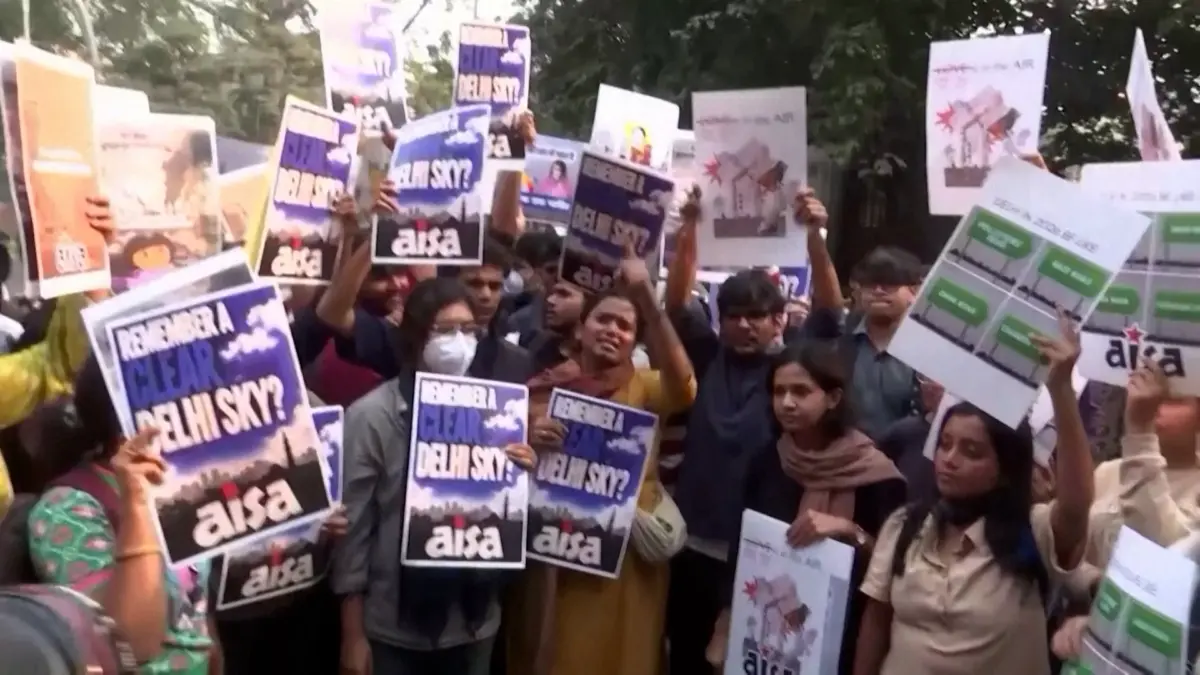
Thousands of students and youth activists have taken to the streets of New Delhi to demand immediate and systemic accountability from federal and local authorities as a thick, hazardous blanket of smog continues to envelop the National Capital Region (NCR). The demonstrations, which gained significant momentum on November 16, 2026, come in the wake of international reports ranking New Delhi as the world’s most polluted city for several consecutive days. The air quality, which traditionally worsens during the autumn months, saw a catastrophic decline following the Diwali festival, leaving residents gasping for breath and prompting a public health emergency.
The protesters, largely comprised of university students and high school environmental clubs, marched toward the Ministry of Environment, Forest and Climate Change, carrying placards that read "Right to Breathe" and "Our Lungs Are Not Filters." The movement represents a growing frustration among the younger generation who view the annual "gas chamber" conditions of the city not as an inevitable seasonal occurrence, but as a failure of governance and urban planning.
The Chronology of a Developing Crisis
The current environmental crisis did not emerge in a vacuum but followed a predictable and devastating timeline. By late October 2026, air quality indices (AQI) in New Delhi were already hovering in the "Poor" to "Very Poor" categories, driven by the cooling temperatures and a reduction in wind speeds that typically trap pollutants near the ground—a meteorological phenomenon known as thermal inversion.
On the eve of Diwali, despite stringent bans on the sale and use of traditional firecrackers, widespread violations were reported across the NCR. By the morning following the festival, the concentration of PM2.5—fine particulate matter that can penetrate deep into the lungs and enter the bloodstream—surged to nearly 30 times the daily limit recommended by the World Health Organization (WHO).
By the second week of November, the situation was exacerbated by the seasonal practice of stubble burning in the neighboring states of Punjab and Haryana. Satellite data from early November indicated thousands of active farm fires, sending plumes of smoke directly into the Indo-Gangetic Plain. On November 14, New Delhi’s AQI crossed the 450 mark in several monitoring stations, placing it firmly in the "Severe Plus" category. This prompted the immediate implementation of Stage IV of the Graded Response Action Plan (GRAP), the highest level of emergency measures in the city’s pollution management protocol.
Statistical Overview and Public Health Data
The scale of the pollution crisis is underscored by harrowing data from both local and international monitoring bodies. According to the Central Pollution Control Board (CPCB), the average AQI in New Delhi for the first half of November 2026 has been the highest recorded in the last five years. PM2.5 levels have consistently remained above 400 micrograms per cubic meter in hotspots like Anand Vihar, Bawana, and Jahangirpuri.
Health statistics provided by major municipal hospitals indicate a 35% surge in respiratory-related emergency room visits since the beginning of the month. Pediatricians have noted a particularly alarming trend: children under the age of 12 are presenting with chronic bronchitis symptoms and reduced lung capacity, conditions usually reserved for lifelong smokers. A recent study by a coalition of environmental health researchers suggests that the current levels of air pollution in the city could be equivalent to smoking 20 to 25 cigarettes a day for every resident, including infants.
The economic impact is equally staggering. Preliminary reports from industry chambers suggest that the smog is resulting in a daily productivity loss of approximately $150 million due to health-related absenteeism and the forced closure of non-essential construction and industrial activities under GRAP mandates.
Demands for Accountability and Official Responses
The student-led protests are centered on a specific set of demands. Unlike previous years where the focus was on temporary relief, the 2026 demonstrators are calling for long-term structural changes. Their "Clean Air Manifesto" includes demands for a complete overhaul of the public transport system to reduce vehicular emissions, the permanent closure of coal-fired power plants within a 300-kilometer radius of the city, and the implementation of a massive, state-funded transition for farmers to move away from stubble burning through the provision of affordable harvesting machinery.
"We are tired of ’emergency measures’ that only kick in when we are already choking," said Aarav Mehta, a 21-year-old student leader from Delhi University. "Closing schools and stopping trucks is a band-aid on a bullet wound. We want a roadmap that ensures we don’t have to wear N95 masks inside our own homes every November."
In response to the protests and the worsening air quality, the Office of the Chief Minister of Delhi issued a statement acknowledging the severity of the situation while emphasizing the regional nature of the problem. "The Delhi government is doing everything within its jurisdiction, including the deployment of anti-smog guns and the implementation of the ‘Odd-Even’ vehicle rationing scheme. However, air pollution does not respect state borders. We require a unified, central-led intervention to address crop residue burning and industrial emissions in the NCR hinterland," the statement read.
Meanwhile, the Supreme Court of India has taken suo motu cognizance of the crisis, summoning the chief secretaries of Delhi, Punjab, Haryana, and Uttar Pradesh to explain the lack of progress in controlling farm fires and urban dust. The court criticized the "shifting of blame" between political parties, noting that the "right to a clean environment is a fundamental right under Article 21 of the Constitution."
The Science of the "Gas Chamber"
The unique geography of New Delhi plays a significant role in why the city suffers more than others during the winter months. Located in a landlocked basin, the city becomes a trap for pollutants when the Himalayan winds bring cold air that sits beneath a layer of warmer air. This prevents the vertical dispersion of smoke and dust.
Furthermore, the chemical composition of the smog in 2026 has shown an increase in secondary inorganic aerosols—particles formed by the reaction of gases like sulfur dioxide and nitrogen oxides. These gases, emitted primarily by heavy industries and the vast number of diesel vehicles still operating in the region, contribute to a denser, more persistent haze. Environmental scientists point out that while the number of electric vehicles (EVs) in the city has grown by 40% since 2024, the sheer volume of overall traffic and the continued reliance on heavy-duty diesel trucks for logistics continue to offset these gains.
Broader Implications and International Context
The crisis in New Delhi has drawn international attention, with the United Nations Environment Programme (UNEP) citing the city as a case study for the urgent need for "airshed management." The situation has also begun to affect India’s diplomatic and economic standing. Several multinational corporations with headquarters in Gurgaon and Noida have reportedly initiated "hardship" policies for expatriate staff, and some have even discussed relocating operations to cities with more stable climates, such as Bengaluru or Hyderabad.
Tourism, a vital sector for the capital, has seen a 20% decline in international arrivals for the November-December window. Travel advisories from several European and North American countries have warned citizens with underlying health conditions to avoid travel to Northern India during the "smog season."
The implications for the future are even more dire. Climate change is expected to make these atmospheric stagnation events more frequent and prolonged. As the planet warms, the traditional wind patterns that used to clear the smog are becoming more erratic, potentially extending the "pollution season" well into February.
Looking Ahead: A Winter of Discontent
As the city moves deeper into the winter of 2026, the outlook remains bleak. Meteorological departments have forecasted a "weak monsoon withdrawal" and a particularly cold December, conditions that are synonymous with high pollution retention.
The student protesters have vowed to continue their demonstrations until a "Binding Clean Air Act" is tabled in Parliament. They are calling for a non-partisan commission with the power to penalize states that fail to meet annual emission reduction targets.
The current situation in New Delhi serves as a grim reminder of the costs of rapid, unplanned urbanization and the delay in transitioning to a green economy. While the government focuses on immediate "Stage IV" restrictions—such as banning non-essential truck entry and halting all construction—the youth on the streets are making it clear that they will no longer accept a reality where the very act of breathing is a hazard.
The next few weeks will be a critical test for India’s environmental policy. With the Supreme Court’s oversight and the mounting pressure from a mobilized youth population, the authorities are under unprecedented scrutiny. Whether this leads to a fundamental shift in how the country manages its air quality, or remains another chapter in the annual cycle of seasonal outrage, remains to be seen. For now, New Delhi remains a city under siege, not by a foreign power, but by the very air that sustains it.
