

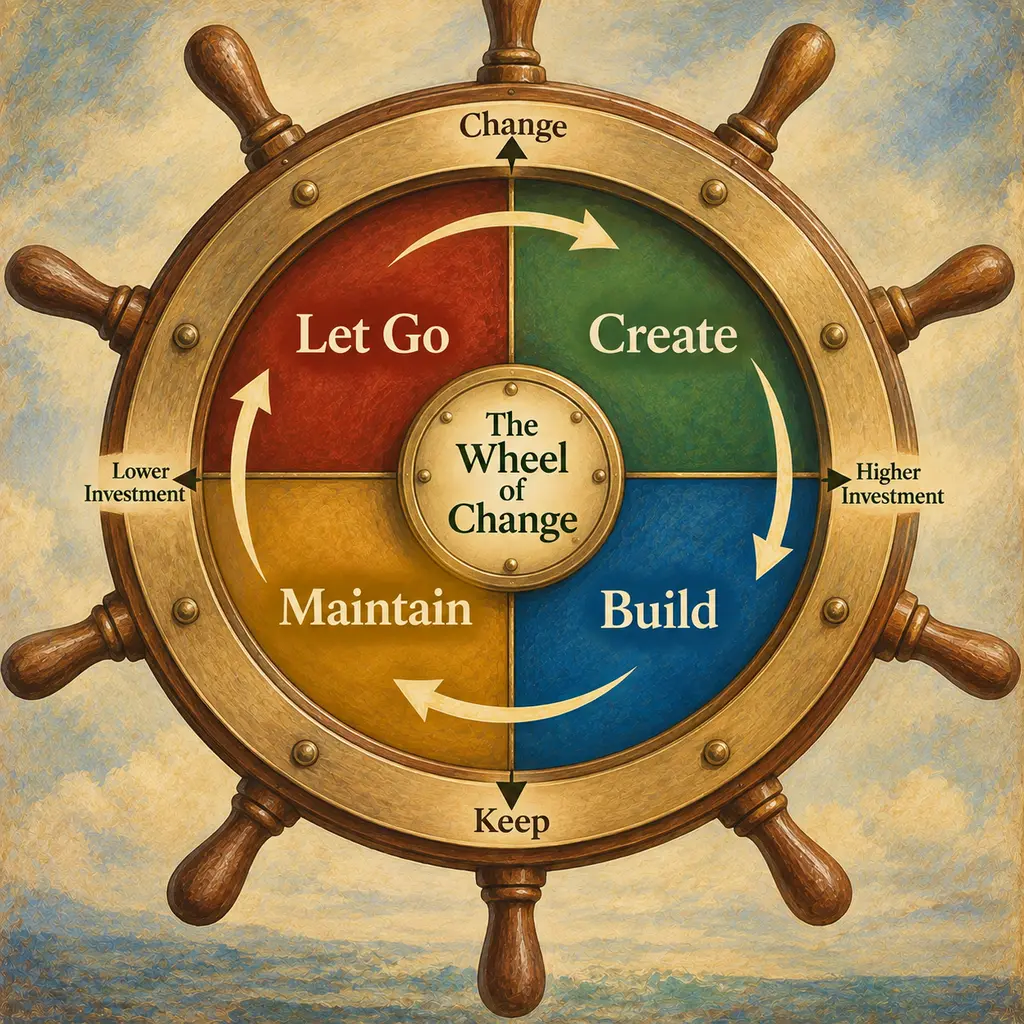
The relentless march of progress and the accelerating pace of change present a fundamental dilemma for organizational leaders: discerning which aspects of their operations require transformation, which must be preserved, and where to most effectively allocate precious resources. This strategic quandary often leads to a critical misalignment, where investments are disproportionately directed towards legacy systems and past successes, inadvertently starving nascent innovations and future growth opportunities. A robust framework, the "Wheel of Change," offers a compelling solution by categorizing organizational activities into four distinct quadrants, guiding leaders to make more informed and forward-looking resource allocation decisions.
The Wheel of Change: A Framework for Strategic Resource Allocation
Developed over years of observation and refined through seminal business literature, including insights from the bestseller Triggers, the Wheel of Change provides a powerful model for navigating the complexities of organizational evolution. It operates on two key dimensions: investment level, ranging from low to high, and the degree of change, from maintaining the status quo to radical transformation. These dimensions intersect to form four critical quadrants, each representing a unique leadership challenge and strategic imperative: Create, Build, Maintain, and Let Go.
Create: This quadrant embodies high change and high investment. It is the domain of initiating entirely new ventures—be it a groundbreaking product, a disruptive technology, an untapped market, a novel capability, or a paradigm-shifting business model. Creation is inherently experimental; it demands courage, significant resources, and an acceptance of uncertainty. There is no immediate guarantee of success, and these initiatives are unlikely to contribute to immediate financial targets. However, "Create" is indispensable for future relevance and long-term viability. It represents the seedbed of future growth, requiring leaders to foster an environment where bold ideas can take root and flourish, even when their ultimate impact is yet to be proven.
Build: Characterized by high investment and a focus on scaling existing successes, "Build" represents the maturation of initiatives that have moved beyond the experimental phase. Once an idea has demonstrated its potential, the focus shifts from "Can this work?" to "How big can this become?" This quadrant involves substantial investment in people, robust systems, expansive distribution networks, advanced technology, and critical infrastructure. The goal is to amplify what is already functioning well, transforming promising ventures into significant revenue streams and market leaders. This phase requires strategic foresight to anticipate future demand and operational excellence to execute at scale.
Maintain: Occupying the space of lower change and typically lower incremental investment, "Maintain" focuses on preserving the core assets and functions that underpin an organization’s current success. This is not about stagnation or neglect. Many foundational elements of a thriving enterprise, such as strong brand equity, a cohesive organizational culture, deep-rooted customer relationships, and proven business models, require diligent stewardship over extended periods. The challenge here lies in differentiating between necessary preservation and complacency, ensuring that the valuable aspects of the organization are protected without mistaking them for the entirety of future progress. Effective maintenance ensures operational stability and protects existing value.
Let Go: This quadrant combines a significant degree of change with lower investment. It addresses elements that, while perhaps once valuable, have become obsolete or are no longer aligned with future strategic objectives. This could encompass products, business units, processes, technologies, physical office spaces, recurring meetings, or deeply ingrained traditions. The stark reality is that many offerings that were successful yesterday will inevitably become irrelevant tomorrow. "Let Go" requires a dispassionate assessment of an organization’s portfolio and the courage to divest from or dismantle what no longer serves the future. This often involves difficult decisions, but it is crucial for freeing up resources and mental bandwidth for more promising endeavors.
The CEO’s Strategic Imperative: Navigating the Dynamic Wheel
The true power of the Wheel of Change becomes profoundly evident when leaders recognize that a corporation is rarely static, operating solely within one quadrant. Instead, a dynamic organization is simultaneously engaged in activities across all four. A nascent technology startup might be heavily focused on "Create," while a mature tech giant could be simultaneously "Building" its cloud services, "Maintaining" its legacy software, and strategically "Letting Go" of unprofitable hardware divisions.
This multi-quadrant reality places resource allocation at the forefront of the CEO’s challenges. The fundamental question becomes: how can leaders ensure that capital, talent, and attention are distributed strategically to optimize for both current performance and future potential?
The Persistent Pitfall: Funding the Past, Starving the Future
A common and detrimental organizational tendency is to allocate resources based on historical precedent rather than future opportunity. Mature businesses, having consistently delivered returns, often continue to receive substantial funding simply because they have always been funded. Legacy activities, bolstered by years of investment and often deeply embedded in organizational inertia, persist due to emotional attachment or a fear of disrupting established routines.

Conversely, promising new ideas, particularly those in the "Create" quadrant, are frequently starved of essential resources. Their results are not yet proven, their market impact is speculative, and they may not align with short-term performance metrics. This bias towards the familiar and the proven creates a self-perpetuating cycle where the past is perpetually reinforced, while the future remains underfunded and underdeveloped.
The Four Questions to Realign Investment with Opportunity
The Wheel of Change provides a simple yet potent mechanism to challenge this ingrained tendency and reorient investment strategies. By systematically applying four critical questions to all facets of the organization—products, services, technologies, processes, and even established organizational practices—leaders can gain clarity and drive more effective decision-making.
The questions are direct and demand honest introspection:
- What should we create? This prompts a forward-looking exploration of unmet needs, emerging trends, and untapped potential. It encourages the identification of entirely new ventures that could define the company’s future.
- What should we build? This question focuses on scaling and expanding successful initiatives that have demonstrated viability. It calls for strategic investment to maximize growth and market penetration.
- What should we maintain? This directs attention to the critical assets and functions that require careful stewardship to preserve their value and ensure ongoing operational stability.
- What should we let go? This is often the most challenging question, requiring leaders to identify and divest from activities, products, or processes that are no longer relevant or that drain resources without future promise.
Following these four diagnostic questions, a fifth, more difficult question must be posed: Does our current investment allocation accurately reflect our answers to these questions? This final query is the lynchpin, forcing a direct confrontation between strategic intent and financial reality. It compels leaders to scrutinize their budgets, project portfolios, and human capital allocations, identifying discrepancies and making the necessary adjustments to align resources with strategic priorities.
Implications for Organizational Agility and Long-Term Success
The cyclical nature of the Wheel of Change underscores the dynamic reality of business strategy. What is created today may need to be built tomorrow. What is built and maintained successfully for years might eventually reach a point where it must be let go to make way for new innovations. This continuous evolution necessitates a leadership approach that is both strategic and adaptable.
Great leadership, therefore, is not about enacting wholesale, constant change, nor is it about rigidly preserving the status quo. Instead, it is about cultivating the wisdom and courage to accurately assess where an organization resides on the Wheel of Change at any given moment. It requires understanding the unique demands of each quadrant and having the foresight to make timely and appropriate decisions regarding resource allocation.
The adoption of such a framework can have profound implications. Organizations that effectively implement the Wheel of Change are likely to experience:
- Enhanced Innovation: By consciously dedicating resources to "Create," companies foster a culture of innovation, leading to the development of groundbreaking products and services that drive future growth.
- Optimized Resource Utilization: A clear understanding of where resources are most effectively deployed prevents the waste of capital and talent on declining or obsolete ventures, directing them towards higher-return opportunities.
- Increased Agility: The framework promotes a more fluid and responsive organizational structure, capable of adapting to market shifts and technological advancements by strategically shifting focus between the quadrants.
- Improved Financial Performance: By aligning investment with strategic imperatives, companies can achieve a more sustainable and profitable growth trajectory, balancing short-term needs with long-term vision.
- Stronger Competitive Advantage: Organizations that master the art of navigating the Wheel of Change are better positioned to outmaneuver competitors, anticipate market trends, and secure a leading position in their respective industries.
In an era defined by volatility and disruption, the ability of an organization to strategically manage its evolution is paramount. The Wheel of Change offers a clear, actionable, and enduring model for leaders to ensure their organizations are not merely surviving but thriving by investing wisely in the future, rather than perpetually funding the past. The journey from creation to obsolescence, and back to creation, is continuous, and mastering this cycle is the hallmark of enduring organizational success.
