

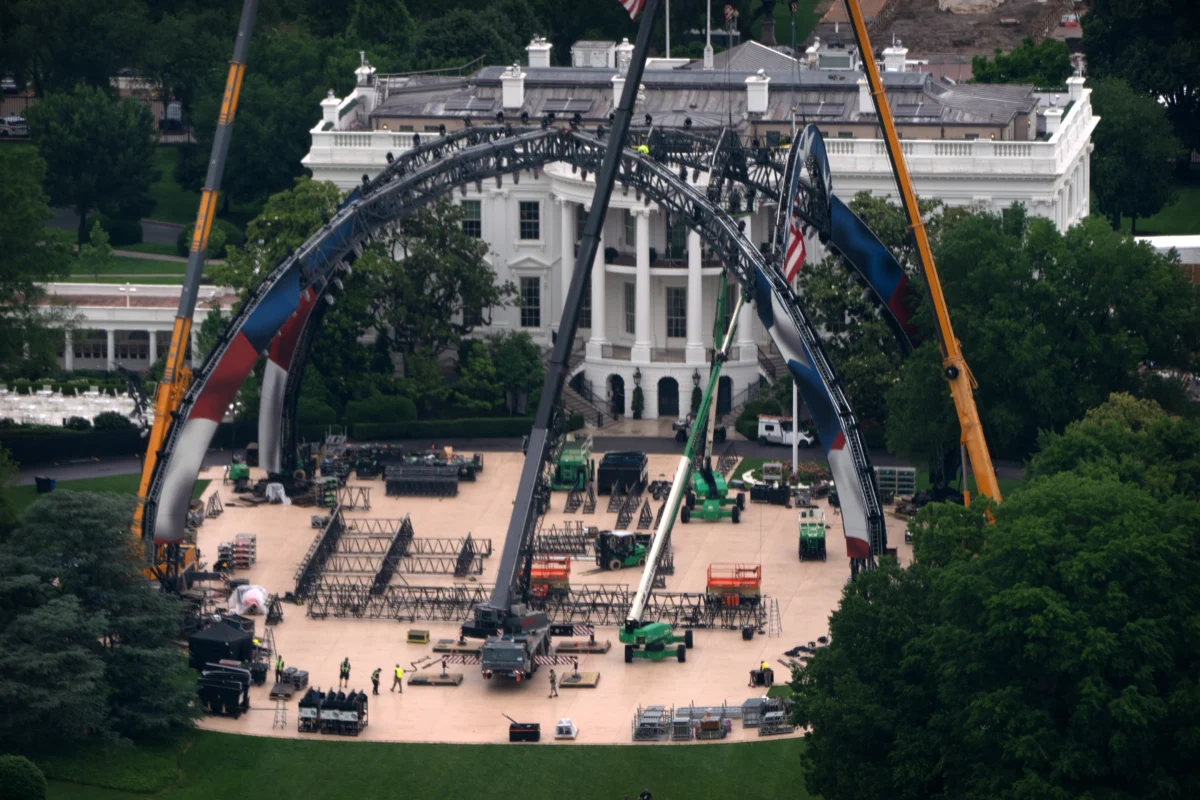
In an unprecedented fusion of high-stakes combat sports, national commemoration, and presidential milestone, the South Lawn of the White House is undergoing a remarkable transformation. Crews are meticulously constructing a temporary, octagon-shaped arena, poised to host an Ultimate Fighting Championship (UFC) bout next month. This historic event, scheduled for June 14, 2026, will serve a dual purpose: celebrating the 250th anniversary of the United States and marking President Donald Trump’s 80th birthday.
A Historic Setting for Combat Sports
The temporary structure is far from a modest setup. Online renderings and on-site observations depict a grand, wire-mesh-fence-ringed fight space that promises to be a visual spectacle. Central to the design is a red, white, and blue stage, crowned by a towering arch adorned with stars-and-stripes patterns. Two large screens will flank the stage, ensuring live, unobstructed views of the action for a wide audience. Surrounding this central fighting stage, thousands of temporary seats are being erected, designed to accommodate an estimated 5,000 spectators directly outside the White House’s front door. Notably, ringside space has been allocated for a full marching band, poised to punctuate the evening with blaring musical accompaniment, adding a distinctly ceremonial flair to the typically raucous atmosphere of a UFC event. This intricate construction project began in late May, with equipment being moved onto the South Lawn, setting the stage for what promises to be one of the most unique events in the White House’s history.
America 250: A Nation’s Milestone
The UFC bout is but one marquee event in a sprawling series of celebrations commemorating the semiquincentennial of the Declaration of Independence’s signing on July 4, 1776. The "America 250" initiative, a nationwide endeavor, aims to engage all Americans in recognizing a quarter-millennium of national history, resilience, and progress. The official America250 Commission, established by Congress, coordinates diverse programs ranging from educational initiatives and historical exhibitions to large-scale public events.
Beyond the combat sports spectacle, other high-profile functions are planned to mark this significant anniversary. An IndyCar race is slated to traverse the streets of Washington D.C., with a route specifically designed to pass by the White House, offering another dynamic display of American ingenuity and speed against a backdrop of iconic national landmarks. Concurrently, the National Mall will be transformed into the site of the "Great American State Fair," a multi-day festival intended to showcase regional cultures, innovations, and achievements from across the fifty states. These events collectively aim to foster a sense of national unity and pride, highlighting the diverse fabric of American identity and its enduring spirit. The decision to integrate a UFC event into these traditionally more staid celebrations underscores a contemporary approach to national commemoration, seeking to appeal to a broader demographic through popular culture.
The Intersection of Sport and State
The choice of the UFC as a centerpiece for such a momentous occasion reflects the growing mainstream appeal of mixed martial arts and its particularly strong ties to President Donald Trump. The President has long been an ardent supporter of the UFC, frequently attending its events and hosting prominent fighters at the White House during his previous term. This relationship is notably reciprocal, with UFC President Dana White and several high-profile fighters openly endorsing Trump. The organization’s journey from a niche, often controversial, combat sport to a global entertainment juggernaut is a testament to its aggressive marketing and the charismatic leadership of figures like White. Its inclusion in a national celebration at the White House symbolizes a definitive shift in its public perception and its integration into the broader American cultural landscape.
Historically, the White House South Lawn has hosted a variety of events, from Easter Egg Rolls and state dinners to concerts and sporting demonstrations, but never a full-fledged professional combat sports competition. This event, therefore, establishes a new precedent, blending the gravitas of the nation’s highest office with the raw energy of professional fighting. This move is seen by supporters as a bold, populist gesture that connects with a significant segment of the American public, while critics may view it as an unconventional, perhaps even undignified, use of the historic venue.
The Unveiling of the Fight Card
Despite the grandeur of the venue, the fight card itself has generated a mixed reaction, with many online fans panning it as "underwhelming." The main event features two championship fights, though both are for interim titles, which often carry less weight in the eyes of hardcore fans compared to undisputed championships. In the interim UFC heavyweight title bout, Brazil’s Alex Pereira is scheduled to face France’s Ciryl Gane. Pereira, a former kickboxing champion, is known for his devastating striking power, having rapidly ascended the UFC ranks. Gane, a former interim champion himself, boasts exceptional athleticism and technical striking for a heavyweight. While a compelling matchup, some fans expressed disappointment that a full, undisputed heavyweight title fight was not secured for such a landmark event.
The co-main event will see Spanish-Georgian lightweight champion Ilia Topuria take on interim lightweight champion Justin Gaethje. Topuria, an undefeated phenom, has quickly established himself as one of the most exciting prospects in the sport, known for his aggressive style and finishing ability. Gaethje, a fan-favorite known for his relentless pressure and thrilling fights, is one of only two Americans currently holding even a share of the UFC’s eleven championship belts. The scarcity of American champions on the card, particularly for an event celebrating the nation’s anniversary, has been a point of contention among some domestic fans who might have hoped for more homegrown talent in the spotlight. The perceived lack of major undisputed titles or more widely recognized American superstars has led to a sense that the card, while featuring talented fighters, might not fully live up to the monumental scale of its setting.
Logistics and Grand Scale Ticketing
The logistics of hosting an event of this magnitude at the White House are formidable. Beyond the 5,000 seats on the South Lawn, additional large screens broadcasting the fights live will be set up in a park at the nearby Ellipse, a public park just south of the White House. The UFC has announced plans to issue as many as 85,000 free tickets to accommodate spectators across both locations. This massive ticket distribution program underscores the event’s ambition to be accessible to a wide public audience, transforming the immediate vicinity of the Executive Mansion into a sprawling festival ground.
President Trump has frequently commented on the extraordinary demand for these tickets, stating, “I have never seen anybody want anything so much as people want those tickets.” He added with characteristic enthusiasm, “That’s gonna be something.” The distribution of free tickets, while democratic, presents significant operational challenges, including managing crowd flow, ensuring equitable access, and mitigating potential scalping. The sheer volume of anticipated attendees necessitates meticulous planning for ingress, egress, and emergency protocols in one of the most secure and historically sensitive locations in the nation.

Security and Operational Considerations
Hosting a mass-attendance event like a UFC fight at the White House presents an unprecedented array of security and operational challenges. The United States Secret Service, responsible for presidential protection and the security of the White House complex, will undoubtedly implement a multi-layered security perimeter far exceeding typical public events. This will involve extensive screening protocols for all attendees, potentially including magnetometers, bag checks, and strict prohibitions on certain items. Given the nature of a combat sports event, crowd control and emergency response planning will be paramount.
Furthermore, the temporary construction itself must adhere to stringent safety and structural integrity standards, overseen by federal agencies. The coordination required between the UFC’s production teams, the Secret Service, National Park Service (which manages the Ellipse), and various D.C. municipal agencies will be immense. Road closures, public transportation adjustments, and increased law enforcement presence will be necessary to manage the influx of tens of thousands of people into the heart of the nation’s capital. The logistical feat of erecting and then dismantling such a complex arena structure within a tight timeframe, all while maintaining the dignity and security of the presidential residence, is a testament to the scale of this undertaking.
A Presidential Legacy: White House Transformations
The temporary UFC arena is but the latest project in what observers have dubbed President Trump’s "White House building boom." Throughout his tenure, the President has embarked on a series of significant renovations and proposed architectural changes, aiming to leave a distinct mark on the Executive Mansion and its surrounding grounds.
One notable project involved tearing up part of the historic Rose Garden to make room for a patio space. The Rose Garden, established in 1913 by Edith Wilson and famously redesigned by Jackie Kennedy in the 1960s, holds deep historical and symbolic significance, often serving as a backdrop for important presidential announcements and ceremonies. The addition of a patio, reportedly reminiscent of his Mar-a-Lago estate in Florida, represented a personalized alteration to a cherished national landmark.
Other efforts include affixing partisan plaques to the wall of the colonnade for a "Presidential Walk of Fame," a novel concept that has drawn both praise and criticism for its departure from traditional White House decorum. Inside the residence, renovations have included redoing the toilet attached to the Lincoln Bedroom, a room steeped in history and frequently used for distinguished guests, and renovating the Palm Room. Externally, new flagpoles have been placed on both the north and south lawns, adding to the ceremonial aesthetic.
Perhaps the most ambitious and controversial of these proposed changes is the demolition of the entire East Wing to make way for a sprawling ballroom. The East Wing, constructed in 1942 to provide additional office space and a bomb shelter, also houses the White House theater and visitor’s entrance. Its potential demolition and replacement with a grand ballroom represents a significant alteration to the White House’s historical footprint and functional layout, raising questions about preservation versus modernization.
Beyond the immediate White House complex, President Trump has also expressed a desire to repaint the Eisenhower Executive Office Building, a stately structure adjacent to the White House that houses many presidential staff. Furthermore, he has proposed the construction of a 250-foot (76-meter) arch at the nearby Lincoln Memorial. This proposed architectural addition at one of the nation’s most revered monuments would be a monumental undertaking, potentially altering the iconic landscape of the National Mall. Significantly, the Lincoln Memorial itself is scheduled to host the weigh-ins for the upcoming UFC fight, further intertwining these distinct presidential initiatives with the national anniversary celebrations.
A Timeline of Preparation and Celebration
The journey to this unprecedented event has unfolded over several months.
- Late 2025/Early 2026: Initial discussions and planning for "America 250" celebrations, with President Trump’s vision for unique, high-profile events taking shape. The idea of a White House UFC bout is floated and gains momentum.
- October 6, 2025: A specific mention from President Trump about staging the UFC fight on his 80th birthday.
- Early Spring 2026: Detailed logistical planning begins in earnest, involving the UFC, the Secret Service, the National Park Service, and various government agencies. Renderings of the proposed arena are circulated.
- May 26, 2026: Equipment and construction crews are observed beginning work on the South Lawn, marking the visible commencement of the temporary arena’s construction.
- Late May/Early June 2026: Intensive construction phase, with the temporary seating, stage, and octagon taking shape. Ticket distribution logistics are finalized.
- June 13, 2026: Official weigh-ins for the fighters are scheduled to take place at the Lincoln Memorial, offering a public preview of the athletes and adding another layer of historical resonance to the event.
- June 14, 2026: The historic UFC bout takes place on the South Lawn of the White House, marking the nation’s 250th anniversary and President Donald Trump’s 80th birthday.
- Post-June 14, 2026: Rapid dismantling of the temporary structures, returning the South Lawn to its customary state.
- Throughout 2026: Continuation of other "America 250" events, including the IndyCar race and the Great American State Fair.
Broader Implications and Public Discourse
The decision to host a UFC fight at the White House carries significant broader implications. It challenges traditional notions of presidential decorum and the appropriate use of historical landmarks. For some, it represents a refreshing and accessible way to engage the public in national celebrations, particularly appealing to younger demographics and fans of combat sports. It aligns with a populist political strategy, showcasing a president willing to break from convention and connect with constituents through popular entertainment.
Conversely, critics may raise concerns about the commercialization of the White House, the potential for political messaging to overshadow historical commemoration, and the perceived incongruity of a violent sport being staged at a symbol of national unity and peace. Historians and preservationists may also weigh in on the impact of such events on the integrity and symbolic value of the White House grounds. The immense security and logistical demands also prompt questions about resource allocation and public safety.
Ultimately, this unprecedented event will serve as a fascinating case study in the evolving relationship between politics, popular culture, and national identity in the 21st century. It will undoubtedly spark extensive public discourse on the boundaries of presidential events, the role of sports in national life, and how a nation chooses to celebrate its enduring legacy while embracing contemporary forms of entertainment. The White House, a bastion of tradition, is set to host an event that is anything but traditional, ensuring its place in the annals of both sports and presidential history.
