

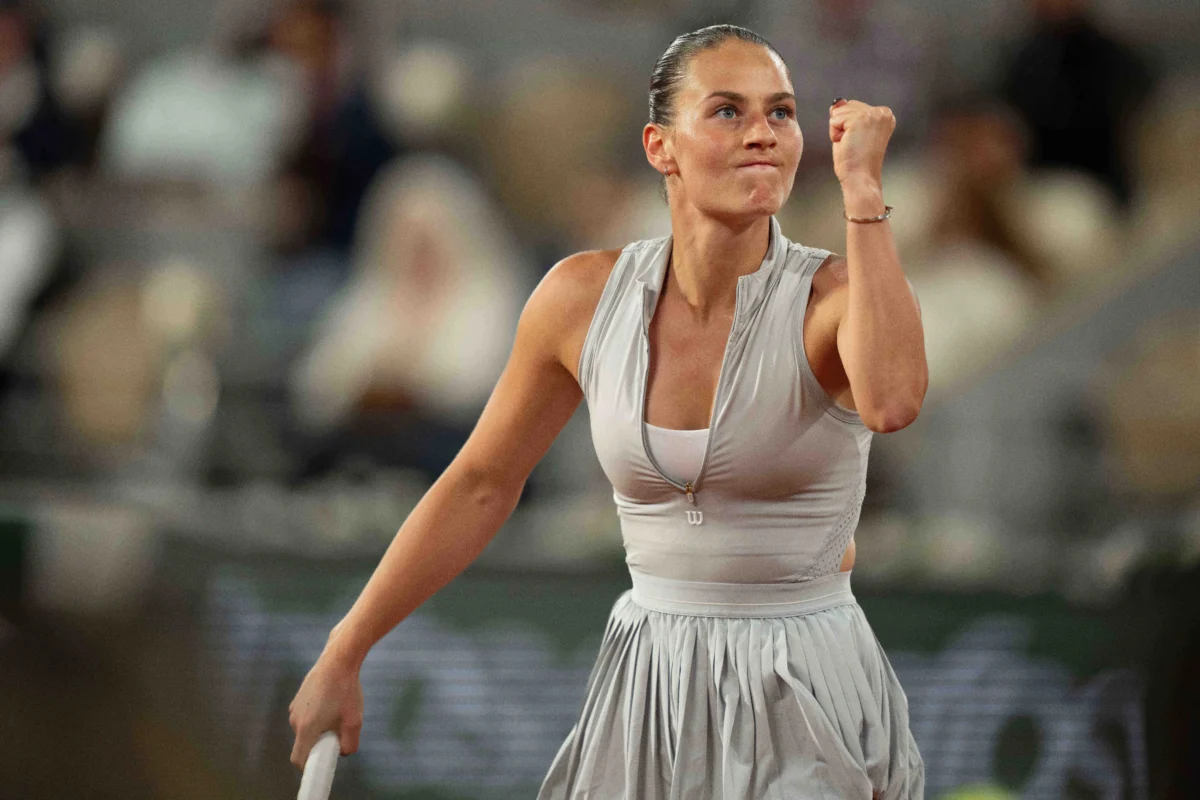
Marta Kostyuk, the 23-year-old Ukrainian tennis sensation, has carved her path into her maiden Grand Slam semifinal at the French Open, a career-defining achievement that unfolded amidst profound emotional and geopolitical currents. Her hard-fought victory over compatriot Elina Svitolina, a seasoned veteran and former world No. 3, was not merely a testament to her athletic prowess but also served as a poignant platform for a scathing critique of Russian players, whom she accused of deliberate silence regarding the ongoing conflict in Ukraine. The quarterfinal match, played on Tuesday at Roland Garros, resonated with a heightened sense of urgency, coming just hours after the Ukrainian capital, Kyiv, endured yet another night of devastating Russian missile strikes.
A Battle On and Off the Court: Kostyuk’s Semifinal Berth
The encounter between Kostyuk and Svitolina was an emotionally charged affair, showcasing both fierce competition and a shared national anguish. Kostyuk ultimately prevailed with a scoreline of 6-3, 2-6, 6-2, demonstrating resilience and tactical acumen against a formidable opponent. For Kostyuk, this breakthrough into the final four of a major tournament marks a significant milestone in her burgeoning career, surpassing her previous best Grand Slam performance. Her journey through the tournament has been marked by a determined focus, but the backdrop of the war has undeniably infused her performances with a deeper meaning. The gravity of representing a nation under siege was palpable in her post-match sentiments, where she dedicated her triumph to "the Ukrainian people," a gesture that underscored the profound personal sacrifice and national pride intertwined with her athletic pursuits.
The match itself was a microcosm of the challenges faced by Ukrainian athletes on the international stage. Competing at the highest level of professional sport requires immense mental fortitude, yet for Kostyuk and Svitolina, this focus is continually tested by the devastating realities unfolding thousands of miles away. Kostyuk revealed that she had woken up to news of the deadly bombings in Kyiv, her immediate thoughts turning to the safety of her family before she even stepped onto the court. This constant shadow of conflict adds an unparalleled layer of psychological burden, transforming every match into not just a personal contest but a symbolic representation of national endurance.
The Scathing Accusation: "Whose Side They Are On"
Following her quarterfinal victory, Kostyuk utilized the global platform of the French Open press conference to launch a direct and unequivocal attack on Russian players. Her primary contention was that their sustained silence over the four years since the full-scale invasion began in February 2022 amounted to a tacit endorsement of their country’s actions. "After four years, I think they’ve made it very clear whose side they are on," Kostyuk asserted, her words carrying the weight of deep-seated frustration and moral indignation. She dismissed the argument that Russian athletes remain silent due to fear of repercussions at home, an excuse she no longer accepts.
Kostyuk’s comments were not a spur-of-the-moment outburst but a culmination of years of observing what she perceives as a collective evasion of responsibility. She highlighted the stark contrast between the devastating impact of the war on her country and the apparent detachment of many Russian athletes. Her remarks directly addressed previous statements from Russian players, including her upcoming semifinal opponent Mirra Andreeva and Diana Shnaider, who have reportedly claimed to focus solely on the "tennis ball" and eschew political discussions. Kostyuk vehemently challenged this narrative, stating, "They are all grown-ups. They know what they’re talking about. They know what’s going on. They have phones. They have Instagram. They have news." This statement underscored her belief that ignorance is not a plausible defense, implying that a conscious choice is being made to remain silent.
Challenging the Narrative of Reprisals
A cornerstone of Kostyuk’s argument against the "silence" of Russian players was her rejection of the notion that they are compelled to remain quiet due to potential reprisals from the Russian government. She offered a counter-narrative, citing individuals who have actively chosen to oppose the regime despite significant personal cost. "There is a way if you don’t agree," Kostyuk explained. "I know some people who have left Russia the moment the war began, who sold all their business, who left everything behind because they just don’t agree with what their country is doing to other people."
As a compelling example, Kostyuk pointed to fellow tennis player Daria Kasatkina. Kasatkina, who switched her allegiance from Russia to Australia last year, has been notably outspoken in her criticism of the war and has faced public scrutiny in Russia as a result. Kostyuk lauded Kasatkina for her courage, despite the pressure on her family in Russia, highlighting her as a model of defiance. Kostyuk further elaborated, "I don’t think she lives in Russia anyways, but the majority of players don’t live in Russia. There is nothing that’s stopping you if this is something you don’t believe in." This observation suggests that for many Russian players, their residency outside Russia mitigates the immediate threat of government reprisal, rendering the "fear" argument less credible in Kostyuk’s eyes.
The Unwavering Stance of Ukrainian Athletes
The sentiments expressed by Marta Kostyuk are not isolated but reflect a broader, deeply felt position among Ukrainian athletes across various sports. From the outset of the full-scale invasion, Ukrainian sports figures have consistently used their platforms to draw international attention to the war, advocate for their homeland, and challenge the participation of Russian and Belarusian athletes under any guise. For them, representing Ukraine has transcended mere athletic competition; it has become an act of patriotism and a desperate plea for international solidarity.
Kostyuk herself articulated this profound sense of duty, stating, "With everything that’s happening, for me being here is a real blessing, and I don’t think about winning. I’m here to represent Ukraine and to enjoy." This perspective highlights the immense psychological toll and the shifting priorities for athletes from a war-torn nation. The joy of competition is intertwined with a pervasive sense of national tragedy, making every serve, every volley, and every victory a small act of defiance and a testament to the resilience of their people. Elina Svitolina, alongside other prominent Ukrainian athletes like Lesia Tsurenko and Dayana Yastremska, has also consistently voiced similar concerns, frequently declining traditional handshakes with Russian and Belarusian opponents as a form of protest against the ongoing aggression.
Geopolitical Tensions in the Tennis Arena: A Chronology
The conflict in Ukraine has cast a long shadow over the world of professional tennis since Russia launched its full-scale invasion on February 24, 2022. The initial response from international sports bodies was swift, albeit varied. The International Olympic Committee (IOC) recommended a ban on Russian and Belarusian athletes and officials from international competitions. Major tennis organizations, the ATP (Association of Tennis Professionals) and WTA (Women’s Tennis Association), along with the International Tennis Federation (ITF), condemned the invasion but adopted a policy allowing Russian and Belarusian players to compete as "neutral athletes" – without national flags, anthems, or identifying symbols. This decision was met with immediate and sustained criticism from Ukrainian players and their supporters.
One of the most contentious moments came in 2022 when Wimbledon, the grass-court Grand Slam, took a stronger stance by outright banning Russian and Belarusian players from its tournament. This decision, however, led to the ATP and WTA stripping Wimbledon of its ranking points, highlighting the deep divisions within the sport’s governing bodies regarding how to address the geopolitical crisis. By 2023, Wimbledon reversed its ban, allowing players from both nations to compete under neutral flags, aligning with the policies of the other Grand Slams and tours.
Throughout this period, interactions between Ukrainian and Russian/Belarusian players have often been tense. Non-handshakes at the net became a visible symbol of protest, with Ukrainian players consistently choosing not to shake hands with opponents from aggressor nations. This has sometimes led to misunderstandings or misinterpretations from audiences unfamiliar with the specific political context, but for the Ukrainian athletes, it has remained a crucial act of solidarity and condemnation. These ongoing tensions underscore the difficulty, if not impossibility, of separating sports from the profound geopolitical realities impacting millions of lives.
The Dilemma of Neutrality: ATP, WTA, and IOC Stances
The "neutral athlete" policy adopted by the majority of international sports federations, including the ATP and WTA, is a complex compromise aimed at balancing individual athlete rights with the broader ethical considerations of international conflict. The argument for neutrality often centers on the principle that athletes should not be penalized for the actions of their governments. However, as Kostyuk’s statements highlight, this stance is increasingly seen by many as insufficient, or even complicit, in the face of ongoing atrocities.
The IOC, after initially recommending a blanket ban, has also moved towards a conditional re-integration of Russian and Belarusian athletes for the Paris 2024 Olympics, under strict neutrality criteria. This includes no team participation, no national symbols, and a vetting process to ensure athletes have not actively supported the war. Yet, for Ukrainian athletes, even this stringent neutrality is perceived as a moral failing, arguing that any participation normalizes the aggressor and undermines the global condemnation of the war. The debate reflects a profound philosophical dilemma: can sport truly be apolitical when human rights and international law are being violated on such a massive scale? The ongoing calls from Ukrainian athletes for a clearer, more decisive stance from governing bodies underscore the chasm between their lived reality and the policies enacted by international sporting organizations.
The Upcoming Semifinal: A Match Charged with More Than Sport
Marta Kostyuk’s upcoming semifinal clash against Russia’s Mirra Andreeva at Roland Garros is poised to be one of the most emotionally charged matches of the tournament, laden with significance extending far beyond the confines of the tennis court. Mirra Andreeva, a rapidly rising star in women’s tennis, has captured headlines with her precocious talent and impressive run at the French Open. However, her presence, like that of other Russian athletes, has been inextricably linked to the ongoing political tensions.
Andreeva, who at 17 is one of the youngest players to reach a Grand Slam semifinal in decades, has maintained a public posture of focusing solely on her tennis, often deflecting questions related to the war. This approach, which Kostyuk directly criticized, sets the stage for a match where the personal and political will inevitably intertwine. For Kostyuk, it will be an opportunity to face an opponent whose nationality embodies the very silence she has condemned. For Andreeva, it will be a test of her ability to perform under intense scrutiny, not just for her tennis but for the geopolitical context surrounding the match.
The encounter is guaranteed to draw immense media attention, not only for its sporting drama but for the stark representation of the conflict it presents. Spectators and commentators will undoubtedly be watching for any gestures, or lack thereof, between the players, and the atmosphere on court is likely to be exceptionally tense. Such encounters have a history in sports, from Cold War-era matchups to more recent conflicts, where athletic contests become symbolic battlegrounds, reflecting broader global anxieties and disputes.
Broader Implications: The Athlete as an Advocate
Marta Kostyuk’s powerful statements at Roland Garros carry broader implications for the role of athletes as public figures and their moral responsibilities in times of crisis. Her insistence that Russian players cannot hide behind silence challenges the long-held notion that sports and politics should remain separate. In an increasingly interconnected world, where information travels instantaneously, athletes often find themselves thrust into roles as de facto ambassadors or spokespersons, whether they seek it or not.
The ongoing debate surrounding the participation of Russian and Belarusian athletes, amplified by voices like Kostyuk’s, forces a re-evaluation of the ethical frameworks governing international sports. It raises critical questions about the limits of neutrality, the responsibilities of individuals in the face of state aggression, and the power of athletic platforms to effect change or highlight injustice. While some argue that politicizing sports detracts from the purity of competition, others contend that in moments of profound human suffering, silence itself can be a political act. Kostyuk’s determined advocacy underscores the profound psychological and moral burden carried by athletes from conflict zones, for whom the personal is undeniably political, and every match is played with the weight of a nation’s struggle on their shoulders. Her voice, alongside others, continues to push the boundaries of what is expected from athletes, demanding a more conscious and morally engaged participation in global affairs.
As Marta Kostyuk prepares to step onto the court for her historic semifinal, her personal quest for Grand Slam glory will be inextricably linked to her unwavering commitment to her homeland. The match against Mirra Andreeva will be more than a tennis contest; it will be a continuation of a profound dialogue, echoing the geopolitical tensions that continue to shape our world, and highlighting the enduring power of an athlete’s voice in the face of adversity.
