

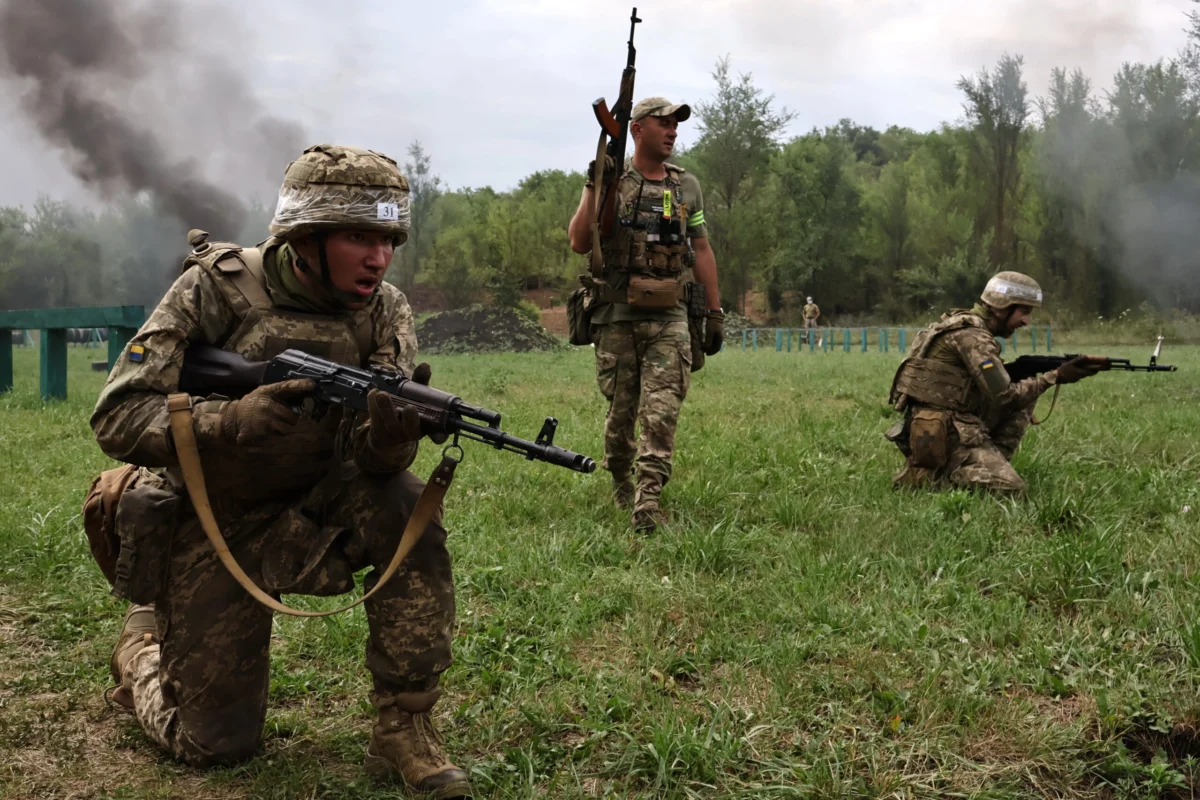
The streets of Kyiv, once bustling with a semblance of wartime normalcy, have become a perilous landscape for men like Anton, a 52-year-old resident who found himself abruptly seized and thrust into the grim reality of Ukraine’s intensified conscription drive. His experience, a harrowing journey from a casual walk home to detention in a military recruitment center, underscores a growing crisis that challenges both Ukraine’s war effort and its democratic principles. Anton, who requested his surname be withheld for safety, recounted being forcibly put into a police car by officers, bound for a future that, he feared, meant the trenches of a brutal war he was medically unfit to fight.
Anton’s story is far from isolated; it represents the sharp edge of a national struggle to replenish its ranks against a relentless Russian invasion. Despite his unwavering support for Ukraine’s sovereignty, Anton dreaded frontline service. His health conditions—HIV-positive status, arthritis, and poor eyesight—were, in his estimation, clear grounds for medical exemption. Yet, the desperation for manpower, fueled by grinding attrition and a protracted conflict, has seemingly overridden such considerations. Since new mobilization laws took effect in May 2024, Ukrainian recruitment officers have increasingly resorted to controversial tactics, often ambushing men on the street in what has colloquially become known as "busification."
The Escalation of Conscription Tactics
Anton’s ordeal began in late January, a period when he had already been self-confining to his apartment block, caught between the twin fears of Russian drone attacks on his neighborhood and the escalating crackdown on draft evasion. On one of his rare ventures outside, police officers, emerging from a car parked in a residential garage, chased and apprehended him. He was then driven to a militarized section of a state clinic in Kyiv. The first sign of the coercive nature of his detention came when his phone was confiscated. "They told me to mute my phone and hand it over," Anton recounted. "I started to protest. The guard said, ‘Don’t push me to use physical methods on you. Give it to me now.’ So I did."
Following cursory medical tests, Anton was transferred to a military recruitment center on the city’s outskirts. There, he spent two days in stark isolation: a room with barred windows, a bucket of cold pasta, and no means to contact the outside world. This experience, a stark departure from due process, highlights the severity of Ukraine’s conscription crisis. Observers note that such practices have become increasingly common as the conflict wears on, marking a significant shift from the initial wave of patriotic volunteers who flocked to recruitment centers in the early days of the full-scale invasion.

From Patriotism to Pressure: A Shifting Landscape
When Russia launched its full-scale invasion in February 2022, Ukraine witnessed an outpouring of patriotic fervor. Hundreds of thousands volunteered to defend their homeland, driven by a fierce determination to repel the aggressor. Initial battlefield successes, including the defense of Kyiv and the liberation of significant territories, bolstered national morale and recruitment efforts. However, the tide began to turn. A challenging counteroffensive in 2023, which yielded limited territorial gains at a heavy cost, significantly depleted Ukraine’s military resources and human capital. This strategic setback led to a stark realization: the war would be long and brutal, requiring a sustained, large-scale mobilization effort to match Russia’s numerical superiority.
The legislative response to this critical manpower shortage came swiftly. In April 2024, two pivotal laws were signed. These measures lowered the draft age from 27 to 25, significantly expanded the pool of eligible recruits, and quintupled fines for draft evasion, signaling a zero-tolerance approach to non-compliance. Crucially, a promised provision that would have allowed soldiers to demobilize after 36 months of service was dropped. This decision, while aimed at maintaining troop numbers, had a demoralizing effect on those already fighting, leaving them with no fixed end to their arduous duty and placing an immense psychological burden on frontline personnel. The absence of a clear demobilization pathway further complicated recruitment efforts, as potential conscripts weighed the indefinite commitment against the immediate dangers of combat.
The intensification of mobilization efforts has manifested in highly visible and often coercive actions across the country. Reports have detailed men being taken from various public spaces. In October 2024, footage captured outside Kyiv’s Palace of Sports showed recruitment officers dragging a man across the pavement, prompting chants of "Shame!" from outraged onlookers. In the western city of Uzhhorod, a man was reportedly rounded up as he left Sunday mass, despite carrying documents proving he was the sole caregiver for his disabled mother – a condition typically grounds for exemption. These incidents, widely circulated on social media, have fueled public resentment and distrust towards enlistment officers.
Corruption and Public Outcry
The coercive nature of conscription has been exacerbated by pervasive allegations of corruption within the recruitment process itself. For many, the desperate need for manpower has created fertile ground for illicit activities, with individuals allegedly obtaining exemptions through paid-for medical diagnoses or other fraudulent means. This systemic issue undermines the fairness and legitimacy of the mobilization effort, eroding public trust at a critical time.

A series of high-profile scandals have brought this corruption to light. In October 2024, Ukraine’s Prosecutor General, Andriy Kostin, resigned following journalistic investigations that exposed dozens of prosecutors in the western Khmelnytskyi region who had allegedly obtained fake disability statuses to avoid military service. This scandal proved to be merely the tip of the iceberg. The Ukrainian Security Service (SBU) later announced the cancellation of 4,106 fake disability certificates that year alone, charging 64 commission officials in connection with the fraudulent schemes.
The scale of the problem became even clearer in January 2025 with the arrest of the chief psychiatrist of Ukraine’s armed forces, a senior member of the central military medical commission responsible for determining conscript fitness. He was arrested for illegal enrichment, having accumulated assets—including a house, multiple apartments in Kyiv and Odesa, land, and four luxury cars—worth more than $1 million since the invasion began. Investigators searching his home discovered $152,000 and 34,000 euros in cash, providing tangible evidence of widespread corruption at the highest levels of the medical review process. These revelations paint a grim picture of a system vulnerable to exploitation, where wealth can buy exemption while those less fortunate face the grim prospect of forced service, regardless of their legitimate health concerns.
International Scrutiny and Domestic Resistance
The alleged abuses in Ukraine’s mobilization practices have not gone unnoticed on the international stage. In a memorandum published on July 8, 2025, the Council of Europe’s Commissioner for Human Rights expressed alarm over the reports, citing concerns such as beatings, harsh detentions, denial of access to legal counsel, and the conscription of men with disabilities. The memorandum specifically referenced Ukraine’s parliamentary human rights commissioner, Dmytro Lubinets, who had characterized these violations as "systematic and large-scale." Such international condemnation places additional pressure on Kyiv to address these issues, balancing the urgent need for defense with adherence to human rights standards.
Domestically, the impact on public opinion has been profound. A July 2025 survey by Ukraine’s Rating Group revealed that only 24 percent of Ukrainians trusted enlistment officers, a stark indicator of the erosion of confidence. This distrust has fueled various forms of resistance. Telegram groups emerged, tracking recruiters in real-time, allowing men to avoid areas where patrols were active. This movement became so popular that Google’s Threat Analysis Group identified a suspected Russian intelligence operation in October 2024 that exploited it, creating a fake app purporting to map recruiter locations while secretly installing malware, highlighting the geopolitical dimensions of internal dissent.
The anger and frustration have, on occasion, boiled over into physical confrontation and violence. More than 600 attacks on enlistment officers have been recorded since the start of the war. Worryingly, these assaults nearly tripled in 2025. The first four months of 2026 alone saw 117 incidents – more than 20 times the five recorded in the entire first year of the full-scale invasion. This alarming escalation underscores the deep-seated resentment within certain segments of the population. Within the span of just three days in February 2026, a draft officer was shot dead at a petrol station in Poltava oblast; an explosion inside a draft office in Rivne killed one person and wounded six, with Ukraine’s Security Service later attributing it to a Russian-recruited perpetrator; and another blast wounded one at an enlistment office in Pavlohrad. The most recent dramatic incident occurred on July 8, 2026, when a crowd in Lviv’s Sykhiv district blocked, damaged, and overturned a recruitment service vehicle during the detention of a man wanted for draft evasion, prompting pre-trial investigations by both the national police and the SBU. These acts of violence, whether orchestrated externally or borne of internal frustration, complicate Ukraine’s already challenging security landscape.

Official Acknowledgment and Future Implications
President Volodymyr Zelenskyy has publicly acknowledged the detrimental impact of these scenes, arguing that such internal divisions and unrest only benefit Russia, providing propaganda material and undermining national unity. Despite his condemnations, Ukrainian institutions, including the Ministry of Defence, have been compelled to temper their stance with concessions. The Defence Ministry has publicly stated that mobilization methods need improvement, signaling an awareness of the systemic issues. Oleksandr Syrskii, who was sacked as the country’s commander-in-chief in July 2026 along with Defence Minister Mykhailo Fedorov, also acknowledged that the army was working to correct mistakes and prevent rights violations at enlistment offices. These acknowledgments, while a step towards transparency, underscore the severity of the crisis and the urgent need for reform.
Anton’s personal story ultimately had a conditional resolution. After the recruitment officers began parcelling men out to military units, Anton discovered that his HIV status had been deliberately withheld from the commanders. Once this crucial medical information was revealed, he was finally deemed too unwell to serve and was eventually released. However, his freedom came at a steep personal cost: $5,000 in lawyers’ fees for a conditional summons, and a further $30,000 paid to "fixers" who promised to secure his documents but then vanished. Now, despite his release, Anton remains confined to his home, haunted by the experience and afraid to step outside, a poignant symbol of the fear gripping many Ukrainian men. At the time of publishing, the Command of the Territorial Defence Forces had not responded to requests for comment regarding these allegations.
The ongoing challenges in mobilization carry significant implications for Ukraine’s future. While the necessity of conscription for national defense is undeniable, the methods employed risk alienating a populace already enduring immense hardship. Erosion of public trust, coupled with allegations of widespread corruption, could undermine societal cohesion and the long-term legitimacy of state institutions. Moreover, the conscription of medically unfit individuals, or those with legitimate exemptions, not only violates human rights but also potentially burdens military units with soldiers unable to perform effectively. As Ukraine continues its existential struggle against Russia, addressing the ethical and practical failings of its mobilization system will be crucial not only for military effectiveness but also for preserving the democratic values it seeks to defend. The balance between national security imperatives and the rights of individual citizens remains a delicate and increasingly fraught challenge for the wartime government.
