

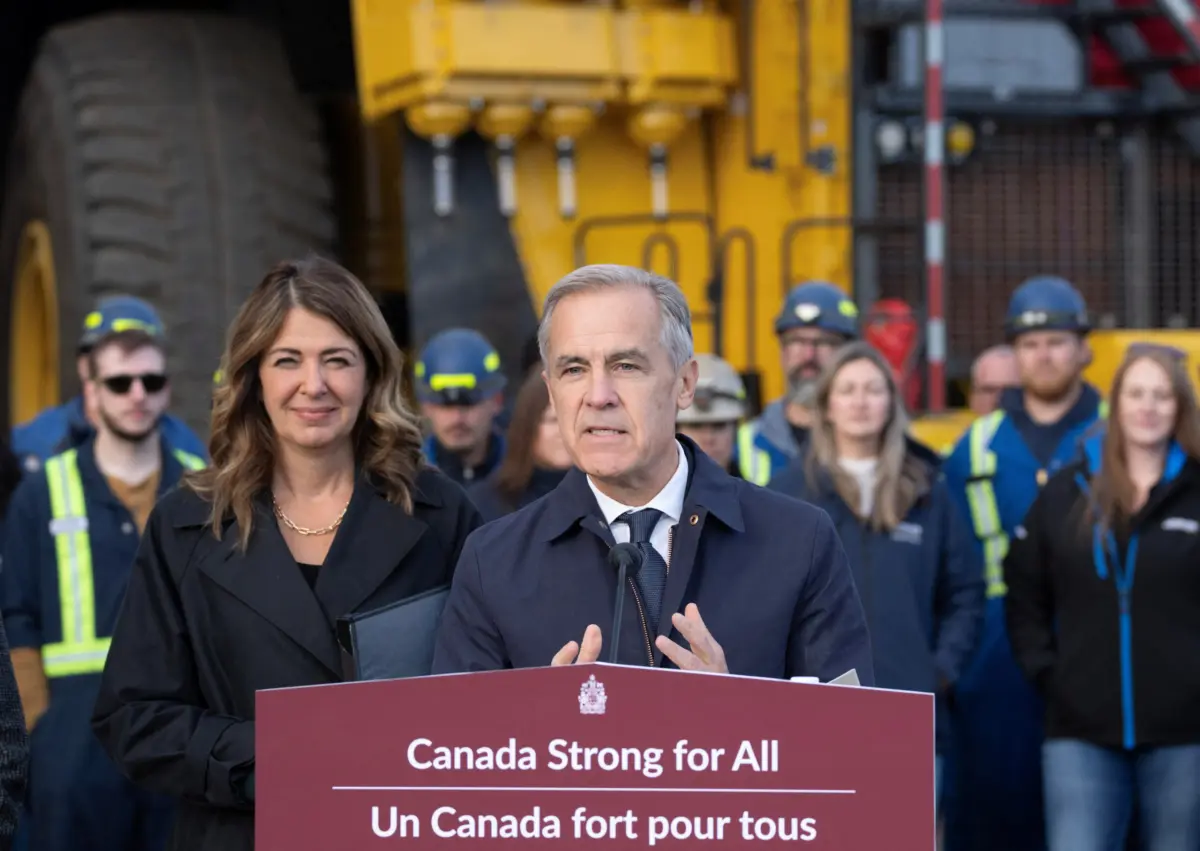
Prime Minister Mark Carney delivered a poignant Thanksgiving message to Canadians, emphasizing national unity just a week before the oil-rich province of Alberta is set to vote on a contentious proposal to secede from Canada. The call for cohesion comes at a pivotal moment for the federation, grappling with both internal political divisions and complex international relations.
The Call for Unity: Prime Minister Carney’s Message
In a video message released on Monday, Prime Minister Carney articulated a powerful plea for solidarity, warning against the dangers of division. "We can’t build big things on fault lines," Carney stated, underscoring that Canada faces multifaceted threats to its economy, security, and distinctive way of life. His message was direct and unequivocal: "We have to be strong, and we are stronger together." The Prime Minister, who hails from Alberta, filmed his message from a classroom at his former school, St. Francis Xavier High School in Edmonton, a deliberate choice to connect with his roots and underscore his commitment to the province.
Carney highlighted ongoing federal investments and initiatives aimed at fostering prosperity in Alberta. "I’m back home a lot these days because we are building big things again in Alberta: thousands of new homes, high-speed rail, a new pipeline to the West Coast that will create lasting opportunity and prosperity for hundreds of thousands of people in this province and across the country," he affirmed. These projects, including significant infrastructure investments and the development of a crucial energy export route, represent the federal government’s tangible efforts to address economic anxieties and demonstrate the benefits of remaining within the Canadian framework. The proposed pipeline, a perennial point of contention and a symbol of Alberta’s desire for market access, is particularly significant in this context, signaling a federal commitment to the province’s primary industry.
Alberta’s Path to a Referendum: Grievances and the "Wexit" Movement
Carney’s unity appeal directly precedes the October 19 vote, where Albertans will decide whether to commence the legal process of seeking independence. The referendum question posed to voters is: "Should Alberta remain a province of Canada, or should the Government of Alberta commence the legal process required under the Canadian Constitution to hold a binding provincial referendum on whether or not Alberta should separate from Canada?" This initial vote is non-binding, serving as a mandate for the provincial government to pursue a future, potentially binding, vote on secession.
The push for independence, often referred to as "Wexit" (a portmanteau of Western Exit, echoing "Brexit"), is driven by a vocal and increasingly organized group of separatists. This movement is fueled by longstanding grievances that resonate deeply within Alberta’s political and economic landscape. For decades, many Albertans have felt marginalized and unfairly targeted by federal policies, particularly those related to energy and the environment.
Economic Discontent: Oil, Pipelines, and Equalization
At the heart of Alberta’s discontent is its vital oil and gas industry, which forms the cornerstone of the provincial economy. Alberta is home to the third-largest proven oil reserves in the world, and its energy sector has historically been a significant contributor to Canada’s Gross Domestic Product (GDP), employment, and federal tax revenues. However, the province has experienced significant economic downturns, exacerbated by volatile global oil prices and, critically, what many Albertans perceive as restrictive federal environmental regulations and a lack of support for pipeline infrastructure.
Separatist leaders and their supporters argue that federal energy policies, such as carbon taxes and stringent environmental assessments, have disproportionately burdened Alberta’s industry, hindering its ability to compete globally and realize its full economic potential. They contend that these policies have led to job losses, stalled investment, and a sense of being penalized for their natural resource wealth. The repeated delays and cancellations of major pipeline projects, essential for transporting Alberta’s landlocked oil to tidewater for export, are frequently cited as prime examples of federal obstructionism.
Another significant grievance revolves around Canada’s equalization program. This federal transfer program aims to reduce fiscal disparities between provinces, ensuring that less prosperous provinces can provide comparable public services at comparable levels of taxation. Alberta, as a relatively wealthy province, has historically been a net contributor to the program, meaning its citizens pay more in federal taxes that are then redistributed to other provinces. Many Albertans argue that they contribute significantly more to the federal treasury than they receive in federal services or transfers, leading to a sense of unfairness and a belief that their prosperity is subsidizing other parts of the country without adequate recognition or return. This sentiment often fuels calls for greater provincial autonomy and control over their own resources and revenues.
The Referendum Question and Its Legal Ramifications
The phrasing of the referendum question is crucial. By asking whether the government should commence the legal process for a binding vote, it allows the provincial government to gauge public appetite for secession without immediately triggering a full constitutional crisis. This staged approach reflects the complexities of Canadian constitutional law regarding secession. While the Canadian Constitution does not explicitly lay out a mechanism for a province to unilaterally secede, the Supreme Court of Canada, in its 1998 reference on Quebec secession, outlined a framework. It stated that a clear vote by a clear majority on a clear question in a province would obligate the federal government to negotiate. However, it also emphasized that any secession would require constitutional amendments involving other provinces, making it a highly complex and challenging legal and political endeavor. The current non-binding vote in Alberta, therefore, is a preliminary step, designed to strengthen the provincial government’s hand in future negotiations with Ottawa, regardless of whether a binding vote ever materializes.
External Influences and International Attention
The burgeoning secessionist movement in Alberta is not an isolated domestic issue; it has garnered attention beyond Canada’s borders, particularly from the United States. Canada’s relationship with the United States has experienced periods of strain, particularly under President Donald Trump, who has often pursued protectionist trade policies and expressed skepticism about multilateral agreements.
An investigation by The Globe and Mail earlier this month brought to light revelations that US Republican operatives had met with secession organizers in Alberta to discuss campaign strategies. More controversially, the report alleged that separatist leaders had reportedly offered access to the province’s water and oil royalties in exchange for US support for independence. While separatist leaders have vehemently disputed these claims, the report underscores the geopolitical interest in Alberta’s energy resources and the potential for external actors to influence Canadian domestic politics. Such alleged foreign involvement, whether substantiated or not, raises concerns about national sovereignty and the integrity of democratic processes.
Adding another layer of international intrigue, US tech entrepreneur Elon Musk, widely considered the richest man on the planet, publicly weighed in on Canadian provincial politics. Following the recent provincial election in Quebec, where the secessionist Parti Quebecois gained significant ground, Musk applauded the results. Known for leveraging his vast wealth and influence to support various political causes, often aligned with the far-right, Musk took to social media, writing, "Good. Quebec should separate. They would be better off. Alberta and Saskatchewan should separate too." Musk’s comments, while offering a perspective from an influential figure, were met with mixed reactions, with some Canadians viewing them as an unwelcome foreign intrusion into domestic affairs, while others saw them as validating the sentiments of provincial autonomy.
A Broader Trend? The Quebec Parallel
Carney’s comments also followed closely on the heels of another significant development in Canadian federal-provincial relations: the secessionist Parti Quebecois won the most seats in a provincial election in Quebec last week, allowing it to return to power after more than a decade. While the Parti Quebecois secured 59 seats out of a total of 129 in Quebec’s National Assembly, leaving it short of a majority government, their victory signals a resurgence of sovereignty-leaning sentiment in the francophone province.
The Quebec sovereignty movement has a long and storied history in Canada, with two provincial referendums on secession held in 1980 and 1995. Both referendums saw Quebecers vote to remain within Canada, though the 1995 vote was exceptionally close. The Parti Quebecois’s return to power, even with a minority government, reignites discussions about national unity and the enduring challenge of accommodating distinct national identities within the Canadian federation. While the grievances of Quebec and Alberta differ significantly – Quebec’s often rooted in linguistic and cultural preservation, Alberta’s in economic autonomy and resource control – the simultaneous rise of strong provincialist and secessionist sentiments in two of Canada’s largest provinces presents a formidable challenge to national unity and the federal government’s ability to balance regional interests.
Public Sentiment and Economic Outlook in Alberta
Despite the growing visibility and vocal advocacy of the secessionist movement, opinion polls suggest that a majority of Albertans continue to oppose outright independence. While specific numbers vary by pollster and methodology, a consistent trend indicates that while there is significant frustration with the federal government and a desire for greater provincial autonomy, most residents still prefer to remain within Canada. Support for secession tends to be higher among specific demographics, often those most directly impacted by downturns in the oil and gas sector or those who feel most alienated from federal politics.
This nuanced public sentiment means that while the referendum itself is a significant political event, its immediate outcome might not be a resounding call for separation. Instead, it could be interpreted as a strong message to Ottawa that Alberta demands greater recognition of its economic contributions and more control over its future.
Economically, Alberta faces the dual challenge of diversifying its economy while maximizing the value of its traditional energy sector. Beyond oil and gas, the province is making strides in technology, agriculture, and renewable energy. The "big things" Prime Minister Carney mentioned, such as high-speed rail and new homes, are part of a broader strategy to create a more resilient and diversified economy, lessening the province’s vulnerability to global commodity price fluctuations. The success of these diversification efforts and the ability to secure market access for its energy products will significantly influence public sentiment regarding Alberta’s place within Canada.
Implications for Canada’s Future
The Alberta referendum, regardless of its outcome, carries profound implications for the future of Canadian Confederation.
Political Implications: A strong "yes" vote, even if non-binding, would significantly empower the provincial government in its dealings with Ottawa, potentially leading to increased demands for greater autonomy, resource control, and changes to federal transfer programs like equalization. It could also encourage other provinces with similar grievances to press for their own demands, potentially destabilizing federal-provincial relations. Conversely, a clear "no" vote could temper the immediate fervor of the secessionist movement, but the underlying grievances would likely persist, requiring continued attention from the federal government.
Economic Implications: The mere discussion of secession introduces an element of uncertainty that can deter investment. For Alberta, any move towards independence would necessitate a complex unbundling of economic ties, renegotiation of trade agreements, and the establishment of new national institutions. For Canada, the loss of Alberta’s significant economic contributions, particularly from its energy sector, would have substantial repercussions on federal revenues, national GDP, and Canada’s international standing as a major energy producer.
Geopolitical Implications: The potential fragmentation of Canada would undoubtedly draw significant international attention. For the United States, a stable, unified Canada is a crucial partner for trade, security, and energy supply. Any instability could prompt the US to re-evaluate its relationship with a potentially fractured neighbor. The future of major energy projects and cross-border infrastructure could also be called into question, affecting North American energy security.
National Identity: At a deeper level, these movements challenge the very fabric of Canadian national identity. Canada has historically prided itself on its ability to accommodate diverse cultures and regional interests within a unified state. The rise of strong secessionist sentiments in both English and French-speaking Canada forces a national introspection about shared values, mutual respect, and the enduring strength of the Canadian experiment.
Looking Ahead: The October 19 Vote and Beyond
As Albertans prepare to cast their ballots on October 19, the vote represents a critical juncture for the province and the nation. While the initial referendum is non-binding, it is a powerful symbolic act that will send a clear message to Ottawa and the rest of Canada. For Prime Minister Mark Carney, a native Albertan, the challenge will be to bridge the divides, address legitimate grievances, and demonstrate the tangible benefits of remaining united, ensuring that the "big things" he envisions for Alberta are indeed built on shared foundations rather than fault lines. The path forward for Canada will require careful navigation, robust dialogue, and a renewed commitment to the principles of federalism and national unity.
