

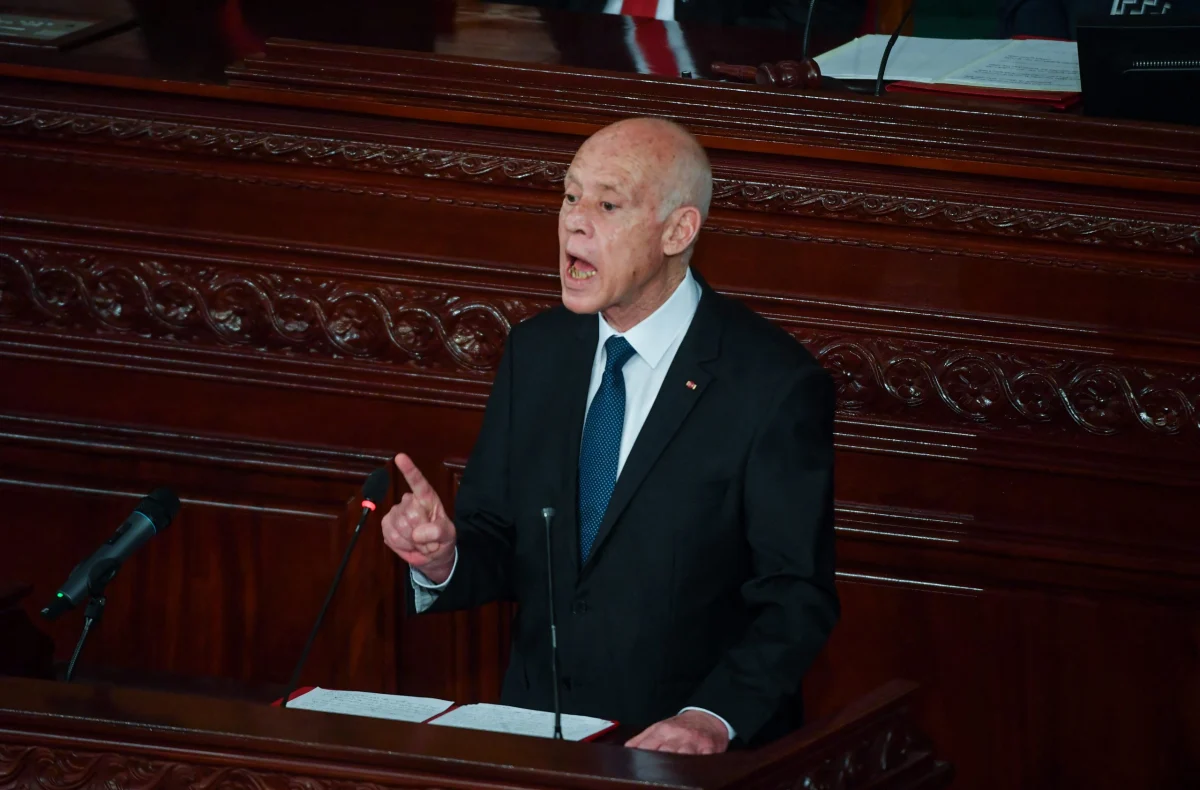
The Tunisian government has officially enacted a significant amendment to Decree 54, a contentious cybercrime law that has become a central point of friction between the administration of President Kais Saied and the country’s civil society. Effective as of Wednesday, the new legislative modification allows for first-time offenders convicted of spreading what the state deems "false news" to pay financial penalties instead of serving mandatory prison time. Under the revised framework, fines for initial violations have been established between 10,000 and 20,000 Tunisian dinars, an amount equivalent to approximately $3,370 to $6,740.
This adjustment represents the first major softening of a law that has seen dozens of journalists, activists, and political opponents incarcerated since its inception in late 2022. While the move replaces the previous standard of a five-year prison sentence for a first offense, the legal threat remains potent; repeat offenders still face the possibility of imprisonment, and the definitions of what constitutes "falsehoods" or "threats to public security" remain broad and subject to judicial interpretation.
The Evolution of Decree 54 and the Mechanism of State Control
Decree 54 was originally issued by President Kais Saied in September 2022, a period marked by the president’s systematic consolidation of executive, legislative, and judicial powers. The decree was ostensibly designed to combat cybercrime, protect personal data, and prevent the spread of disinformation in the digital age. However, its implementation told a different story. Article 24 of the decree became particularly notorious, as it criminalized the use of communication networks to produce, spread, or broadcast "false news, statements, or rumors" with the intent of defaming others, damaging public security, or inciting fear.
Prior to the current amendment, the penalties were among the harshest in the region for speech-related offenses. A standard conviction carried a five-year prison term and a fine of 50,000 dinars. If the alleged offense targeted a public official or a "person of equivalent status," the penalties were automatically doubled to ten years in prison and a fine of 100,000 dinars (approximately $32,000). The vagueness of the terminology—specifically what constitutes "moral harm" or "threats to public security"—provided the state with a flexible tool to prosecute critics who questioned government policy or reported on economic instability.
The amendment introduced this week does not repeal these definitions but alters the sentencing guidelines. By shifting the focus to heavy financial penalties for first-time infractions, the government appears to be attempting to deflect international criticism regarding the imprisonment of dissidents while maintaining a significant deterrent against public criticism.
A Chronology of Suppression: From the 2011 Revolution to the 2021 Power Shift
To understand the weight of Decree 54, it is essential to view it within the broader timeline of Tunisia’s political trajectory. Following the 2011 Jasmine Revolution, which sparked the Arab Spring, Tunisia was widely regarded as the sole democratic success story of the region. The country established a robust constitution in 2014, fostered a vibrant media landscape, and protected the right to protest.
However, the political landscape shifted dramatically in July 2021. President Kais Saied, citing a state of emergency and widespread public frustration with economic stagnation and political gridlock, suspended parliament and dismissed the prime minister. By 2022, he had overseen the drafting of a new constitution that transformed Tunisia from a parliamentary democracy into a hyper-presidential system with limited oversight.
Decree 54 was introduced shortly after this constitutional shift. Since then, the National Syndicate of Tunisian Journalists (SNJT) has documented a sharp decline in press freedom. In its latest annual report, covering the period between April 2025 and April 2026, the SNJT recorded 14 separate prosecutions of journalists, six of which were conducted specifically under the auspices of Decree 54. The organization has declared the state of media freedom in Tunisia an "emergency," noting that the law has created a pervasive culture of self-censorship.
High-Profile Cases and the Human Cost of Legal Overreach
The practical application of Decree 54 is best illustrated through the cases of those it has targeted. Sonia Dahmani, a prominent lawyer and media commentator, has become a symbol of the struggle against the decree. In May 2026, Dahmani was sentenced to two years in prison for comments made during a radio interview where she criticized the state of Tunisian prisons. This was merely one of five cases brought against her under the decree, all stemming from her media appearances and critiques of Saied’s administration.
Another harrowing example is that of Saber Ben Chouchane, a citizen who faced the death penalty after being charged under a suite of censorship laws, including Decree 54, following a series of Facebook posts. Although he eventually received a presidential pardon, the case underscored the extreme lengths to which the state’s legal apparatus could go to punish digital dissent.
Political figures have not been spared. Rafik Abdessalem, a former foreign minister and senior member of the Ennahdha party, has consistently characterized the decree as a weapon used to "silence every voice critical of the regime." Ennahdha, once the dominant force in Tunisian politics, has seen its leadership systematically dismantled through arrests and lengthy prison sentences, often handed down in absentia for those who managed to flee the country.

International Reactions and Geopolitical Pressure
The international community has grown increasingly vocal in its condemnation of Tunisia’s human rights record. Amnesty International and Human Rights Watch have frequently called for the total repeal of Decree 54, labeling it a violation of international treaties to which Tunisia is a signatory. The European Parliament has similarly described the law as a "tool to interfere with fundamental freedoms" and has urged the Tunisian government to return to the democratic standards established after the 2011 revolution.
Perhaps the most significant pressure has come from the United States. In mid-2026, Joe Wilson, a member of the US House of Representatives, signaled his intent to push forward a bill that would impose targeted sanctions on President Saied and his inner circle. The proposed sanctions are a response to what US lawmakers describe as "anti-democratic policies" and the systematic erosion of the rule of law.
Analysts suggest that the decision to soften the decree now is a calculated move to mitigate these external pressures. By replacing prison time with fines, the Tunisian government can present a facade of reform to international lenders and diplomatic partners, even as the underlying legal structures of repression remain intact.
Domestic Unrest and the Economic Impetus for Change
The amendment also arrives at a time of significant domestic volatility. Tunisians are currently grappling with a severe cost-of-living crisis, characterized by high inflation, fuel shortages, and a lack of basic commodities. While Saied was elected on a platform of anti-corruption and economic revival, many citizens feel that the focus has shifted toward political policing rather than solving the country’s financial woes.
In the months leading up to the amendment, Tunisia saw a resurgence of popular mobilization. In June 2026, hundreds of protesters took to the streets of the capital, Tunis, demanding the release of political prisoners and the restoration of press freedom. By July, on the fifth anniversary of Saied’s suspension of parliament, thousands gathered to call for his resignation. Civil society groups, spearheaded by the country’s powerful labor unions, have been planning nationwide marches, signaling that the public’s patience with restrictive decrees is wearing thin.
Analysis: Is a Fine More Than a "Softened" Sentence?
While the reduction in penalties is objectively a "positive development" in the eyes of some human rights observers, legal experts remain skeptical. Said Benarbia, the Middle East and North Africa director of the International Commission of Jurists (ICJ), argues that the core issue is not the severity of the punishment, but the existence of the crime itself. Benarbia emphasizes that as long as "false news" is treated as a criminal offense, the state maintains the power to arbitrarily restrict expression.
Furthermore, the fines themselves are prohibitively expensive for many Tunisians. In an economy where the average monthly wage is relatively low, a fine of 20,000 dinars can be financially ruinous, acting as a "civil death" for activists and independent journalists. Critics argue that this shift simply changes the method of suppression from physical incarceration to economic liquidation.
Lotfi Hajji, the head of Al Jazeera’s bureau in Tunisia, points out that the journalists’ union and other advocacy groups are not satisfied with mere amendments. They are demanding that Decree 54 be scrapped entirely in favor of the 2011 press freedom law. That post-revolution law was designed to balance journalistic responsibility with constitutional protections, and it did not include the draconian measures found in the 2022 decree.
The Broader Impact on Tunisia’s Democratic Future
The amendment to Decree 54 serves as a litmus test for the future of Tunisian democracy. On one hand, it shows that the government is not entirely immune to domestic and international pressure. The "popular mobilization" cited by figures like Rafik Abdessalem has forced a tactical retreat by the executive branch.
On the other hand, the move highlights the entrenched nature of the current administration’s approach to dissent. By keeping the decree on the books and maintaining the threat of jail for reoffenders, the government ensures that the "chilling effect" on public discourse remains. For the hundreds of journalists and bloggers currently facing trial, the change in law may offer some relief from the prospect of a cell, but it does not provide the freedom of speech that was the hallmark of the post-2011 era.
As Tunisia moves forward, the focus of civil society will likely shift from seeking amendments to demanding a full restoration of the legislative safeguards that once protected the "only democracy in the Arab world." Whether this minor concession by the Saied administration will be enough to quell the rising tide of domestic anger and international isolation remains to be seen. For now, the amendment stands as a reminder of the fragile balance between state power and individual liberty in a nation still searching for the stability promised by its revolution.
