

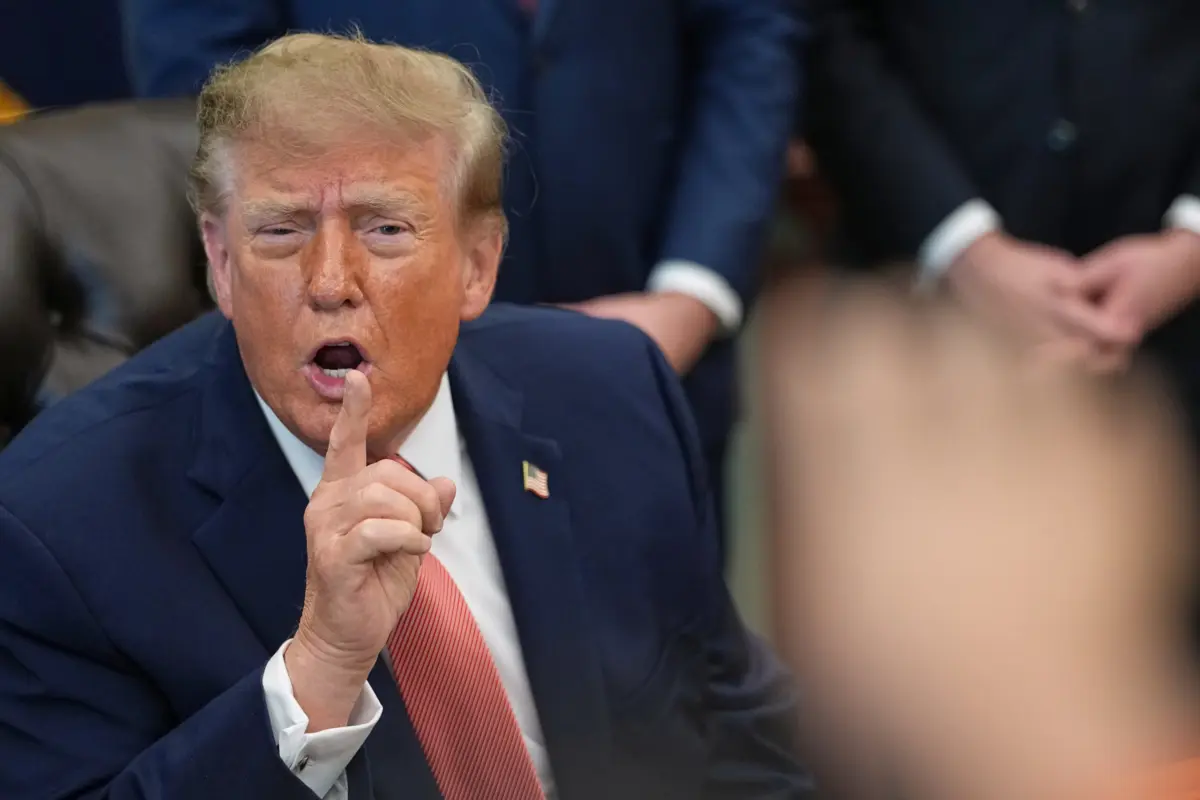
United States President Donald Trump has significantly intensified pressure on Ukrainian President Volodymyr Zelenskyy to reach a settlement with the Russian Federation, marking a critical juncture in the years-long conflict that has reshaped global geopolitics. Speaking from the White House on Tuesday, President Trump doubled down on his rhetoric, placing the onus for the continuation of the war squarely on the leadership in Kyiv. The President’s remarks suggest a hardening of the American stance, moving away from the unconditional support of previous years toward a transactional approach aimed at an immediate cessation of hostilities.
During his address to reporters, Trump emphasized the disparity in military resources and manpower between the two warring nations. He pointed to Russia’s perceived ability to sustain a prolonged war of attrition, noting that Moscow possesses what he described as an "unlimited" supply of personnel to deploy into the theater of operations. "Zelenskyy has to want to settle this war, and if he doesn’t, I think it’s going to be a very bad thing," Trump stated. This warning underscores the White House’s growing impatience with the stalemate and its desire to pivot American foreign policy focus away from the Eastern European front.
The Diplomatic Friction: A History of Contentious Meetings
The current friction between Washington and Kyiv is not a sudden development but rather the culmination of a deteriorating relationship that began shortly after President Trump’s return to power. During his remarks on Tuesday, Trump referenced a pivotal and reportedly contentious Oval Office meeting held in February 2025. According to the President, that meeting represented a missed opportunity for Ukraine to secure more favorable terms for peace.
Trump suggested that the geopolitical landscape has shifted to Ukraine’s disadvantage since that early 2025 encounter. "He’s going to have to want to make a deal, because I don’t think his people are going to stand for it any longer," Trump added, hinting at potential domestic fatigue within Ukraine as the humanitarian and economic costs of the war continue to mount. The President’s narrative suggests that the window for a "better deal" may have closed, and that the current reality necessitates more significant concessions from the Ukrainian side.
While Trump issued these warnings from Washington, President Zelenskyy was engaged in high-level diplomatic efforts in Oslo, Norway. The Ukrainian leader met with a delegation that included U.S. special envoy Steve Witkoff, as well as European leaders, to discuss a framework for ending the war. This summit in Oslo highlights the multi-track nature of current peace efforts, involving both direct U.S. pressure and broader European mediation.
The Oslo Peace Track and the Trilateral Proposal
In the aftermath of the Oslo discussions, President Zelenskyy took to social media to signal that Ukraine remains proactive in the search for a resolution, despite the pressure from the White House. While he did not disclose specific terms, Zelenskyy indicated that his administration has developed "clear ideas" on how to achieve a durable peace. A central component of this strategy appears to be a shift toward direct high-level negotiations.
"We are united with our European partners in this effort, and we want the Americans to take these ideas to the Russians," Zelenskyy wrote. He specifically proposed a trilateral meeting involving the leaders of Ukraine, Russia, and the United States. According to the Ukrainian president, such a meeting is essential to address "the issues that only the leaders can do."
The diplomatic mission continues as U.S. envoy Steve Witkoff is scheduled to travel to Russia on Wednesday. This move signals that the Trump administration is actively facilitating a channel of communication between Kyiv and Moscow, even as it publicly critiques the Ukrainian leadership. Zelenskyy expressed a cautious "wait-and-see" approach regarding the upcoming Moscow talks, stating, "Let’s see what Putin has to say."
However, President Trump remains skeptical about the personal chemistry between Zelenskyy and Russian President Vladimir Putin. When asked about the feasibility of a direct meeting between the two, Trump noted the "tremendous" hatred between them. "It’s hard for them to be in the same room," he remarked, though he reiterated his indifference to the format of the negotiations as long as a deal is reached. "I don’t care how it’s done," he added.
The Starshield Controversy: Strategic Leverage or Technical Glitch?
Parallel to the diplomatic pressure is a burgeoning controversy surrounding Starshield, the military-grade satellite communication system operated by SpaceX. Over the past week, Ukrainian officials have reported significant slowdowns and service interruptions with the system, which is vital for the country’s battlefield intelligence, drone operations, and secure communications.
The cause of these restrictions remains a point of intense debate and political finger-pointing. Given the timing of the slowdowns, many observers have questioned whether the Trump administration is using the technology as leverage to force Ukraine to the negotiating table. This theory gained traction following social media posts by SpaceX CEO Elon Musk, a prominent ally of the President.
On October 14, Musk stated that Starshield systems are "owned and controlled by the U.S. government," and that any limits on usage or speed are dictated by the U.S. military and, ultimately, the President. This assertion was supported by reports from Reuters, which cited U.S. and Western officials claiming the order to restrict access originated within the White House.
However, the narrative is complicated by conflicting reports. A Tuesday report in The Wall Street Journal suggested that some U.S. officials blame Musk himself for the disruptions. In response, both President Trump and Defense Secretary Pete Hegseth have denied that the federal government issued any formal directive to throttle the service. Hegseth explicitly pushed the responsibility back toward SpaceX, creating a cycle of ambiguity regarding who holds the "kill switch" for Ukraine’s most critical communication infrastructure. Regardless of the source, the degradation of Starshield service represents a major tactical setback for Ukrainian forces at a time of heightened Russian military pressure.
A New Era of U.S.-Russia Relations
The Trump administration’s approach to Ukraine is inseparable from its broader efforts to recalibrate relations with the Kremlin. Since 2025, the U.S. has moved away from the policy of isolation that characterized the early years of the conflict. In August 2025, President Trump hosted Vladimir Putin in Alaska, marking the first time the Russian leader had set foot on American soil in over a decade. This summit was a clear signal that the Trump administration viewed Russia as a necessary partner in a new global security architecture.
Furthermore, the President has expressed a desire for trilateral discussions involving the U.S., Russia, and China, specifically focusing on denuclearization. This "Great Power" diplomacy suggests a return to a realist foreign policy where the interests of major nuclear powers are prioritized over the regional sovereignty of smaller nations.
Economic ties have also seen a dramatic shift. Earlier this month, President Trump announced a deal to import Russian diesel to the United States. This move was presented as a solution to soaring domestic fuel prices, but it also served to dismantle the economic blockade that had been built against Moscow. By purchasing Russian energy, the U.S. has effectively provided a lifeline to the Russian economy, undermining the efficacy of previous sanctions regimes.
The Waiver of the Lindsey Graham Act
In a move that further signaled a thaw in relations, the Trump administration recently waived new economic restrictions that were set to be imposed under the Lindsey Graham Sanctioning Russia and Iran Act. The bipartisan law, signed by Trump just a month prior in honor of the late senator, was designed to target Russian banks, officials, and the "shadow fleet" of tankers used to export oil. It also included provisions for tariffs on any nation purchasing Russian petroleum products.
The decision to waive these sanctions drew criticism from hawks in Congress but was defended by Secretary of State Marco Rubio. Speaking to India’s News18, Rubio characterized the decision as part of a "balancing act." He argued that the President utilized a national security waiver to prevent the sanctions from causing collateral damage to the global economy.
"The president chose to use a national security waiver… because he recognizes that these things have to be looked at in their totality," Rubio said. He noted that intense economic pressure on Russia often "spills over" and negatively impacts third-party countries, including U.S. allies. Rubio’s defense highlights the administration’s belief that economic warfare is a blunt instrument that may no longer serve American interests in a multipolar world.
Chronology of Key Events (2025–2026)
To understand the current escalation, it is necessary to view the timeline of the Trump administration’s engagement with the conflict:
- January 2025: Donald Trump is inaugurated as the 47th President of the United States, pledging to end the Ukraine war within "24 hours."
- February 2025: Trump holds his first meeting with President Zelenskyy in the Oval Office. Reports suggest the meeting is tense as Trump pushes for immediate territorial concessions.
- August 2025: The "Alaska Summit" takes place. Trump and Putin meet in Anchorage to discuss Arctic security and the framework for a new European security treaty.
- September 2026: Bipartisan passage of the Lindsey Graham Sanctioning Russia and Iran Act. Trump signs the bill but expresses reservations about its impact on energy markets.
- October 9, 2026: Trump announces the Russian diesel deal to combat high U.S. gas prices, effectively ending the U.S. energy embargo on Moscow.
- October 14, 2026: Reports emerge of Starshield outages in Ukraine. Elon Musk attributes the restrictions to the White House.
- October 20, 2026: Zelenskyy meets with U.S. and European officials in Oslo. Trump issues a public warning to Kyiv from the White House, while Rubio defends the waiver of Russian sanctions.
Analysis of Implications
The shift in U.S. policy carries profound implications for the future of NATO and the security of Europe. By pivoting toward a negotiated settlement that likely involves Ukrainian territorial losses or neutrality, the Trump administration is challenging the post-WWII consensus on the inviolability of national borders.
For Ukraine, the situation is increasingly precarious. The combination of reduced military-grade communication (Starshield), the resumption of U.S.-Russia trade, and the public withdrawal of diplomatic "blank check" support places Kyiv in its most vulnerable position since the initial invasion. The administration’s focus on Russia’s "unlimited" manpower reflects a grim assessment of the battlefield reality, suggesting that Washington no longer believes a total Ukrainian military victory is achievable or desirable.
For Russia, the current trajectory represents a significant strategic win. The easing of sanctions and the invitation back into high-level summits suggest that Moscow has successfully weathered the period of Western isolation. The "diesel deal" and the waiver of the Lindsey Graham Act demonstrate that Russia’s role as a global energy provider remains a powerful tool of leverage.
European allies, meanwhile, find themselves in a difficult position. While leaders participated in the Oslo talks, there is a palpable sense of anxiety in Brussels and London that a "deal" struck between Washington and Moscow could leave Europe’s eastern flank exposed. Zelenskyy’s insistence on European partnership in his "clear ideas" for peace is an attempt to ensure that any settlement is not merely a bilateral agreement between two superpowers, but a multilateral framework that protects Ukrainian sovereignty.
As Steve Witkoff arrives in Moscow, the world watches to see if the "tremendous hatred" between the leaders can be bypassed by the pragmatic—and often ruthless—demands of international diplomacy. The coming weeks will likely determine whether the war in Ukraine ends at a negotiating table in a neutral capital or continues as a grinding conflict with a significantly diminished level of American support.
