

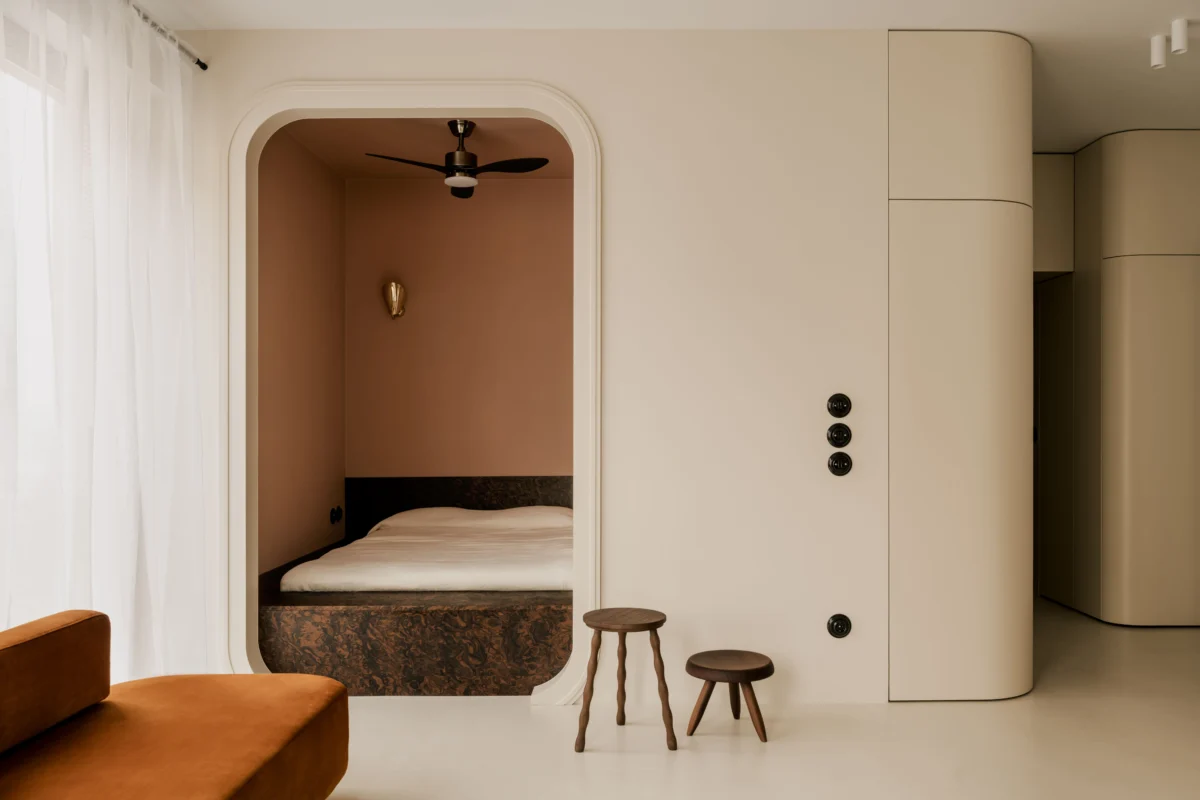
In the heart of Warsaw’s rapidly evolving right bank, a 366-square-foot apartment in the Port Praski district has become a masterclass in spatial efficiency and high-end interior architecture. Originally constructed in 2024 as part of a massive urban regeneration initiative, the unit was acquired by a couple of professional photographers seeking a functional yet sophisticated retreat for their periodic visits to the Polish capital. Despite the building’s brand-new status, the owners found the developer’s original layout insufficient for their needs, prompting a total gut renovation led by local architect Dawid Konieczny. The resulting project demonstrates a growing trend in European urban centers: the prioritization of bespoke, high-quality "micro-living" environments over standard residential configurations.

The Context of Port Praski: From Industrial Docks to Luxury Living
The transformation of this apartment cannot be fully understood without the context of its location. Port Praski is currently one of the largest and most ambitious urban renewal projects in Central Europe. Spanning approximately 38 hectares, the site was once a bustling industrial dockland and port facility that fell into disrepair during the late 20th century. The multi-phase regeneration project aims to create a "city within a city," blending residential, commercial, and recreational spaces while maintaining a connection to the Vistula River.
For the photographer couple, the appeal of Port Praski lay in its dual identity—a mix of gritty industrial history and modern luxury. However, the standard 34-square-meter (366-square-foot) floor plan offered by the developer followed a conventional logic that felt cramped and uninspired. To achieve the "cozy retreat" they envisioned, they granted Konieczny the authority to ignore the existing walls and systems entirely.

Chronology of a Radical Reconfiguration
The renovation began with a complete stripping of the interior, a move that is statistically rare for buildings completed within the same calendar year. Konieczny’s strategy was not merely cosmetic; it involved a fundamental re-engineering of the apartment’s core infrastructure.
Phase 1: Infrastructure and Demolition
The first step involved the total removal of internal partition walls and a complete overhaul of the electrical and plumbing systems. In a space of less than 400 square feet, every inch of utility placement is critical. By relocating the primary plumbing stacks, Konieczny gained the freedom to move the bathroom’s internal fixtures, including the shower and toilet, to optimize the flow of the entryway.

Phase 2: The Spatial Flip
The most significant architectural intervention was the relocation of the bedroom into what was originally intended to be the kitchen area. This unconventional move allowed the architect to consolidate the remaining space into a "compound living and dining area." By pushing the private sleeping quarters into a more secluded corner, the social areas of the home were allowed to breathe, benefiting from the natural light of the apartment’s primary windows.
Phase 3: Custom Integration
Following the structural changes, the focus shifted to millwork. Because standard furniture often consumes excessive floor space in small apartments, Konieczny utilized custom-built cabinetry to define the rooms. The entryway was lined with lacquered oatmeal-colored storage units that wrap around the walls, leading the eye diagonally into a fan-shaped living area. This diagonal orientation is a classic architectural technique used to make small footprints feel more expansive.

Materiality and the Sunset-Hued Aesthetic
The interior palette was carefully curated to evoke warmth and "cocooning," a departure from the stark, cold minimalism often found in modern Polish developments. The design utilizes a "sunset-hued" spectrum, dominated by apricot tones, cream lacquers, and rich wood grains.
The Kitchen and Living Area
The kitchen, now relegated to a single wall within the living zone, features a sophisticated blend of oiled oak cabinet fronts and cream lacquer panels. The centerpiece of this area is the use of Blue Roma quartzite for the countertops and backsplashes. This specific stone is prized by designers for its dramatic blue-grey base and copper-brown veining, which in this case, perfectly complements the oak cabinetry. The kitchen was designed with increased counter space and overhead storage, ensuring that despite its smaller footprint, it remains fully functional for hosting.

The "Ship’s Cabin" Bedroom
The bedroom was designed with the intimacy of a luxury ship’s cabin in mind. To achieve this, Konieczny utilized Alpi Wood California burl wood trim—a high-end engineered veneer known for its intricate, swirling patterns. The walls and ceiling are finished in a peachy, apricot tone, creating a monochromatic environment that feels both private and protective. Large floor-to-ceiling built-in units provide ample storage, featuring glass windows with rounded corners—a recurring motif throughout the apartment that softens the industrial lines of the building’s exterior.
Technical Data and Design Specifications
The success of the project relies on a precise selection of materials and high-end furnishings that provide a sense of permanence and history.

| Feature | Material/Source |
|---|---|
| Flooring & Walls | Off-white polished concrete |
| Kitchen Countertop | Blue Roma Quartzite |
| Cabinetry | Oiled oak veneer and cream lacquer |
| Bedroom Trim | Alpi California burl wood |
| Seating | Charlotte Perriand stools (Cassina) & Zara Home |
| Decor | Vintage brass artwork (Belarus), Gropk Ceramic vase |
The bathroom, noted as the owners’ favorite room, serves as a focal point for the home’s eclectic influences. It features a bold Art Deco-inspired red-and-white checkered floor, paired with blue stucco walls and vintage fixtures. The inclusion of burl wood in the bathroom ties the space back to the bedroom’s aesthetic, creating a cohesive design language throughout the 366 square feet.
Analysis of Implications: The Rise of the High-End Micro-Apartment
The Port Praski project reflects a broader shift in the global real estate market, particularly in high-density European capitals like Warsaw, Prague, and Berlin. As property prices in prime regeneration zones continue to rise, buyers are increasingly opting for smaller square footage but investing significantly higher percentages of their budget into bespoke interior architecture.

In Warsaw, specifically, the "pied-à-terre" market has seen a 15% increase in demand over the last three years, driven by professionals who live primarily outside the city but require a high-standard base for work or culture. For this demographic, the "luxury" of an apartment is no longer defined by total area, but by the quality of materials (such as Blue Roma quartzite and burl wood) and the intelligence of the floor plan.
Architect Dawid Konieczny’s work suggests that the "bad floor plan" is the primary obstacle to mental well-being in urban environments. By gutting a brand-new space, he posits that developer-standard layouts are often out of sync with the actual lifestyles of modern inhabitants. The "compound living" model—where dining, lounging, and cooking overlap in a curated, high-texture environment—is becoming the preferred standard for the modern urbanite.

Conclusion: A New Standard for Warsaw’s Right Bank
The completion of this Warsaw retreat marks a significant moment for the Port Praski development. It proves that the district can support not just large-scale residential blocks, but also highly personalized, architectural "jewel boxes." By blending vintage objects—such as the brass artwork found in a Belarusian flea market—with cutting-edge materials and radical spatial logic, Konieczny has created a space that feels rooted in history despite its 2024 construction date.
As Warsaw continues its trajectory as a major European hub for design and finance, projects like this serve as a blueprint for the future of urban living. They demonstrate that with the right architectural vision, even the most constrained industrial footprint can be transformed into a sanctuary of warmth, style, and efficiency. The photographer couple’s new pad is more than just a place to stay; it is a testament to the power of reconfiguration over mere decoration.
