

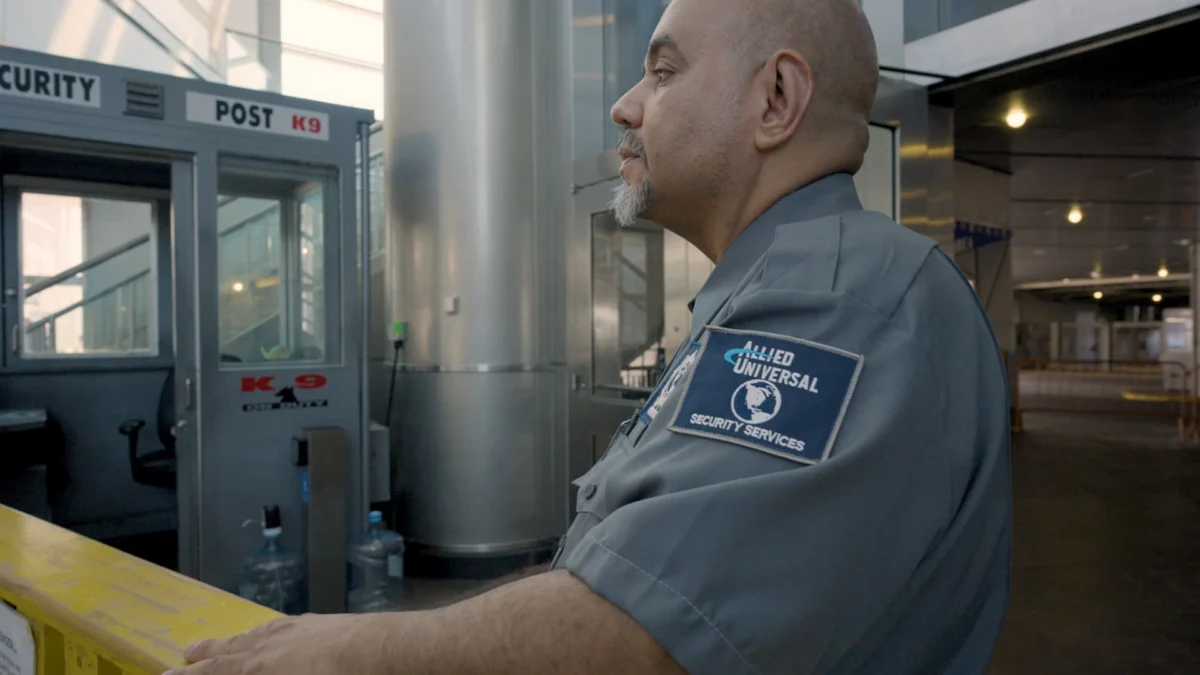
The trendy Hillcrest neighborhood of San Diego, California, once celebrated for its vibrant community and inclusive spirit, has become a stark symbol of a growing unease. In response to a series of unsettling incidents, including acts of violence and hate crimes that have shaken local businesses, the Hillcrest Business Association (HBA) has significantly amplified its investment in private security. This trend reflects a broader national phenomenon: an explosion in spending on protection services, even as official statistics indicate a decline in violent crime rates.
In 2024, HBA members began pooling resources to fund a third-party security service, dedicating approximately $400,000 annually for eight hours of unarmed security guard patrol each day. This commitment is poised to expand further, with plans to allocate an additional $150,000 in the upcoming year to implement a second daily shift. "It’s about setting a tone in the neighborhood," explained Benjamin Nicholls, the HBA’s executive director, emphasizing the proactive stance being taken to ensure a safe and welcoming environment for residents and visitors alike.
This localized initiative in San Diego mirrors a national trend that is proving to be a significant boon for private security firms, most notably Allied Universal. Despite government data consistently showing a substantial decrease in violent crime across the U.S. over recent decades, a series of high-profile incidents targeting businesses, political figures, and community groups has fostered a palpable sense of vulnerability. This heightened perception of risk is driving a dramatic increase in the demand for security services, reshaping the landscape of public and private safety.
The private security sector has experienced remarkable growth, with revenues climbing 17% over the past decade to surpass $50 billion in 2025, according to an analysis by Robert H. Perry & Associates. Outsourced services, encompassing both electronic security systems and manned guarding, now represent a substantial portion of this market, accounting for over $35 billion in the U.S. alone. Industry experts suggest this surge is a direct reflection of the current sociopolitical climate, where escalating political and cultural tensions have created an environment where even seemingly ordinary public spaces are perceived as potential targets for violence.
"Who would have thought 10 years ago that you would need to hire private security at a school board meeting or at a town meeting," remarked Steve Amitay, executive director of the National Association of Security Companies (Nasco), an industry advocacy group. "We live in a very divisive and inflammatory society right now." His observation underscores a sentiment echoed across various sectors, highlighting the pervasive feeling that the need for protective measures has transcended traditional security concerns.
"We’re Everywhere": The Dominance of Allied Universal
At the forefront of this burgeoning personal protection industry stands Allied Universal, a privately held behemoth with operations spanning over 100 countries and an annual revenue of approximately $23 billion. The company’s ubiquitous presence is felt at a vast array of events and locations. Allied Universal guards, identifiable by their distinctive uniforms, are a common sight managing queues, operating metal detectors, and conducting bag inspections at major sporting events, music festivals, and corporate office buildings. The company boasts an impressive client roster, with over 80% of Fortune 500 companies relying on its services. Furthermore, Allied Universal has been instrumental in providing security for globally significant events, including this past summer’s World Cup.
The company’s CEO, Steve Jones, has openly expressed his aspirations for Allied Universal to go public, a move that would further solidify its position in the global market. While a public offering remains a future consideration, Allied Universal emphasized in a statement to CNBC that its immediate focus is on "expanding the business and serving customers," while also continuously assessing the company’s capitalization strategies.
Allied Universal’s sheer scale is staggering. The company positions itself as the seventh-largest private employer globally, with a workforce estimated at roughly 800,000 employees. This workforce is nearly double the size of retail giant Target and more than triple that of entertainment conglomerate Disney. The company’s recruitment efforts are equally impressive, with approximately 65,000 applications received weekly, leading to around 40,000 interviews and approximately 3,500 hires for its North American operations.
"We’re everywhere," stated Glen Kucera, president of Allied Universal’s enhanced protection services division, painting a vivid picture of the company’s widespread deployment. "I can take you down streets where you’re going to have a tough time taking three steps without tripping over one of our dogs." This statement highlights the integration of highly visible security measures, including canine units, into the company’s operational strategy.
In the bustling environment of Lower Manhattan, for instance, Allied Universal’s human-and-canine teams are a constant presence at iconic landmarks such as the Staten Island Ferry terminal and the World Trade Center. During a recent weekday morning at the ferry terminal, Kucera’s guards not only assisted passengers with directions and inquiries but also conducted thorough sweeps with their canine partners, sniffing bags and bicycles for potential explosive threats.
Beyond these overt security measures, Allied Universal employs a sophisticated, multi-layered approach that often goes unnoticed by the general public. The company’s personnel sometimes humorously refer to themselves as more than just "mall cops," a nod to their diverse range of duties. Plainclothes officers discreetly patrol Manhattan’s streets, actively identifying potential dangers. Simultaneously, a dedicated team monitors surveillance cameras from a central command center, equipped to swiftly alert on-site personnel to any emerging threats.
"Everyone sees the overt security measures," acknowledged Justin Kelley, a vice president at Allied Universal, during an interview at a canine training facility in Windsor, Connecticut. Kelley, who possesses over two decades of experience with the Connecticut State Police, emphasized the dual importance of visible deterrence and covert surveillance. "It’s very important to have that physical guard there," he stated. "At the same time, it’s extremely important to have the backstop of the covert security." This integrated strategy aims to provide a comprehensive security net, addressing both immediate threats and potential future risks.
The Drivers of Growing Demand
Industry leaders attribute the escalating demand for private security services to a confluence of factors, including increased corporate investment and evolving insurance mandates. A recent analysis of corporate disclosures by Equilar revealed that approximately 40% of S&P 500-listed firms provided security services to at least some of their executives in 2025, a significant leap from just under 19% in 2019. The median cost of these services also surged dramatically, ballooning by 178% over the same period.
Major corporations such as Walmart and other prominent companies have begun implementing executive security measures for the first time in recent years. In some instances, this protective coverage extends beyond an executive’s tenure. For example, Cracker Barrel disclosed in a regulatory filing that it would continue to cover protective service expenses for its former CEO, Julie Masino.
The trade publication Security, in its annual report based on self-reported data from security leaders, consistently ranks the threat of workplace violence as the top concern for these professionals since 2021. This persistent concern fuels the demand for enhanced security protocols and personnel.
Furthermore, pressure from insurance providers has become a significant catalyst for increased security spending, according to Nasco’s Steve Amitay. Insurers are increasingly viewing the implementation of a comprehensive security plan as a fundamental aspect of a business’s "duty of care," particularly for companies operating in high-risk environments or hosting public events. This shift in perspective compels organizations to invest more robustly in preventative security measures to secure favorable insurance terms and mitigate potential liabilities.
Across the United States, third-party security guards are being deployed to supplement the efforts of law enforcement agencies. In Louisville, Kentucky, city lawmakers enacted a measure in July that mandates businesses operating late at night to hire private security personnel. Similarly, the Public Works Department in Santa Fe, New Mexico, has allocated nearly $1 million for contract security services at various municipal facilities in its current fiscal year, reflecting a growing reliance on private sector solutions to address public safety needs.
"People need to choose their destiny," articulated Jonah Nathan, vice president of Ranger Guard, a Texas-based private security provider. "You are your first responder. You have to mitigate things before you can rely on the local law enforcement groups." This statement encapsulates the prevailing sentiment among many organizations and individuals who feel compelled to take a more proactive role in their own security.
An "Essential Workforce" Facing Challenges
The Bureau of Labor Statistics estimates that nearly 1.3 million Americans were employed as security guards in May 2025, a figure that nearly doubles the number of individuals employed in police and sheriff’s patrol roles. The growth in the security guard workforce has been substantial, surging by over 16% between 2016 and 2025, according to federal data. In contrast, the nationwide police force experienced a more modest growth of around 2% during the same period.
While the total security guard workforce is projected to remain relatively stable through 2034, according to a July report from the UC Berkeley Labor Center, high turnover rates are expected to sustain consistent hiring. The security industry experienced an annual churn rate of 89% in 2024, significantly higher than the average of 66% across private-sector payrolls. This high turnover necessitates continuous recruitment efforts by security companies.
Security firms often promote their roles as vital to social order and relatively immune to automation driven by artificial intelligence. However, the profession also entails inherent safety risks and is characterized by compensation that falls below the average for many other occupations. The mean wage for a security guard was $20.42 per hour, or $42,470 annually, as of May 2025, according to the Bureau of Labor Statistics. This is considerably less than the average income for police and sheriff’s patrol officers, who earned $38.08 per hour or $79,200 annually. Across all occupations tracked by the government, the average worker earned $33.54 per hour or $69,770 per year.
The challenges faced by security guards extend beyond compensation. The UC Berkeley Labor Center report indicates that more than two out of every five security guards lack health insurance through their employer or a family member’s plan. Furthermore, the analysis found that security guards are significantly more likely to die while on duty compared to the average employee across various industries.
"This is an essential workforce that’s being asked to do more and more," stated Enrique Lopezlira, director of the UC Berkeley Center’s Low-Wage Work Program. "Yet the pay, training and other labor standards of the job have not kept up." This disparity highlights a critical issue: the increasing demands placed upon security personnel are not being matched by commensurate improvements in wages, benefits, or professional development.
The critical role of on-site security was tragically underscored at the Islamic Center of San Diego in May, where an armed security guard was among three individuals killed in a shooting incident. Authorities credited the slain guard with slowing the attacker’s progress, potentially preventing a far greater tragedy. The San Diego Police Department reported their officers arrived on the scene within minutes, despite facing staffing shortages. The department subsequently announced a review to determine if low workforce levels impacted their response time to the attack.
Perception Versus Reality: The Paradox of Safety
Despite a consistent downward trend in violent victimizations over the past three decades, with one government-tracked metric plummeting by 71% between 1994 and 2024, public perception of crime remains elevated. The FBI reported an estimated 9% decrease in violent crime in 2025 alone. However, a Gallup poll conducted in October 2025 indicated that nearly half of Americans believe crime is increasing compared to the previous year. Another Gallup survey from March 2025 revealed that approximately two out of every three adults expressed significant worry about crime and violence.
"The most fundamental fact about public perception of crime and violence in the U.S. is that it is nearly always out of step with reality," observed David Kennedy, director of the National Network for Safe Communities and a professor at the John Jay College of Criminal Justice. This disconnect between statistical reality and public sentiment is a key factor driving increased demand for security services.
While homicide rates have fallen, Kennedy notes that they remain higher in the U.S. compared to other developed nations, a disparity he attributes to the relatively lax firearm regulations. Paradoxically, he points out that despite the potential for increased fatalities associated with more guns, many Americans have increasingly turned to firearms as a means of enhancing their personal safety.
Research from Harvard and Northeastern universities found that between 2021 and 2024, over 11 million Americans became first-time gun owners, a number exceeding the combined populations of Maryland and Connecticut. Government data indicates that annual non-military gun production in the U.S. nearly tripled in 2023 compared to two decades prior.
"It’s very simple fundamentally," Kennedy explained. "The less secure people feel, the more likely they are to take steps to protect themselves and their loved ones." This fundamental human instinct for self-preservation, amplified by a heightened sense of insecurity, is a powerful driver behind the current surge in security spending.
Organizations contemplating investments in protective services often look to events like the incident at Temple Israel in March. An attacker drove into the synagogue, which was filled with children. Fortunately, the temple’s in-house security staff responded immediately, and no community members were harmed. Temple Israel leaders lauded their guards as heroes. "It is a miracle that they kept everybody as safe as they did," said Andy Bocknek, the temple’s past president. "Had we not had people who were so committed to the institution, to the people that they see every day, I can’t even imagine what this may have looked like." This testament underscores the invaluable role of dedicated security personnel in safeguarding communities, even in the face of declining overall crime rates.
