

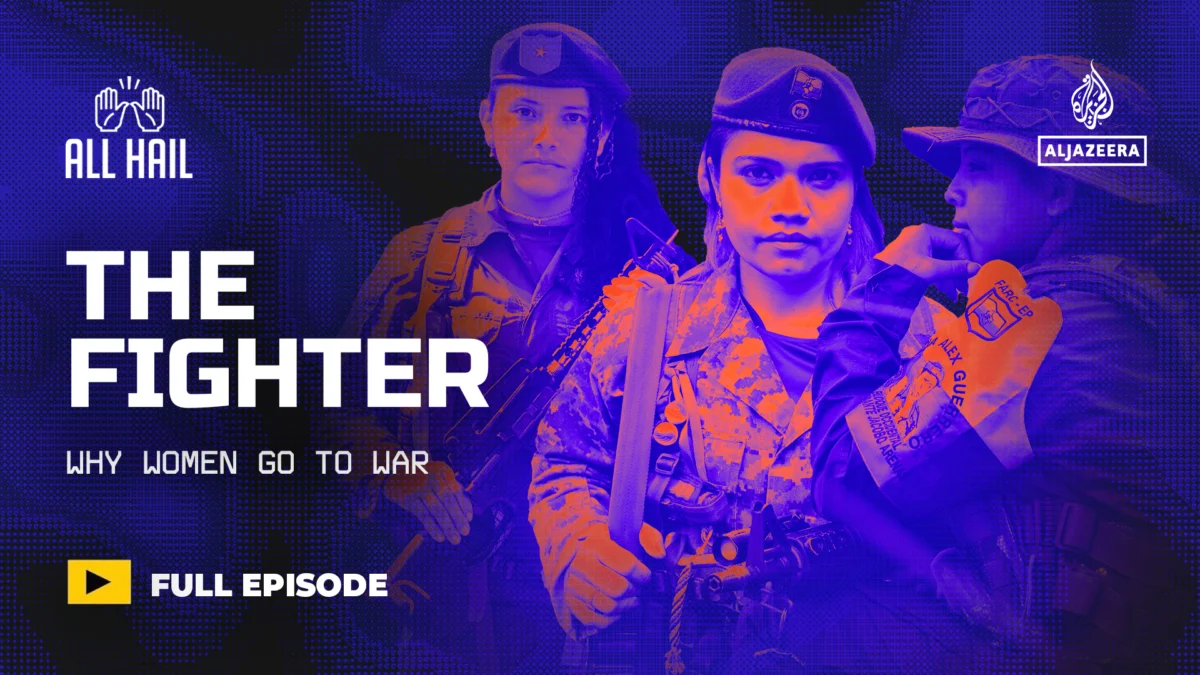
The image of the “fighter” often brings to mind a man, a figure chiselled from centuries of patriarchal narratives that have dominated military history and popular culture. Yet, women have always been present on and around the battlefield — in rebellion, defence, and offence alike. Their contributions, often pivotal and multifaceted, have shaped wars in ways history rarely records, frequently simplified, romanticised, or fetishised in popular narratives. This pervasive historical oversight not only distorts our understanding of past conflicts but also obscures the complex realities of contemporary warfare. Around the world, women consistently make up a far greater share of non-state armed groups and rebellions than of national armies, prompting critical questions: what are the motivations, struggles, and circumstances that drive women to take up arms, and how significant is their impact on how battles are fought and conflicts unfold?
A Legacy of Unsung Contributions: Women Throughout Military History
The notion of women as mere spectators or passive victims in war is a modern construct, largely reinforced by post-industrial societal norms and the institutionalisation of male-dominated national armies. Historically, the lines between combatant and non-combatant, and between men’s and women’s roles, were far more fluid. From ancient times, evidence suggests women’s active participation. Legends of the Amazon warriors, while mythologised, likely drew from real-world Scythian and Sarmatian women, whose burial sites reveal them interred with weapons and battle scars. In ancient Britain, Boudica led a significant rebellion against Roman occupation in 60-61 AD, commanding tribes into battle.
Throughout the medieval period, women often played crucial roles in defending castles during sieges, managing logistics, providing medical care, and even taking up arms when necessary. Joan of Arc, the iconic French peasant girl who led the French army to several important victories during the Hundred Years’ War in the 15th century, is perhaps the most famous example of a woman directly commanding troops, though her story remains an anomaly in official military annals. In later centuries, women frequently disguised themselves as men to enlist, seeking adventure, economic independence, or to follow loved ones into conflict. Deborah Sampson of the American Revolutionary War and Hannah Snell in the 18th-century British military are notable examples, their true identities often revealed only years later.
The 20th century, particularly the two World Wars, saw a dramatic, though often temporary, expansion of women’s roles. While initially relegated to support positions, the scale of conflict demanded their greater involvement. Women worked in munitions factories, drove ambulances, served as nurses on the front lines, and joined resistance movements. The Soviet Union stands out for its extensive deployment of women in combat roles during World War II, including as snipers (like Lyudmila Pavlichenko, credited with 309 kills), pilots, machine gunners, and partisans, often earning the moniker "Night Witches" for their daring aerial raids. This period demonstrated women’s capabilities in direct combat, yet post-war, many nations reverted to traditional gender roles, pushing women out of military service or into strictly auxiliary functions.
Motivations and Pathways to Arms: A Complex Tapestry
The decision for a woman to take up arms is rarely monolithic, often stemming from a confluence of personal, social, economic, and political factors. Unlike the often institutionalised recruitment pathways for men into national armies, women’s entry into conflict, especially within non-state armed groups, can be highly individualised and driven by desperation, conviction, or coercion.
- Survival and Protection: For many, particularly in regions ravaged by prolonged conflict, taking up arms is a direct response to threats against their families and communities. The desire to protect children, secure resources, or defend against sexual violence – which is often used as a weapon of war – can be a powerful motivator. Women in groups like the Kurdish YPJ (Women’s Protection Units) in Syria often cite the defence of their homeland and community from extremist groups like ISIS as their primary reason for fighting.
- Ideology and Political Conviction: Women are equally susceptible to the pull of nationalist, revolutionary, or religious ideologies. They may join movements advocating for self-determination, social justice, or regime change, believing deeply in the cause. Groups such as the Liberation Tigers of Tamil Eelam (LTTE) in Sri Lanka or the Revolutionary Armed Forces of Colombia (FARC) saw significant female participation, with women often holding leadership positions and engaging in direct combat based on shared political objectives.
- Revenge and Justice: The loss of loved ones, the destruction of homes, or personal experiences of violence, particularly sexual violence, can fuel a desire for retribution and justice. For some, joining an armed group offers a tangible way to avenge wrongs and prevent future atrocities, providing a sense of agency in the face of overwhelming trauma.
- Socio-economic Factors and Agency: In contexts where women face severe social restrictions, limited economic opportunities, or entrenched patriarchal norms, joining an armed group can paradoxically offer a pathway to greater autonomy, status, and economic stability. Within the group, they might gain access to education, leadership roles, or a sense of purpose denied to them in civilian life. This pursuit of agency can be a significant, albeit complex, driver.
- Coercion and Abduction: It is crucial to acknowledge that not all participation is voluntary. Women, like men, are often forcibly recruited, abducted, or coerced into armed groups. This is particularly prevalent in conflicts involving child soldiers, where girls are often forced into combat roles, used as human shields, or subjected to sexual slavery. Their "participation" under such circumstances is a grave human rights violation.
The Disparity: National Armies vs. Non-State Armed Groups
A striking feature of women’s involvement in contemporary conflict is the significant disparity between their representation in state-sanctioned national armies and non-state armed groups or rebellions.
National Armies:
While most developed nations have opened military service to women, their integration into combat roles has been a gradual and often contentious process. As of 2023, women constitute approximately 15-18% of the armed forces in countries like the United States, 11-12% in the United Kingdom, and around 18% in Canada and Australia. Israel, known for its mandatory military service for both men and women, has a higher percentage of women in uniform (around 33%), though restrictions on direct combat roles have historically existed, only recently being relaxed to allow women into more frontline positions.
The journey towards full integration in national armies is fraught with challenges. Women often face institutional barriers, cultural resistance, and implicit biases. Issues such as sexual harassment and assault, unequal opportunities for promotion, and the "glass ceiling" remain prevalent. Debates often revolve around physical standards, unit cohesion, and the perceived psychological impact of women in combat. Despite these hurdles, the trend in most Western militaries is towards greater inclusion, driven by evolving societal norms, legal challenges, and the recognition of diverse talent pools.
Non-State Armed Groups and Rebellions:
In stark contrast, women’s participation in non-state armed groups often reaches much higher proportions, sometimes comprising 30-50% or more of a fighting force. Research by institutions like the Geneva Centre for Security Sector Governance (DCAF) and UN Women consistently highlights this trend. Groups such as the PKK (Kurdistan Workers’ Party), LTTE, and various insurgent groups in Africa and Latin America have historically integrated women extensively, often placing them in direct combat, intelligence gathering, and even leadership roles.
The motivations for this higher proportional involvement are multifaceted. Non-state groups often operate outside traditional societal structures, allowing for more fluid gender roles out of necessity. They may actively recruit women to swell their ranks, garner broader community support, or present a more inclusive image. Furthermore, as discussed, the desperate circumstances of insurgency, where entire communities are mobilised, mean that women are often as directly affected by conflict as men, and thus equally motivated to fight for survival or ideological goals. In these contexts, the traditional distinctions between civilian and combatant often blur, and women may find themselves taking up arms simply as a matter of course for community defence.
Impact on Battlefields and Conflict Dynamics
The presence of women on the battlefield is not merely a demographic shift; it has tangible impacts on tactical operations, strategic objectives, and the overall dynamics of conflict.
- Tactical Advantages: Women can offer unique operational advantages. In many cultural contexts, they can move through communities and gather intelligence with less suspicion than men. They can be particularly effective in psychological operations, sometimes used to provoke or disarm adversaries. There is no evidence to suggest women are inherently less capable in combat, with numerous examples of women excelling as snipers, saboteurs, and frontline fighters.
- Strategic Significance: The inclusion of women can lend legitimacy to an armed group, both domestically and internationally. It can signal a commitment to social change and inclusivity, potentially broadening the movement’s appeal and recruitment base. In some cases, women’s participation can be leveraged for propaganda purposes, presenting an image of a fully mobilised and determined population.
- Challenges and Unique Vulnerabilities: Despite their contributions, women in armed conflict face specific challenges. They are disproportionately vulnerable to sexual violence, both from enemy forces and, disturbingly, sometimes from within their own ranks. The trauma associated with combat is compounded by gender-specific vulnerabilities, often leading to complex psychological and physical health issues. Reintegration into post-conflict societies can also be particularly difficult for female combatants, who may face stigmatisation, rejection from families, and a lack of support services tailored to their unique needs. The skills they acquired in conflict may not be easily transferable to civilian life, and the societal roles they transcended during wartime may be reimposed upon their return.
Societal Perceptions and Media Narratives: Beyond Simplification
Popular narratives often struggle to accurately portray women’s roles in conflict, frequently resorting to simplification or fetishisation. The "female fighter" is often cast into one of two archetypes: the "reluctant warrior" forced into arms by dire circumstances, or the "bloodthirsty Amazon" who defies gender norms in a sensationalised manner. Both tropes strip women of their complex motivations, agency, and individual experiences.
Media coverage often sensationalises female combatants, focusing on their gender rather than their military capabilities or political motivations. This can lead to a dehumanisation that either diminishes their role or exoticises it, rather than treating them as equally capable actors in conflict. When women fight for groups deemed "terrorist" by Western powers, they are often portrayed as inherently more dangerous or misguided, whereas women fighting for allied forces are celebrated as heroines. This dichotomy underscores the political lens through which female combatants are viewed, further complicating objective understanding. This simplification impacts how post-conflict societies deal with female ex-combatants, often making their reintegration and recognition of their experiences more challenging.
Expert Perspectives and Policy Implications
Academics and practitioners in gender and conflict studies, military sociology, and international humanitarian law have increasingly focused on women’s roles in conflict, offering crucial insights and policy recommendations.
- Gender and Conflict Studies: This field highlights how women’s participation challenges traditional understandings of war, peace, and security. It underscores that conflict is a gendered experience, affecting men and women differently, and that understanding these differences is vital for effective peacebuilding and post-conflict recovery. Scholars like Cynthia Enloe have pioneered work on how militarism impacts women’s lives globally, exposing the hidden complicities and power structures.
- Military Doctrine and Effectiveness: Military strategists are increasingly recognising that diverse forces, including gender-integrated units, can enhance operational effectiveness through varied perspectives, improved intelligence gathering, and better engagement with local populations. However, this also necessitates adapting training, equipment, and support systems to accommodate the physiological and psychological differences between men and women, moving beyond a one-size-fits-all approach.
- International Humanitarian Law (IHL): IHL provides protection for all individuals in armed conflict, regardless of gender. However, specific provisions and interpretations are necessary to address gender-specific violations, such as sexual violence as a weapon of war, and to ensure that female combatants receive the same protections as their male counterparts, including fair treatment as prisoners of war.
- Security Sector Reform (SSR) and Gender Mainstreaming: Post-conflict security sector reform efforts are increasingly incorporating gender mainstreaming approaches. This involves ensuring that women are represented in police forces, military, and justice systems, and that security policies are designed to address the specific needs and vulnerabilities of women and girls. This approach aims not only to enhance the effectiveness and legitimacy of security institutions but also to promote broader societal gender equality.
Join Ali Rae in Episode Four of All Hail the Military — a five-part series that reveals the systems, power, and hidden complicities that sustain global militarism — and the profound impact it has on us all. This episode delves into the often-overlooked experiences of women in conflict, from their motivations for taking up arms to their enduring impact on how battles are fought and societies are shaped by war. By exploring these narratives, we begin to dismantle the narrow, male-centric view of warfare and embrace a more comprehensive understanding of militarism’s true reach. The acknowledgment of women’s pervasive and diverse roles in conflict is not merely about historical revisionism; it is essential for developing effective security policies, fostering genuine peace, and building more equitable societies in the shadow of war.
