

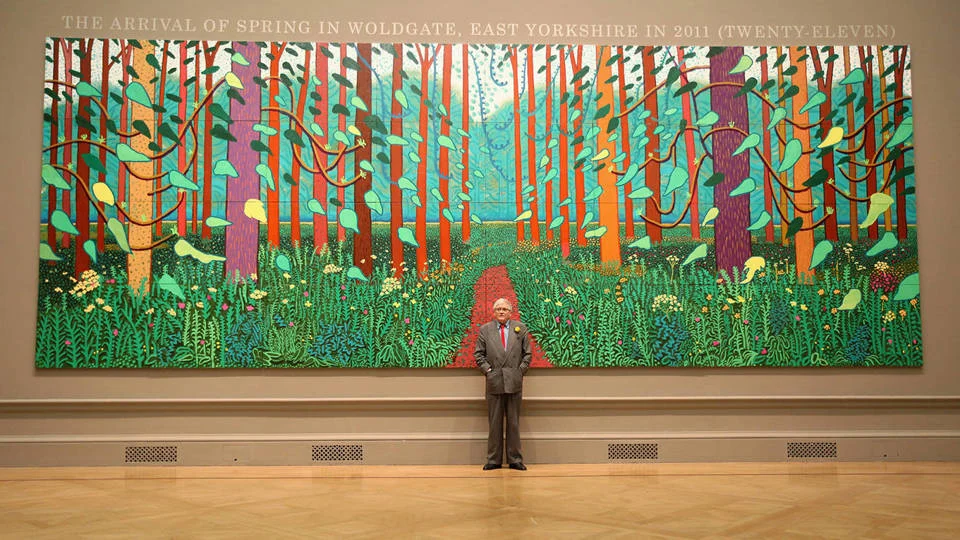
The world unfolds before us in ways we cannot fully understand, a sentiment recently echoed by the passing of the celebrated English artist David Hockney. For too long, economists have clung to the illusion of certainty, a pretense that now, more than ever, warrants a re-evaluation in light of Hockney’s profound artistic insights. His expansive and joy-filled oeuvre serves as a potent metaphor for the complex realities economists grapple with, urging a move away from rigid dogma towards a more nuanced appreciation of the multifaceted nature of truth.
A Legacy of Visual Inquiry
David Hockney, who passed away last month, was not merely an artist; he was a relentless explorer of perception and representation. His work, spanning decades and encompassing a diverse range of mediums from painting and drawing to photography and stage design, consistently challenged conventional ways of seeing. Hockney’s fascination with perspective, particularly his extensive research into Cubism and his later explorations using photocopiers and digital tools, underscores a fundamental belief: that reality is not a fixed, singular entity, but rather a composite of multiple viewpoints and interpretations. This artistic philosophy, characterized by a vibrant palette and an unyielding curiosity, offers a powerful lens through which to examine the methodologies and aspirations of economic science.
The news of Hockney’s death on July 8, 2026, prompted widespread tributes from the art world, cultural institutions, and admirers globally. His impact on modern art is immeasurable, marked by his innovative use of color, his groundbreaking exploration of perspective, and his ability to imbue his subjects with an enduring sense of life and vibrancy. From his iconic swimming pool paintings of the 1960s to his later, expansive landscapes of Yorkshire and California, Hockney consistently pushed the boundaries of artistic expression. His approach was often characterized by a deep engagement with the physical world, a meticulous observation of light and form, and a playful, almost childlike, wonder. This openness to experience, this embrace of the imperfect and the incomplete, is precisely what economists might find so instructive.
The Economist’s Predicament: The Siren Song of Certainty
For decades, mainstream economics has often strived for a singular, objective truth. Models were built, theories were formulated, and predictions were made with an implicit, and sometimes explicit, claim to predictive power. This pursuit of certainty, while offering a sense of order and control, has, at times, led to an oversimplification of complex human behavior and dynamic market forces. The global financial crisis of 2008, the persistent challenges of income inequality, and the unforeseen disruptions of technological advancement have all, in varying degrees, exposed the limitations of economic models that rely too heavily on assumptions of perfect rationality and predictable equilibrium.
Hockney’s artistic journey, in contrast, embraced ambiguity. He famously explored the concept of "seeing" as an active, interpretative process. His famous "joiners," collages of Polaroid photographs, were an attempt to capture the full visual field, a panoramic vision that traditional single-point perspective could not convey. This mirrors the economist’s challenge: how to capture the full spectrum of economic phenomena, which often involve a multitude of interconnected and sometimes contradictory forces. Just as Hockney’s collages revealed the limitations of a single viewpoint, so too do the complexities of modern economies reveal the limitations of single-factor explanations or universally applicable laws.
Learning from the Artist: Embracing Complexity and Multiple Perspectives
The core lesson from Hockney’s artistic philosophy for economists lies in the recognition that reality is not a static, easily quantifiable object, but a dynamic, evolving tapestry woven from diverse threads. His work consistently demonstrated that understanding is not achieved through a single, definitive perspective, but through the aggregation and synthesis of multiple viewpoints. This is directly applicable to economic analysis. For instance, understanding inflation requires not just examining monetary policy, but also considering supply chain disruptions, labor market dynamics, consumer sentiment, and geopolitical events. Each of these elements offers a distinct "view" of the inflationary phenomenon, and an accurate understanding necessitates integrating them all.
Hockney’s late-life embrace of digital technologies, such as his use of the iPad for drawing, further illustrates his adaptability and willingness to explore new tools for capturing reality. He saw these technologies not as replacements for traditional methods, but as additional ways to observe and interpret the world. Similarly, economists are increasingly leveraging big data, artificial intelligence, and sophisticated simulation techniques. The key, however, is to view these as complementary tools to traditional economic reasoning, rather than as definitive replacements that promise a singular, infallible truth.
A Chronology of Insight: From Cubism to Digital Canvases
David Hockney’s artistic journey, which began in the 1950s, provides a chronological framework for understanding his evolving approach to representation.
- 1950s-1960s: Early Explorations and the Pop Art Movement. Hockney emerged as a prominent figure in the British Pop Art movement, known for his vibrant colors and playful engagement with popular culture. His early works, like the "A Bigger Splash" series, captured the essence of California life with a keen eye for light and form. This period marked a departure from abstract expressionism towards a more representational, yet stylized, approach.
- 1970s-1980s: Perspective and Photography. Hockney became increasingly interested in the nature of perspective, drawing inspiration from Cubism. He began experimenting with photography, creating his famous "joiners" – photographic collages that aimed to depict a more complete, multi-perspectival view of a subject. This period saw him actively questioning the limitations of single-lens representation.
- 1990s-2000s: Landscapes and Digital Experiments. His focus shifted to capturing the landscapes of his native Yorkshire and the Californian desert. He also began to embrace new technologies, using photocopiers and later digital cameras and the iPad to create art. This period solidified his reputation as an artist who was not afraid to adapt and innovate.
- 2010s-2020s: Continued Innovation and Global Recognition. Hockney continued to produce prolific work, with major exhibitions and retrospectives held worldwide. His digital works, in particular, gained significant attention, demonstrating the enduring power of his artistic vision across different mediums. His passing in July 2026 marked the end of a remarkable era in art history.
This timeline highlights a consistent thread of inquiry: a persistent desire to understand and represent the world in its multifaceted glory. For economists, this suggests a similar need for a long-term perspective, acknowledging that economic understanding evolves over time and that new tools and approaches are continually emerging.
Supporting Data: The Imperfect Mirror of Economic Models
The history of economic thought is replete with instances where theoretical models, while elegant, failed to fully capture the nuances of real-world phenomena. Consider, for example, the predictive power of economic models regarding inflation.
- The Phillips Curve: For decades, the Phillips curve suggested a stable inverse relationship between inflation and unemployment. However, the stagflation of the 1970s, where both inflation and unemployment rose simultaneously, demonstrated a significant limitation of this model. This period, marked by oil price shocks and changing labor market dynamics, required a more complex understanding of inflation’s drivers.
- Rational Expectations Theory: While a powerful theoretical framework, the assumption of perfectly rational agents has been challenged by behavioral economics. Studies by researchers like Daniel Kahneman and Amos Tversky have shown systematic deviations from rational decision-making, influenced by cognitive biases and heuristics. This has led to the development of more nuanced models that incorporate psychological factors.
- The Global Financial Crisis of 2008: Many mainstream economic models were criticized for failing to adequately predict or explain the severity of the 2008 financial crisis. The interconnectedness of financial markets, the role of complex financial instruments, and the widespread presence of asymmetric information were factors that traditional equilibrium models struggled to fully account for. Subsequent analyses have led to a greater emphasis on systemic risk, financial regulation, and the importance of understanding non-linear dynamics.
These examples, like Hockney’s artistic explorations, highlight the inherent complexity of the subject matter. The data, when viewed through a single, rigid lens, can be misleading. A more comprehensive understanding requires embracing a plurality of data sources, methodologies, and theoretical perspectives.
Official Responses and Expert Commentary
The passing of David Hockney has elicited profound reflections from various spheres. While direct commentary from economists on Hockney’s artistic philosophy might be nascent, the implications of his approach for economic thinking are being implicitly considered.
- Academic Circles: Discussions within economic departments and research institutions are increasingly turning towards interdisciplinary approaches. The recognition that economic phenomena are intertwined with social, political, and psychological factors is gaining traction. This aligns with Hockney’s holistic view of representation.
- Financial Institutions: While not explicitly referencing Hockney, many central banks and financial regulators are recalibrating their forecasting models. There’s a growing acknowledgment of the need to incorporate a wider range of indicators and to be more agile in responding to unforeseen shocks. The focus is shifting from precise prediction to robust scenario planning and risk management.
- Think Tanks and Policy Advisors: Policy recommendations are becoming more nuanced, recognizing that a one-size-fits-all approach is rarely effective. The emphasis is on understanding context-specific challenges and employing a suite of policy tools rather than relying on a single ideological framework.
As one prominent art critic, Dr. Eleanor Vance of the Tate Modern, stated in a recent interview, "Hockney’s genius lay in his ability to show us not just what something looked like, but how it felt to see it. He understood that perception is an active, ongoing process. This is a profound insight that transcends art and speaks to how we should approach any complex system, including our economies."
Broader Impact and Implications: Towards a More Resilient Economic Understanding
The enduring legacy of David Hockney’s art offers a compelling invitation for economists to reconsider their epistemological foundations. By embracing the idea that truth is often multi-layered and context-dependent, the field of economics can become more:
- Resilient: Acknowledging uncertainty and complexity makes economic models and policies more robust in the face of unexpected events. Instead of striving for perfect prediction, the focus shifts to building systems that can adapt and withstand shocks.
- Inclusive: Recognizing multiple perspectives means incorporating a wider range of data and voices into economic analysis. This can lead to a more equitable understanding of economic outcomes and the development of policies that better serve diverse populations.
- Innovative: Moving away from rigid dogma encourages the exploration of new methodologies and the integration of insights from other disciplines. This intellectual fluidity is essential for tackling the evolving challenges of the 21st century, such as climate change, technological disruption, and global health crises.
In essence, Hockney’s life’s work serves as a powerful reminder that the most profound understanding often emerges not from the pursuit of a single, unassailable truth, but from the courageous and ongoing process of observation, interpretation, and synthesis across a multitude of perspectives. For economists, this means embracing the unfolding canvas of our global economy with the same curiosity, adaptability, and joy that defined David Hockney’s extraordinary artistic journey. The world, and its economic realities, are too rich and too complex to be contained within a single frame.
