

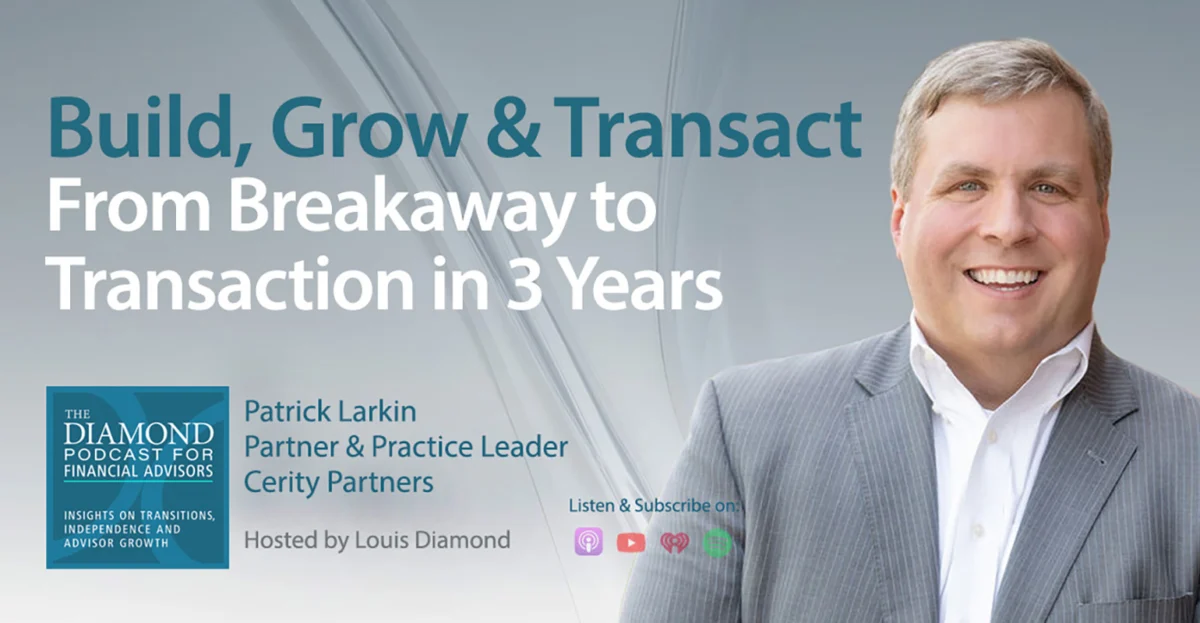
Patrick Larkin’s journey in the financial advisory world has defied conventional expectations, transforming the notion of independence from a final destination into a pivotal starting point. What began as a bold leap to establish Oak Hill Wealth Advisors in 2022, after nearly 15 years with established giants like AG Edwards, Wachovia, and Wells Fargo, evolved into a strategic decision to merge with Cerity Partners just three years later. This unconventional path, detailed in a recent "Build Grow & Transact" series conversation with Louis Diamond, CEO of Diamond Consultants, offers profound insights into the evolving landscape of wealth management, the true meaning of enterprise value, and the strategic optionality that ownership can unlock.
Larkin’s initial objective was clear: to build a business on his own terms, free from the constraints of a large corporate structure. Like many advisors contemplating the transition to independence, the assumption was that this newfound autonomy would represent a long-term endgame. However, the experience of ownership proved to be a transformative catalyst, fundamentally altering his perspective not just on economics, but on the very nature of building and valuing a financial advisory firm.
"Going independent is often viewed as the destination," Louis Diamond reflected. "But Patrick discovered it was just the beginning. His experience is a powerful illustration of how ownership fundamentally changes the way you think about enterprise value."
The Genesis of Oak Hill Wealth Advisors
The decision to leave a secure role at Wells Fargo and embark on the entrepreneurial path in 2022 was driven by a desire for greater control and the ability to shape a client-centric practice without corporate mandates. The establishment of Oak Hill Wealth Advisors marked a significant personal and professional milestone, representing years of accumulated client relationships and a vision for a more personalized advisory model. The industry data at the time supported the growing trend of advisor independence. In 2022 alone, industry reports indicated a significant number of advisors were making the move to independent Registered Investment Advisor (RIA) models, seeking greater equity and operational flexibility. This exodus was fueled by a desire to escape the sales-driven cultures of wirehouses and to build firms aligned with their core fiduciary principles.
However, the narrative of independence as a permanent sanctuary began to shift for Larkin as inquiries from potential acquirers started to surface sooner than anticipated. These conversations, rather than being a distraction, became a profound educational experience.
A Paradigm Shift: From Book of Business to Enterprise Value
The crucial realization came during discussions with prospective buyers. Larkin discovered that these sophisticated entities were not merely interested in acquiring a "book of business"—a collection of client accounts and revenue streams. Instead, they were evaluating Oak Hill as a true "business"—an integrated enterprise with scalable operations, robust infrastructure, a strong team, and a clear growth trajectory beyond the founder.
"A conversation with a prospective acquirer revealed that buyers weren’t interested in purchasing a book of business—they were looking for a business," Diamond elaborated. "That realization reshaped how he invested, hired, delegated, and ultimately positioned his firm for the future."
This insight marked a critical inflection point. It shifted Larkin’s strategic focus from maximizing immediate profitability or client retention in the short term to cultivating a firm with enduring value and systemic strength. This meant investing in technology that enhanced efficiency and client experience, building a high-performing team capable of operating independently, and implementing clear delegation protocols to foster a culture of shared responsibility. The concept of "enterprise value" in the RIA space has become increasingly sophisticated, moving beyond simple revenue multiples to encompass factors like recurring revenue, recurring profitability, operational efficiency, client retention rates, and the strength of the management team. Buyers are increasingly looking for firms that are not reliant solely on the founder’s personal relationships.
The Strategic Merger: A Leap Towards Enhanced Optionality
The strategic decision to merge with Cerity Partners, a rapidly growing RIA with significant scale and resources, was not an admission of failure or a forced exit strategy. Instead, it was a proactive move driven by the redefined understanding of enterprise value and the desire to accelerate the firm’s trajectory. By joining forces with Cerity Partners, Larkin aimed to leverage the larger organization’s infrastructure, compliance expertise, investment capabilities, and operational efficiencies. This merger, completed in approximately three years from Oak Hill’s inception, provided a platform for enhanced client service, broader service offerings, and greater opportunities for his team.
The timing of the merger, so soon after establishing an independent practice, underscores the dynamic nature of the wealth management industry and the strategic thinking required to navigate it. While many advisors envision a long tenure as independent principals before considering an exit or succession plan, Larkin’s experience suggests that early strategic partnerships can be equally, if not more, valuable.
Life After the Merger: Balancing Autonomy and Resources
The conversation between Diamond and Larkin delved into the intricacies of life post-merger. A critical aspect discussed was the evaluation of cultural fit between Oak Hill and Cerity Partners. Successful mergers hinge not only on financial synergies but also on the alignment of values, operational philosophies, and team dynamics. Larkin shared his insights on how to assess this crucial element, ensuring a smooth integration that benefits both clients and employees.
Balancing autonomy with the resources of a larger organization was another key theme. While independence offers ultimate control, a larger firm like Cerity Partners can provide access to advanced technology, sophisticated compliance frameworks, robust marketing support, and a wider array of investment solutions that might be challenging for a smaller, standalone RIA to replicate. The challenge, and opportunity, lies in harnessing these resources while maintaining the personalized touch and entrepreneurial spirit that defined Oak Hill.
"More broadly, it illustrates how ownership creates optionality—and why the most valuable decision an advisor makes may not be the one they originally envisioned," Diamond observed. This statement encapsulates the essence of Larkin’s journey. The initial decision to go independent created the foundational ownership that, in turn, provided the strategic option to merge from a position of strength, thereby enhancing the long-term value proposition for all stakeholders.
Broader Implications for the Advisory Industry
Patrick Larkin’s story provides a compelling case study for financial advisors contemplating their own paths. It challenges the traditional narrative of independence as the ultimate, static goal and highlights the power of strategic evolution.
- The Evolving Definition of "Business": The insight that buyers seek a "business" rather than just a "book of business" is critical. Advisors looking to build long-term value must focus on building scalable, well-managed operations with strong leadership and diversified revenue streams, not solely on client relationships.
- Ownership as a Catalyst for Value Creation: The very act of owning an RIA, even for a short period, can significantly increase its intrinsic value. This is due to the operational improvements, strategic focus, and enhanced team dynamics that ownership often necessitates.
- Strategic Optionality: Independence creates options. Whether that option is to remain independent indefinitely, to recruit and grow, or to strategically merge, ownership provides the leverage to make choices that best serve the advisor, their clients, and their families.
- The Importance of Cultural Fit in Mergers: Larkin’s emphasis on cultural alignment underscores that successful M&A activity in the RIA space requires more than just financial due diligence. A shared vision and compatible working environment are paramount for long-term success.
- The Rise of Sophisticated Buyers: The market for RIA acquisitions continues to mature. Buyers are increasingly sophisticated, looking for well-structured businesses with clear growth potential and strong management teams. This trend favors advisors who are building their firms with an eye toward future valuation and strategic positioning.
The financial advisory industry is undergoing a period of significant consolidation and transformation. Advisors who can adapt their strategies, embrace new models, and understand the evolving metrics of enterprise value are best positioned for success. Patrick Larkin’s journey, from establishing Oak Hill Wealth Advisors to strategically merging with Cerity Partners, serves as a powerful testament to the fact that the most impactful decisions are often those that create future opportunities, even if those opportunities diverge from the original plan.
The podcast episode, part of the "Build Grow & Transact" series, offers a detailed exploration of these themes. Listeners can download a transcript of the episode and access more content from The Diamond Podcast for Financial Advisors, which focuses on insights into transitions, independence, and advisor growth. Louis Diamond’s expertise, honed through guiding numerous successful transitions and growth strategies, provides valuable context for advisors navigating the complexities of today’s wealth management landscape. His background, which includes roles at Ernst & Young, Morgan Stanley, and UBS, coupled with his magna cum laude degree from George Washington University, equips him with the business acumen and analytical skills necessary to advise on intricate multi-generational teams and independent business owners seeking accelerated growth through mergers, acquisitions, and strategic recruiting.
Related Content and Further Resources
The discussion around strategic growth and technological adoption in the RIA space is ongoing. Recent related content highlights the increasing importance of artificial intelligence for RIAs, as discussed by Ryan Belanger on The Diamond Podcast. Additionally, insights from firms like Cyndeo, which operates at a significant scale, offer perspectives on how to think and strategize like a much larger entity, even at smaller asset levels. These discussions collectively paint a picture of an industry in flux, where strategic thinking, adaptability, and a clear understanding of value creation are paramount for advisors seeking to thrive in the years ahead.
