

For entrepreneurs and business owners charting a course for significant expansion, the decision to integrate professional management into their leadership ranks often brings a fundamental question into sharp focus: what is the true cost of top-tier executive talent? This transition, particularly for founders who have personally steered their companies through years of development, can necessitate a profound recalibration of how executive compensation is perceived and structured. The compensation packages required to attract and retain experienced presidents, Chief Financial Officers (CFOs), and Chief Operating Officers (COOs) can substantially exceed the salaries historically paid to themselves or their early-stage leadership teams. Even seasoned CEOs, who often benefit from substantial equity incentives, may find it prudent to offer higher compensation to secure executives possessing critical, growth-enabling capabilities.
Recent research from Chief Executive Group offers a detailed examination of executive compensation within U.S. private companies, illuminating the significant financial commitment required for senior leadership and demonstrating a clear upward trajectory in these figures as companies scale. The findings, detailed in the 2026-2027 CEO & Senior Executive Compensation Report, reveal that in 2025, the median total compensation for presidents of U.S. private companies reached $354,608. Chief Operating Officers (COOs) earned a median of $282,940, while Chief Financial Officers (CFOs) commanded a median of $272,434. While these national averages provide a valuable baseline, a deeper dive into the data, segmented by company revenue, reveals a more nuanced and often considerably higher financial landscape for businesses aiming for the next echelon of growth.
The Escalating Investment in Leadership as Companies Grow
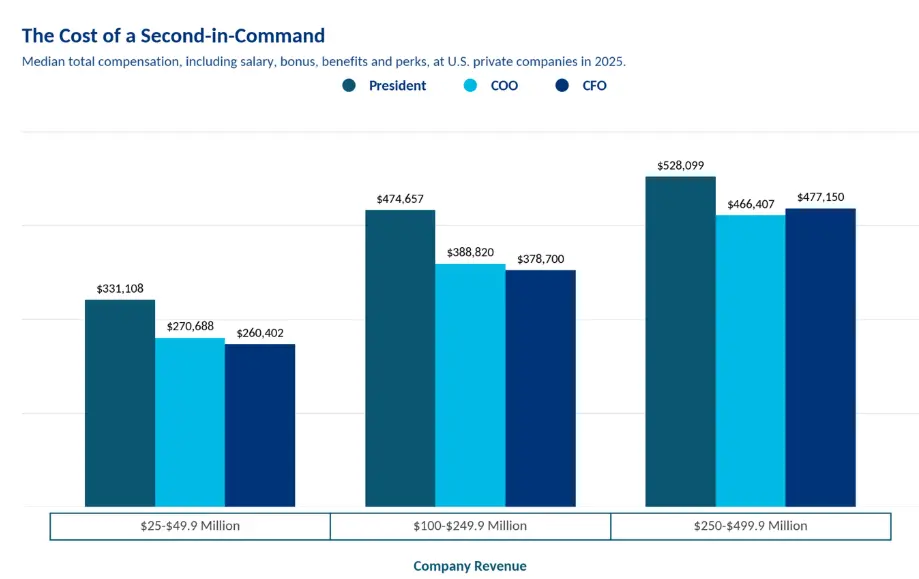
The Chief Executive Group’s report underscores a critical correlation between company size and executive compensation. For private companies generating between $25 million and $49.9 million in annual revenue, the median total compensation for presidents stood at $331,108 in 2025. COOs in this revenue bracket received a median of $270,688, and CFOs, $260,402. These figures, while substantial, represent an entry point into the realm of professional executive compensation.
As companies ascend to higher revenue tiers, the investment in senior leadership escalates significantly. In organizations with annual revenues ranging from $100 million to $249.9 million, the median total compensation for presidents rose to $474,657. COOs in this segment earned a median of $388,820, and CFOs, $378,700. The trend continues its upward climb for even larger enterprises. Companies reporting annual revenues between $250 million and $499.9 million saw median compensation for presidents reach $528,099. COOs in this bracket earned a median of $466,407, and CFOs, $477,150.
It is crucial to understand that these median figures encompass a comprehensive compensation structure, including base salary, bonuses, equity awards, benefits, and other perquisites. Furthermore, these are medians, representing the midpoint of compensation. They do not necessarily reflect the compensation required to attract an executive with exceptional experience, specialized skills, or a proven track record in a particular niche. For instance, within the $100 million to $249.9 million revenue bracket, the top quartile of total compensation for CFOs reached an impressive $596,198, significantly exceeding the $378,700 median. This data point strongly suggests that business owners and CEOs should budget for executive hires based on the higher end of compensation ranges, rather than the midpoint, as a considerable portion of the market already operates above the median.
The Strategic Imperative: Aligning Capabilities with Compensation
The challenge for founders and CEOs extends beyond simply affording a higher cash compensation for a new executive. The core task lies in accurately identifying the specific capabilities a business requires for its next phase of growth and then determining the market value of those capabilities. Often, bringing in a key executive with experience gained at larger, higher-paying organizations can be a strategic move to infuse the company with the expertise needed to achieve ambitious growth targets.
Consider the scenario of a company looking to expand into new international markets. This might necessitate a president with a demonstrated history of managing larger, more complex global operations. For a founder preparing for a potential sale or seeking substantial outside investment, a CFO with deep expertise in intricate financing structures, regulatory reporting, transaction execution, and capital raising becomes indispensable. Similarly, a rapidly growing manufacturing firm might require an operations leader who can instill greater discipline and efficiency into production processes and supply chain management. Each of these roles presents a distinct compensation puzzle, demanding a tailored approach to attract the right caliber of talent.
The Chief Executive Group’s research also highlights that compensation packages are not monolithic; they vary significantly based on industry, ownership structure, and profitability. For example, private equity-backed companies often distinguish themselves by offering more aggressive compensation structures, particularly through performance-based bonuses and equity incentives, compared to many other privately held businesses. This competitive landscape means that founders vying for the same pool of top executive talent may need to look beyond base salary alone. Innovative approaches, such as performance bonuses tied to key growth metrics, long-term incentive plans that reward the creation of enterprise value, or other creative remuneration strategies, become essential tools for attracting and retaining high-caliber leaders.
Rethinking the Benchmark: Beyond the Founder’s Paycheck
A fundamental distinction often exists between founders and hired senior executives: a significant ownership stake in the business. This difference is paramount when evaluating compensation packages. The salary and short-term compensation elements that a founder draws from the company may represent only a portion of their overall financial return, which is intrinsically linked to the long-term appreciation of their equity. A hired senior executive, without an equivalent ownership interest, will likely assess an opportunity through a different financial lens, prioritizing immediate and predictable financial rewards.
There is no one-size-fits-all formula for determining the appropriate compensation for a second-in-command executive, and simply offering a higher salary does not inherently guarantee superior leadership. However, as chief executives contemplate the future trajectory of their companies and plan for the next phase of growth, using their own compensation as the primary benchmark for hiring new executives can be a flawed approach.
A more effective and strategic question to ask is: "What do comparable companies, operating at a similar scale and in similar industries, pay for the specific capabilities we need?" Furthermore, how can compensation be structured to directly align with and incentivize the achievement of the business’s most critical growth objectives and desired outcomes? This forward-looking perspective, grounded in market realities and strategic imperatives, is essential for building a leadership team capable of driving sustainable and significant expansion.
The Chief Executive Group’s 2026-2027 CEO & Senior Executive Compensation Report serves as an invaluable resource for this process, offering detailed benchmarks for presidents, COOs, CFOs, and other senior executives. These benchmarks are meticulously broken down by company size, industry, ownership structure, and performance metrics, providing the data-driven insights necessary for informed compensation decisions. By understanding the nuances of executive compensation in the private company landscape, leaders can make more strategic hires, ensuring they are not only meeting but exceeding their growth ambitions.
The Broader Implications for Business Growth
The insights from the Chief Executive Group report have significant implications for the future of private company growth. As the economic landscape continues to evolve, with increasing complexity and competition, the demand for highly skilled and experienced executive leadership will only intensify. Companies that fail to accurately assess and appropriately compensate for these critical roles risk stagnation or even regression.
The data suggests a maturing private company ecosystem, where the "founder-centric" model is increasingly giving way to a more professionalized approach to management. This shift is driven by the recognition that scaling beyond a certain point requires specialized expertise that founders may not possess, or that their time is better allocated to strategic vision rather than day-to-day operational leadership. The investment in executive talent, therefore, is not merely an expense but a strategic imperative, a foundational element for achieving sustainable growth and long-term value creation.
Furthermore, the report implicitly underscores the importance of robust HR and compensation strategy development within private companies. As these organizations mature, formalizing compensation structures, developing clear performance metrics, and understanding market dynamics become as crucial as product development or sales strategies. The ability to attract and retain top talent directly impacts a company’s capacity to innovate, execute, and ultimately, outmaneuver competitors.
For private equity firms and venture capitalists, the detailed compensation data provides crucial intelligence for portfolio company management. Understanding prevailing compensation norms allows for more effective negotiations, better talent acquisition strategies, and ultimately, improved financial performance across their investments. It reinforces the principle that human capital is a critical driver of financial returns.
In conclusion, the journey of a private company from its nascent stages to a significant market player is often defined by its ability to attract and retain the right leadership. The Chief Executive Group’s latest report offers a vital roadmap, demystifying the often-opaque world of executive compensation and providing the concrete data needed for strategic decision-making. As businesses navigate the complexities of growth, embracing a data-informed and market-aware approach to executive remuneration will be paramount to unlocking their full potential.
