

The integration of artificial intelligence (AI) into the Registered Investment Advisor (RIA) industry is a complex landscape, marked by varying degrees of adoption and strategic implementation. While the allure of AI’s efficiency and analytical power is undeniable, a recent analysis by Caddi Technologies, an AI-native workforce provider for professional services, sheds critical light on what distinguishes firms making tangible progress in AI adoption from those still in the nascent stages. The overarching finding points to a single, crucial prerequisite: the designation of clear ownership for AI initiatives.
Caddi Technologies, distinct from the physical design and manufacturing platform CADDi Co., has undertaken a comprehensive study to gauge the pulse of AI integration within the RIA sector. Their research methodology involved an in-depth analysis of publicly available Securities and Exchange Commission (SEC) Form ADV data to identify the 455 largest independent wealth management RIAs by Assets Under Management (AUM). This was followed by an examination of LinkedIn job postings since late 2023 and a review of the LinkedIn profiles of current employees within these firms. This data-driven approach aimed to uncover patterns in hiring and role designation that correlate with AI adoption.
The Crucial Role of AI Ownership
According to Caddi CEO Alejandro Castellano, the firms that are successfully navigating the complexities of AI implementation share a common foundational step: assigning a dedicated owner to their AI strategy. "The firms getting somewhere with AI all did one thing first: they gave it an owner. Everything else, the data, the controls, the integrations, follows from that decision," Castellano stated in an interview. This executive-level commitment, he suggests, acts as the linchpin for all subsequent AI-related activities.
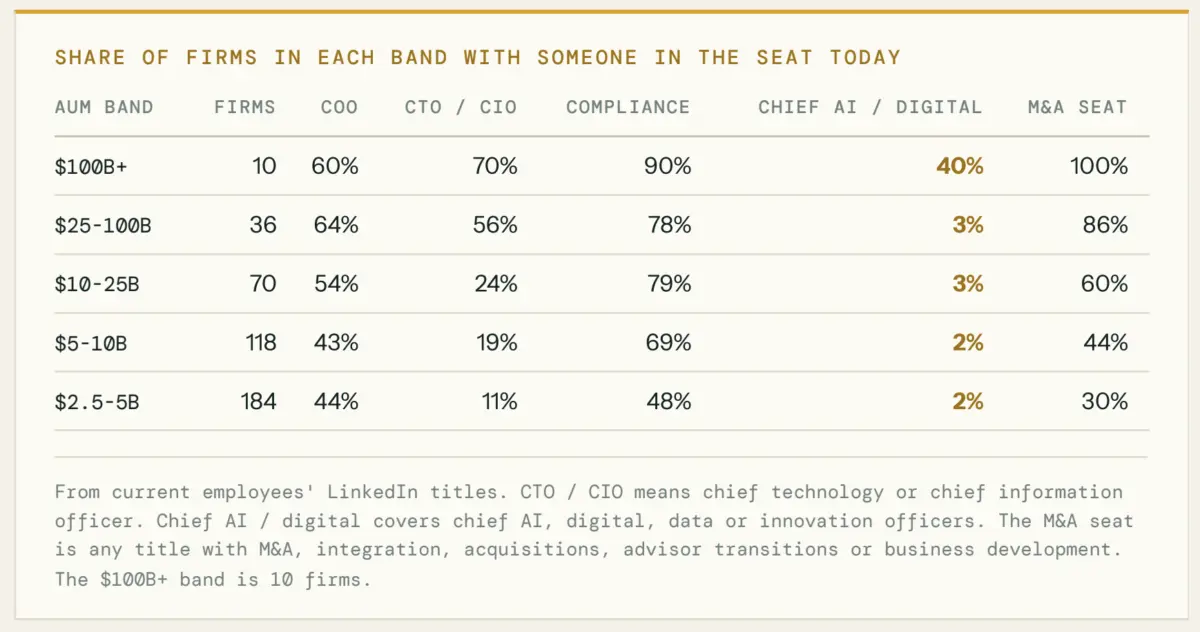
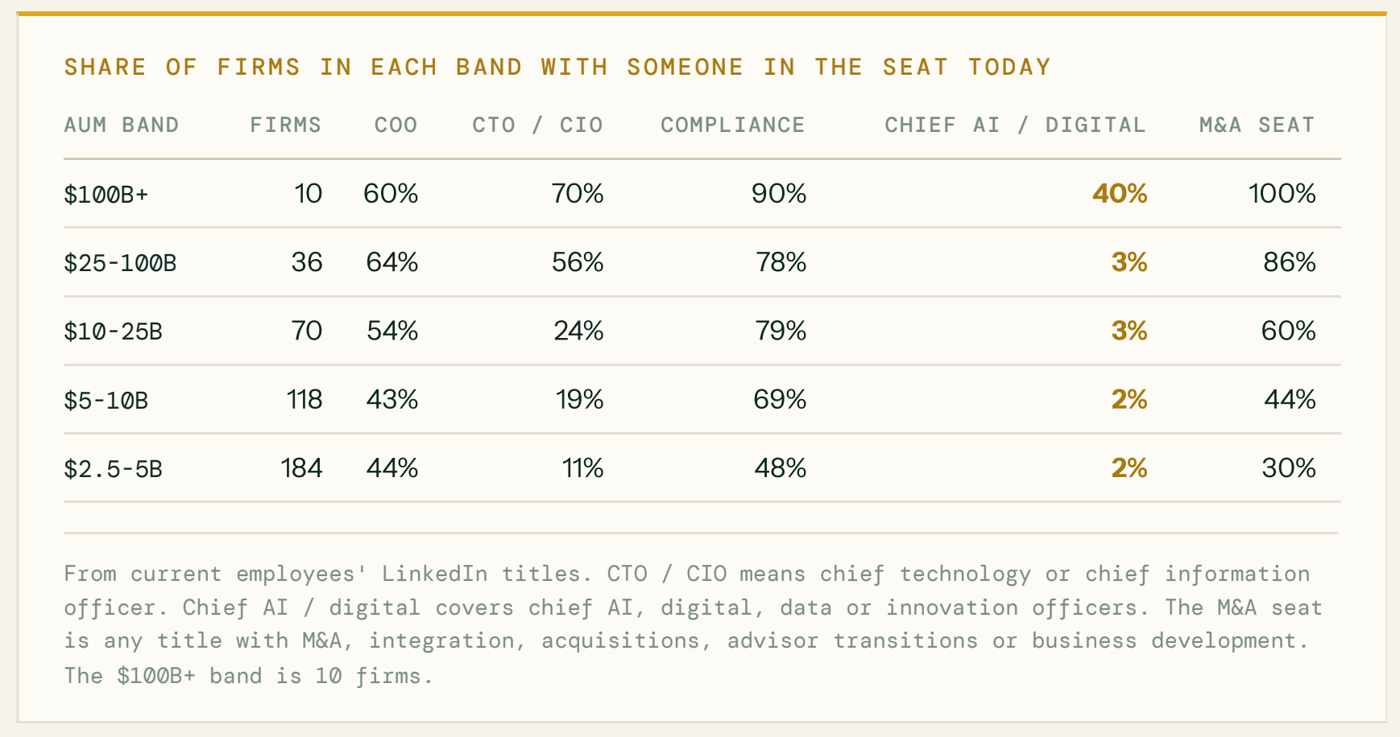
The findings from Caddi’s analysis powerfully underscore this assertion. Out of the 455 largest RIAs studied, a mere 42 firms (approximately 9.2%) have individuals whose job titles explicitly indicate a leadership role in AI or innovation. This includes titles such as Chief AI Officer, Head of AI Center of Excellence, or Head of AI Enablement and Automation. This relatively small cohort of AI-focused leaders reveals a significant gap in dedicated oversight across the broader RIA landscape.
Quantifying the Impact of Dedicated Leadership
The correlation between having a designated AI leader and actual AI tool adoption is stark. Caddi’s research indicates that a substantial 71.4% of wealth firms with a clearly identified AI leader have actively hired for roles related to AI tools. This suggests that dedicated leadership fosters an environment conducive to talent acquisition and, by extension, the implementation and utilization of AI technologies.
In sharp contrast, among firms lacking a specific AI leader, the picture is significantly different. Only 11% of these firms have been hiring for AI tools. This disparity highlights the potential for AI initiatives to stall or remain theoretical without a clear champion to drive them forward.

The study also explored the impact of other technology-focused leadership roles. Firms that may not have a dedicated AI lead but do possess a Chief Technology Officer (CTO) or Chief Information Officer (CIO) also show a discernible, albeit less pronounced, effect on AI hiring. Approximately 32.7% of firms with CTOs or CIOs have made hires for AI-related positions, compared to the 11% in firms without such leadership and without a specific AI lead. This indicates that existing technology leadership can provide a partial bridge towards AI adoption, but the impact is amplified when AI is a specific mandate.
Furthermore, the analysis revealed that even Chief Operating Officers (COOs) can play a role. Nearly a quarter (24%) of firms with a COO, but without an AI lead or CTO, had made hires to manage or use AI tools. This suggests that operational leadership can also recognize and act upon the potential efficiencies offered by AI, even if not from a purely technological perspective.
Emergence of New Roles and Growing Firms
A notable aspect of Caddi’s findings is the recency of these AI leadership roles. Of the 42 individuals identified with AI leadership titles, 24 hold positions that are explicitly AI-focused. Intriguingly, 17 of these 24 individuals began their roles in 2026, suggesting a recent surge in the formalization of AI leadership within the industry. Moreover, a significant portion of these newly appointed AI leaders (12 out of 24) are situated within firms managing over $25 billion in AUM. This concentration in larger firms might indicate a greater capacity and strategic imperative to invest in advanced technologies.
This trend of new roles emerging within established firms points to a growing recognition of AI’s strategic importance. As AI technology matures and its applications become more defined, RIAs are increasingly formalizing these positions to steer their AI journeys. The emergence of roles like "Chief AI Officer" signals a shift from ad-hoc experimentation to a structured, strategic integration of AI into the core business.
The Unaddressed Frontier: Compliance and Security
Despite the growing interest and nascent adoption of AI, a significant concern remains the lagging integration of AI into compliance and security frameworks. Caddi’s research highlights that a striking 56.6% of RIAs that have hired for AI roles have not made corresponding hires in compliance archiving or security. This implies that many firms are leveraging AI without adequately bolstering their existing compliance and security infrastructure to address the unique challenges AI presents.
The current compliance staff and technology in these firms are likely unchanged from their pre-AI era, creating a potential vulnerability. This oversight is particularly concerning given the rapid advancements in AI technology and its increasing prevalence across the financial services industry. The implications of this gap are profound, potentially exposing firms to heightened risks related to data privacy, regulatory scrutiny, and cybersecurity threats. As AI systems process and generate vast amounts of sensitive client data, robust compliance and security protocols are not merely advisable but imperative. The lack of dedicated hires in these areas suggests a critical disconnect between the embrace of AI’s operational benefits and the necessary safeguarding of client information and regulatory adherence.
Caddi Technologies: The "Caddy for the Back Office"
The insights from Caddi Technologies stem from their unique position as an AI-native workforce provider for professional services. The company’s origin story, as shared by CEO Alejandro Castellano, offers further context. Caddi was recognized as a finalist in XYPN’s AdviceTech competition during its 12th annual conference in San Diego. While the AI-first CRM Slant ultimately won the competition, Caddi made a strong impression.
Castellano described Caddi as "the caddy for the back office," aiming to automate repetitive tasks without requiring firms to adopt new tools or alter their existing workflows, and crucially, without demanding new technical skills from their employees. The company initially focused on law firms before pivoting to the RIA market after securing several top-tier RIA clients.
This strategic focus on automation and seamless integration is rooted in Castellano’s experience. His background includes working in a family office in Peru, where he encountered extensive paperwork, and subsequent roles that solidified his belief in the transformative potential of digitizing and automating workflows within professional services. He recognized that the sheer volume of manual tasks in professions like law, accounting, and financial advising presented a fertile ground for significant efficiency gains through AI.
"The moment I realized there were 1.5 million attorneys, a similar number of CPAs and hundreds of thousands to a million financial advisors out there," Castellano remarked, he understood the vast market potential for AI solutions like Caddi’s. The company currently serves approximately a dozen RIA firms with over $1 billion in AUM, demonstrating its capability to support substantial operations.
Implications for the RIA Industry
The findings from Caddi Technologies offer a clear roadmap for RIAs contemplating their AI journey. The data suggests that the initial and most critical step is to designate clear leadership and ownership for AI initiatives. Without this foundational element, efforts to integrate AI are likely to falter.
For the majority of RIAs who have not yet formally embraced AI, the relatively low adoption rates among the largest firms may offer a degree of reassurance. They are, in essence, in good company. However, this should not be interpreted as a signal to delay strategic planning. The rapid evolution of AI technology and its increasing integration across all business sectors necessitate proactive engagement.
The identified gap in compliance and security hires is a pressing concern that requires immediate attention. Firms that are implementing AI solutions must simultaneously invest in strengthening their regulatory and security frameworks. This may involve hiring specialized compliance officers, investing in AI-specific cybersecurity tools, and developing robust data governance policies. Failure to do so could lead to significant operational, financial, and reputational risks.
As the RIA industry continues to evolve, the strategic adoption of AI is poised to become a key differentiator. Firms that approach AI with a clear vision, dedicated leadership, and a comprehensive understanding of its implications for all aspects of their operations – including compliance and security – will be best positioned to harness its full potential and maintain a competitive edge in the years to come. The insights provided by Caddi Technologies serve as a valuable benchmark, highlighting both the opportunities and the critical challenges that lie ahead in the AI-driven transformation of wealth management.
