

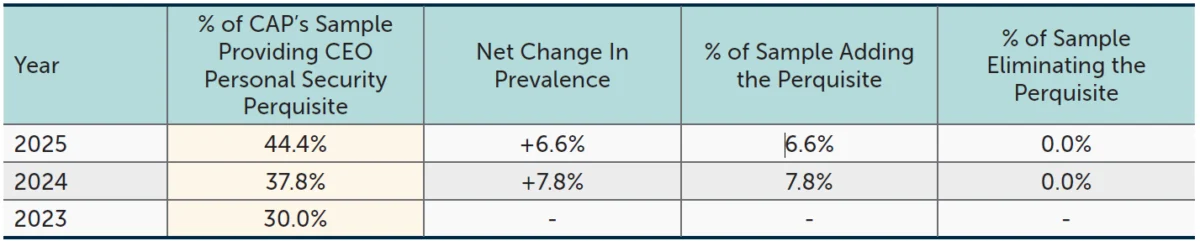
The tragic assassination of UnitedHealthcare CEO Brian Thompson in December 2024 sent shockwaves through corporate America, igniting an urgent and widespread reevaluation of executive security protocols among boards of directors and compensation committees. While this deeply disturbing event served as a stark catalyst, an analysis of recent proxy disclosures reveals that the trend toward enhancing personal security perquisites for senior executives was already in motion and has continued its ascent with notable momentum. Compensation Advisory Partners (CAP), a leading firm in executive compensation consulting, has released a memorandum detailing these evolving practices, offering an early glimpse into how companies are adapting to an increasingly complex threat landscape.
The imperative for executive security is not a novel concept. For years, many publicly traded companies have incorporated security-related benefits as a component of their broader risk management strategies. These provisions have historically included measures such as the installation of residential security systems, the provision of personal security detail, and the arrangement of secure transportation. Furthermore, these security considerations frequently intersect with policies governing the personal use of corporate aircraft. In certain instances, companies may mandate or strongly encourage their chief executive officers to utilize company planes precisely to minimize exposure in public travel environments and to ensure a more controlled and secure transit experience. This proactive approach aims to safeguard executives from potential threats, allowing them to focus on their strategic leadership responsibilities without undue personal risk.
The challenge in definitively attributing the acceleration of these trends solely to the Thompson incident lies in the timing of corporate disclosures. Most 2025 proxy statements reflect compensation arrangements and benefit allocations that were determined and implemented prior to the December 2024 event. To gain an early understanding of emerging practices and board sentiment in the wake of this tragedy, CAP undertook an analysis of companies with fiscal years concluding between March and November of 2025. This specific timeframe is crucial because it encompasses several months following the UnitedHealthcare incident, providing an initial indicator of how corporate leadership is responding to the heightened security concerns.
Key Findings from CAP’s Analysis
CAP’s comprehensive review of proxy statements from a significant sample of U.S. public companies has illuminated several critical trends regarding executive security perquisites:

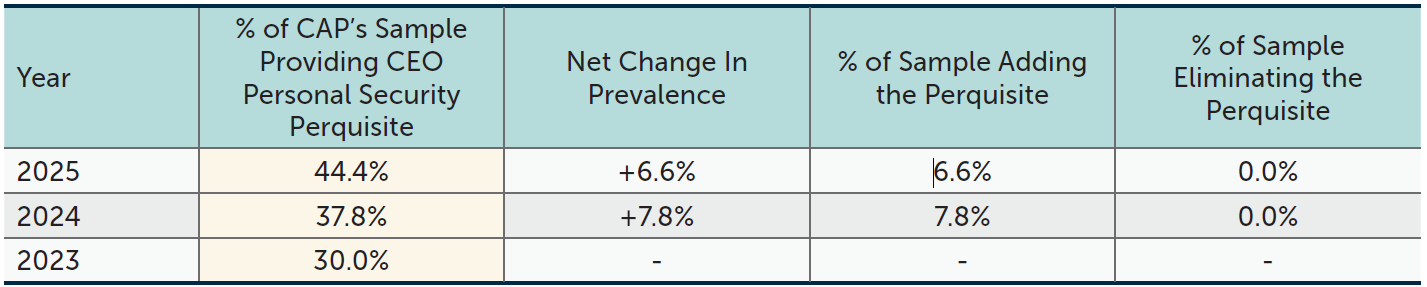
- Steady Increase in Prevalence: The prevalence of CEO personal security perquisites has demonstrated a consistent upward trajectory over the past three fiscal years, reaching 44.4% for fiscal year 2025. This steady climb underscores a growing commitment to safeguarding top executives.
- Irreversible Trend: Notably, the observed increases in prevalence are solely attributable to the addition of new CEO security perks. No companies within the analyzed period eliminated existing security benefits. This stands in contrast to other perquisites, such as the personal use of corporate aircraft, where companies may both introduce and retract benefits based on evolving circumstances and executive transitions. The absence of eliminations suggests that once implemented, CEO security perks are largely viewed as indispensable, ongoing risk-mitigation measures rather than discretionary or easily dispensable benefits.
- Post-Incident Acceleration: The approximately seven-percentage-point increase in the adoption of security perks observed for fiscal year 2025 suggests a potential acceleration in program implementation or expansion following the UnitedHealthcare incident. However, it is important to note that only one company in CAP’s sample – an industry peer of UnitedHealthcare – explicitly referenced the fatal shooting in its proxy disclosure, indicating that while the event may have spurred action, direct attribution in public filings remains infrequent.
- Varied Scope and Form: The disclosed CEO security perks exhibit considerable variation in their scope and structure. These programs are typically informed by internal or external risk assessments and often comprise a combination of elements. Common components include the provision of residential security systems, personal security personnel, secure transportation arrangements, and access to safe houses.
- Disclosure as Perquisites: Despite the perception of these measures as necessary for risk mitigation, Securities and Exchange Commission (SEC) disclosure rules generally mandate that companies report them as executive perquisites when they confer a direct or indirect personal benefit to the executive. This regulatory framework ensures transparency regarding the compensation packages provided to top leadership.
Study Methodology and Scope
To conduct its analysis, CAP meticulously reviewed the proxy statements of 90 large-cap U.S. public companies. The selection criteria focused on companies with fiscal years ending between March and November of 2025. This methodology was specifically chosen to capture the most up-to-date information, including compensation elements and benefit decisions made in the period following the critical December 2024 event.
For each company within the sample, CAP undertook a detailed assessment of proxy statement disclosures spanning the preceding three fiscal years. This in-depth review encompassed:
- Identification of Security-Related Perquisites: Scrutinizing disclosures to pinpoint any benefits explicitly identified as related to personal security for the CEO.
- Valuation of Disclosed Perquisites: Quantifying the monetary value of these security perquisites as reported by the companies.
- Analysis of Disclosure Language: Examining the narrative explanations provided by companies regarding the rationale for offering these benefits, looking for any mentions of specific security threats or risk assessments.
For clarity in presentation, fiscal years are referenced by the calendar year in which the fiscal year concluded. Thus, fiscal years ending between March and November 2025 are collectively referred to as "2025."
It is crucial to acknowledge that this study’s focus on companies with non-calendar fiscal years means the sample may not perfectly represent the broader large-cap market. A more comprehensive understanding of how security-related perquisites have evolved post-UnitedHealthcare will emerge when proxy statements from calendar-year companies are filed during the 2026 proxy season. These future disclosures will provide additional insights into the full impact of the incident on executive security practices across the wider corporate landscape.
The Escalating Costs of CEO Personal Security
Among the companies that disclosed the financial value of their CEO personal security perquisites, CAP’s analysis revealed a wide variance in reported costs. These figures are intrinsically linked to the comprehensiveness of the security measures implemented. While the median value of these perquisites saw a decline year-over-year, this statistic masks a more significant underlying trend: a majority of companies (72.0%) reported an increase in the value of their CEO security perks for 2025, and the average reported value also increased. This suggests a general upward trend in the overall investment in executive security across the analyzed sample.
The average CEO security perk value significantly surpasses the 75th percentile, a disparity driven by a number of high-cost outliers. Within the group of companies that disclosed a value for 2025, approximately 12.1% reported costs exceeding $1 million. These substantial expenditures are typically associated with highly comprehensive and multi-faceted executive security programs designed to address elevated risk profiles.
It is also important to consider that year-over-year fluctuations in reported values can be influenced by the episodic nature of certain security benefits. For instance, the initial installation of a sophisticated residential security system might incur a substantial upfront cost, followed by lower, recurring expenses for monitoring and maintenance in subsequent years. Therefore, changes in the reported monetary value do not always directly correlate with a proportional change in the level of security being provided.
Personal Use of Corporate Aircraft: A Synergistic Security Measure
The personal use of corporate aircraft continues to be one of the most prevalent executive perquisites and is frequently intertwined with broader executive security programs. CAP’s analysis indicates a modest but steady increase in the prevalence of CEO aircraft perks over the past three years, reaching 44.4% for fiscal year 2025.
A significant finding in this area is the explicit linkage between aircraft usage and security concerns. One hundred percent of the companies that introduced a CEO aircraft perk in 2025 cited security-related considerations in their proxy disclosures as the primary driver. Furthermore, in instances where aircraft perks were eliminated, this was universally linked to a CEO transition, with the outgoing executive receiving the benefit and the incoming executive not being granted the same privilege. This pattern reinforces the notion that aircraft usage, in many cases, is viewed as a security imperative rather than a standard perk.
Among companies that provided CEO aircraft perks in both 2024 and 2025, a notable trend emerged: several companies enhanced the scope of this benefit. For example, in 2024, 29% of these companies disclosed a dollar-value cap on their CEO’s aircraft usage, with a median cap of $225,000. By 2025, more than one-third of these same companies had either eliminated the cap entirely (27.3%) or increased it (9.1%). Crucially, none of these companies reduced their existing limits, further underscoring the perceived necessity and growing importance of this benefit.

The valuation of CEO aircraft perks is typically calculated based on incremental costs, such as fuel, crew expenses, and landing fees. These costs can fluctuate significantly from year to year, largely depending on the extent of executive usage. Similar to the observed trends in CEO security perk values, while the median value of aircraft perks declined year-over-year in this specific metric, a majority of companies (60.0%) reported increases in their disclosed values, and the average value also rose, signaling an overall upward trend in the financial commitment to this benefit.
Governance and Disclosure Considerations in a Shifting Landscape
Security-related perquisites are subject to the SEC’s stringent executive compensation disclosure rules. These regulations stipulate that companies must disclose perquisites when:
- The aggregate value of all perquisites for a named executive officer exceeds $10,000.
- The individual perquisite, regardless of its value, is not in the ordinary course of business and is not directly related to the performance of the executive’s duties.
The evolving nature of executive perquisite disclosure, particularly concerning security programs, was a topic of discussion at the SEC’s June 2025 Executive Compensation Roundtable. During this forum, regulators and market participants engaged in a dialogue to assess whether the current disclosure framework adequately captures the nuances of benefits such as comprehensive executive security programs.
Some industry commentators have put forth the argument that security-related perquisites might be more appropriately categorized as essential business expenses necessitated by executive safety concerns, rather than as discretionary executive benefits. However, until such a reclassification is formally adopted through changes in disclosure rules, companies are obligated to continue evaluating their security arrangements within the existing framework for perquisite reporting. This regulatory landscape necessitates careful consideration and transparent disclosure by all public companies.
Looking Ahead: The Enduring Focus on Executive Safety
The tragic events of December 2024 have undeniably amplified board-level awareness of executive security risks and have prompted numerous boards to proactively reassess their strategies for protecting senior leadership. Early indications from companies with off-cycle proxy filings suggest that security-related perks were already gaining traction prior to the incident and that this trend has continued to strengthen.

The full extent of the UnitedHealthcare incident’s impact on executive security practices may not be entirely apparent until the 2026 proxy season, when calendar-year companies submit their disclosures covering a complete fiscal year following the event. CAP intends to continue its diligent monitoring of proxy disclosures and broader market developments to provide ongoing assessments of how executive security practices and associated perks evolve in response to an ever-changing global environment.
A confluence of factors, including persistent geopolitical tensions, escalating social and political polarization, and the increasing public visibility of senior executives, is likely to further influence corporate approaches to executive security. As these risks continue to evolve and manifest, it is imperative for companies to regularly reassess the scope, structure, and effectiveness of their security-related perquisites to ensure the continued safety and well-being of their leadership teams. The commitment to robust executive security is no longer merely a matter of best practice; it is rapidly becoming a fundamental component of responsible corporate governance in an unpredictable world.
