

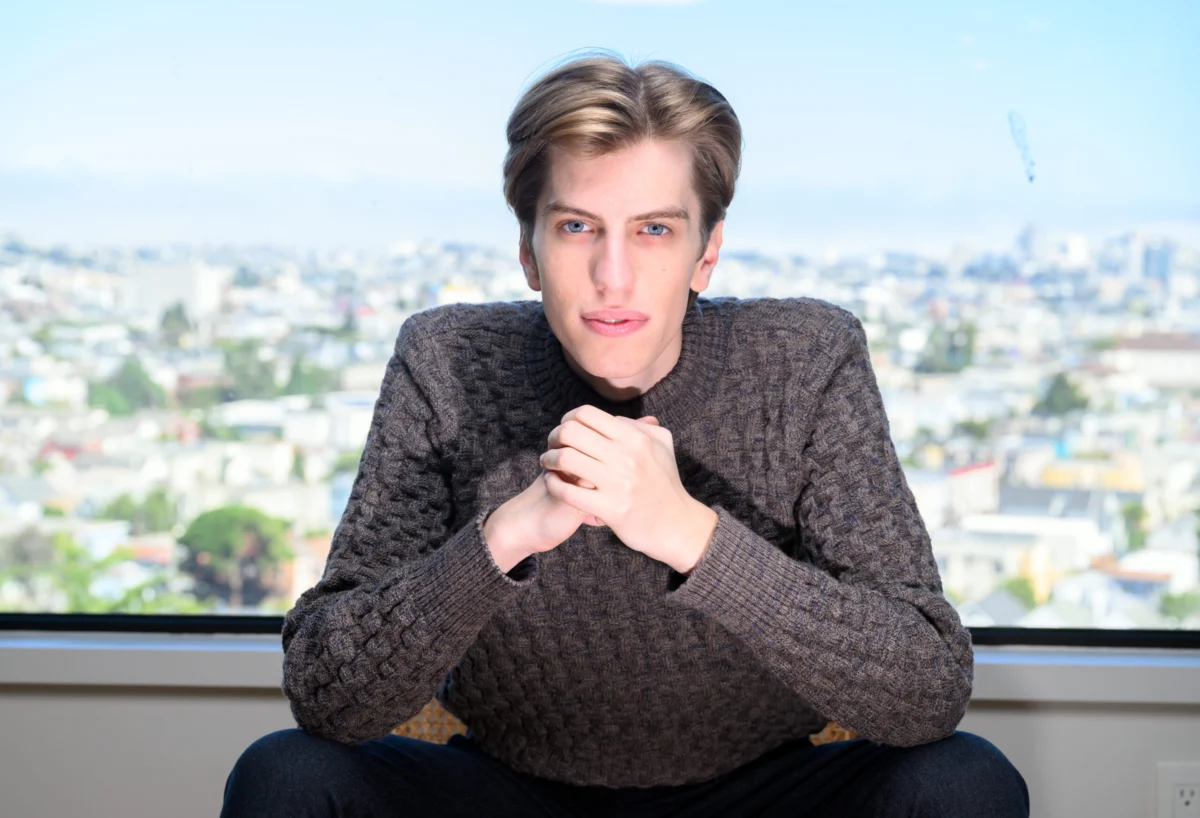
The sudden collapse of Situational Awareness, a high-profile artificial intelligence-themed hedge fund, has sent shockwaves through both the financial corridors of Wall Street and the technological hubs of Silicon Valley. Leopold Aschenbrenner, the 24-year-old former OpenAI researcher who founded the fund, saw his firm’s assets under management plummet from a peak of $45 billion to approximately $10 billion in a matter of days. This staggering $35 billion erasure of value was precipitated by a combination of extreme market volatility in the semiconductor sector and the unforgiving mechanics of high-leverage trading. By Thursday, Aschenbrenner was forced to liquidate the fund’s leveraged positions, selling off significant stakes in key AI infrastructure companies like SK Hynix and CoreWeave to Ken Griffin’s Citadel at a steep discount.
The downfall of Situational Awareness marks a dramatic pivot in the narrative of Aschenbrenner, a figure who had, until very recently, been hailed as a visionary "prophet" of the artificial general intelligence (AGI) era. His meteoric rise was fueled by a 165-page manifesto—also titled Situational Awareness—which argued that the world was on the precipice of a technological revolution that would dwarf the Industrial Revolution. However, the transition from theoretical researcher to institutional money manager proved treacherous. The fund’s implosion serves as a stark reminder of the "harsh reality" that faces even the most brilliant tech-centric minds when they enter the arena of public equity markets, where long-term vision often clashes with short-term liquidity requirements.
The Architect of the AGI Manifesto
Leopold Aschenbrenner’s journey to the center of the AI discourse began long before he launched his ill-fated hedge fund. Born in Germany to a family of physicians, Aschenbrenner was identified early as a mathematical prodigy. He skipped several grades in the German educational system and graduated high school at the age of 15. By 19, he was the valedictorian of Columbia University’s class of 2021, an achievement that solidified his reputation as a generational talent.
During his time at Columbia, Aschenbrenner was not merely a student of mathematics and economics but a burgeoning philosopher of risk. His academic paper, "Existential Risk and Growth," explored the intersection of economic expansion and the survival of the human race, a theme that would define his later work. He was also a foundational figure in the Columbia chapter of Effective Altruism (EA), a movement that advocates for using evidence and reason to figure out how to benefit others as much as possible. For many in the EA community, "earning to give"—amassing great wealth to fund philanthropic efforts—is a core tenet, a philosophy that likely informed Aschenbrenner’s eventual move into the world of high-stakes finance.
The OpenAI Tenure and the Superalignment Conflict
After a brief stint at the Future Fund, the philanthropic arm of the now-collapsed crypto exchange FTX, Aschenbrenner joined OpenAI in 2023. He was placed on the "Superalignment" team, a prestigious group led by OpenAI co-founder Ilya Sutskever. The team’s mission was critical: to develop methods to ensure that superintelligent AI systems, should they ever be created, remain aligned with human interests and safety protocols.
Aschenbrenner’s tenure at OpenAI was marked by both brilliance and friction. He became increasingly concerned about the company’s internal security measures, particularly in the wake of a hacking incident that breached OpenAI’s systems. Aschenbrenner authored a memo to the board of directors, warning that the firm’s security was insufficient to prevent state-sponsored espionage, specifically citing the threat from China. He argued that the race for AGI was a matter of national security and that the "weights"—the core data of AI models—were not being guarded with the rigor required for such powerful technology.
In early 2024, OpenAI fired Aschenbrenner, alleging that he had improperly shared confidential information outside the company. Aschenbrenner contested this characterization, maintaining that his actions were those of a whistleblower concerned with safety and security. Despite the acrimonious exit, his reputation as a "true believer" in the impending arrival of AGI only grew, setting the stage for his next venture.
The Birth and Strategy of Situational Awareness
In June 2024, Aschenbrenner published his viral essay, Situational Awareness. The document was an exhaustive, data-driven argument that AGI would be achieved by 2027. He predicted that the demand for computational power would lead to individual data centers requiring as much electricity as small cities and that the geopolitical landscape would be fundamentally reshaped by whoever controlled the most advanced AI models.
The essay became a sensation in Silicon Valley, earning praise from tech luminaries and providing the momentum needed to launch his hedge fund, Situational Awareness, in July 2024. Aschenbrenner raised $225 million in seed capital from a "who’s who" of the tech world, including Stripe co-founders Patrick and John Collison, former GitHub CEO Nat Friedman, and investor Daniel Gross.
The fund’s strategy was as bold as its founder’s predictions. It employed massive leverage—reportedly as high as 400%—to bet on the companies providing the "shovels" for the AI gold rush. This included public equities like SK Hynix, the South Korean chipmaker essential for high-bandwidth memory, and CoreWeave, a specialized cloud provider. Before the recent crash, the fund had reportedly achieved returns exceeding 1,000%, a performance that attracted billions in additional capital and propelled the fund to its $45 billion peak.

The Anatomy of a Collapse: Margin Calls and Market Shifts
The undoing of Situational Awareness was rooted in the very leverage that had fueled its rise. In the public markets, leverage acts as a double-edged sword; while it magnifies gains during an upswing, it accelerates losses during a downturn. In July 2024, the semiconductor sector, which had seen a historic run-up in valuations, began to experience a significant correction. Investors started to question whether the massive capital expenditures by big tech companies into AI infrastructure would yield immediate returns.
As stocks like SK Hynix and other AI-linked names began to slide, Situational Awareness faced a series of margin calls. A margin call occurs when the value of an investor’s account falls below a certain level, requiring them to either deposit more cash or sell assets to cover the gap. Because Aschenbrenner’s fund was so heavily leveraged, even a moderate dip in stock prices required massive liquidations to satisfy creditors.
The situation reached a breaking point this week. Unable to meet the mounting margin requirements, the fund was forced into a "fire sale." Citadel, the multi-strategy hedge fund giant led by Ken Griffin, stepped in to purchase the fund’s public equity book. Such transactions typically occur at a discount to market prices, as the buyer takes on the risk of offloading large positions in a volatile environment. The result was a catastrophic loss of capital for Situational Awareness’s investors, leaving the fund with roughly $10 billion in remaining assets, much of which is tied up in illiquid private stakes, including a multibillion-dollar investment in Anthropic.
Industry Reactions and the "Luck vs. Skill" Debate
The collapse has ignited a fierce debate on Wall Street regarding the qualifications of tech-native founders entering the hedge fund space. Critics point out that Aschenbrenner, despite his intellectual prowess, had zero experience in professional money management or risk control prior to 2024.
"A lot of people saw this blow-up as a matter of not if, but when," said Jerry Diao, founder of a Wall Street coaching firm. "Maybe his views on AI are correct in the long run, but in the public markets, you have to be prepared for the short-term. High leverage is a death trap if you don’t have the institutional guardrails to manage volatility."
Conversely, Aschenbrenner’s supporters, such as computer scientist Scott Aaronson, view him as a brilliant mind who was perhaps too early or too aggressive in his convictions. Aaronson noted that Aschenbrenner’s departure from OpenAI was a loss for the safety community and that his attempt to "do the right thing" regarding security had been unfairly punished.
The timing of the fund’s near-collapse has also added a layer of personal irony to the narrative. Aschenbrenner is scheduled to be married this weekend to Avital Balwit, the chief of staff for Anthropic CEO Dario Amodei. The juxtaposition of a massive financial failure with a significant personal milestone has made Aschenbrenner a figure of intense fascination and scrutiny.
Broader Implications for the AI Investment Landscape
The Situational Awareness implosion is more than just the story of one young man’s financial ruin; it is a potential harbinger for the broader AI investment landscape. For the past two years, the "AI trade" has been the primary driver of global equity markets. The massive valuations of companies like NVIDIA and its suppliers have been built on the assumption of uninterrupted growth and the imminent arrival of transformative AI capabilities.
Aschenbrenner’s failure suggests that the "AI bubble"—if it exists—may be starting to show cracks, not necessarily in the technology itself, but in the financial structures built around it. Institutional investors may now approach AI-themed funds with greater skepticism, demanding more robust risk management and less reliance on extreme leverage.
Furthermore, the transfer of assets to Citadel highlights a shift in power. While "prophet-led" funds may capture the imagination of Silicon Valley, the established giants of Wall Street, with their vast capital reserves and sophisticated risk systems, remain the ultimate arbiters of the market. Ken Griffin’s firm, by absorbing Aschenbrenner’s book, has once again demonstrated its role as the "liquidity provider of last resort," profiting from the volatility that destroyed its smaller competitor.
As the dust settles, Leopold Aschenbrenner remains a polarizing figure. To some, he is a cautionary tale of hubris and the dangers of treating the stock market like a theoretical exercise. To others, he remains a visionary whose long-term thesis on AGI may still prove correct, even if his first foray into finance ended in disaster. Regardless of his future, the story of Situational Awareness will be remembered as a defining moment in the first great AI investment cycle—a period where the boundaries between technological prophecy and financial reality were, for a brief and expensive moment, blurred.
