

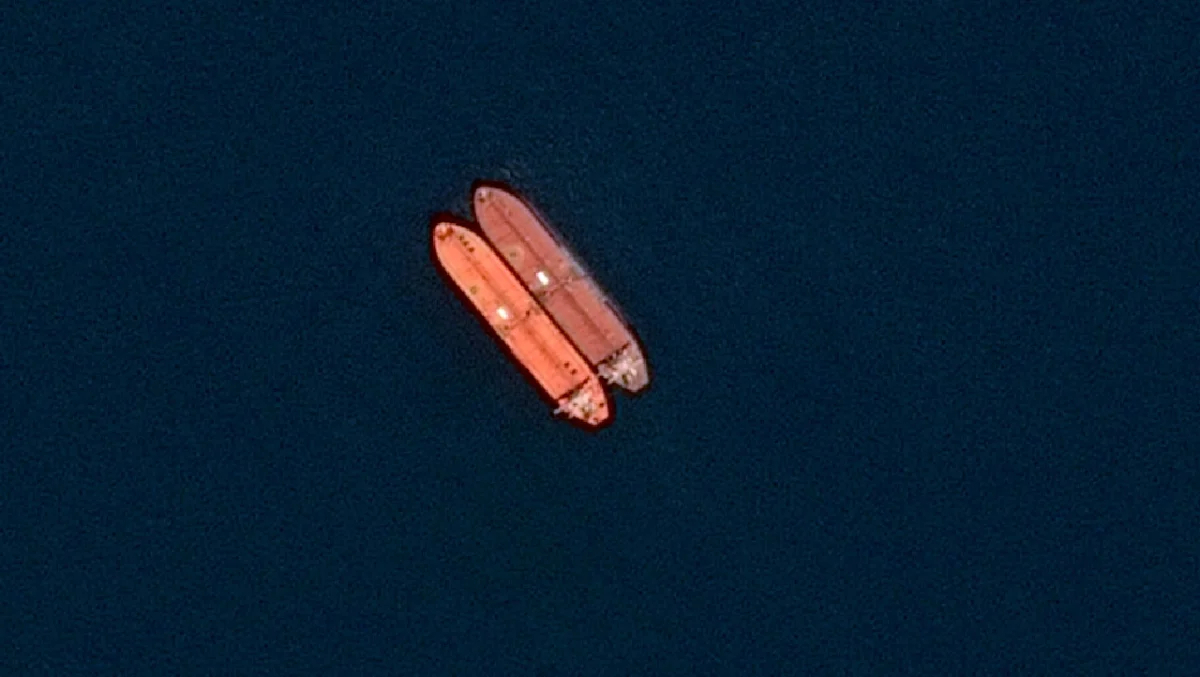
Saudi Arabia’s vital oil export infrastructure has been severely compromised following a series of sophisticated attacks attributed to Iran-aligned Houthi rebels, which significantly damaged the kingdom’s crucial East-West pipeline. This pipeline, a strategic asset designed to bypass the volatile Strait of Hormuz, a globally recognized oil chokepoint, has seen its operational capacity drastically curtailed. With the Strait of Hormuz effectively rendered a high-risk zone and the Bab al-Mandeb strait also falling under Houthi influence, Riyadh has been compelled to adopt increasingly clandestine and unorthodox methods to sustain its crude oil exports, prominently featuring ship-to-ship (STS) transfers conducted off the coast of Oman.
The escalating conflict in the region has led to a pronounced reluctance among commercial shipping companies to traverse the Strait of Hormuz, citing elevated risks of attack and seizure. This operational paralysis has forced Saudi Arabia to transport crude oil to safer havens, primarily Oman’s Sohar port, strategically located just outside the strait’s most perilous confines. Here, the oil is discreetly transferred from Saudi-flagged tankers to other vessels, which then undertake the onward journey to international markets. This shift to covert maritime logistics underscores the profound impact of regional hostilities on global energy supply chains.
The Geopolitical Chessboard and Strait of Hormuz Closure
The current crisis is deeply rooted in the broader geopolitical tensions gripping the Middle East. Iran’s decision to effectively close the Strait of Hormuz, a narrow waterway through which nearly a fifth of pre-war global energy supplies once transited, came as a direct response to what it perceives as the United States-Israeli war. Tehran has consistently leveraged control over this critical maritime artery as a potent bargaining chip in ongoing, fraught negotiations with international powers. The strategic importance of the Strait of Hormuz cannot be overstated; its closure or severe disruption sends immediate shockwaves through global oil markets, often leading to sharp price hikes and widespread economic uncertainty.
Media reports and intelligence assessments suggest that the dual pressures of the Hormuz closure and the resultant surge in global oil prices have prompted the United States and its regional allies to embrace "shadow tactics." These methods, often involving covert shipping and opaque financial transactions, mirror strategies long employed by Iran to circumvent international sanctions and export its own crude oil. This convergence of tactics highlights a dangerous escalation in the economic and logistical warfare being waged across the region’s waterways.
Chronology of Escalation and Disruption
The timeline of this unfolding crisis reveals a rapid deterioration of maritime security:
- Early 2026: Initial reports emerge of increased Houthi drone and missile capabilities, signaling a growing threat to Saudi infrastructure.
- Late February/Early March 2026: A series of precision drone attacks, claimed by Houthi rebels, target critical sections of Saudi Arabia’s East-West pipeline. These attacks cause significant damage, forcing a partial or complete shutdown of the pipeline. The Saudi Ministry of Energy condemns the attacks as acts of terrorism and a threat to global energy security.
- March 5, 2026: A US Navy guided-missile destroyer is photographed moving through the Suez Canal, reportedly en route to support "Operation Epic Fury," a broader military response to Iranian aggression, as depicted in accompanying imagery. This deployment underscores the rising military posture in the region.
- Mid-March 2026: Iran formally announces measures to restrict navigation through the Strait of Hormuz, citing "unauthorized routes" and "violations of sovereignty." This move is widely interpreted as a direct response to US-Israeli military actions and a strategic attempt to exert leverage.
- Late March 2026: With both the East-West pipeline compromised and the Strait of Hormuz under Iranian scrutiny, Saudi Arabia begins actively exploring alternative export routes, including increased reliance on ports outside the Strait.
- Early April 2026: Reports from independent maritime trackers begin to show a notable uptick in ship-to-ship (STS) transfers off the coasts of Oman and the UAE.
- Early May 2026: The US military is reportedly observed assisting "scores" of these secretive STS oil transfers, indicating a coordinated effort to maintain Gulf energy exports despite the regional turmoil.
- August 2026: Data from LSEG and Rystad Energy indicates a significant increase in Hormuz-route exports, reaching over 2 million barrels per day (mb/d) in the first two weeks of the month, a substantial rise from August figures. This suggests a desperate push to maintain supply through various means.
- September 2026: TankerTrackers reports a 56% increase in STS transfers compared to the previous month, with 7.15 million barrels per day being exchanged over a 14-day period, highlighting the escalating reliance on these high-risk operations.
The Strategic Importance of Bypass Ports: Sohar and Fujairah
The severe constraints imposed on traditional shipping lanes have elevated the strategic importance of specific ports outside the Strait of Hormuz. Two such hubs have emerged as central to bypassing the Iranian-controlled waterway: Sohar in Oman and Fujairah in the United Arab Emirates.
Sohar, a major deepwater industrial port in Oman, boasts extensive capabilities for handling bulk cargo, petrochemicals, and container traffic. Its strategic location on the Gulf of Oman, just beyond the narrow confines of the Strait, allows international shipping lines to circumvent the inherent risks of the Gulf bottleneck while maintaining crucial overland connectivity to the broader Arabian Peninsula markets. The port’s advanced infrastructure and capacity for large vessels make it an ideal staging ground for the intricate logistics of STS transfers.

Similarly, the UAE’s Port of Fujairah, situated on the country’s eastern coast, has long been recognized as one of the world’s largest bunkering and crude oil storage hubs. Its open-ocean anchorage provides an invaluable offshore staging area, enabling ship-to-ship transfers and energy exports to proceed unimpeded by the Strait of Hormuz’s restrictions. Both Sohar and Fujairah are strategically positioned close to the boundaries demarcated by the Persian Gulf Strait Authority, a new Iranian body established to assert greater control over the Strait of Hormuz. Iranian authorities have reportedly engaged in aggressive actions against vessels they accuse of using "unauthorized routes" – specifically, the southern route of the strait, which runs closer to Omani waters. This further complicates navigation and underscores the need for alternative export mechanisms.
Unpacking Ship-to-Ship Transfers: Mechanics and Risks
Ship-to-ship (STS) transfers are maritime operations where cargo, typically crude oil or liquefied natural gas (LNG), is moved directly between two vessels while at sea. These transfers serve as a critical logistical bridge, particularly when direct port access is blocked, restricted, or deemed too hazardous. The process itself is complex, demanding meticulous coordination and favorable sea conditions to mitigate the significant risks of spills, collisions, and environmental disasters.
During an STS operation, one vessel, often the larger of the two, maintains a steady course or anchors in designated safe waters. The maneuvering ship then approaches slowly and carefully, bringing its hull parallel to the stationary vessel. Large pneumatic rubber fenders are deployed along the ship sides to absorb impacts and prevent hull damage. A key aspect of these "shadow" transfers is the deliberate disabling of Automatic Identification System (AIS) trackers on both vessels. This practice, while enhancing secrecy and avoiding detection by surveillance systems, also significantly elevates the risk profile, as it renders the vessels "dark" to conventional maritime traffic monitoring.
Once the vessels are securely alongside each other and mandatory safety checks are completed, the discharging ship’s pumps begin moving oil through a system of specialized hoses connecting the two vessels. Constant monitoring of pressure and prevailing weather conditions is paramount throughout this process to prevent accidents.
Who is Engaging in STS and Why?
Saudi Arabia’s reliance on STS transfers is a direct consequence of the Houthi attacks. Riyadh traditionally relied heavily on its 1,200km (746-mile) East-West pipeline, also known as the Petroline, which connects the kingdom’s main oil-producing fields in the eastern provinces to the Yanbu port on the Red Sea coast in the west. This pipeline offered a direct route for exports to Europe and North America, bypassing the Gulf entirely. With its closure after recent drone attacks, Saudi Arabia’s options have narrowed considerably.
Rishi Rajanala, a research specialist in Oil Americas at LSEG Data & Analytics, noted that Riyadh’s primary alternative now involves "shipping more crude from its Gulf terminals through the Strait of Hormuz, including ship-to-ship transfers outside the strait, such as Sohar in Oman." He highlighted that while Gulf producers have historically engaged in such transfers, current volumes are heavily dependent on tanker availability, prohibitive insurance and freight costs, and remain well below pre-war levels.
Despite the challenges, data indicates a growing trend. Rahul Choudhary, VP Upstream Research at Rystad Energy, observed that Hormuz-route exports "edged higher, over 2 mb/d [million barrels per day] in the first two weeks" of the current month, representing "roughly 1 mb/d above August." He further projected that this uptick is expected to intensify, citing "Aramco offering additional loadings to Asian refiners out of Sohar." Choudhary also suggested that "Saudi Arabia can lean further on dark tanker activity in the coming days to offset Yanbu losses," referring to the kingdom’s temporary loss of direct access to the Red Sea for shipping.
It is not solely Saudi Arabia engaging in these high-stakes maneuvers. Independent maritime trackers and media reports have also identified Kuwait and Qatar utilizing similar tactics at times to transit their valuable crude and liquefied natural gas cargoes past the Strait of Hormuz, underscoring a regional trend driven by necessity.
The Perilous Nature of Shadow Shipping

While offering a critical workaround, STS transfers, particularly those conducted under the cloak of secrecy, are inherently dangerous and considerably less efficient than conventional port-to-port shipping. Experts caution that unregulated STS operations frequently involve aging vessels with questionable maintenance records, uninspected hoses, and, crucially, deactivated AIS tracking systems, often operating without adequate insurance coverage. These factors collectively multiply the risks of catastrophic spills, collisions, and other maritime accidents.
TankerTrackers, a prominent platform that monitors global oil shipments, recently reported a significant surge in STS activity. "Over the past 14 days, there were 7.15 million barrels per day being exchanged," the monitor stated, basing its figures on a combination of AIS data (when available) and high-resolution satellite imagery. This represents a staggering 56 percent increase compared to the preceding month, illustrating the rapid adoption of these risky methods.
Despite these grave risks, STS transfers present a distinct advantage in the highly volatile geopolitical landscape of the Middle East. Major transport companies and tanker operators are increasingly unwilling to risk their vessels by entering the Strait of Hormuz, fearing attacks from either Iranian forces or, in a retaliatory scenario, US military assets. Yet, the oil and gas-producing nations of the Gulf remain under immense pressure to maintain export flows to global markets. Consequently, these countries bear the brunt of the risk, deploying their own tankers, often with trackers switched off, to designated transfer zones just outside the most dangerous stretches of the Strait of Hormuz. Here, traditional oil and gas carriers, waiting in comparatively safer international waters, receive the cargo and ferry it onward to major consuming nations such as China, India, South Korea, and Japan.
The Insurance Conundrum
The complexities and heightened risks associated with STS transfers pose a significant challenge for traditional insurers. Oscar Seikaly, CEO of the NSI Insurance Group, explained that any potential loss arising from an STS operation could encompass not only damage to the physical vessels and their valuable cargo but also "pollution and collision liabilities, cargo insurance, war-risk cover," and a host of other intricate factors. Underwriters, he noted, "may also impose navigational warranties, security conditions, additional war premiums or restrictions" to mitigate their exposure.
However, Seikaly pointed out a crucial mitigating factor: "most of the oil that is being moved belongs to the national oil companies of the respective country." This means that many of these operations rely on robust sovereign-backed self-insurance arrangements or sophisticated private insurance markets specifically tailored for high-risk ventures. Seikaly emphasized that "during wartime or other high-risk disruptions, insurers are unlikely to provide broad cover to include ship-to-ship transfers." As a direct consequence, a "significant share of the risk may ultimately remain with the producing country rather than being transferred fully to commercial insurers," effectively placing the financial burden of potential disasters squarely on the shoulders of the exporting nations.
Broader Implications and Future Outlook
The reliance on ship-to-ship transfers and other "shadow tactics" carries profound implications for global energy security, environmental protection, and regional stability. The increased frequency of such operations, particularly those involving "dark" vessels, heightens the risk of major maritime incidents, including oil spills that could devastate the fragile ecosystems of the Arabian Gulf and Gulf of Oman. The lack of transparency and regulatory oversight in these transfers also raises concerns about adherence to international safety and environmental standards.
Economically, the added costs associated with higher insurance premiums, longer transit times, and the operational complexities of STS transfers will inevitably translate into higher prices for consumers globally. Major importing nations, especially those heavily dependent on Middle Eastern oil, face increased supply chain vulnerabilities and potentially higher energy bills, which could fuel inflationary pressures.
Geopolitically, the normalization of "shadow shipping" tactics further blurs the lines of international maritime law and exacerbates tensions in an already volatile region. The direct involvement of the US military in facilitating these transfers, while aimed at stabilizing global energy markets, also risks drawing Washington deeper into regional proxy conflicts. The establishment of the Iranian-controlled Persian Gulf Strait Authority and its aggressive stance towards perceived unauthorized routes signals a dangerous escalation in maritime control, potentially leading to further confrontations.
Looking ahead, as long as the Strait of Hormuz remains a contested and high-risk waterway, and alternative pipeline infrastructure remains vulnerable, the use of STS transfers and similar covert strategies is likely to persist and even grow. This new reality demands innovative solutions for maritime security, robust international cooperation to de-escalate regional conflicts, and a renewed focus on diversifying global energy supplies to reduce reliance on vulnerable chokepoints. The current situation serves as a stark reminder of the intricate interplay between regional geopolitics, energy markets, and the fundamental stability of global trade.
