

For over two decades, across more than 200 organizational transformations, a singular question has consistently yielded a revealing silence from leadership teams: "Who in this company owns customer profitability?" The immediate aftermath is invariably a hesitant pause, followed by a subtle, often unconscious, deflection of responsibility. This pervasive organizational blind spot, the author argues, stems from a deeply ingrained, product-centric operational framework that has inadvertently trained customers to behave as mere transactional entities, rather than long-term, valuable relationships.
The foundational issue, as detailed in extensive business analyses, lies in the structural allocation of accountability. Every product within a company typically boasts a designated owner – a product manager, a brand manager, or a category head. These individuals are equipped with a Profit and Loss (P&L) statement, specific margin targets, and performance-based bonuses intrinsically linked to their product’s financial success. When a product falters, a name is directly associated with the underperformance, necessitating an explanation and often remedial action.
Conversely, the customer, the ultimate wellspring of all revenue, remains largely unowned. Instead, the customer is fragmented and distributed across various functional silos, each measured on its isolated interaction. Marketing might track lead generation, sales focuses on closing deals, customer service addresses inquiries, and product development iterates on features. While every department may touch the customer, a holistic accountability for the customer’s enduring profitability is conspicuously absent.
The rise of the Chief Customer Officer (CCO) role, while a positive development, has not fundamentally altered this dynamic in most organizations. Gartner’s research from 2019 indicated that approximately 90% of organizations had a CCO or an equivalent position. However, the scope of this role typically encompasses customer surveys, experience design, and advocacy. Crucially, it rarely extends to direct ownership of pricing strategies, the intricate cost to serve, acquisition strategy, or a comprehensive customer P&L. These CCOs often possess a voice in strategic discussions but lack the decisive vote required to implement fundamental shifts in customer-centricity.
This is not a minor organizational quirk; it represents a profound misunderstanding of the customer’s pivotal role in a company’s long-term viability. The article posits that businesses have meticulously constructed their entire infrastructures—systems, budgets, incentive structures, reporting lines, and even their internal lexicon—around products. This product-centric architecture inevitably leads to the expectation that customers will behave transactionally, a self-fulfilling prophecy that overlooks the immense value inherent in nurturing sustained customer relationships.
The Undeniable Link Between Customer Relationships and Profitability
The assertion that customer relationships, rather than individual products, are the true engine of profitability is powerfully illustrated by examining two iconic companies: Delta Air Lines and Best Buy.
Delta Air Lines: While Delta’s core business is ostensibly the transportation of passengers—its product encompassing seats, routes, schedules, and aircraft—its financial performance reveals a striking reliance on its customer loyalty program. In 2025, Delta received an astounding $8.2 billion in remuneration from American Express for its co-branded SkyMiles credit card. This figure represents an 11% increase year-over-year. For context, Delta’s entire operating income for the same year, as reported, was $5.8 billion. This means the revenue generated from customer loyalty—a direct outcome of their relationship with the airline—surpassed the total operating profit from its core flight operations. Delta itself attributes the card’s success to "growing brand preference," a clear indicator of customer loyalty, not just flight efficiency.
Best Buy: Similarly, Best Buy’s primary business is the sale of electronics. However, historical data and contemporary analysis highlight the critical role of extended warranties in its profitability. In 2005, the last year Best Buy publicly detailed its profit centers, approximately one-third of its profits were attributed to warranty sales. Current analyst estimates suggest this figure has risen significantly, with some projecting that half, or even all, of Best Buy’s profit now derives from these extended service agreements. The profit margins on these contracts, as reported by BusinessWeek in the mid-2000s, ranged from 50% to 60%, a staggering 18 times higher than the margins on the electronics themselves. The television or laptop may draw the customer into the store, but it is the post-sale relationship—the assurance of protection and support—that generates substantial financial returns.
These examples underscore a fundamental truth: while products serve as the crucial entry point, it is the cultivated customer relationship that sustains and drives financial success.
A Tale of Two Time Horizons: Product vs. Customer Profitability
The divergence between a product-centric and a customer-centric business model can be distilled into a fundamental difference in their time horizons and core strategic questions.
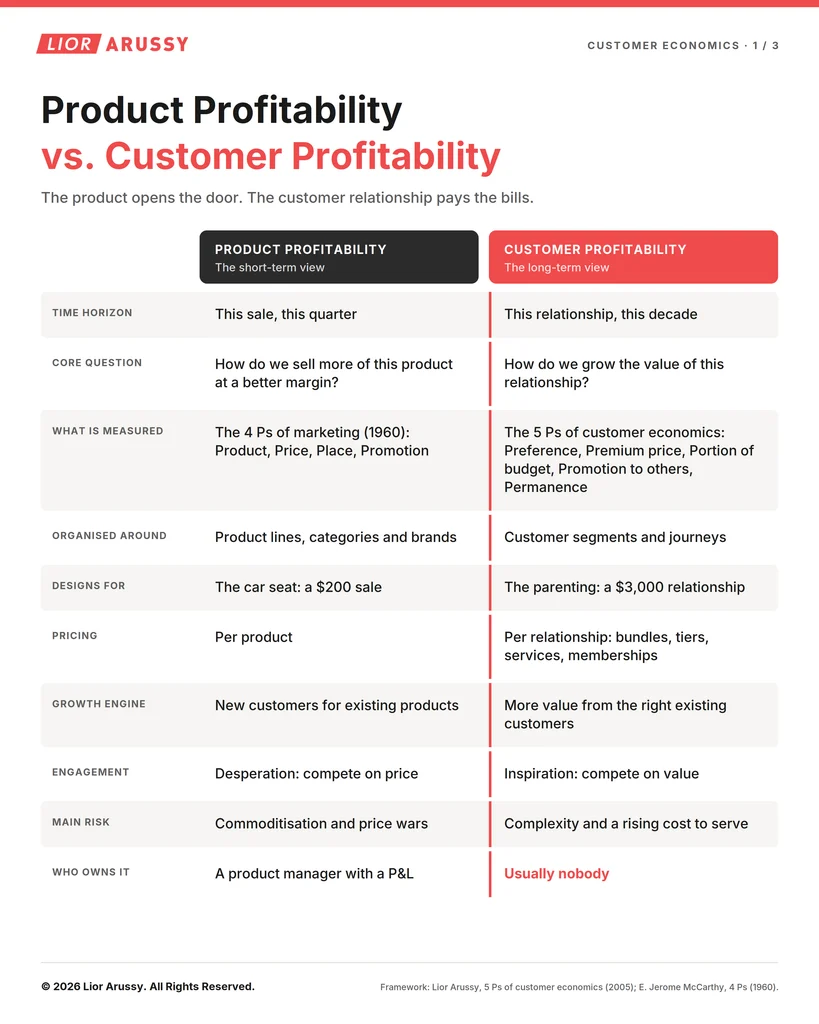
Product Profitability (Short-Term View): This perspective focuses on immediate gains. The central question is: "What margin did we make on this specific sale?" The primary metrics revolve around product margins, units sold, and market share. Innovation is geared towards creating superior products that can be pushed into the market. The organizational structure is typically built around product lines, categories, or brands. Pricing is determined on a per-product basis. The growth engine relies on acquiring new customers for existing products. The most significant risk is commoditization and the inevitable price wars that ensue when competitors can easily replicate product features.
Customer Profitability (Long-Term View): This approach prioritizes the enduring value of the customer relationship. The core question shifts to: "What is this relationship worth over the next 10 years, and what are we doing to grow it?" This perspective necessitates measuring customer retention, share of wallet, referrals, and the overall profitability of the relationship. Innovation is driven by designing solutions that address the customer’s broader needs and journeys. The organizational structure aligns with customer segments, their journeys, and the management of these relationships. Pricing becomes more nuanced, considering bundles, tiered services, and membership models. The growth engine focuses on extracting greater value from existing, loyal customers. The primary risk lies in managing complexity and ensuring the cost to serve does not outstrip the revenue generated.
Frederick Reichheld of Bain & Company’s seminal work has extensively documented the importance of this long-term view. His research consistently demonstrates that the high cost of customer acquisition often renders initial relationships unprofitable. It is only over time, as the cost to serve diminishes and purchase frequency increases, that these relationships yield substantial returns. A commonly cited statistic reveals that a mere 5% increase in customer retention can boost profits by an astonishing 25% to 95%. Companies fixated solely on product margins fail to appreciate this relationship curve, often cutting services that foster repeat purchases because they appear as mere costs in quarterly product reports.
Designing for the Journey: The "Parenting" Analogy
To concretize this strategic shift, consider an example from the baby products industry. A company’s flagship product was the car seat, a mandatory purchase for new parents and often the first significant transaction in their journey. The average sale for a car seat was approximately $200. This company excelled at designing, engineering, and marketing car seats, fiercely competing for market share.
However, the broader opportunity lay not just in the car seat but in the entire spectrum of parenting needs. Mapping the company’s product portfolio revealed an additional $3,000 worth of potential sales to the same parents over subsequent years, including strollers, high chairs, toddler seats, travel gear, and various accessories.

The pivotal question posed to the leadership team was transformative: "Do you design for the product, or do you design for the parenting?"
Designing for the Product: This approach focuses on optimizing the car seat itself—making it safer, more comfortable, or more aesthetically appealing. The competition is solely with other car seat manufacturers. The key metric is units sold, and each transaction is viewed as an isolated event.
Designing for the Parenting: This paradigm shift redefines the car seat not as the ultimate product but as the initial step in a long-term relationship. The focus extends beyond the initial purchase to encompass the entire parental journey: the first car trip, dining out with a baby, transitioning to a toddler seat, and managing travel needs. The company begins to understand parental anxieties and identify opportunities to provide support. The key metric becomes the share of the family’s overall parenting budget, rather than just the share of the car seat market. This necessitates an organizational structure that follows the family’s evolving needs, not just the product catalog. The outcome is a potentially fifteen-fold increase in revenue per customer, utilizing the same products and manufacturing capabilities but adopting an entirely different business model.
This "parenting question" is a universal framework. A bank selling a mortgage is entering into a customer’s life-building journey. A software company licensing its product is enabling a customer’s job success. A watchmaker selling a timepiece is participating in a collector’s quest to build a collection and a narrative. The underlying principle remains constant: identifying the larger need that the product merely serves as an entry point to.
The Legacy of the 1960s Playbook and the Evolution of Marketing
The persistent misapplication of business strategy can be partly attributed to the enduring influence of management tools developed in a different economic era. The traditional marketing mix, famously articulated by E. Jerome McCarthy in his 1960 textbook, comprises the Four Ps: Product, Price, Place, and Promotion. While groundbreaking for its time—a period characterized by mass production, mass media, and mass distribution—these Ps are inherently product-centric. They describe what a company does to the market, with the customer appearing primarily as a passive target.
In contrast, the author introduced the "Five Ps of Customer Economics" in his 2005 book, Passionate and Profitable. This framework shifts the focus from what companies do to customers to what customers do for companies, recognizing that this is where true profitability lies. These five Ps are:
- Preference: The customer’s willingness to choose your offering over competitors, even at a premium.
- Premium: The customer’s willingness to pay more for your offering due to its perceived superior value or unique attributes.
- Portion of Budget: The customer’s allocation of their spending towards your offerings relative to other needs.
- Promotion: The customer’s active advocacy and referral of your products or services to others.
- Permanence: The customer’s loyalty and commitment to a long-term relationship with your company.
The real return on a customer strategy, as argued in various industry analyses, is manifested in these five customer behaviors, not merely in cost savings. Examining Delta and Best Buy through this lens, Delta’s substantial income from American Express represents Preference and Permanence translated into tangible revenue. Best Buy’s warranty profits are a clear example of capturing a Portion of the customer’s budget after the initial product sale. The baby products company’s expanded opportunity hinges on increasing Portion of Budget and Permanence by designing for the entire parenting journey. While the Four Ps offer insight into product sales efficacy, the Five Ps illuminate the health and potential of the business itself. Yet, a significant gap persists in the widespread adoption and accountability for measuring these customer-centric metrics.
Navigating the Trade-offs: Scale vs. Depth
The strategic choice between a product-dominant and a customer-dominant business model involves fundamental trade-offs that leaders must consciously address.
| Feature | Profitable-Product Business | Profitable-Customer Business |
|---|---|---|
| Time Horizon | Short term: this sale, this quarter | Long term: this relationship, this decade |
| Core Question | How do we sell more of this product at a better margin? | How do we grow the value of this relationship? |
| What’s Measured | 4 Ps: product margin, units, share | 5 Ps: preference, premium, portion, promotion, permanence |
| Organization | Product lines, categories, brands | Customer segments, journeys, relationships |
| Innovation | Better products pushed to market | Solutions designed around the customer’s larger need |
| Pricing | Per product | Per relationship: bundles, tiers, services, memberships |
| Growth Engine | New customers for existing products | More value from the right existing customers |
| Main Risk | Commoditization and price wars | Complexity and a cost to serve that grows too high |
The product-centric model is inherently simpler and scales more readily. It rewards operational excellence and a singular focus, offering clear lines of accountability. Its primary vulnerability lies in its susceptibility to commoditization; when competitors achieve parity in product features, price becomes the sole competitive differentiator—a scenario described as "desperation."
In contrast, the customer-centric model fosters greater stickiness and is far more defensible. While products can be replicated within months, replicating years of accumulated customer relationship is a formidable challenge. This approach embodies "inspiration." However, its inherent weakness is complexity. Every customized service, bespoke pricing arrangement, and dedicated team introduces additional costs. Without stringent discipline, "customer-centric" can devolve into an unmanageable commitment to satisfying every request, regardless of profitability.
The fundamental trade-off lies between scale and depth. Product businesses achieve success by doing one thing exceptionally well for a large number of customers. Customer businesses thrive by doing more for a carefully selected group of the right customers.
The Nuance of Profitability: Not All Customers Are Equal
A critical pitfall in many customer-centric strategies is the erroneous assumption that all customers hold equal value. This is rarely the case. Extensive analysis, such as activity-based costing applied at companies like Kanthal, a Swedish heating-systems manufacturer, has revealed that its largest-volume customers were often among its least profitable. These customers frequently demanded small, custom orders, frequent changes, and specialized handling, driving up service costs to a point where they eroded any potential margin. In such instances, the solution is not to abandon these customers but to implement strategic adjustments, such as surcharges for order modifications or minimum order quantities, thereby transforming loss-making relationships into profitable ones and, in some cases, even prompting the customer to optimize their own operations.
Best Buy has similarly grappled with customer segmentation. Former CEO Brad Anderson famously categorized customers into "angels" (those who bought new technology at full price) and "devils" (those who exploited rebates, returned items, and repurchased at a discount). While the underlying economics might have been sound, the public reaction to such stark distinctions served as a reminder that differential treatment must be perceived as fair by customers.
The crucial lesson is that managing solely by revenue can inadvertently reward the wrong customers. The biggest customer by revenue might, in fact, be the costliest to serve.
The Catalyst for Change: Commoditization and the Rise of the Customer
The impetus for companies to shift from a product-centric to a customer-centric model is almost invariably the onset of commoditization. When a product ceases to be a compelling reason for a customer to buy, the relationship must become that reason.
IBM’s strategic pivot in the early 1990s serves as a landmark case. Facing a dramatic decline in hardware sales—a halving in three years, erasing over $14 billion in profits—the company’s then-CEO, Lou Gerstner, discovered through direct customer engagement that clients valued IBM not for any single product but for its ability to integrate disparate components into a cohesive, working solution. Gerstner then orchestrated a company-wide rebuilding effort around this insight, leading to a significant shift where services began to outweigh hardware in importance by 1999. IBM did not abandon its products; rather, it refocused its design and strategy from the product itself to the customer’s ultimate success.
Several concurrent forces are accelerating this industry-wide transition. The proliferation of subscription models places retention at the core of the economic equation. Advances in data analytics provide unprecedented visibility into customer profitability. Rising customer acquisition costs make nurturing existing relationships increasingly prudent. Furthermore, evolving customer expectations often outpace the traditional product development cycle.
The Practical Roadmap for Transformation
The transition to a customer-centric model, while strategic, requires concrete operational steps:
-
Map Customers by Profitability and Frequency, Not Revenue: Revenue is a misleading metric at the individual customer level. A robust analysis involves plotting each customer or segment based on the profitability of their relationship and their purchase frequency. This typically reveals four distinct groups:
- Stars: High profitability, high frequency. These are the most valuable customers, requiring retention and growth strategies.
- Cash Cows: High profitability, low frequency. These customers are valuable but require strategies to increase engagement.
- Question Marks: Low profitability, high frequency. These relationships need to be analyzed for opportunities to increase profitability or potentially managed for cost efficiency.
- Problem Customers: Low profitability, low frequency. These relationships may require re-evaluation or strategic de-emphasis.
-
Measure the Full Cost to Serve: All direct and indirect costs associated with serving a customer—returns, discounts, custom orders, service calls, sales team time, and delivery exceptions—must be accurately attributed to the customer relationship, not general overhead.
-
Assign Ownership with Real Authority: A customer P&L must be assigned to a specific individual or team for each customer segment. This owner must have genuine authority over acquisition strategies, pricing decisions, and service levels. Without a designated owner, customer profitability remains a shared concern with no one truly accountable.
-
Revise Incentive Structures: If employees are rewarded based on product revenue, their focus will naturally remain on product sales. Incentives should be realigned to reward customer retention, share of wallet, referrals, and relationship margin—the Five Ps.
-
Embrace the "Parenting Question": Identify the broader need that your product addresses, and redesign your offering to align with the customer’s entire journey and evolving requirements.
-
Price the Relationship, Not Just the Product: Implement pricing models that capture value over time, such as bundles, tiered service plans, membership programs, and extended warranties.
-
Manage Cost to Serve Deliberately: Customer-centricity does not equate to indiscriminate indulgence. Clearly define the service levels and associated costs for each customer segment.
-
Maintain Product Excellence: A strong product remains the foundation of any customer relationship. The pursuit of customer-centricity should never compromise product quality or performance.
-
Report the Five Ps to the Board: Integrate customer-centric metrics, specifically the Five Ps, into regular board reporting alongside traditional financial statements.
In certain instances, companies may need to reintroduce product discipline. This often occurs when customer strategies become overly complex, leading to an unsustainable cost to serve. The solution, however, is not to abandon customer focus but to re-anchor customer strategy to customer profitability, ensuring relationships are deep and valuable, not simply indulgent.
The Seven Questions of Customer-Centric Strategy
Effective customer-centric strategy begins not with spreadsheets but with fundamental questions that probe the heart of the customer relationship:
- Customer Value: What do our customers truly value beyond the product itself?
- Experience: How can we design experiences that consistently encourage customers to return?
- Trust: How do we earn the right to deepen our relationship with our customers?
- Growth: How does the success of our customers translate into sustainable, profitable growth for our company?
- Transformation: How can we fundamentally transform our customers’ lives or businesses through our offerings?
- Collaboration: How can we foster genuine co-creation and partnership with our customers?
- Relevance: How do we ensure we continuously evolve and remain relevant to our customers’ changing needs?
Notably, none of these questions directly addresses the product. Instead, each focuses on the relationship and directly aligns with the Five Ps. Customer value and experience drive Preference. Trust garners a Premium price and fosters Permanence. Customer growth and transformation expand the Portion of Budget allocated to the company. Collaboration cultivates Promoters. Relevance ensures the long-term viability of the entire relationship.
The Enduring Asset: The Profitable Customer Relationship
In an era where products are readily copied, prices are easily matched, promotions are fleeting, and distribution channels become commoditized, the one truly sustainable competitive advantage remains a profitable customer relationship. Delta recognized that the loyalty of its flyers held greater intrinsic value than the act of flying itself. Best Buy discovered that the post-sale relationship was more financially rewarding than the initial transaction. The baby products company learned that its true business was not car seats but the entire spectrum of parenting.
Ultimately, every company must confront a critical question: Are we designing for the product, or are we designing for the customer’s life? And the more challenging follow-up: Who in this organization is accountable for answering that question? If the answer is "nobody," then identifying and empowering that individual or team becomes the most critical and urgent task, a strategic imperative that could very well define the company’s future success.
