

For years, the allure of private equity (PE) ownership for top executives has been intrinsically linked to the promise of substantial financial rewards. The model was clear: talented leaders who could navigate the demanding landscape of PE-backed companies, drive significant value creation, and achieve ambitious performance targets stood to gain immensely, often earning considerably more than their counterparts at conventionally owned private firms. However, new historical compensation data reveals a dramatic narrowing of this once-significant premium, prompting critical questions about the evolving financial landscape for PE-affiliated CEOs and the underlying drivers of this shift.
The Declining Premium: A Statistical Shift
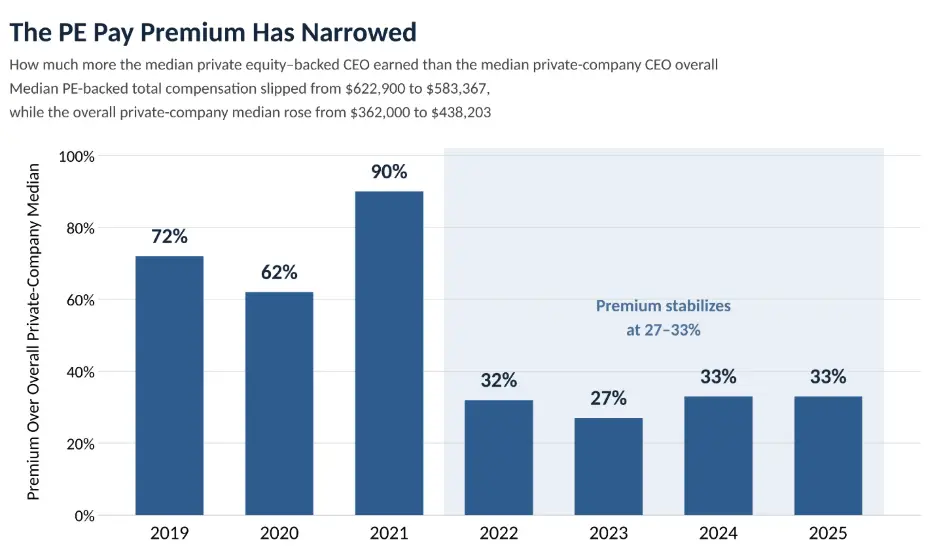
Chief Executive Group Research’s comprehensive analysis of CEO compensation data, spanning seven years from 2019 through 2025, provides compelling evidence of this trend. In 2019, the median CEO of a private equity-backed company commanded a remarkable 72 percent more in total compensation than the median CEO of a privately held company across the broader market. This substantial advantage, a long-standing hallmark of PE leadership roles, translated into a median compensation of $622,900 for PE-backed CEOs compared to $362,000 for the general private company CEO.
The premium remained robust in the initial years of the study. In 2020, it stood at a still-significant 62 percent. The following year, 2021, witnessed a notable surge, with the premium reaching nearly 90 percent. During this period, PE-backed CEOs saw their median total compensation climb to $844,500, a stark contrast to the $445,000 earned by the overall private company CEO sample. This peak performance year for PE-backed executive earnings was likely influenced by a confluence of favorable market conditions.
However, the data reveals a sharp reversal thereafter. By 2022, the median compensation for PE-backed CEOs experienced a significant dip to $546,000, resulting in a considerably reduced premium of just 32 percent. This downward trend, while not necessarily indicative of a complete erosion of the PE advantage, marked a decisive shift from the preceding years. The premium has since remained relatively stable, hovering around the one-third mark: 27 percent in 2023, 33 percent in 2024, and holding steady at 33 percent in the projected figures for 2025.
This trajectory presents a markedly different picture from the pre-pandemic era and even the immediate post-pandemic boom. While PE-backed executives continue to out-earn their general private company peers, their financial advantage has been substantially curtailed.
Unpacking the "What Changed?": A Multifaceted Analysis
The immediate question that arises is whether private equity firms have simply become less generous with executive compensation, or if the very structure and components of executive remuneration have evolved. The data, while pointing to a narrowing gap, does not definitively attribute the cause to a single factor.
Total executive compensation is a complex amalgam of various elements, including base salary, annual bonuses, benefits, perks, and crucially, equity grants and equity appreciation. The volatility inherent in equity-based compensation plays a pivotal role in these fluctuations. When business valuations soar, the value of an executive’s ownership stake can skyrocket, significantly inflating their total compensation. Conversely, a downturn in market conditions or company performance can lead to a sharp retreat in these equity values, making total compensation more susceptible to market swings.
The exceptional market conditions of 2021 appear to be a significant factor in the elevated compensation figures for that year. A period characterized by strong economic recoveries, a surge in deal-making activity, and substantial increases in private market valuations likely contributed to inflated reported values of executive equity stakes. This surge in valuations, driven by a combination of economic stimulus, pent-up consumer demand, and a generally optimistic outlook, created an environment where the paper gains on equity could be substantial.
However, attributing the entire shift solely to the 2021 market anomaly would be an oversimplification. Chief Executive Group Research’s analysis suggests that even when controlling for equity gains, the premium has shown a discernible decline. This implies that other structural or strategic changes within the PE landscape might also be at play.
Potential Contributing Factors and Emerging Trends
Several theories can be posited to explain the diminishing PE executive compensation premium:
- Increased Competition for Talent: As the private equity model has matured and become more widespread, the demand for highly skilled CEOs capable of navigating its specific demands has intensified. This increased competition, even within the PE ecosystem, might be leading to more standardized compensation structures across different PE firms and investment strategies, thus compressing the premium over non-PE companies.
- Maturation of the PE Industry: The private equity industry itself has evolved significantly. Many PE firms now operate with a greater emphasis on operational improvements and long-term value creation rather than purely financial engineering. This shift in focus might lead to more balanced compensation packages that incorporate a wider array of performance metrics beyond just immediate valuation increases.
- Regulatory Scrutiny and Investor Pressure: Increased regulatory oversight and growing pressure from limited partners (LPs) – the institutional investors that fund PE funds – to demonstrate greater alignment of interests and cost efficiency could also be influencing compensation practices. LPs are increasingly focused on ensuring that executive compensation is directly tied to demonstrable value creation and not simply a function of market exuberance.
- Diversification of PE Strategies: The PE landscape is no longer monolithic. A wide array of strategies, from growth equity to distressed debt, employ different approaches to value creation and, consequently, different compensation frameworks for their leadership. This diversification could lead to a broader spectrum of CEO compensation within the PE universe, potentially lowering the median premium.
- Shifting Risk-Reward Calculus: For some CEOs, the perceived risks associated with PE ownership – intense performance expectations, potential for demanding exit strategies, and the inherent volatility of private markets – might now be viewed as less commensurate with the reduced financial upside compared to earlier periods. This could lead them to seek opportunities in other sectors or opt for more stable, albeit potentially lower-paying, roles in established public companies.
Implications for Private Equity Firms and Executives
The shrinking compensation premium poses a critical strategic challenge for private equity firms. If the differential in earning potential is no longer as pronounced, how can they continue to attract and retain the caliber of leadership talent necessary to drive their investment theses?
This situation necessitates a re-evaluation of how PE firms communicate and structure executive incentives. The focus may need to shift from solely emphasizing the magnitude of the premium to articulating the clarity and compelling nature of long-term wealth creation opportunities. This could involve:
- Enhanced Communication of Incentive Value: PE firms might need to become more adept at clearly explaining the intricate ways in which executive compensation is tied to sustainable value creation, operational excellence, and strategic growth, rather than solely relying on market valuation surges.
- Refined Alignment with Achievable Business Outcomes: Ensuring that executive reward structures are more closely and demonstrably aligned with specific, achievable business objectives and milestones will be crucial. This could involve greater emphasis on metrics related to market share growth, innovation, operational efficiency, and customer satisfaction, alongside financial returns.
- Exploring Alternative Incentive Structures: Beyond traditional equity grants, PE firms might explore other incentive mechanisms that offer predictable upside tied to specific performance targets, or benefit-sharing models that reward sustained long-term performance and value creation.
- Transparency and Fairness: Greater transparency in compensation structures and a demonstrable commitment to fairness can build trust and enhance the attractiveness of PE leadership roles.
For CEOs considering a move into PE-backed leadership, the question is no longer simply about the potential for earning "more." Instead, the relevant consideration is the opportunity to create significant value and the proportion of that created value they are positioned to receive. This requires a more nuanced assessment of the specific PE firm, its investment strategy, its track record, and the alignment of its incentive framework with the CEO’s personal career aspirations and risk appetite.
The Future of PE Leadership Compensation
The narrowing compensation premium is not necessarily an indictment of the private equity model itself, but rather an indication of its maturation and the evolving dynamics of the executive talent market. While the days of exceptionally wide compensation gaps might be receding, the core appeal of PE leadership – the opportunity to significantly impact a company’s trajectory, drive substantial growth, and participate in that success – remains.
As the PE industry continues to evolve, so too will the strategies for incentivizing its leaders. The focus will likely shift towards demonstrating robust and sustainable value creation, fostering clear alignment between executive efforts and business outcomes, and ensuring that the rewards offered are both competitive and reflective of the unique challenges and opportunities inherent in private equity ownership. For both PE firms and the executives they seek to attract, understanding and adapting to these shifts will be paramount to continued success in the dynamic world of private capital.
For a deeper dive into compensation benchmarks across various company sizes, industries, and ownership structures, Chief Executive Group Research’s comprehensive CEO & Senior Executive Compensation Report offers valuable insights.
