

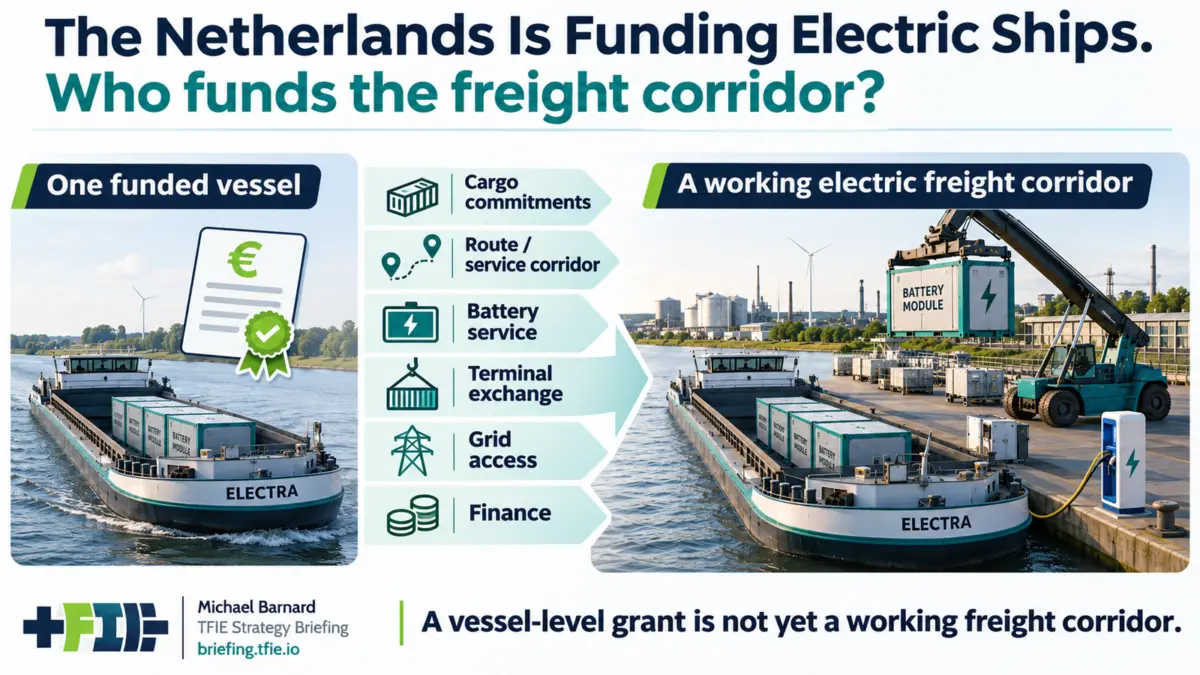
The Dutch government has formalized a multi-year financial commitment to transition its inland shipping fleet away from fossil-fuel propulsion, allocating €231.2 million over a four-year period to support the maritime industry’s energy transition. This significant fiscal intervention, managed by the Netherlands Enterprise Agency (RVO), aims to modernize the vessels that navigate the country’s extensive waterway network, which serves as the primary logistical artery for Western Europe. The program is designed to bridge the financial gap between traditional diesel-powered operations and emerging zero-emission technologies, with a specific focus on battery-electric systems and hybrid configurations.
According to the official program rollout, the first tender, valued at €36.93 million, is scheduled to open on November 17, 2026. This initiative represents a sophisticated evolution in maritime policy, moving beyond small-scale technology demonstrations toward a comprehensive industrial shift. By providing vessel-level grants, the Netherlands seeks to meet its domestic climate goals while maintaining its competitive edge as a global leader in maritime logistics and port operations.
Strategic Context of Dutch Inland Waterways
The Netherlands possesses one of the most dense and utilized inland waterway networks in the world, with over 6,000 kilometers of navigable rivers and canals. This network is vital for the transit of goods from the Port of Rotterdam—Europe’s largest maritime hub—to the industrial centers of Germany, Belgium, and Switzerland. Historically, inland shipping has been viewed as a more environmentally friendly alternative to road transport; however, the sector remains heavily dependent on gas oil (diesel).
As the European Union tightens its environmental regulations under the "Fit for 55" package and the Green Deal, the pressure to decarbonize the "last mile" of international shipping has intensified. The Dutch inland fleet, which comprises thousands of vessels ranging from small barges to large container ships, faces a daunting capital expenditure hurdle in transitioning to electric or hydrogen propulsion. The €231.2 million program is intended to mitigate these risks, encouraging shipowners to invest in hardware that would otherwise be cost-prohibitive in a low-margin industry.
Technical Scope and Eligibility Criteria
The RVO program is designed to be technologically inclusive while maintaining a clear preference for the most efficient pathways to decarbonization. Eligible investments include:
- Battery-Electric Propulsion: Direct electric drive systems powered by onboard battery arrays.
- Hybrid Arrangements: Systems that combine electric motors with low-emission internal combustion engines or fuel cells.
- Swappable Battery Systems: Modular battery containers that can be exchanged at specialized terminals, reducing downtime for charging.
- Charging and Refueling Infrastructure: Support for the shore-side facilities required to power these new vessels.
A critical component of the subsidy calculation is the "emissions avoided per euro" metric. This scoring system prioritizes projects that offer the greatest environmental return on investment. While this ensures fiscal responsibility, it also creates a competitive environment where shipowners must demonstrate the long-term viability of their chosen technology.

The Challenge of Integrated Freight Corridors
While the subsidy provides a clear path for individual shipowners to upgrade their vessels, industry analysts suggest that a vessel-level grant is only one component of a functioning green freight corridor. A "corridor" implies a seamless network where a vessel can operate reliably between ports without the risk of energy depletion or logistical bottlenecks.
The current Dutch tender recognizes this by awarding points for commercial cooperation and cargo-owner agreements. However, a significant "accounting boundary" remains. The subsidy primarily targets the propulsion systems of the ships themselves, often leaving the broader infrastructure—such as grid upgrades, specialized cranes for battery swapping, and energy management software—to be funded through separate, often disconnected, channels.
For a battery-electric barge to be commercially useful, it requires more than just an electric motor. It needs access to a robust "energy-as-a-service" ecosystem. This includes:
- Battery Inventory: A surplus of charged batteries available for exchange.
- Grid Capacity: High-voltage connections at terminals capable of charging massive battery arrays without destabilizing the local power grid.
- Standardization: Interoperable hardware that allows a ship to swap batteries at any port along the Rhine or Meuse rivers.
Case Study: Zero Emission Services (ZES)
The Netherlands is already home to pioneering efforts in this space, most notably through Zero Emission Services (ZES). ZES has demonstrated the viability of the "ZESpack" system—standardized 20-foot containers filled with batteries that can be swapped in minutes. This model decouples the cost of the energy storage from the cost of the vessel, allowing shipowners to pay for energy usage rather than the full capital cost of the batteries.
At the Moerdijk terminal, ZES has successfully integrated battery exchange facilities with existing electricity infrastructure. This site serves as a blueprint for the "corridor" approach. By combining battery handling equipment with committed cargo flows—such as those from major retailers like Heineken—ZES has shown that electrification is possible when the entire value chain is synchronized. The new government subsidy aims to scale this model, though critics warn that without dedicated funding for shared assets, the transition may remain fragmented.
Chronology of the Transition
The path toward the 2026 tender is marked by several key milestones in Dutch maritime policy:
- 2020–2023: Early pilot programs and the launch of the first ZES-powered vessels.
- 2024: Finalization of the €231.2 million budget allocation and development of the RVO scoring criteria.
- 2025: Pre-qualification period for shipowners and infrastructure providers to form consortiums and secure commercial agreements.
- November 17, 2026: Opening of the first €36.93 million tender round.
- 2027–2030: Subsequent tender rounds and the expected deployment of dozens of new zero-emission vessels.
Shifting Cargo Dynamics and Future-Proofing
One of the more nuanced challenges facing the Dutch inland shipping sector is the changing nature of the cargo itself. Traditionally, a large portion of inland freight has consisted of fossil fuels, such as coal for power plants and petroleum products for industrial use. As Europe transitions to renewable energy, these bulk flows are expected to decline significantly.

The Dutch program encourages shipowners to look beyond current cargo patterns. An electric vessel designed today must be versatile enough to handle the cargo of tomorrow—likely containerized goods, green hydrogen carriers, or circular economy materials. This shift requires a different architectural approach to vessel design and route planning. A high-utilization route with steady demand may justify a fixed charging station, whereas a lower-utilization route might rely on mobile battery containers.
Broader Economic and Environmental Impact
The implications of this subsidy program extend far beyond the borders of the Netherlands. As the primary gateway to the European hinterland, Dutch maritime policy sets the standard for the rest of the continent. If the Netherlands successfully creates a network of electric freight corridors, it will provide a scalable model for other major river systems, such as the Danube in Central Europe or the Seine in France.
From an environmental perspective, the impact is substantial. Inland shipping is a major contributor to nitrogen oxide (NOx) and particulate matter (PM) emissions in densely populated areas. By replacing diesel engines with electric propulsion, the program will significantly improve air quality in port cities and along riverbanks, contributing to the "Zero Pollution" ambition of the European Union.
Conclusion: From Ships to Systems
The Dutch government’s €231.2 million investment is a bold statement of intent. It acknowledges that the decarbonization of heavy transport cannot be left to the market alone, given the high entry costs and infrastructure dependencies. However, the ultimate success of the program will be measured not just by the number of electric ships on the water, but by the reliability and repeatability of the freight services they provide.
To move from vessel grants to working corridors, the industry must focus on shared assets and data-driven logistics. The ship is the most visible part of the transition, but the invisible infrastructure—the grid, the battery pools, and the commercial contracts—is what makes the transition commercially viable. As the 2026 tender approaches, the focus must remain on connecting these individual investments into a cohesive, zero-emission network that can sustain Europe’s industrial heartland for decades to come.
