

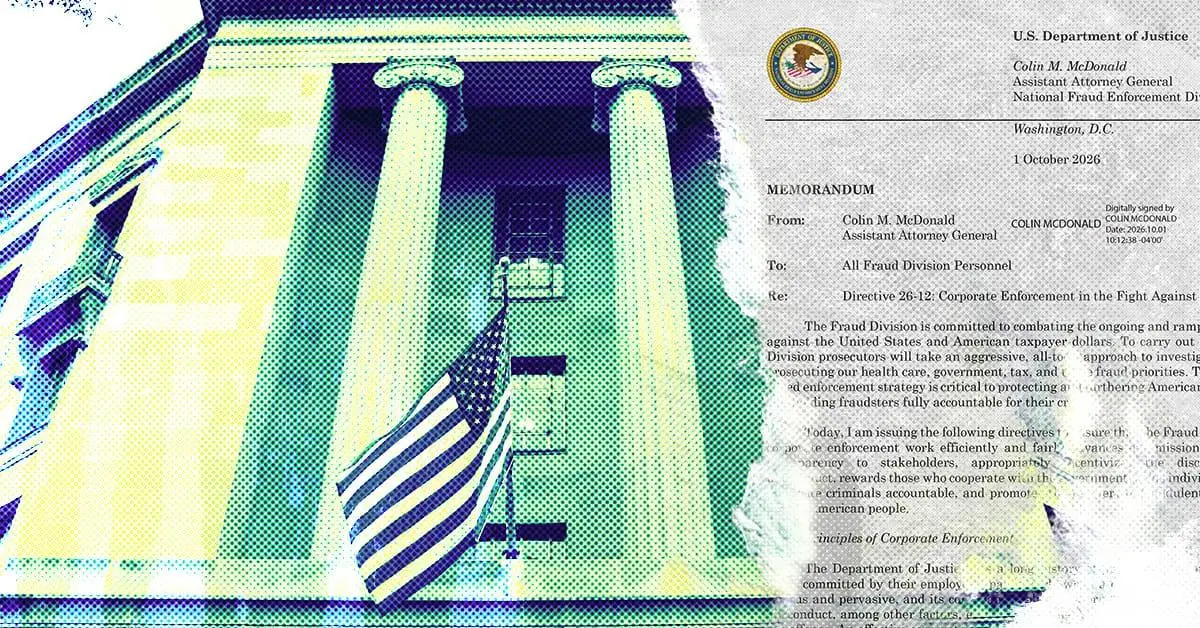
The Justice Department’s newly established National Fraud Enforcement Division (NFED) has issued its most comprehensive public directive to date, providing corporate fraud prosecutors with clear guidelines on factors to consider when deciding whether to bring charges against corporations. This significant memo, spearheaded by Assistant Attorney General Colin McDonald, offers a crucial roadmap for companies navigating the complexities of corporate compliance and facing potential government scrutiny. The directive underscores a strategic shift in enforcement priorities, emphasizing enhanced whistleblower incentives and a more centralized approach to corporate case management, signaling a proactive stance in combating white-collar crime.
A New Era of Corporate Enforcement Guidance
On October 1, Assistant Attorney General Colin McDonald of the National Fraud Enforcement Division distributed a directive that meticulously outlines ten key factors prosecutors must weigh heavily when evaluating corporate cases. This guidance serves as a substantial step forward from previous, less detailed pronouncements, offering unprecedented clarity on the Department of Justice’s (DOJ) approach to corporate enforcement. The memo is not merely a procedural update; it represents a strategic refinement of the NFED’s mission, which was largely assembled this year from existing units within the DOJ’s Criminal Division. This reorganization, while raising some eyebrows due to the perceived overlap with existing functions, signals a dedicated focus on national fraud enforcement.
Central to the directive is the mandate that all corporate cases within the division must be brought before the new Corporate Enforcement Section. This section will play a pivotal role in assessing whether companies are adhering to the terms of their resolutions, ensuring accountability and robust oversight. Furthermore, the memo explicitly instructs division leaders to develop and implement incentives for whistleblowers. This includes provisions for individuals who may have been complicit in misconduct, aligning with a broader trend of federal programs designed to encourage insiders to report corporate wrongdoing.
Deconstructing the McDonald Memo: Key Factors for Prosecution
The October directive builds upon priorities previously articulated by Assistant Attorney General McDonald in August, when he identified corporate misconduct as one of the division’s five primary focus areas. However, the recent memo provides the practical details that were previously absent. The ten factors prosecutors are to consider are applied to cases falling within the NFED’s priority areas: healthcare, government programs and procurement, revenue evasion, and international trade, with a particular emphasis on issues such as forced labor and tariffs.
Among the factors that prosecutors are instructed to give "great weight" are:
- Management Involvement: Whether senior management was aware of or actively participated in alleged schemes.
- Concealment Efforts: Whether the company actively attempted to hide misconduct from government agencies or auditors.
- Threats to National Security and Public Safety: This encompasses a broad range of risks, including impacts on military readiness and the safety of American citizens.
- Financial Harm to Government Programs: Significant financial hardship inflicted upon taxpayer-funded programs, such as Medicare or Social Security.
- Harm to Multiple Government Programs: Schemes that negatively impact several federal programs simultaneously.
- Foreign Adversary Funding and Immigration Offenses: Cases where illicit funds are channeled to foreign adversaries or involve violations of immigration laws.
The memo also introduces specific quantitative thresholds designed to provide companies with greater visibility into what the DOJ considers significant. These include:
- Duration of Conduct: Schemes lasting at least three years.
- Geographic Scope: Conduct impacting at least three federal districts.
- Victim Impact or Financial Loss: Harming at least 25 victims or causing at least $25 million in losses.
While these numerical benchmarks offer a clearer picture, legal experts caution against viewing them as absolute "safe harbors." Carla Baumel, a trial litigator at Robins Kaplan and former Assistant U.S. Attorney, emphasizes that the memo explicitly states these factors are non-exhaustive and that prosecutorial discretion remains paramount. "Companies should not mistake those numbers for safe harbors," Baumel noted in a written interview. "The memo expressly describes the factors as non-exhaustive and preserves prosecutorial judgment. A scheme involving $24 million or lasting 35 months does not suddenly become insignificant. The thresholds give companies greater visibility into what DOJ considers significant – and should help compliance teams identify matters that warrant immediate escalation."
Allen Slaughter, a partner at Robins Kaplan and former federal prosecutor, advises companies to interpret the memo based on their exposure rather than solely by industry. "The practical exercise for compliance teams is… to identify where the company touches federal funds, federal programs, government revenue or the movement of goods into the United States," Slaughter stated. "Where those connections exist, the directive provides a fairly direct indication of both the conduct DOJ is targeting and the circumstances likely to elevate misconduct into a corporate enforcement matter."
Jacqueline Kelly, a partner at Boies Schiller Flexner and former federal prosecutor, suggests that the memo’s emphasis on prioritizing investigations from the outset could lead to a reduction in the number of corporate cases initiated. "This can be expected to affect the types of investigations that get opened at all, which legally have a low bar to initiate," Kelly explained. "We can expect this will result in fewer corporate investigations being opened."
The Evolving Landscape of Corporate Compliance
Experts generally agree that most existing corporate compliance programs do not require a complete overhaul in response to this new guidance. Instead, the focus should shift to a meticulous re-assessment of exposure to enforcement risks, particularly in areas highlighted by the October memo and the creation of the NFED itself. These critical areas include engagement with federal programs, the utilization of government funding, and international trade activities.
The memo reinforces a long-standing DOJ message: compliance programs must be effective in practice, not merely on paper. "The new memo does not create a new compliance standard; it reinforces the existing message that DOJ will look beyond written policies to how a company identifies, escalates, investigates, and responds to misconduct," Slaughter reiterated. This means that robust internal controls, thorough investigation protocols, and demonstrable remediation efforts are more crucial than ever.
A Race Against Time: Self-Disclosure and Whistleblower Incentives
While the October memo does not fundamentally alter the rules for self-disclosure of misconduct, it provides a compelling incentive for companies to ensure their internal mechanisms for identifying and reporting wrongdoing are both robust and swift. The NFED is instructed to adhere to the DOJ’s department-wide Corporate Enforcement Policy (CEP), issued in March. This policy offers a declination of charges for companies that voluntarily self-disclose, fully cooperate with investigations, and implement timely remediation, barring aggravating circumstances.
Two significant developments highlighted by the memo are the DOJ’s increasing reliance on data analytics and the explicit instruction to create enhanced whistleblower incentives. The memo notes that the NFED is already generating leads and initiating investigations at an accelerated pace, leveraging new resources, advanced technology, and data analytics capabilities through its National Fraud Detection Center. This center was established in April when the division was created, underscorizing the DOJ’s commitment to proactive enforcement.
The directive for division leaders to design programs that encourage whistleblowers, even those who may have participated in misconduct, is particularly noteworthy. While the specific forms these incentives will take remain undisclosed, this initiative is poised to amplify the government’s ability to uncover corporate malfeasance.
These two factors – enhanced data analytics and improved whistleblower incentives – collectively increase the likelihood that the government will learn about misconduct before a company self-reports. This is a critical consideration under the CEP, as voluntary disclosure credit is generally contingent upon the DOJ not already being aware of the misconduct. The CEP does allow for a window if a company self-reports after an internal report, but an insider going directly to the government bypasses this entirely. Previous analyses of enforcement actions have shown that companies have frequently forfeited voluntary disclosure credit because whistleblowers, media reports, or parallel investigations have alerted the authorities first.
"The details of that program have not yet been announced, but a company investigating potential misconduct has even less reason to assume it is the only one that knows about it," Baumel cautioned. Slaughter echoed this sentiment, stating that additional reporting incentives "could make the existing race for voluntary-disclosure credit even more difficult."
This dynamic places a premium on companies’ internal systems for surfacing problems and making informed decisions about disclosure. The ability to quickly investigate serious issues and make timely, well-documented disclosure decisions is paramount. "Compliance teams should examine whether significant allegations reach the right decisionmakers quickly and whether they can investigate them efficiently," Baumel advised. "Written policies only go so far. Companies need processes that allow them to investigate serious issues and make informed disclosure decisions quickly."
Jenelle Beavers, a managing director with Alvarez & Marsal Disputes and Investigations, further recommended that firms revisit their whistleblower programs to ensure they are "robust, easily accessible to their employees, and that information learned is processed and evaluated in a timely manner."
The Broader DOJ Reorganization and Future Outlook
The October memo is the latest development in a series of rapid organizational changes within the DOJ concerning fraud enforcement. The White House initially announced plans for the NFED in January, with Colin McDonald’s confirmation by the Senate in March. An April DOJ memo formally transferred key units, including the Health Care Fraud Unit, the Market, Government and Consumer Fraud Unit, and the Tax Section, from the Criminal Division into the new division. The formal establishment of the NFED through regulation occurred in August, coinciding with the renaming of the Criminal Division’s Fraud Section to the White Collar and Corporate Enforcement Section.
This significant reshuffling has involved a substantial reallocation of personnel. The NFED is projected to comprise approximately 500 attorneys and staff, drawn from various DOJ components and U.S. Attorney’s offices, with plans for continued growth. This is a notable expansion compared to the approximately 200 lawyers in the Criminal Division’s Fraud Section in 2025. Consequently, some units within the Criminal Division have experienced a reduction in staff, with attorneys moving to the new division. The FCPA unit, for instance, has seen its numbers decrease, with some prosecutors transferring to healthcare and government fraud units now housed within the NFED.
Crucially, the Criminal Division retains its own corporate enforcement unit, leading to a situation where two distinct DOJ groups are now engaged in similar work, including evaluating compliance programs and overseeing corporate resolutions. While the department-wide CEP aims to mitigate inconsistencies, Slaughter raised a pertinent question: "a more pressing question may be whether the two corporate-enforcement groups may develop different practical approaches within that common framework."
The memo’s directive for a seven-day inventory of ongoing corporate investigations is also a point of interest. Slaughter cautions against interpreting this as a signal for a broad review akin to the DOJ’s pause on FCPA enforcement last year, which resulted in numerous case closures. "The better inference is that DOJ wants immediate visibility into its corporate docket," he suggested. "That could result in some cases being accelerated, narrowed, coordinated, redirected or closed, but it could just as readily result in additional resources being assigned to matters that fit the division’s priorities."
Civil fraud enforcement under the False Claims Act remains with the DOJ’s Civil Division. While the April memo provided a 120-day period for the DOJ to recommend whether non-criminal functions should be integrated into the NFED, no outcome had been announced as of the article’s publication. "What we are already seeing is greater coordination across civil and criminal enforcement," Baumel observed. "For now, companies should prepare for parallel proceedings."
Despite the evolving organizational structure and enforcement strategies, the fundamental tenets of effective corporate compliance remain constant. "The durable elements are familiar: effective internal controls, escalation, investigation, documentation, remediation, and the ability to respond promptly when serious misconduct is identified," Slaughter concluded. As the NFED solidifies its operational framework, companies must remain vigilant, ensuring their compliance programs are not only comprehensive but also demonstrably effective in preventing and detecting misconduct.
