

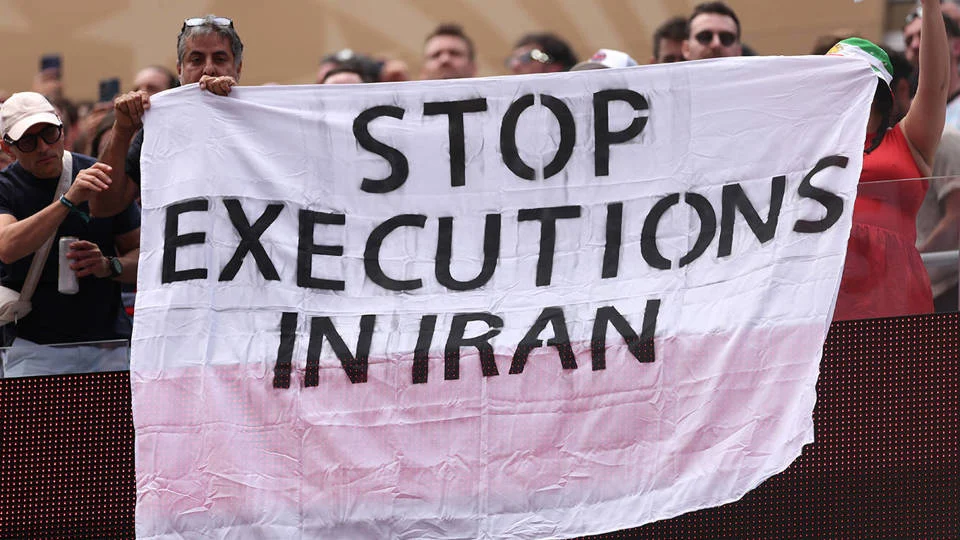
As the pyre smoke from the funeral of Supreme Leader Ayatollah Ali Khamenei, felled in the initial volleys of the US-Israeli aerial campaign in February, began to dissipate, a different kind of inferno ignited across Iran’s southern expanse. The chilling percussion of renewed bombardment from the skies was met not with a pause in the grim machinery of the Islamic Republic, but with an accelerated tempo of executions. Protesters apprehended in the recent unrest, alongside political prisoners languishing for years, are now facing the swift and brutal finality of the gallows, a stark testament to the enduring doctrine of repression embedded within the very foundations of the regime. This unyielding posture casts a stark light on the miscalculations of the United States and Israel, who perhaps harbored misplaced hopes for a behavioral shift or even the system’s collapse under popular pressure.
The Unyielding Grip of the Islamic Republic
The Islamic Republic of Iran, since its inception following the 1979 revolution, has been built upon a bedrock of ideological tenets that prioritize the preservation of the clerical system above all else. This doctrine inherently permits and necessitates the total repression of the population, demanding the mobilization of all state resources—from intelligence apparatuses and security forces to the judiciary and the media—to maintain its grip on power. This ingrained characteristic explains the persistent resilience of the regime, even in the face of unprecedented external pressures and internal dissent. The expectation that the Iranian populace, through sheer force of will, could dismantle such a deeply entrenched system, or that external military actions would compel a fundamental change in its modus operandi, appears to have been a critical underestimation of the state’s capacity for ruthless self-preservation.
A Timeline of Crisis and Continued Repression
The events of February 2026 marked a seismic shift in the geopolitical landscape of the Middle East. The precise timing and catalyst for the US-Israeli airstrikes remain subjects of ongoing analysis, but their immediate impact was undeniable. The elimination of Supreme Leader Ayatollah Ali Khamenei, a figurehead who had presided over Iran for over three decades, sent shockwaves through the nation and the international community.
February 2026: The US-Israeli airstrikes commence, targeting key strategic and military installations within Iran. The strikes result in the death of Supreme Leader Ayatollah Ali Khamenei.
Late February – Early March 2026: Following the Supreme Leader’s demise, a period of intense uncertainty and internal power struggles is widely reported within Iran. Simultaneously, protests, which had been simmering for months and years, erupt with renewed vigor in various cities, fueled by economic hardship, political grievances, and the vacuum created by Khamenei’s death.
March – July 2026: The Iranian judiciary, under the interim leadership and in the absence of a clear successor to the Supreme Leader, initiates a sweeping crackdown on dissent. Security forces apprehend thousands of individuals involved in protests and those deemed to be political opponents. Reports emerge of widespread interrogations and the imposition of harsh sentences.
July 23, 2026: The current report details a significant acceleration in the execution of detainees. The chilling juxtaposition of Khamenei’s funeral rites with the renewed bombardment and the simultaneous surge in executions highlights the regime’s unwavering commitment to suppressing any perceived threat to its authority. This period, therefore, represents not a moment of capitulation, but a desperate doubling-down on the established methods of control.
The Instruments of State Control: An Enduring Legacy
The Islamic Republic’s apparatus of repression is multifaceted and deeply embedded. The Intelligence Ministry (VEVAK), the Islamic Revolutionary Guard Corps (IRGC) and its associated Basij paramilitary force, and the judiciary all play crucial roles in maintaining order and crushing dissent. The legal framework, often criticized by international human rights organizations, provides a basis for swift trials and severe penalties, including capital punishment, for offenses ranging from sedition and espionage to acts deemed to be undermining national security.
The execution of political prisoners and protesters, while not new to Iran’s history, has been amplified in recent years. Prior to the February strikes, human rights groups had already documented a significant increase in executions. For instance, in 2025, Iran reportedly carried out the highest number of executions globally for the seventh consecutive year, according to data from various human rights watchdogs. This pre-existing trend of state-sanctioned killings has now been exacerbated by the current crisis, suggesting a deliberate strategy to reassert control and deter any further challenges to the regime’s authority.
International Reactions and Inferences
The US and Israeli governments have not officially commented on the specific details of the airstrikes beyond acknowledging their strategic objectives. However, prior to the conflict, both nations had consistently voiced concerns over Iran’s nuclear program, regional destabilization activities, and its human rights record. Their stated aim was often to compel Iran to alter its behavior, a goal that, based on the current situation, appears to have been elusive.
International human rights organizations have condemned the recent surge in executions. Amnesty International and Human Rights Watch have issued urgent appeals to the Iranian authorities to halt the killings and to ensure due process for all detainees. These organizations have consistently highlighted the lack of transparency in Iran’s judicial system and the prevalence of torture and forced confessions.
"The speed at which these executions are reportedly being carried out, particularly in the context of ongoing political turmoil and military action, is deeply alarming," stated a spokesperson for a prominent human rights advocacy group, speaking on condition of anonymity due to security concerns. "It suggests a deliberate policy to eliminate perceived opposition and instill fear, rather than to uphold justice. The international community must not remain silent."
Broader Impact and Implications
The continued reliance on repression by the Iranian regime, even amidst external military pressure and internal upheaval, carries significant implications:
Internal Stability vs. Long-Term Legitimacy: While executions may temporarily quell immediate dissent, they risk further alienating the population and eroding any semblance of legitimacy the regime may still hold. This can sow the seeds for future, potentially more volatile, outbreaks of unrest.
Regional Destabilization: The ongoing crisis in Iran, coupled with the existing regional tensions, could lead to further instability in the Middle East. The potential for proxy conflicts, refugee flows, and increased economic disruption remains a significant concern.
Humanitarian Crisis: The accelerated pace of executions and the broader crackdown on dissent contribute to a growing humanitarian crisis within Iran. Access to information and independent oversight is severely restricted, making it difficult to ascertain the full extent of the human cost.
Shifting Geopolitical Alliances: The conflict and the internal dynamics of Iran are likely to reshape regional and global alliances. Nations that have historically supported or opposed the Islamic Republic will be forced to recalibrate their strategies in response to the evolving situation.
The events unfolding in Iran are a stark reminder of the complex interplay between state ideology, power structures, and popular will. The enduring doctrine of repression, as exemplified by the unceasing march of the gallows, suggests that the path towards any fundamental transformation within Iran will be long and arduous, marked by continued struggle and the persistent application of state control. The expectations of swift change, whether from internal or external forces, appear to have been severely tested by the regime’s ingrained capacity for ruthless self-preservation. The international community faces the challenge of navigating this volatile landscape, balancing concerns for human rights with the realities of a deeply entrenched and resilient system.
