

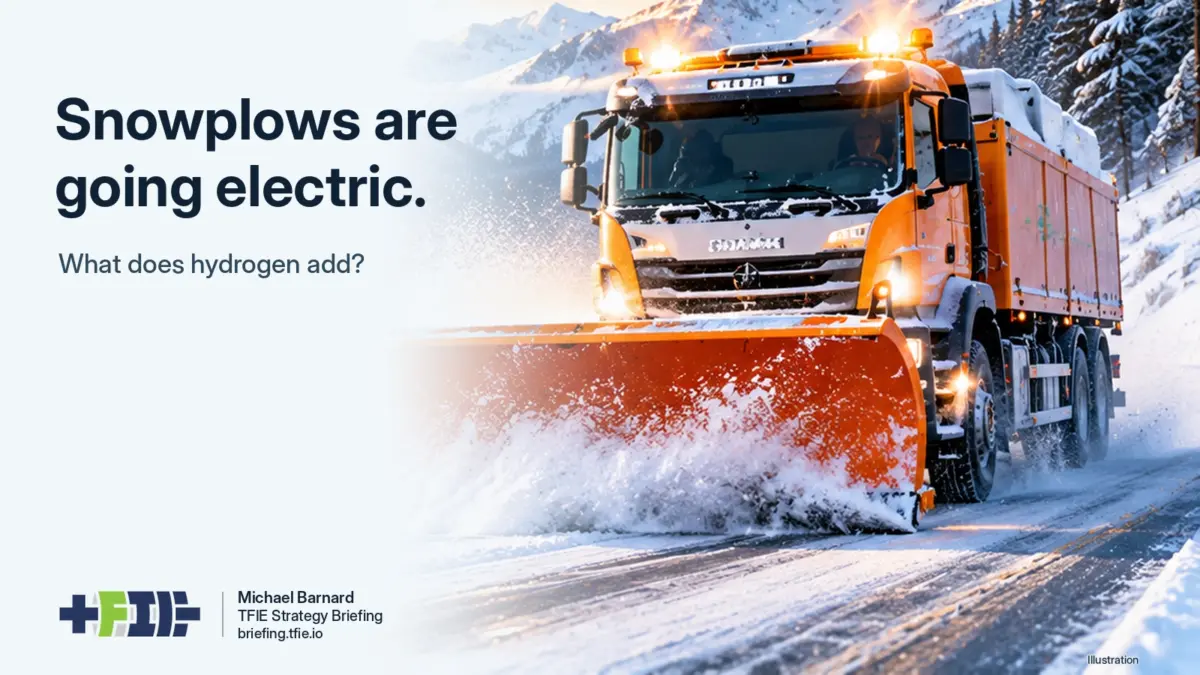
The global transition toward sustainable transportation has reached one of the most demanding frontiers of civil engineering: heavy-duty winter road maintenance. In the harsh climates of Northern Europe and East Asia, government agencies and private contractors are moving beyond the internal combustion engine to pilot zero-emission solutions for snow removal. While battery-electric vehicles (BEVs) have demonstrated significant prowess in initial trials, a competing technological philosophy involving hydrogen fuel cell range extenders is emerging in Sweden. This shift represents a broader industrial debate regarding energy density, infrastructure costs, and operational reliability in sub-zero temperatures. As Norway, Sweden, and China deploy these next-generation machines, the data gathered will likely dictate the future of municipal fleets and heavy-duty specialized machinery for decades to come.
The Norwegian Breakthrough: Battery-Electric Dominance on Hardangervidda
Norway, a global leader in electric vehicle adoption, has recently concluded a landmark demonstration of battery-electric snowplowing on one of its most challenging terrains. The Norwegian Public Roads Administration (Statens vegvesen) conducted a rigorous trial of a Scania 45 R, a heavy-duty electric truck, on the Hardangervidda mountain plateau. This region is notorious for its brutal winter conditions, characterized by high-speed winds, deep snowdrifts, and temperatures that frequently plummet well below freezing.
During the 2024–2025 winter season, the Scania 45 R covered approximately 7,000 kilometers while performing a variety of essential tasks, including plowing, grading, and spreading sand. The results of the trial exceeded the expectations of both the operators and the manufacturers. Data collected during the evaluation showed that the vehicle maintained an average energy consumption of 2.02 kWh per kilometer. Under mixed-duty conditions, which included the heavy mechanical load of pushing snow and the energy drain of heating the cabin and maintaining battery temperature, the truck achieved an operating endurance of roughly six and a half hours.
While the trial was considered a success, it highlighted specific engineering hurdles that must be addressed for wider adoption. The Norwegian Public Roads Administration noted that the payload capacity was slightly reduced due to the weight of the battery packs, and charging compatibility at remote mountain stations required careful logistical planning. However, these were categorized as iterative engineering challenges rather than fundamental flaws in the battery-electric concept. The Norwegian experience suggests that for most standard shifts, existing battery technology is already capable of performing the heavy lifting required for winter maintenance.
Sweden’s Hydrogen Alternative: The Case for Range Extension
In contrast to the pure battery-electric approach favored in Norway, Sweden has unveiled a more complex hybrid solution. A collaborative project involving Scania, the logistics firm MaserFrakt, and the construction company Peab has introduced a snowplow that utilizes a dual-energy storage system. This vehicle is built on a battery-electric chassis but incorporates a hydrogen fuel cell and high-pressure storage tanks to serve as a range extender.
The Swedish vehicle is equipped with a 356 kWh rechargeable battery and carries 56 kilograms of hydrogen. The fuel cell acts as an onboard generator, converting hydrogen into electricity to supplement the battery during extended operations. This configuration is designed to address the "range anxiety" associated with extreme-duty cycles where a truck might be required to work for 12 to 24 hours continuously during a major blizzard.

The engineering rationale behind this second energy system is the ability to refuel hydrogen in minutes, compared to the hours required for a full battery recharge. However, this flexibility comes at a significant cost in terms of complexity. The vehicle requires two distinct energy-storage systems and the hardware to manage the conversion of hydrogen. Furthermore, the operational logistics are doubled: the truck needs access to high-power electric charging infrastructure as well as a complete hydrogen supply chain, including production, delivery, storage, and specialized refueling stations.
Comparative Data: Energy Storage and Efficiency
The debate between pure battery-electric and hydrogen-extended systems often centers on efficiency and weight. The following data points illustrate the technical divide:
- Energy Efficiency: Battery-electric vehicles typically boast a "well-to-wheel" efficiency of 70% to 90%. In contrast, hydrogen systems involve energy losses during electrolysis, compression, transport, and the final conversion back to electricity within the fuel cell, often resulting in a total efficiency of 25% to 35%.
- Operational Endurance: The Norwegian trial proved that a 40-tonne electric truck can operate for over six hours on a single charge. The Swedish hydrogen-extended model aims to push this endurance to 10 or 12 hours, potentially allowing for double-shift operations without returning to a central depot for long charging sessions.
- Consumption Rates: At 2.02 kWh/km, a standard heavy-duty electric snowplow requires massive amounts of energy. For a 12-hour shift, a vehicle would need over 1,000 kWh of energy. A battery capable of storing this much energy would be prohibitively heavy, which is where hydrogen advocates argue that 56 kg of hydrogen (providing roughly 1,800 kWh of raw energy, though much less after conversion) offers a superior weight-to-energy ratio.
China’s Industrial Scale and Market Expansion
While Scandinavia serves as a laboratory for high-end specialized equipment, China is focusing on the rapid scaling of electric snow-removal technology. Leveraging its world-leading battery supply chain and massive heavy-duty vehicle industry, China is moving beyond isolated demonstrations toward municipal-wide deployments.
In September 2026, Beijing’s Mentougou district signaled a major shift by awarding contracts for 24 multifunction snow-removal trucks. While the final specifications for every unit in the fleet have not been disclosed, the procurement process emphasized battery-electric powertrains. China’s strategy relies on the "volume effect": by using standardized batteries and motors developed for the millions of electric freight trucks already on Chinese roads, manufacturers can produce specialized snow-removal equipment at a fraction of the cost of European prototypes.
This industrial scale provides a significant advantage. Specialized equipment manufacturers in China can source high-performance components—such as high-torque electric motors and thermal management systems—that have already been "stress-tested" in the freight sector. This reduces the research and development burden and allows for a faster rollout of zero-emission municipal fleets.
The Role of Renewable Diesel (HVO) as a Bridge Technology
The push for hydrogen range extension is also facing competition from a much simpler, established technology: Hydrotreated Vegetable Oil (HVO). HVO is a renewable, paraffinic diesel that can be used as a "drop-in" fuel in conventional engines with little to no modification.
Critics of the hydrogen approach argue that if a battery-electric truck needs a range extender for occasional extreme weather events, a conventional generator running on HVO would be a more logical choice. HVO uses existing liquid-fuel infrastructure, is easier to store than high-pressure hydrogen, and the generators are a mature, low-cost technology.

Copenhagen Airport has already implemented a version of this pragmatic strategy. The airport is progressively electrifying its ground support equipment but continues to use HVO in its compatible heavy vehicles, including snow-removal machines. This allows the airport to maintain zero-emission or low-emission operations without the massive capital expenditure required for hydrogen infrastructure. By using HVO for the "last 10%" of extreme-duty shifts that batteries cannot yet cover, operators can achieve their climate goals while maintaining operational resilience.
Analysis of Implications: The Economic and Operational Reality
The primary challenge for hydrogen-powered snowplows is the "seasonal utilization" problem. Snow-removal equipment is typically used for only three to four months of the year. Investing in expensive hydrogen refueling infrastructure for vehicles that sit idle for 75% of the year is difficult to justify for many municipal budgets.
Conversely, battery-electric trucks can often be repurposed. A heavy-duty chassis used for snowplowing in the winter can be fitted with different equipment for road maintenance, dust suppression, or hauling during the summer months. Because charging infrastructure for electric trucks is increasingly being built out for the logistics sector, snowplows can "piggyback" on existing networks.
Furthermore, the "whole-system cost" of hydrogen remains a barrier. To make hydrogen a viable competitor, it must outperform the combined cost-efficiency of:
- Larger, more energy-dense batteries (which are decreasing in price annually).
- High-speed Megawatt Charging Systems (MCS) that can recharge a truck in under 30 minutes.
- The use of HVO in existing diesel fleets for extreme weather reserves.
Conclusion: A Multi-Pathway Future
The trials in Norway and the procurement trends in China suggest that the "simpler" electric solution—relying on high-capacity batteries and robust charging networks—is currently the frontrunner for the future of winter maintenance. Norway’s successful 7,000 km trial on Hardangervidda has debunked the myth that electric trucks cannot handle extreme cold and heavy mechanical loads.
However, the Swedish hydrogen project represents an important exploration of the limits of battery technology. If hydrogen can prove its worth in the most extreme 1% of weather events where continuous operation is a matter of public safety, it may find a niche in high-altitude or extremely remote regions.
Ultimately, the goal for road authorities remains the same: maintaining safe, clear roads with the lowest possible environmental impact and cost. As the industrial scale of China meets the rigorous field testing of Scandinavia, the transition away from fossil-fuel-powered snowplows appears inevitable, whether the energy comes from a battery, a fuel cell, or a tank of renewable diesel. The coming years will determine which of these technologies can survive the "cold reality" of operational economics.
