

The executive compensation landscape is undergoing a significant transformation, marked by a pronounced and expanding emphasis on personal security and corporate aircraft usage for top company leadership. A recent analysis by Pay Governance LLC, a leading compensation consulting firm, reveals a notable surge in the provision and disclosure of these benefits, driven by evolving risk environments and heightened board-level scrutiny. The findings, based on a comprehensive review of proxy statements, indicate a maturing approach to executive protection, extending beyond the chief executive officer to encompass a broader range of named executive officers (NEOs) and integrating these provisions within a more formal risk-management framework.
The impetus for this heightened focus on executive safety has been amplified by a series of concerning events. Notably, the tragic murder of a high-profile healthcare insurance company executive in December 2024 served as a stark wake-up call for many corporations. This incident prompted numerous large organizations to commission urgent security reviews by external experts. The subsequent implementation of enhanced personal security measures, often stemming from these expert assessments, has become increasingly common. Historically, such programs were largely confined to the CEO. However, the current trend demonstrates a clear expansion of these protective measures to other key members of the leadership team, including Chief Financial Officers, Chief Operating Officers, and other senior executives deemed critical to the company’s operations and strategic direction.
This shift reflects a broader societal concern regarding the safety of corporate leaders, exacerbated by their increasing public and digital visibility. Boards of directors are now more proactively reassessing whether existing protection programs are adequately scoped and robust enough to address contemporary threats. In many instances, the provision of corporate aircraft usage is no longer viewed solely as a perquisite but is increasingly being integrated into broader security strategies, mandated as a necessary component of board-approved safety protocols rather than an independent perk.
Pay Governance’s research highlights that executive protection programs are not merely experiencing incremental changes; they are undergoing a significant maturation process. The most striking development is not simply an increase in disclosed values for CEOs, but rather the extensive expansion of these programs to include select members of the broader leadership team. This expansion is increasingly supported by more robust governance practices and detailed proxy disclosures, offering greater transparency to shareholders.
Personal Security Programs Witness Broad Expansion Across the S&P 500
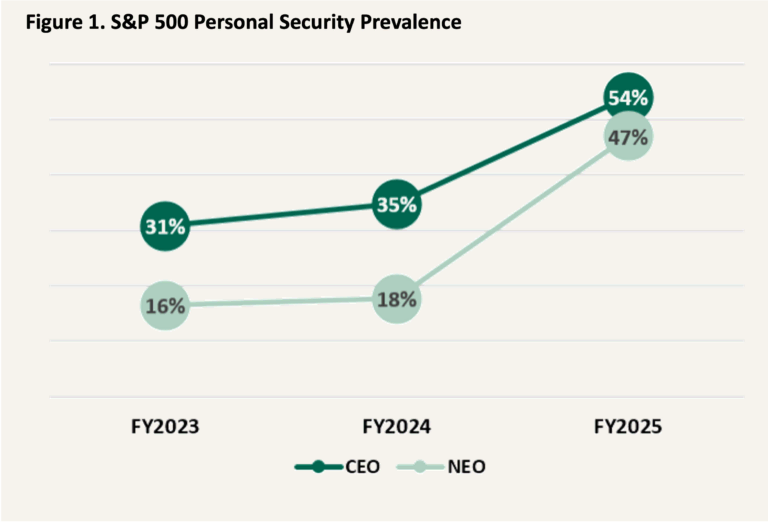
The past three fiscal years have seen a consistent expansion of personal security programs across companies within the S&P 500 index. While CEO arrangements continue to be the most prevalent, the Pay Governance review identified a significant trend: the growing provision of executive protection benefits to other named executive officers. According to the firm’s analysis, approximately 47% of S&P 500 companies now offer personal security benefits to at least one additional NEO. This figure represents a substantial increase from less than 20% in both fiscal year 2023 and fiscal year 2024, underscoring a clear market-wide shift in the distribution of these protective measures.

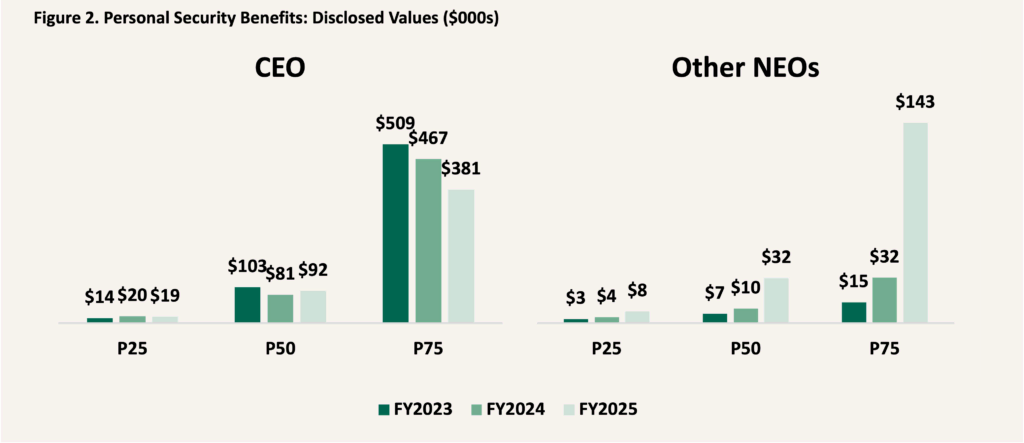
The financial implications of these programs also present a nuanced picture. In fiscal year 2025, disclosed values for CEO personal security arrangements showed mixed trends. The median disclosed value experienced an approximate 14% increase, signaling a rise in the typical investment in CEO safety. However, the 75th percentile for CEO personal security values saw a decline of 18%. This divergence suggests a potential shift in the types of security measures being implemented. As more companies adopt less costly, technology-driven solutions such as digital monitoring, comprehensive privacy protection services, identity theft prevention, and enhanced home network security, the overall prevalence of these benefits can rise even as the median or upper-quartile financial values remain more moderate. This strategic adoption of a wider array of security tools allows for broader coverage without necessarily inflating the highest disclosed dollar amounts for CEO protection.
The growth in personal security benefits has been far more pronounced for NEOs other than the CEO. The Pay Governance data illustrates a dramatic increase in the financial commitment to their security. Median personal security values for these executives rose from approximately $10,000 to $32,000, more than tripling the typical investment. Concurrently, the 75th percentile for NEO personal security values saw an even more substantial jump, increasing from $32,000 to $143,000. This significant escalation indicates that companies are increasingly viewing executive protection not as an exclusive benefit reserved solely for the CEO, but as a necessary component of risk management for a select group of critical leaders.
A closer examination of the higher-value programs reveals the extent of this expansion. While the number of companies providing CEO personal security benefits exceeding $500,000 remained constant at 29 in both fiscal years 2024 and 2025, suggesting that the increased prevalence for CEOs was driven by broader adoption at more typical spending levels, the picture for other NEOs is markedly different. Specifically, the number of NEOs receiving personal security benefits valued at over $100,000 surged from 18 in fiscal year 2024 to 57 in fiscal year 2025. This nearly threefold increase among top-tier NEOs significantly contributed to the substantial rise in the 75th percentile for this group, underscoring a strategic decision to invest more heavily in the security of a wider echelon of leadership.
Emerging Trends Redefine Executive Security Perquisites
The proxy disclosures for fiscal year 2025 reveal a significant evolution in the nature of personal security provisions. These programs are increasingly extending beyond traditional physical security measures, which historically included elements such as home alarm systems, on-site residential security personnel, secure transportation, and travel protection protocols. Companies are now more frequently articulating broader, risk-based executive security programs. These comprehensive initiatives often encompass independent security assessments, enhanced residential protection measures, and security arrangements that are explicitly supported by the Board of Directors or its relevant committees, such as the Compensation Committee.
A key aspect of this evolving disclosure language is the framing of these costs. Rather than being presented as mere personal benefits, these expenditures are increasingly being described as necessary business protections. This reframing links the costs directly to critical factors such as executive visibility in public forums, the prevailing threat environment, and the company’s overarching risk management strategy. This shift in narrative aims to contextualize these expenses as essential investments in safeguarding company leadership and, by extension, ensuring business continuity and protecting shareholder interests.
Furthermore, the fiscal year 2025 proxy disclosures highlight a continuing expansion of personal security into the digital and cyber realms. Companies are now more explicitly detailing services aimed at protecting executives from online threats. This includes a wider array of digital executive protection measures, sophisticated cybersecurity monitoring, robust identity theft protection services, online privacy enhancements, personal data removal initiatives, home network monitoring, and comprehensive data protection for executives and, in some cases, their family members. This move represents a critical expansion of the traditional understanding of executive security, which historically focused primarily on physical threats. For many organizations, the definition of executive security now encompasses the mitigation of reputational risks, digital vulnerabilities, residential security, and travel-related hazards.
Personal Use of Corporate Aircraft Demonstrates Consistent Value Growth
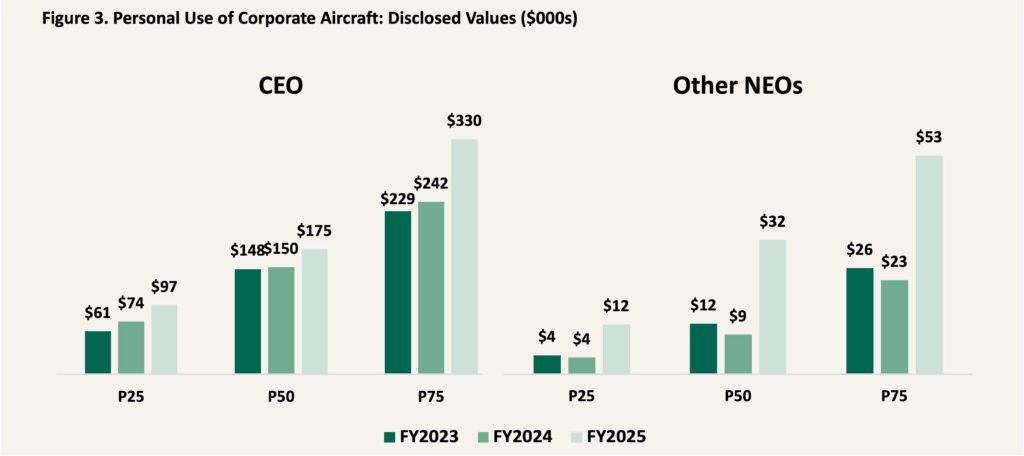
In contrast to the expanding scope and varied financial trends observed in personal security programs, the utilization of corporate aircraft for personal use by executives has followed a more consistent pattern of value growth. Corporate aircraft usage is a more established executive benefit compared to the rapidly evolving personal security landscape. In fiscal year 2025, approximately 57% of S&P 500 CEOs and 32% of other NEOs were provided with personal use of corporate aircraft. The growth observed in this area during the fiscal year was concentrated primarily in the disclosed values rather than a significant increase in broader adoption rates.
The financial metrics for CEO aircraft usage in fiscal year 2025 show a substantial increase. The median disclosed value for CEO aircraft usage rose by 17%, indicating a higher typical cost associated with this benefit. More significantly, the 75th percentile for CEO aircraft usage values saw an impressive 37% increase, pointing to a notable rise in the upper range of disclosed values.
For other NEOs, the trend in aircraft usage values also indicates significant growth. The median disclosed value for their personal aircraft use more than tripled, reflecting a dramatic increase in the typical financial commitment. The 75th percentile for other NEOs’ aircraft usage also rose considerably, from approximately $23,000 to $53,000. This upward trajectory in aircraft usage values for both CEOs and other NEOs is likely influenced by the same independent security assessments that are driving the expansion of personal security programs. In some instances, these assessments may have mandated the use of private aircraft for CEOs and select NEOs to comply with increasingly stringent safety and security policies being implemented by their organizations. This integration highlights how personal security concerns are directly impacting the utilization and valuation of corporate aircraft benefits.
A Market-Wide Expansion in Executive Protection
The data from Pay Governance’s review indicates that the growth in executive protection programs is not confined to specific sectors or a few leading companies. Across all industry sectors analyzed, there were documented increases in either the prevalence or the disclosed value of personal security or corporate aircraft usage benefits. This suggests a broader market-wide shift rather than isolated developments. While certain industries may continue to report higher values due to factors such as their business model, the inherent visibility of their executives, the location of their headquarters, typical travel patterns, or their specific risk profile, the overall direction of change across the market has been remarkably consistent. This uniform upward trend in executive protection provisions points to a widespread recognition of the evolving risks faced by corporate leaders.
Looking Ahead: Board and Compensation Committee Considerations
Executive protection is poised to remain a critical area of oversight for Boards of Directors and Compensation Committees. Given the persistently elevated risk environment and the expanding scope of these programs, it is likely that the prevalence and disclosed values of personal security and corporate aircraft usage will continue to increase, particularly for executives beyond the CEO.
The U.S. Securities and Exchange Commission (SEC) is reportedly re-evaluating how executive personal security should be classified for disclosure purposes, with discussions ongoing regarding whether it should be treated solely as a "perk." However, no specific regulatory changes have been formally announced or outlined to date. Nevertheless, the focus of major shareholders and influential proxy advisory firms appears to be shifting. Their attention is increasingly directed not merely at the existence of these benefits but more critically on whether companies can provide a clear and compelling rationale for their provision, ensure transparent disclosure, demonstrate appropriate oversight mechanisms, and articulate how these arrangements ultimately support and align with shareholder interests.
For Compensation Committees, several practical considerations emerge from this evolving landscape:
- Risk Assessment and Program Justification: Committees must ensure that any executive protection program is based on a thorough and documented risk assessment. The rationale for providing these benefits, particularly for NEOs beyond the CEO, should be clearly articulated and linked to specific, identifiable risks.
- Disclosure Clarity and Transparency: Robust and transparent disclosure in proxy statements is paramount. This includes clearly detailing the types of security measures provided, the rationale behind them, and the associated costs. Companies should avoid vague language and strive for specificity to satisfy shareholder and proxy advisor expectations.
- Oversight and Governance: Establishing clear governance structures for approving, monitoring, and reviewing executive protection programs is essential. This includes defining the roles and responsibilities of the Board, the Compensation Committee, and management in overseeing these benefits.
- Alignment with Shareholder Interests: Committees should be prepared to explain how investments in executive protection ultimately serve the long-term interests of shareholders. This might involve demonstrating how these measures contribute to leadership stability, mitigate operational disruptions, or enhance the company’s ability to attract and retain top talent in a challenging environment.
- Regular Review and Adaptation: Given the dynamic nature of security threats and regulatory considerations, committees should regularly review and adapt executive protection programs to ensure they remain appropriate, effective, and aligned with evolving best practices and shareholder expectations. This includes staying abreast of potential changes in SEC disclosure requirements.
Methodology of the Study
The Pay Governance analysis was conducted by reviewing the "All Other Compensation" section of the Summary Compensation Table (SCT) and related Compensation Discussion and Analysis (CD&A) and footnote disclosures within proxy statements for fiscal years 2023, 2024, and 2025. The data utilized for this study was provided by ESGAUGE, a leading provider of executive compensation data and analytics. Proxies filed in 2024, 2025, and 2026 typically report compensation data for fiscal years 2023, 2024, and 2025, respectively. The results presented in the Pay Governance report are organized by fiscal year.
The sample for this comprehensive review comprises companies within the S&P 500 index, reflecting proxy statements that were publicly filed as of June 15, 2026. The analysis specifically focused on company-provided personal security and corporate aircraft usage, examining key metrics such as the prevalence of these benefits, their disclosed financial values, and the quality and detail of associated disclosure practices. For NEOs other than the CEO, the disclosed values reflect the average of reported values across each company’s non-CEO named executive officers, with zero values being excluded from this calculation to ensure a representative analysis of executives who actually received these benefits. This rigorous methodology ensures that the findings provide a robust and accurate snapshot of current trends in executive compensation related to personal security and aircraft usage.
