

For years, the allure of private equity (PE) ownership for chief executive officers has been synonymous with the promise of substantial financial rewards, a potent incentive for leaders willing to navigate the often-rigorous demands of PE-backed enterprises. The underlying proposition was clear: ambitious performance targets, dedicated efforts to build a more valuable company, and a direct financial stake in the success realized. This potential for significant upside was a powerful draw, positioning PE-backed CEOs as the highest earners among private company leaders. However, new historical compensation data reveals a dramatic shift, indicating that this once-substantial earning advantage has narrowed considerably, prompting a re-evaluation of the executive reward landscape in the private equity sector.
The Shrinking Pay Gap: A Statistical Overview
Chief Executive Group Research’s comprehensive analysis of CEO compensation data, spanning seven years from 2019 through 2025, illuminates this evolving trend. The research, drawing from annual surveys of U.S. private companies, reveals a pronounced compression of the compensation premium enjoyed by CEOs leading PE-backed firms.
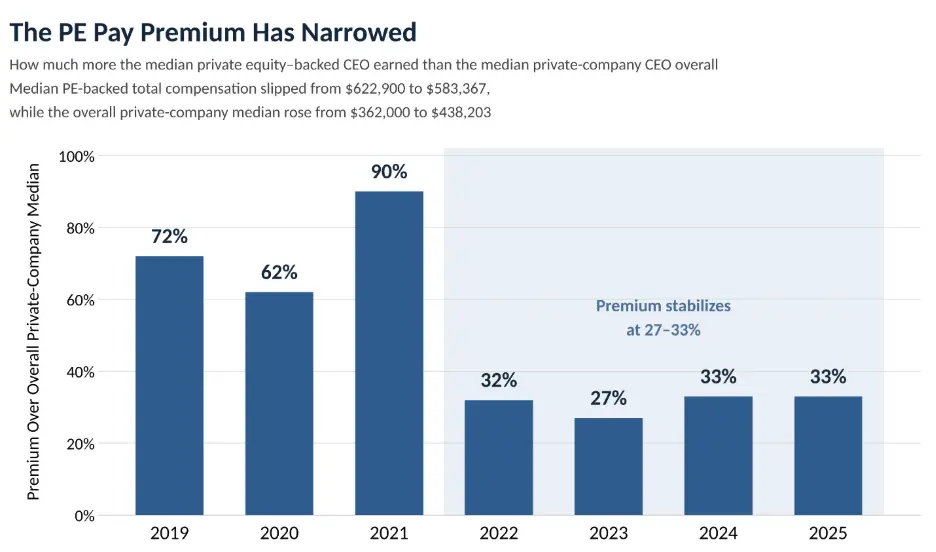
In 2019, the median CEO of a private equity-backed company commanded a total compensation package that was an impressive 72 percent higher than that of the median CEO in the broader private company landscape. This translated to a median compensation of $622,900 for PE-backed leaders, compared to $362,000 for their counterparts in the general private company pool.
The premium remained robust in the immediate aftermath of the initial pandemic shockwaves. By 2020, the gap stood at a still substantial 62 percent. The following year, 2021, marked a peak in this disparity. Fueled by a strong economic rebound, elevated transaction activity, and a surge in private market valuations, PE-backed CEOs saw their median compensation climb to $844,500, a remarkable 90 percent premium over the overall private company median of $445,000. This period represented the zenith of the PE-backed CEO’s compensation advantage, a testament to the buoyant market conditions and the perceived value creation potential inherent in PE investments.
However, the trajectory soon began to reverse. The period from 2022 onwards witnessed a sharp contraction in this premium. In 2022, the median compensation for PE-backed CEOs experienced a notable decline to $546,000. While still a significant sum, this represented a narrowed premium of just 32 percent over the overall private company median. This trend of compression has persisted, with the premium remaining relatively stable in subsequent years: 27 percent in 2023, 33 percent in 2024, and holding steady at 33 percent in the most recent data for 2025.
This contrast with the pre-pandemic era is striking. While PE-backed executives continue to earn more than the average private company CEO, their financial advantage is considerably less pronounced than it was just a few years ago.
Unpacking the "What Changed?"
The immediate question arising from these findings is whether private equity firms have simply become less generous in their compensation structures, or if the very nature of how executives are rewarded has undergone a fundamental shift. The data suggests a more nuanced reality than a simple reduction in PE firm largesse.
It is crucial to understand that total executive compensation is a multifaceted package, encompassing base salary, annual bonuses, benefits, perks, and, critically, equity grants and the appreciation of those equity stakes. These various components can exhibit vastly different performance trajectories from one year to the next.
Equity appreciation, in particular, plays a pivotal role in the volatility of total compensation, especially for executives whose packages include substantial equity participation. When business valuations soar, the value of these ownership stakes can skyrocket, leading to significant increases in total compensation. Conversely, when market conditions turn unfavorable, these valuations can retreat, causing a commensurate drop in executive wealth derived from equity. This inherent volatility makes total compensation figures more susceptible to market fluctuations for those with significant equity exposure.
The exceptional conditions of 2021 serve as a prime example. This period was characterized by robust economic recoveries following the initial pandemic disruptions, a surge in merger and acquisition (M&A) activity, and substantial increases in asset valuations across various segments of the private market. These favorable market dynamics likely inflated the reported value of executive equity holdings during that year, contributing to the exceptionally high premium observed.
However, the narrowing gap is not solely attributable to the ebb and flow of equity valuations. Even when controlling for equity gains, the premium has demonstrably fallen. This suggests that other factors are at play, potentially including shifts in compensation philosophy, increased competition for executive talent across all private company sectors, or a recalibration of performance metrics and reward structures within PE firms themselves.
Implications for Private Equity and Executive Talent
The diminishing compensation premium raises a critical strategic question for private equity firms: If the immediate, year-over-year compensation advantage over other private companies has narrowed, is the long-term potential for wealth creation still sufficiently compelling to attract and retain the caliber of leadership talent necessary to drive value?
This challenge does not necessarily necessitate an outright increase in annual cash compensation. Instead, it may prompt PE firms to explore more effective ways of communicating the full value of their incentive structures. This could involve greater transparency regarding the potential for long-term equity appreciation, enhanced clarity on exit strategies and the realization of gains, and ensuring that executive reward programs are meticulously aligned with clearly defined and achievable business outcomes. The emphasis may need to shift from simply the quantum of immediate earnings to the strategic long-term value creation opportunity and the executive’s share in that success.
For both CEOs considering PE-backed roles and investors evaluating PE fund performance, the pertinent question may evolve. It is no longer solely about "how much more can a PE-backed executive earn?" but rather, "how much value is the executive empowered to create, and what proportion of that created value will they ultimately realize?" This reframing underscores the shared interest in strategic value generation and the equitable distribution of the rewards stemming from it.
Broader Market Context and Future Outlook
The trend observed in PE-backed CEO compensation reflects broader shifts in the executive compensation landscape. Across the private company sector, there has been a growing recognition of the importance of competitive compensation packages to attract and retain top-tier leadership. This intensified competition for talent, coupled with evolving economic conditions and market valuations, has likely contributed to the general upward pressure on CEO pay in the overall private company segment, thereby shrinking the relative premium for those in PE-backed roles.
The data also points to a potential maturation of the private equity industry. As PE has become a more established and widespread form of ownership, the unique advantages it once offered to executives may be becoming more normalized. Furthermore, increased scrutiny from regulators and investors regarding executive compensation practices across all sectors could also be influencing how PE firms structure their reward programs.
Looking ahead, the compensation dynamics for PE-backed CEOs will likely continue to be shaped by several key factors:
- Market Volatility: Fluctuations in macroeconomic conditions, interest rates, and public market valuations will continue to impact private company valuations and, consequently, the appreciation of executive equity.
- PE Fund Performance: The ability of PE funds to consistently generate strong returns for their investors will influence their capacity and willingness to offer attractive compensation packages to their portfolio company leaders.
- Talent Demand: The ongoing demand for skilled executives capable of driving growth and efficiency in a competitive business environment will remain a significant determinant of compensation levels.
- Evolving Incentive Structures: PE firms may innovate with more sophisticated and tailored incentive plans that go beyond traditional equity grants, potentially incorporating performance-based bonuses tied to specific ESG (Environmental, Social, and Governance) goals, operational milestones, or strategic initiatives.
The narrowing compensation premium for PE-backed CEOs signals a dynamic and evolving landscape. While the financial allure of private equity ownership remains, the nature of that allure is shifting. The focus is increasingly on the comprehensive value proposition – the opportunity to drive significant value creation, the strategic challenges, and the long-term wealth-building potential, balanced against a more competitive and perhaps more nuanced compensation environment. For both executives and the private equity firms themselves, understanding and adapting to these changes will be crucial for continued success in attracting and motivating the leadership talent essential for growth and value realization.
For a more detailed breakdown of compensation benchmarks across various company sizes, industries, and ownership structures, Chief Executive Group Research’s latest CEO & Senior Executive Compensation Report offers in-depth insights.
