

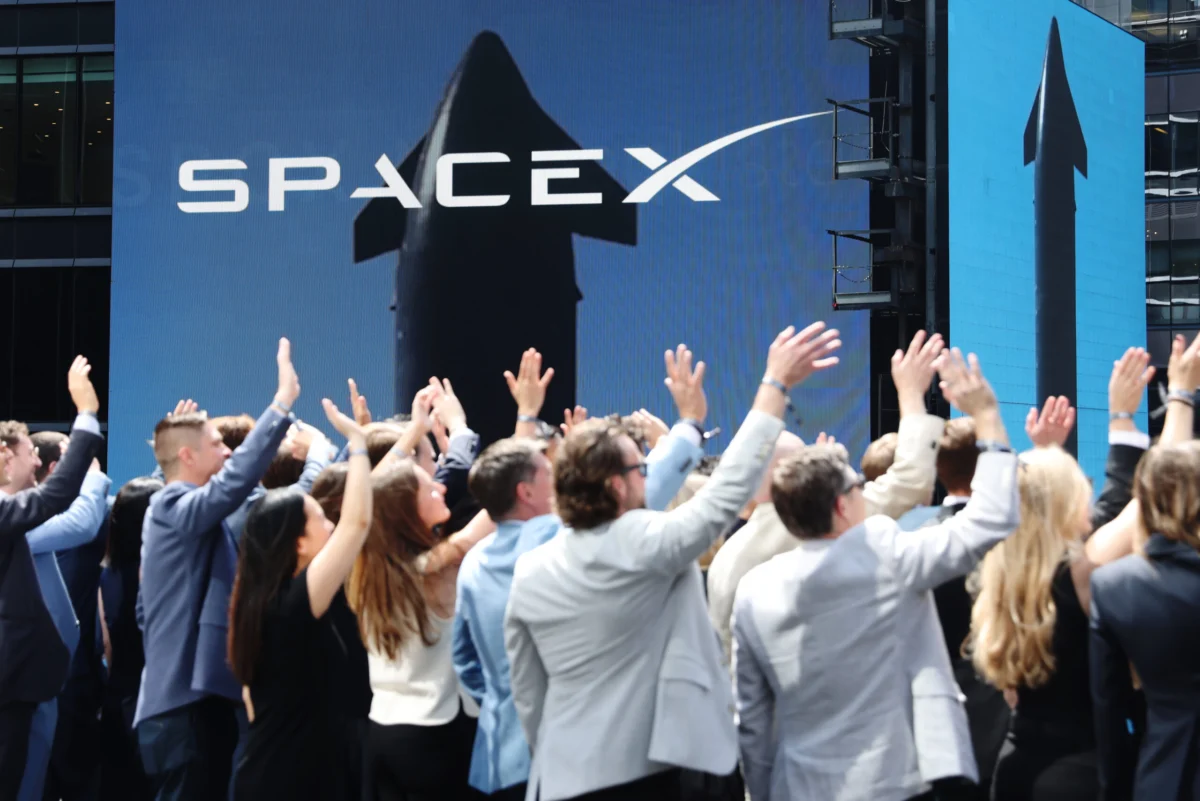
SpaceX shares experienced a significant rally on Tuesday, climbing approximately 5% as the aerospace giant, led by Chief Executive Officer Elon Musk, continued its remarkable upward trajectory following a historic initial public offering (IPO) just days prior. The stock’s performance in premarket trading and throughout the session reflects intense investor enthusiasm for the company’s dual identity as both a space exploration leader and an emerging powerhouse in the artificial intelligence sector. This surge follows a massive 20% gain during the company’s first full day of trading on Monday, cementing its status as one of the most significant market debuts in recent financial history.
The momentum behind the stock has pushed SpaceX’s valuation to levels that now threaten to overtake Amazon in total market capitalization. While the shares initially pared some gains following the official announcement of a multi-billion-dollar acquisition, the stock remained resilient, trading up 5.4% by mid-day. The volatility underscored the market’s attempt to digest the massive $60 billion deal to acquire Anysphere, the software firm responsible for the widely acclaimed AI coding agent, Cursor. This move signals a pivot toward integrating advanced generative AI into the core of SpaceX’s engineering and operational infrastructure.
The Anysphere Acquisition and the Cursor AI Ecosystem
The centerpiece of Tuesday’s news cycle was the $60 billion acquisition of Anysphere. By bringing Anysphere under its umbrella, SpaceX is effectively internalizing one of the most sophisticated AI development environments currently available. Cursor, Anysphere’s flagship product, has gained a reputation as a premier AI-native code editor, designed to assist engineers in writing, debugging, and optimizing complex software through natural language processing and predictive modeling.
For SpaceX, the acquisition is viewed as a strategic necessity rather than a mere diversification. As the company scales its Starlink satellite constellation and prepares for long-duration missions to Mars via the Starship program, the demand for high-reliability, autonomous software has grown exponentially. Analysts suggest that by leveraging Cursor’s AI capabilities, SpaceX can drastically reduce the development cycle for flight software and satellite management systems.
The $60 billion price tag is a testament to the premium currently placed on "AI coding agents"—tools that do not just suggest code, but actively participate in the architectural design of software systems. This acquisition follows a $2 billion funding round for Anysphere earlier this year, which originally valued the startup at a fraction of the current buyout price, highlighting the rapid escalation of AI valuations within the broader tech landscape.
Financial Performance and the Path to One Trillion Dollars
Despite the euphoria surrounding the stock price, SpaceX’s underlying financials reveal a company in a state of massive, capital-intensive transition. In 2025, SpaceX reported revenue of $18.7 billion, a figure that highlights its dominance in the commercial launch and satellite internet markets. However, the pursuit of reusable rocket technology and the global rollout of Starlink have come at a steep cost. The company posted a net loss of $4.9 billion in 2025 and continued that trend into the current year, recording a loss of $4.28 billion in the first quarter of 2026 alone.

Elon Musk has remained characteristically undeterred by these short-term losses, focusing instead on a long-term vision of unprecedented scale. In a recent communication on the social media platform X, Musk suggested that SpaceX "might be able to reach approximately" $1 trillion in annual revenue by the year 2030. Achieving such a milestone would require SpaceX to not only maintain its lead in aerospace but also successfully monetize its AI acquisitions and expand Starlink into a ubiquitous global utility.
The path to $1 trillion would necessitate a compound annual growth rate (CAGR) that few companies in history have ever achieved. It would likely involve the full operational capacity of the Starship launch system, which is designed to carry massive payloads at a fraction of current costs, thereby opening up new industries such as space-based manufacturing and asteroid mining.
A Chronology of Innovation and Consolidation
The current market frenzy is the culmination of nearly a quarter-century of development. To understand the significance of the SpaceX IPO and its current valuation, it is essential to trace the company’s evolution:
- 2002: Elon Musk founds SpaceX with the goal of reducing space transportation costs to enable the colonization of Mars.
- 2008: After three failed attempts, the Falcon 1 becomes the first privately developed liquid-fuel rocket to reach orbit.
- 2015: SpaceX successfully lands a Falcon 9 first-stage booster on land, proving the viability of orbital-class rocket reusability.
- 2019: The first large batch of Starlink satellites is launched, marking the beginning of the world’s largest commercial satellite constellation.
- 2025: In a major corporate restructuring, Musk merges SpaceX with his AI startup, xAI, after having already integrated xAI with the social media platform X (formerly Twitter). This creates a vertically integrated ecosystem of data, compute, and physical infrastructure.
- June 2026: SpaceX goes public in a blockbuster IPO, followed immediately by the $60 billion acquisition of Anysphere.
This timeline illustrates a shift from a pure-play aerospace company to a diversified technology conglomerate where hardware (rockets), connectivity (Starlink), and intelligence (xAI/Cursor) are inextricably linked.
Market Sentiment and Analyst Divergence
The "sky-high" valuation of SpaceX has polarized Wall Street. While retail demand has reached record levels, institutional analysts are divided on whether the company can justify its current price-to-earnings (P/E) expectations—or lack thereof, given current losses.
CFRA Research recently initiated coverage of SpaceX with a "sell" rating, setting a 12-month price target of $115. This represents a nearly 29% downside from the stock’s post-IPO highs. CFRA analysts cited the "extremely ambitious growth strategy" and "significant capital intensity" as primary risks. They argued that the market might be overlooking the technical hurdles and regulatory scrutiny that come with such rapid expansion.
Conversely, many tech bulls view SpaceX as the vanguard of a new industrial era. Dan Ives, global head of tech research at Wedbush Securities, characterized the current investor interest as a focus on the "fourth industrial revolution." According to Ives, investors are looking past traditional valuation metrics to identify the companies that will provide the fundamental infrastructure for the next century—whether that infrastructure is located on Earth or in orbit.

Steve Westly, founder of The Westly Group and a former Tesla board member, offered a more pragmatic view during an interview with CNBC’s "Squawk Box Asia." While acknowledging the company’s potential, Westly warned that the patience of public market investors is finite. "Investors at SpaceX, I believe, will get pretty grumpy after three or four quarters if he doesn’t meet some of the growth projections that they made in the S1," Westly noted. He emphasized that the transition from a private company to a public one requires a level of transparency and consistent delivery that Musk’s ventures have occasionally struggled with in the past.
Implications for the Global Tech Landscape
The rise of SpaceX as a public entity and its aggressive acquisition of AI firms like Anysphere have profound implications for several industries.
First, the aerospace sector is now under immense pressure to accelerate innovation. Legacy players like Boeing and Lockheed Martin, as well as newer rivals like Jeff Bezos’s Blue Origin, must now compete with a company that has access to public capital markets and a massive valuation "currency" for acquisitions.
Second, the AI industry is seeing a shift toward "embodied AI" and industrial applications. While much of the AI hype in 2023 and 2024 focused on chatbots and consumer applications, the SpaceX-Anysphere deal highlights the value of AI in complex engineering environments. If SpaceX successfully integrates Cursor to automate rocket design and satellite maintenance, it could set a new standard for how industrial giants utilize artificial intelligence.
Finally, the potential for SpaceX to surpass Amazon in market cap signals a changing of the guard. For the past decade, the market has been dominated by cloud computing and e-commerce. The ascent of SpaceX suggests that the next decade’s market leaders may be those who successfully bridge the gap between digital intelligence and physical exploration.
As SpaceX navigates its first few months as a public company, the world will be watching to see if Musk can turn his $1 trillion vision into a financial reality. With the acquisition of Anysphere, the company has doubled down on its belief that the future of space is not just about fuel and physics, but about the code that governs it. For now, the market seems willing to fund that vision, propelling SpaceX into a stratosphere of valuation that few companies have ever reached.
