

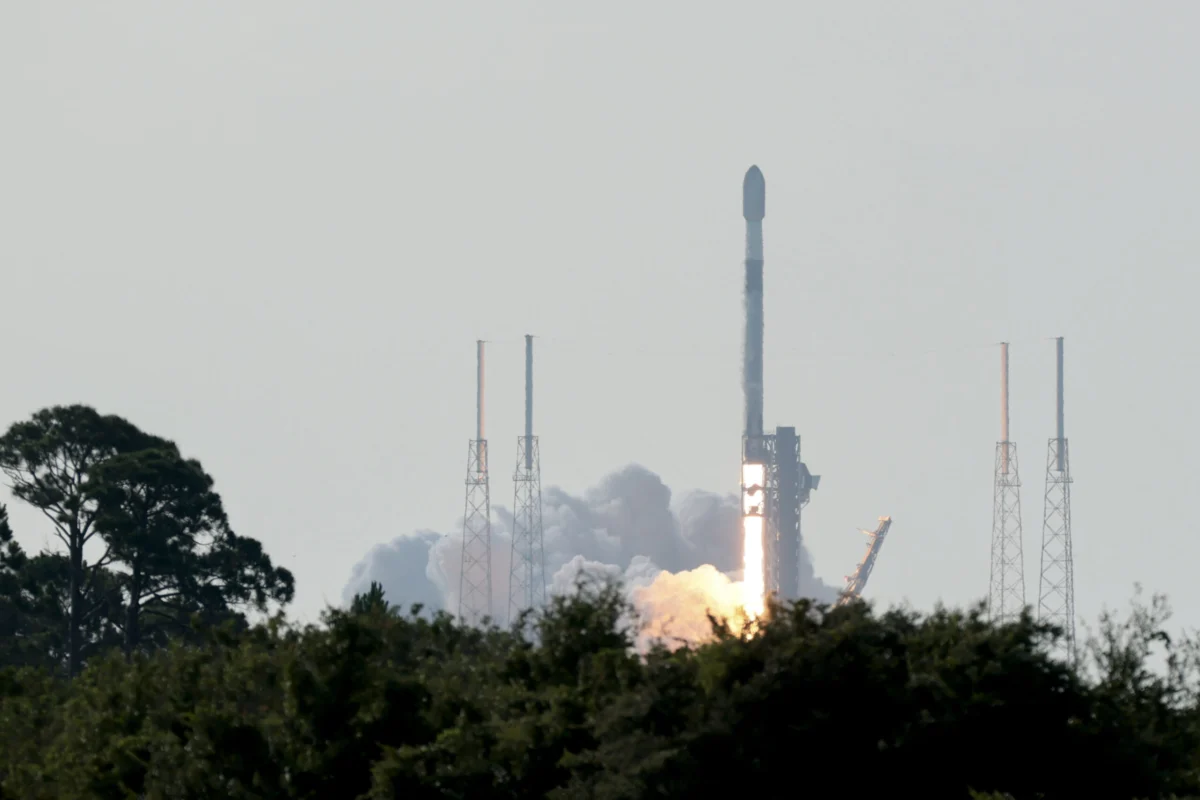
SpaceX, the ambitious aerospace manufacturer and space transportation services company founded by Elon Musk, made a resounding debut on the Nasdaq exchange on Friday, captivating global financial markets. The company’s shares surged by more than 19% on its inaugural day of trading, propelling its market capitalization above an astounding $2 trillion. This historic public offering solidifies SpaceX’s position as a titan in the burgeoning commercial space sector and marks a significant milestone for a company that began with the audacious goal of revolutionizing space travel. While the immediate financial success underscores investor confidence in its current operations, including the ubiquitous Falcon 9 launches – such as the one observed lifting off from Space Launch Complex 40 on June 12, 2026, at Cape Canaveral Space Force Station, Florida – and its burgeoning Starlink satellite internet constellation, the company’s more distant, inter-planetary ambitions remain a subject of long-term speculation and market skepticism.
A Historic Public Offering: The Road to Nasdaq
The decision by SpaceX to go public, a move long anticipated by investors and industry observers, was executed amidst a robust market appetite for innovative technology and aerospace ventures. For years, SpaceX maintained its private status, fueled by rounds of private investment that saw its valuation steadily climb from an initial $1.2 billion in 2012 to over $180 billion by late 2023, making it one of the world’s most valuable privately held companies. This gradual build-up allowed the company to channel capital directly into research, development, and infrastructure for its ambitious projects, including the Starship program and the rapid deployment of the Starlink constellation, without the immediate pressures of public quarterly earnings.
The IPO, a meticulously planned event, offered a tranche of shares to the public, providing liquidity for early investors and employees while also raising substantial capital to further accelerate its capital-intensive endeavors. Analysts lauded the company’s diversified revenue streams, primarily driven by its reliable launch services for both government and commercial clients, and the rapidly expanding subscriber base of Starlink, which now boasts millions of users worldwide. The market’s reception of SpaceX, pushing its valuation past the $2 trillion mark, places it among an elite group of global corporations, signaling not just faith in its current profitability but also profound belief in its future potential to reshape human civilization and extend its reach beyond Earth. This valuation significantly outpaces traditional aerospace giants, underscoring a paradigm shift in investor perception towards companies leading the new space economy.
Elon Musk’s Vision: The Martian Imperative
At the core of SpaceX’s long-term corporate identity, as explicitly detailed in its initial public offering prospectus filed with the Securities and Exchange Commission (SEC), lies an unwavering focus on the "Moon, Mars and beyond." This mantra is not merely aspirational rhetoric but a foundational principle guiding the company’s technological development and strategic planning. The prospectus itself, a document designed to inform potential investors of both opportunities and risks, mentions Mars a striking 63 times, in addition to its appearance in a featured photo caption, unequivocally demonstrating the planet’s central role in the company’s ultimate mission.
Elon Musk, SpaceX’s visionary founder and CEO, has repeatedly articulated his belief that humanity must become a multi-planetary species to ensure its long-term survival and unlock its full potential. This existential imperative is codified within the company’s incentive structures. Remarkably, Musk’s own compensation package includes a provision where he will not receive a substantial bonus of restricted shares unless SpaceX successfully establishes a self-sustaining colony on Mars with a population exceeding 1 million inhabitants. This unprecedented performance target, disclosed in regulatory filings, highlights the extraordinary scale of ambition that permeates SpaceX’s corporate culture and strategic objectives, linking the company’s very leadership incentives to the realization of a future Martian civilization. The development of Starship, SpaceX’s fully reusable, super heavy-lift launch system, is the linchpin of this vision, designed specifically for interplanetary travel, capable of transporting large payloads and hundreds of people to the Moon and Mars.
The Reality Check: Prediction Markets and Technical Hurdles
Despite the clear strategic alignment and the founder’s personal commitment, the timeline for achieving such ambitious interplanetary colonization remains highly uncertain, a sentiment echoed by both external observers and SpaceX’s own candid disclosures. Traders on Kalshi, a regulated prediction market platform, reflect this skepticism regarding immediate Martian endeavors. According to Kalshi’s data, there is only an 18% chance that SpaceX will launch a human mission to Mars by 2030. This probability has remained consistently low since the event contract’s inception in March 2024, never exceeding one-in-four odds for a manned mission within this decade. The event contract is set to resolve to "yes" only if SpaceX verifies a human mission to Mars by December 31, 2029.
This market skepticism is not unfounded and largely mirrors the company’s own acknowledgments of the monumental challenges ahead. SpaceX’s prospectus explicitly states: "Many of our initiatives… involve significant technical complexity, unproven technologies or technologies that do not exist, and such initiatives may not achieve commercial viability." The document further cautions that "As a result, the timeline for certain of our initiatives involving unproven or new innovations… may be difficult or impossible to determine." These statements underscore the inherent risks and the pioneering nature of deep-space human exploration. The challenges span a multitude of disciplines: from developing reliable, fully reusable interplanetary transport systems, to creating closed-loop life support systems for extended missions, mitigating radiation exposure in deep space, mastering entry, descent, and landing in a Martian atmosphere, and ultimately, constructing habitats capable of sustaining human life in an alien environment.
Chronology of SpaceX’s Journey and Martian Ambitions
SpaceX’s journey from a nascent startup to a multi-trillion-dollar entity is a testament to its relentless innovation and ambitious long-term goals.
- 2002: Founded by Elon Musk with the explicit goal of reducing space transportation costs and enabling the colonization of Mars.
- 2008: Achieved a critical milestone with the successful launch of its Falcon 1 rocket, becoming the first privately funded liquid-propellant rocket to reach Earth orbit.
- 2012: The Dragon spacecraft successfully docked with the International Space Station (ISS), marking the first time a commercial company delivered cargo to the orbital laboratory.
- 2015: Pioneered reusable rocket technology with the successful landing of a Falcon 9 first stage, dramatically reducing launch costs and increasing launch cadence.
- 2017: Demonstrated reflight of a Falcon 9 first stage, solidifying the economic viability of rocket reusability.
- 2018: Launched the Falcon Heavy, then the world’s most powerful operational rocket, showcasing its heavy-lift capabilities.
- 2019: Initiated the deployment of the Starlink satellite internet constellation, rapidly becoming the largest satellite operator in the world and a significant revenue generator. Simultaneously, accelerated development of the Starship program, conducting numerous prototype tests in Boca Chica, Texas.
- 2020: Launched NASA astronauts to the ISS on its Crew Dragon spacecraft, restoring human spaceflight capabilities to the United States after a nearly decade-long hiatus.
- 2021: Conducted the Inspiration4 mission, the first all-civilian orbital spaceflight.
- 2024-2026 (Projected): Continued rapid deployment of Starlink, increasing launch cadence with Falcon 9 and Falcon Heavy. Ongoing rigorous testing and iterative development of Starship, with an increasing focus on orbital test flights and potential lunar missions under NASA’s Artemis program (e.g., Human Landing System). The June 12, 2026 Falcon 9 launch, captured in the image, represents the ongoing operational excellence that underpins the company’s financial stability.
- Post-2026 (Long-term): Focus shifts increasingly towards lunar logistics for NASA’s Artemis program as a stepping stone, and the development of a fully operational Starship system capable of sustained interplanetary travel, leading eventually to the ambitious goal of a human mission to Mars.
Supporting Data and Industry Context
SpaceX’s ascension occurs within a rapidly expanding global space economy. The commercial space market, estimated to be worth over $400 billion currently, is projected to grow to well over $1 trillion in the coming decades, driven by satellite broadband, in-orbit servicing, space tourism, and lunar/Martian resource utilization. SpaceX commands a significant share of the global launch market, routinely conducting more orbital launches annually than any other provider, including national space agencies. This operational efficiency and market dominance contribute substantially to its robust valuation.
Comparatively, the $2 trillion valuation places SpaceX in an exclusive league alongside technology giants like Apple, Microsoft, and Nvidia, far surpassing traditional aerospace and defense contractors like Boeing and Lockheed Martin, whose market capitalizations typically hover in the tens to low hundreds of billions. This valuation reflects investor confidence not just in SpaceX’s current hardware and services but in its long-term vision and potential to unlock entirely new economic frontiers in space.
However, the scientific and engineering challenges of a human mission to Mars are immense. A journey to Mars can take six to nine months one-way, exposing astronauts to significant radiation doses, microgravity effects, and psychological stress. The Martian environment itself is hostile, with a thin atmosphere, extreme temperatures, and pervasive dust. Developing reliable closed-loop life support systems, radiation shielding, and autonomous repair capabilities for such extended missions requires breakthroughs in materials science, biology, and robotics. While SpaceX has made unparalleled progress in rapid iteration and development, these deep-space challenges represent a different order of complexity than orbital launches or satellite deployment.
Reactions and Expert Analysis
The market’s enthusiastic reception of SpaceX’s IPO has been widely interpreted as a vote of confidence in the commercial space industry’s maturity. Financial analysts, such as those from Morgan Stanley and Goldman Sachs (often associated with major IPOs), have highlighted SpaceX’s dual-engine growth strategy: the dependable and rapidly scaling revenue from Starlink and launch services providing a stable financial foundation, while the high-risk, high-reward Starship and Mars programs offer exponential long-term upside. "SpaceX has successfully diversified its portfolio, mitigating some of the inherent risks associated with purely speculative long-term space ventures," noted one market observer, suggesting the blend of proven services and audacious goals makes it a unique investment proposition.
Aerospace engineers and planetary scientists, while acknowledging SpaceX’s incredible technological prowess and its ability to disrupt established norms, maintain a pragmatic perspective on the Mars timeline. Dr. Maria Rodriguez, a professor of aerospace engineering at MIT, commented, "SpaceX has demonstrated an unparalleled ability to innovate and execute. However, colonizing Mars involves overcoming not just engineering hurdles but fundamental biological and planetary science challenges that require time, international collaboration, and potentially entirely new scientific discoveries. The 2030 target for a manned mission is exceptionally ambitious, even for SpaceX."
From a regulatory standpoint, the SEC’s scrutiny of the prospectus ensures that the company transparently communicates both its grand ambitions and the significant risks involved. The detailed disclosure regarding "unproven technologies" and the "difficult or impossible to determine" timeline for certain initiatives is crucial for investor protection, balancing the excitement of a new public listing with the realities of groundbreaking, frontier-pushing endeavors.
Broader Implications: A New Era for Space and Investment
SpaceX’s successful Nasdaq debut and its multi-trillion-dollar valuation represent a pivotal moment for the global space industry. It legitimizes the commercial space sector on an unprecedented scale, signaling to mainstream investors that space is no longer solely the domain of government agencies but a viable and lucrative arena for private enterprise. This could open the floodgates for further investment into other private space companies, fostering greater competition and innovation across the entire ecosystem, from launch services to in-orbit manufacturing and asteroid mining.
For investors, SpaceX offers a unique opportunity to participate in a company that is not just a leader in its current market but is actively building the infrastructure for a multi-planetary future. While the high valuation may reflect some speculative premium on its long-term Mars vision, it is underpinned by substantial, tangible assets and revenue streams. The company’s performance will be closely watched as a bellwether for the broader new space economy.
Ultimately, SpaceX’s dual narrative—immediate financial triumph rooted in operational excellence and an audacious, yet distant, quest to colonize Mars—redefines what is possible in space exploration. It keeps the dream of human interplanetary migration alive and pushes the boundaries of technological innovation. Even if the timelines for a Martian colony remain uncertain and subject to adjustment, the company’s relentless pursuit of this goal continues to inspire a generation and shape the trajectory of human civilization’s expansion into the cosmos. The journey to Mars is undeniably long, fraught with challenges, but SpaceX’s public market debut ensures that this monumental endeavor will continue to be funded, scrutinized, and ultimately, pursued with unwavering resolve.
