

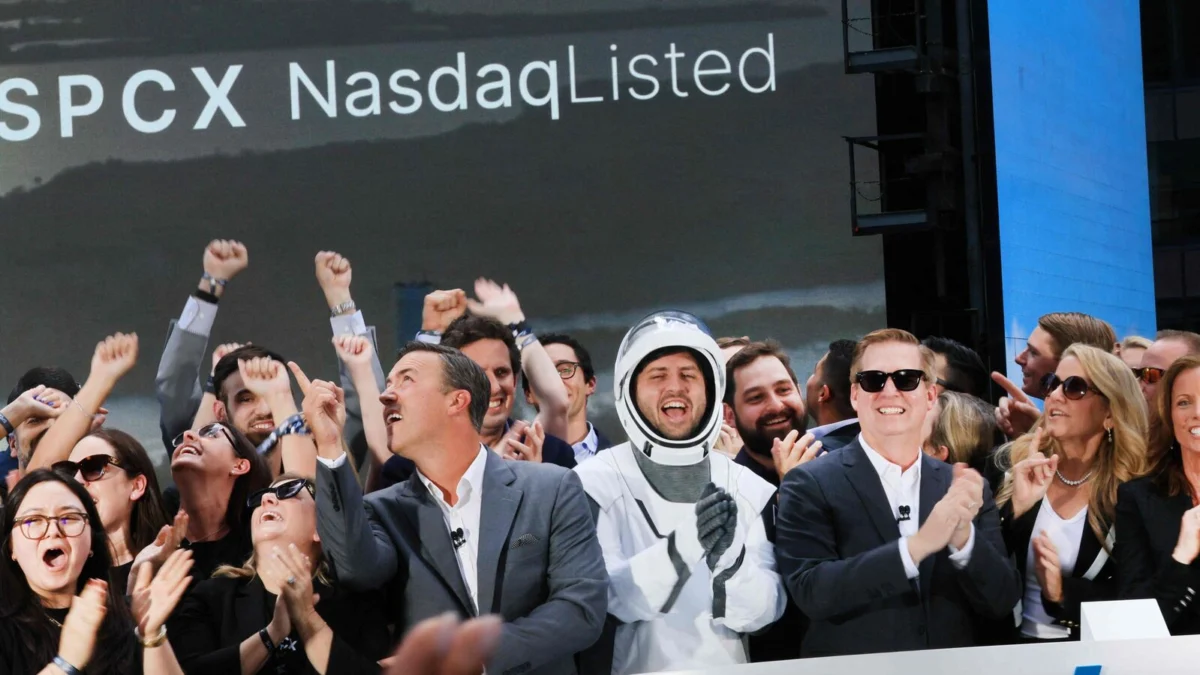
SpaceX shares experienced a significant downturn on Wednesday, marking the fourth consecutive session of declines and pushing the stock price below its initial public offering (IPO) level for the first time since its historic market debut. The stock fell 2% during mid-week trading to close at $133.34, officially breaching the $135 threshold that served as the benchmark for its massive entry into the public markets. This movement represents a pivotal moment for the aerospace giant, as the initial euphoria surrounding its listing appears to have succumbed to broader market pressures and specific internal concerns regarding valuation and liquidity.
The decline marks a stark reversal for a company that, only weeks ago, was the darling of Wall Street. After raising approximately $85.7 billion and securing an initial valuation of roughly $2.1 trillion, SpaceX’s shares had surged to an all-time high of $225.64. At that peak, the company’s market capitalization briefly eclipsed those of established technology titans like Microsoft and Amazon, signaling a massive vote of confidence in Elon Musk’s vision for reusable rocketry and global satellite internet. However, the current slide below the IPO price leaves many investors who entered at the offering with paper losses, raising questions about the sustainability of the "space economy" premium in a volatile macroeconomic environment.
The Volatility of a New Market Giant
The trajectory of SpaceX’s stock since its listing has been characterized by extreme volatility, a common trait for high-growth companies in the capital-intensive aerospace sector. Following the IPO, the stock witnessed a meteoric 50% rise within the first three days of trading. This rapid appreciation was driven by a combination of retail enthusiasm and institutional FOMO (fear of missing out). However, the subsequent correction was equally swift, with the stock shedding nearly a quarter of its value over the following three sessions before eventually sliding below the $135 mark this week.
Market analysts suggest that much of the early momentum may have been artificially inflated by technical factors rather than fundamental shifts. Specifically, SpaceX’s rapid inclusion into major indices played a significant role. In late June, just two weeks after its IPO, the company joined the Russell 1000 Index. Shortly thereafter, in July, it was added to the Nasdaq 100. This inclusion was made possible after Nasdaq eased its listing rules, allowing large-cap companies to join the index after only 15 trading days, a significant reduction from the previous three-month requirement. This forced passive index-tracking funds to buy massive quantities of shares regardless of the price, creating a "forced buying" scenario that likely pushed the stock to its $225 peak. Now that this initial rebalancing phase has concluded, the stock is being left to find its "natural" price based on investor sentiment and fundamental analysis.
Macroeconomic Pressures and the Federal Reserve
The downturn in SpaceX shares does not exist in a vacuum. The broader equity market has remained under significant pressure as investors grapple with uncertainty regarding the Federal Reserve’s monetary policy. While inflation has shown signs of cooling, the timing and magnitude of potential interest rate cuts remain a subject of intense debate. For a company like SpaceX, which requires billions of dollars in capital expenditures to develop its Starship program and expand the Starlink satellite constellation, the "higher-for-longer" interest rate environment is a headwind.
Furthermore, the broader technology sector, which led the market rally earlier this year on the back of Artificial Intelligence (AI) optimism, has seen a rotation of capital. Investors are increasingly scrutinizing the valuations of companies that are not yet profitable or those whose long-term business models rely on unproven technologies. Despite its dominance in the launch market, SpaceX remains unprofitable on a consolidated basis, and its most ambitious projects—such as a crewed mission to Mars—are years, if not decades, away from generating traditional returns.
The Looming Threat of Share Lockups
One of the most significant immediate concerns for SpaceX investors is the impending expiration of share lockup periods. According to reports from Bloomberg, the first of several lockup agreements, which prevent early investors and employees from selling their shares, is set to expire following the company’s first quarterly earnings report.
Historically, the expiration of a lockup period leads to increased selling pressure as insiders look to diversify their portfolios or realize gains. Given that many early-stage investors hold shares at a cost basis significantly lower than the $135 IPO price, even a sale at current levels would represent a massive profit for them. If a wave of selling occurs once these restrictions are lifted, it could create further downward pressure on the stock, potentially testing new support levels below $130.

Fundamentals and the Overvaluation Debate
The recent price action has emboldened critics who argue that SpaceX’s $2 trillion-plus valuation was premature. While the company has revolutionized the space industry through its reusable Falcon 9 rockets and has captured a significant portion of the global satellite launch market, the path to sustained profitability is complex.
SpaceX’s business is currently split into three primary pillars:
- Launch Services: The Falcon 9 and Falcon Heavy remain the gold standard for reliability and cost-effectiveness. However, competition is intensifying. China’s Long March 10B and other international efforts aim to replicate the reusable model, potentially eroding SpaceX’s margins in the long run.
- Starlink: The satellite internet division is the company’s most promising revenue generator. While it has millions of subscribers, the infrastructure costs of maintaining and refreshing a low-Earth orbit (LEO) constellation are immense.
- Starship: The massive next-generation rocket is essential for NASA’s Artemis program and Musk’s Mars ambitions. However, the development of Starship has been marked by spectacular test flight failures and regulatory hurdles, representing a high-risk, high-reward gamble for shareholders.
Analysts at Reuters previously noted that many institutional investors were wary of the "initial IPO hype," suggesting that a better entry point would emerge once the first wave of excitement faded. The current dip below $135 may be the beginning of that normalization process.
Wall Street Remains Optimistic
Despite the current slump, the consensus among Wall Street analysts remains surprisingly bullish. Once the mandatory "quiet period" following the IPO ended, several major financial institutions issued glowing reports on the company’s long-term prospects. Raymond James set a Street-high price target of $800, suggesting that the company’s role in the "final frontier" justifies a valuation far beyond current levels.
Data compiled by Bloomberg shows that more than 80% of analysts covering SpaceX rate the stock as a "Buy" or the equivalent. The average price target stands at approximately $238, which would represent a 78% upside from the current closing price of $133.34. Proponents of the stock argue that SpaceX is more than just a rocket company; it is a foundational utility for the future of global communications and interstellar exploration. They view the current dip as a temporary "technical correction" rather than a fundamental breakdown.
Chronology of Key Events
To understand the current state of SpaceX’s market position, it is helpful to look at the timeline of its transition to a public entity:
- Late May 2026: SpaceX announces its intention to go public, targeting a raise of over $80 billion.
- Mid-June 2026: The IPO prices at $135 per share. Trading begins with a massive surge.
- Late June 2026: The stock joins the Russell 1000 Index, triggering large-scale institutional buying.
- Early July 2026: SpaceX reaches its all-time high of $225.64. Nasdaq 100 inclusion follows shortly after.
- Mid-July 2026: A four-day losing streak begins as market sentiment shifts and index-related buying exhausts itself.
- July 15, 2026: The stock closes at $133.34, officially falling below the IPO price for the first time.
Implications for the Broader Space Industry
SpaceX’s performance is often viewed as a bellwether for the entire private space sector. If the world’s most successful aerospace company struggles to maintain its IPO price, it could signal a cooling of investor appetite for other "New Space" startups and Special Purpose Acquisition Companies (SPACs) in the sector.
However, some industry experts argue that a lower share price could actually be healthy for the market in the long term. It forces a move away from speculative "meme-stock" behavior and encourages investors to focus on quarterly earnings, launch cadence, and Starlink subscriber growth. For Elon Musk, who has historically been vocal about his distaste for the short-term pressures of public markets, the current volatility may serve as a reminder of the challenges inherent in balancing a multi-planetary vision with the demands of Wall Street.
As the market looks ahead to SpaceX’s first quarterly earnings report, the focus will be on two key metrics: the cash burn rate associated with Starship development and the revenue growth of Starlink. Until then, the $135 mark will likely serve as a significant psychological resistance level. Whether the stock can reclaim this ground or if it will continue to drift lower depends on the company’s ability to prove that its $2 trillion valuation is backed by more than just atmospheric expectations.
