

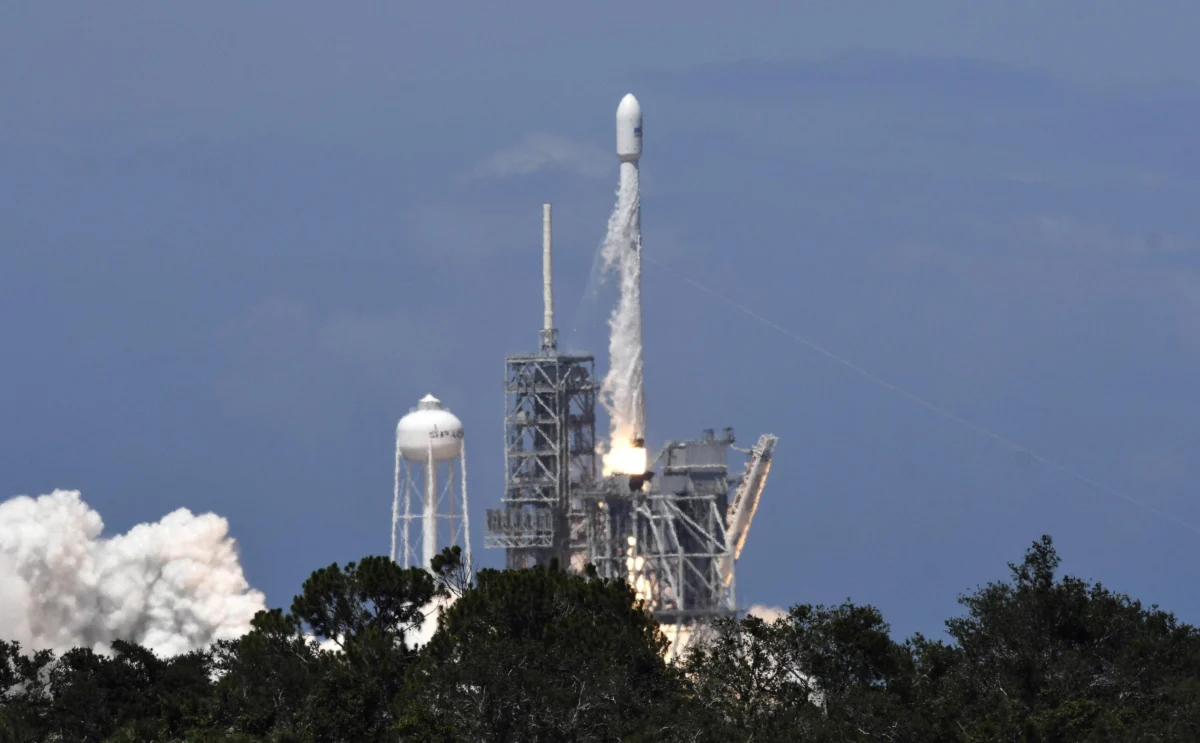
The trajectory of a discarded SpaceX Falcon 9 rocket stage reached its terminal conclusion on Wednesday as the four-metric-tonne piece of hardware collided with the lunar surface at high speed. The impact, which occurred at approximately 06:35 GMT (2:35 a.m. ET), marks a rare instance of an unintentional human-made object striking the moon. While the event posed no immediate threat to Earth or its inhabitants, it has reignited international discourse regarding the proliferation of space debris and the long-term sustainability of lunar exploration. Experts monitoring the event via ground-based telescopes and orbital tracking software believe the rocket segment struck the Einstein Crater, a geological feature located on the moon’s western limb that is often difficult to observe from terrestrial vantage points.
Traveling at a staggering velocity of 5,400 miles per hour (approximately 8,690 kilometers per hour), the rocket stage was expected to generate a significant plume of lunar dust upon impact. Because the collision occurred on the far side or the extreme limb of the moon relative to Earth, the event was not visible to the naked eye. However, scientists expect the Lunar Reconnaissance Orbiter (LRO) and other active lunar missions to eventually provide photographic confirmation of the new crater formed by the strike. Initial estimates suggest the impact would have displaced several tons of lunar regolith, creating a fresh scar on the moon’s surface that could provide unique, albeit unplanned, scientific insights into the composition of the lunar crust.
Chronology of the Mission and Orbital Decay
The origins of this lunar impact trace back to a launch conducted in January of the previous year. A SpaceX Falcon 9 rocket was tasked with a high-energy mission to deliver two lunar landers into a trajectory heading toward the moon. In a standard Falcon 9 mission, the rocket is composed of two primary sections: the first-stage booster and the second-stage upper segment. The first-stage booster is designed for reusability, typically performing a controlled descent to land back on Earth or on a drone ship at sea. However, the second stage is responsible for the final push into deep space.
During this specific mission, the requirements for thrust were significantly higher than those for missions deploying satellites into Low Earth Orbit (LEO). To successfully push the lunar landers toward their destination, the second stage exhausted its fuel reserves at an altitude and velocity that prevented a standard de-orbit maneuver. While most second-stage segments eventually fall back into Earth’s atmosphere to burn up harmlessly over the ocean, this particular unit entered a chaotic, high-altitude orbit.
For over a year, the 4,000-kilogram cylinder of aluminum and steel drifted through the Earth-Moon system, influenced by the competing gravitational pulls of the Earth, the Moon, and the Sun. It was not until earlier this year that astronomers, led by independent researchers like Bill Gray, creator of the Project Pluto orbital tracking software, identified that the object was on a definitive collision course with the lunar surface. Gray’s calculations, which were later corroborated by other observers, pinpointed the timing and location of the impact with remarkable precision, despite the unpredictable nature of solar radiation pressure on the tumbling rocket body.
The Physics of the Impact and Scientific Potential
The physics of the collision are a testament to the immense energies involved in space travel. At 5,400 mph, the kinetic energy released upon impact is equivalent to several tons of TNT. Because the moon lacks an atmosphere to slow the descent, the rocket stage hit the surface with its full momentum. The resulting crater is expected to be roughly 10 to 20 meters in diameter.
While the crash was unintentional, the scientific community is moving quickly to extract value from the event. NASA spokesperson Jimi Russell confirmed that the agency would utilize the impact as a training opportunity for tracking teams and a subject for future study. By analyzing the size and shape of the resulting crater, as well as the distribution of the ejected material (the "ejecta blanket"), geologists can learn more about the density and layering of the lunar soil in the Einstein Crater region.
This is not the first time the moon has been used as a laboratory for high-velocity impacts. In 2009, NASA’s Lunar Crater Observation and Sensing Satellite (LCROSS) mission intentionally crashed a Centaur rocket stage into the Cabeus crater near the lunar south pole. That mission was a success, as it kicked up a plume of debris that contained evidence of water ice. While the SpaceX impact was not equipped with the same sensor suites, the "unplanned experiment" still offers a rare look at how the lunar surface responds to large, man-made masses.
Official Responses and Corporate Accountability
The collision has prompted responses from both SpaceX and NASA, highlighting a shift in how space agencies view "disposable" hardware. Julianna Scheiman, SpaceX’s director of NASA science missions, addressed the event during a recent news conference, explaining that the company followed all established protocols for high-energy missions. She noted that while SpaceX typically performs maneuvers to ensure the safety of discarded stages, the specific combination of solar activity and gravitational forces in this instance redirected the hardware toward the moon.
"We did that [the safety maneuvers]," Scheiman stated, "but what has happened is essentially a mixture of solar activity and gravity forces have put it on a path towards the moon."
NASA has maintained a pragmatic stance, emphasizing that the event posed no risk to Earth. However, the agency is reportedly in discussions with SpaceX and other commercial partners to refine disposal strategies for future missions. This is particularly critical as NASA prepares for the Artemis program, which aims to establish a permanent human presence on the moon. An environment littered with unpredictable, fast-moving debris could pose a significant risk to lunar bases, orbiting stations like the Gateway, and descending astronaut crews.
The Broader Impact of Space Debris
The SpaceX rocket impact serves as a visceral reminder of the growing "space junk" crisis. According to data released by the European Space Agency (ESA) in July, there are currently more than 46,000 tracked pieces of debris in orbit, with a combined mass exceeding 17,000 tonnes. These objects range from defunct satellites and spent rocket stages to small fragments of paint and metal resulting from past collisions.
The environmental concerns extend beyond the lunar surface. Atmospheric chemists, such as Eloise Marais of University College London, have raised alarms regarding the impact of rocket launches on Earth’s atmosphere. The combustion of rocket fuels releases soot and chemicals that can deplete the protective ozone layer. Furthermore, as more objects re-enter the atmosphere and burn up, they leave behind metallic vapors and particles that may have long-term effects on the climate.
"The environmental impacts that we’re most concerned about include climate and the ozone hole," Marais noted. She explained that particles of soot released during launch absorb sunlight and warm the upper atmosphere, potentially altering delicate weather patterns and chemical balances.
Historical Context of Lunar Collisions
To understand the significance of Wednesday’s event, it must be viewed within the context of lunar history. The moon has been a target for human-made objects since the early days of the Space Race. In the 1970s, NASA intentionally crashed the S-IVB stages of the Saturn V rockets into the moon during the Apollo missions. These impacts were monitored by seismometers placed on the surface by astronauts, allowing scientists to "X-ray" the moon’s interior by measuring the resulting seismic waves.
More recently, in March 2022, a rocket segment widely believed to be from a Chinese lunar mission (though disputed by Chinese officials) crashed into the moon, creating a double crater. This led to increased calls for more transparent tracking of deep-space objects. The fact that several private and national spacecraft—such as the Israeli Beresheet lander and the Indian Vikram lander—have accidentally crashed into the moon in recent years underscores the difficulty of lunar operations and the increasing frequency of human "contact" with our celestial neighbor.
Implications for Future Lunar Governance
As the "New Space" era accelerates, with private companies like SpaceX, Blue Origin, and Intuitive Machines playing leading roles, the legal and ethical framework for lunar impacts remains murky. Currently, there is no international "traffic control" for the moon, and regulations regarding the disposal of deep-space hardware are largely voluntary or based on non-binding guidelines.
The SpaceX impact highlights the need for a more robust regulatory environment. If the moon is to become a hub for scientific research and economic activity, the international community must address several key questions:
- Who is liable for damage caused by errant space debris on the lunar surface?
- Should there be designated "graveyard" orbits or impact zones for spent rocket stages?
- How can we ensure that the "pristine" nature of the lunar environment is preserved for future scientific study?
NASA’s Scheiman acknowledged that these discussions are ongoing, noting that the agency does not want errant pieces of junk impacting its multibillion-dollar Artemis assets. The establishment of "safety zones" and more rigorous tracking requirements are likely to be at the forefront of future international space treaties.
Conclusion: A New Era of Lunar Responsibility
The crash of the SpaceX Falcon 9 stage into the Einstein Crater is more than just a footnote in astronomical observations; it is a signal that the era of treating the moon as an unreachable wilderness is over. While the scientific data gleaned from the impact may be "minor," as described by Bill Gray, the symbolic weight of the event is substantial. It marks a transition into a period where human activity in space has permanent, physical consequences on other worlds.
As telescopes turn toward the western limb of the moon to find the new crater, the mission serves as a call to action for better stewardship of the orbital and lunar environments. The challenge for the coming decade will be balancing the rapid expansion of space exploration with the necessity of maintaining a clean and safe "final frontier." For now, the moon bears one more human-made scar, a silent witness to the complexities of our journey into the stars.
