

South Korea’s economy, long a powerhouse in global technology manufacturing, is currently experiencing an unprecedented surge in semiconductor exports, driven by the insatiable demand for artificial intelligence (AI) infrastructure. In August, these vital shipments reached a staggering $46.65 billion, marking a remarkable 209% increase year-on-year and constituting nearly half of the nation’s total goods exports for that month. This stellar performance, while a boon for Asia’s fourth-largest economy, is also casting a long shadow of concern over the sustainability of such rapid growth and the potential economic ramifications should the current boom decelerate abruptly.
The Ministry of Trade, Industry and Resources reported earlier this week that semiconductor exports accounted for an astounding 47.5% of South Korea’s total goods exports, which amounted to $98.25 billion in August. This overwhelming contribution underscores the central role of the semiconductor industry in the nation’s economic vitality. Analysts attribute this dramatic upswing primarily to the significant capital expenditure undertaken by major cloud providers, including tech giants like Google and Amazon, as they aggressively expand their AI capabilities and data center infrastructure.
Jeff Ng, head of Asia macro strategy at Sumitomo Mitsui Banking Corporation, highlighted the profound impact of this trend, estimating that semiconductor exports were responsible for nearly 80% of South Korea’s export growth in August. "Overall export growth was driven by chips, computers, and higher petroleum product prices," Ng stated, emphasizing the synergistic effect of multiple export drivers.
The Double-Edged Sword of Rapid Growth
While a surge in export figures is conventionally viewed as a positive economic indicator, the sheer velocity of this semiconductor boom has ignited discussions about its long-term implications. The concern is not necessarily about a gradual cooling of demand, which would be more manageable, but rather the potential for an abrupt halt.
"A gradual slowdown would be manageable. An abrupt stall is a different matter, because the economy already runs at two speeds, and the sectors that would need to take up the slack are the ones under pressure today," explained Dave Chia, an economist at Moody’s Analytics. This sentiment points to a potential vulnerability where a sharp decline in chip exports could leave other sectors, which are already facing headwinds, ill-equipped to absorb the shock and compensate for the lost revenue.
Monetary Policy and Economic Resilience
Adding another layer of complexity to the economic outlook is the prevailing monetary policy environment. The Bank of Korea (BOK) has been actively working to combat elevated core inflation, raising its base interest rate to 3% in August, marking its second consecutive hike. This tightening of monetary policy, while necessary to curb inflation, could limit the nation’s economic cushioning if the semiconductor cycle turns downwards imminently.
Chia further elaborated on this risk: "The windfall fades when domestic demand isn’t strong enough to take over." This suggests that if chip demand cools while monetary policy remains restrictive, the economy might face a double whammy of reduced export earnings and insufficient domestic consumption to bridge the gap.
Broader Economic Landscape: Challenges and Opportunities
The challenges faced by other traditional export sectors in South Korea are noteworthy. Automobile exports, for instance, saw a significant decline of 29.8% year-on-year in August. While the trade ministry attributed a portion of this decrease to seasonal factors such as summer holidays and partial labor strikes, more persistent headwinds are also at play. These include the imposition of U.S. tariffs and a strategic shift by some automakers towards establishing production facilities within American plants, aiming to mitigate trade barriers and cater to local market demands.
Despite these challenges, there are nascent signs of a broader economic recovery. The BOK, in its August monetary policy statement, acknowledged a gradual acceleration in consumption recovery. Furthermore, data from the Ministry of Trade, Industry and Resources (MOTIR) indicated that non-semiconductor exports experienced a respectable growth of 20% in August, suggesting a potential diversification of export drivers, albeit at a less dramatic pace than the semiconductor sector.
Homin Lee, a senior macro strategist at Swiss private bank Lombard Odier, offered a cautiously optimistic perspective. He posited that even if semiconductor momentum were to wane, provided other cyclical sectors demonstrate robust performance, South Korea could still maintain an annual real growth rate of approximately 2% to 3%. This scenario hinges on the resilience and performance of these other economic pillars.
Looking Ahead: Navigating the Uncertainty
Analysts’ near-term outlooks generally remain positive, with expectations of continued export growth over the next twelve months. However, a moderation in this growth rate is anticipated, partly due to base effects – the comparison against exceptionally high figures from the previous year – and the potential stabilization of commodity prices.
Lee’s assessment of the situation offers a nuanced view, acknowledging the exceptional nature of the current semiconductor and tech export boom. However, he refrains from characterizing it as an "over-reliance," arguing that South Korea possesses other cyclical sectors that are intrinsically linked to the health of the broader global economy. This suggests that a diversified economic base, while currently overshadowed by the semiconductor surge, could provide a stabilizing force.
The Semiconductor Landscape: A Glimpse into Innovation
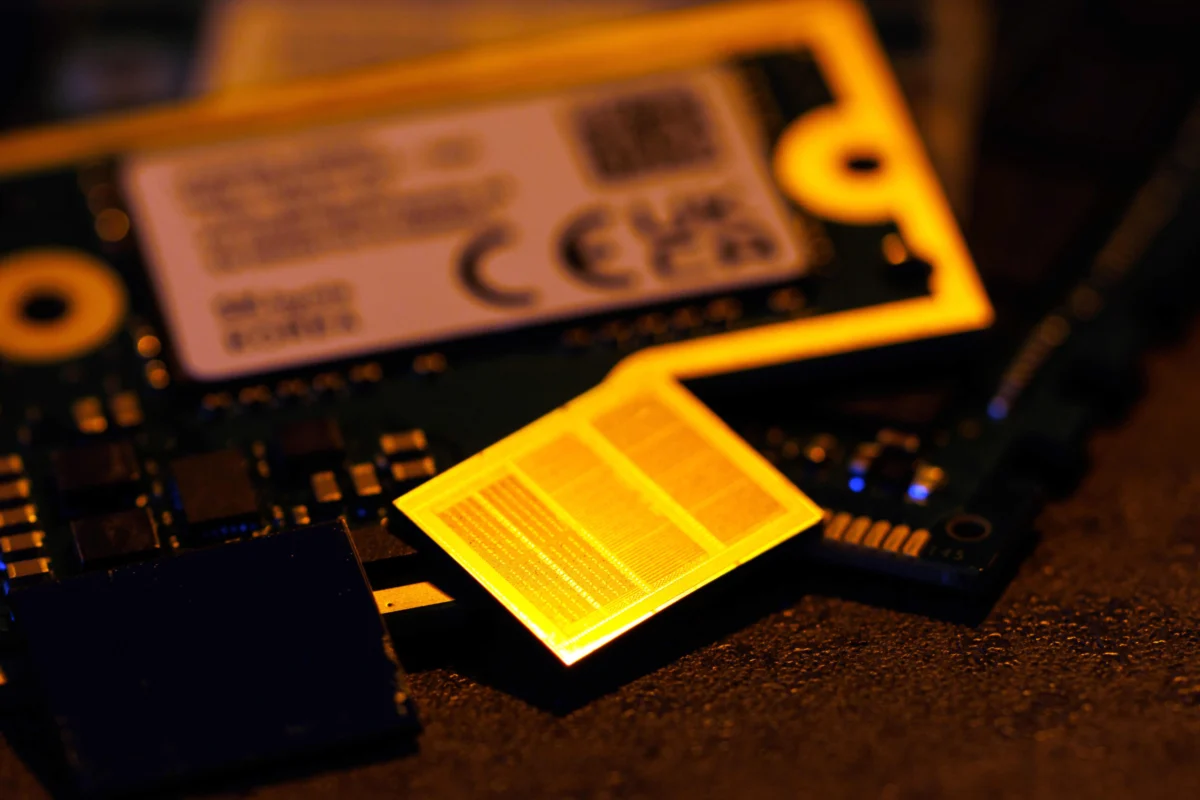
The remarkable surge in semiconductor exports is intrinsically linked to the cutting-edge technologies powering the AI revolution. Companies like SK Hynix and Samsung Electronics are at the forefront of developing and producing advanced memory chips that are crucial for high-performance computing. The image accompanying this report, showcasing SK Hynix’s 12-layer HBM4E memory chips integrated into an LPDDR5X CAMM2 memory module, offers a tangible representation of the technological advancements driving this market.
High Bandwidth Memory (HBM) chips, in particular, have become indispensable for AI accelerators and high-performance computing applications due to their ability to deliver significantly faster data transfer rates compared to conventional DRAM. The development of HBM4E, an even more advanced iteration, signifies the relentless pace of innovation in this sector. This continuous evolution ensures that South Korean chip manufacturers remain at the cutting edge, poised to meet the ever-increasing demands of the global AI industry.
The intense competition and rapid innovation cycle within the semiconductor industry necessitate substantial and ongoing investment in research and development. Companies are not only focused on increasing the capacity and performance of their chips but also on improving energy efficiency and reducing manufacturing costs. This intricate interplay of technological advancement, strategic investment, and market demand is what fuels the current export boom and shapes the future trajectory of South Korea’s economic landscape.
Conclusion: A Balancing Act for Sustained Prosperity
South Korea’s current economic narrative is dominated by the extraordinary success of its semiconductor sector, a testament to its technological prowess and strategic positioning in the global AI supply chain. The record-breaking export figures provide a significant boost to the nation’s GDP and employment. However, the rapid ascent also brings inherent risks, necessitating careful economic management and proactive strategies to mitigate potential vulnerabilities.
The coming months will be critical in observing how the global AI market evolves, how other economic sectors perform, and how effectively South Korea can leverage its existing strengths and diversify its export base. The nation’s ability to navigate these complexities will determine whether this period of unprecedented growth translates into sustained long-term prosperity or becomes a fleeting chapter in its economic history. The close watch on South Korea’s stock market, now seen as a bellwether for global AI sentiment, further emphasizes the interconnectedness of its economic fortunes with the broader technological landscape.
