

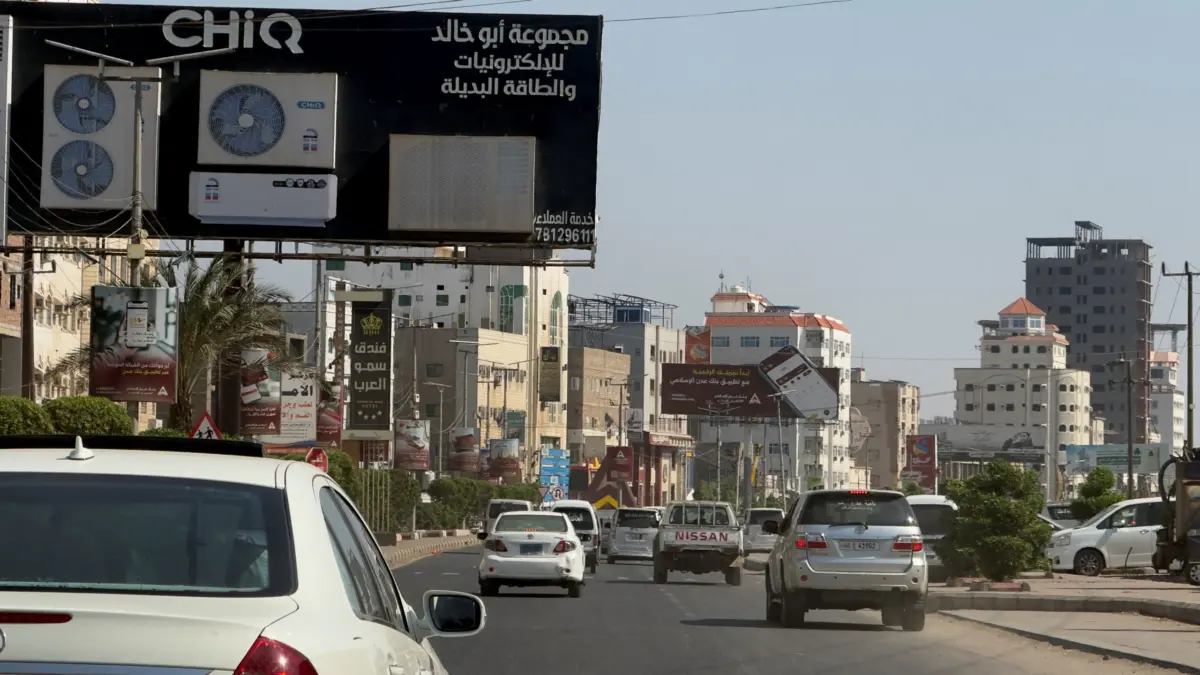
For Mohammed Abdul Malik, a resident of Yemen’s southern port city of Aden, the thunderous echoes of explosions that have rocked the streets over the past month are more than just a disruption of peace; they are a grim harbinger of a returning conflict. After nearly four years of fragile stability, the city that serves as the temporary seat of Yemen’s internationally recognized government is once again under fire. Houthi rebels have intensified their campaign, launching a series of missile and drone strikes targeting critical infrastructure, including the international airport, military installations, the commercial port, and the Ma’ashiq Presidential Palace.
The psychological weight of these attacks has transformed daily life into a series of tactical preparations. Abdul Malik, like many of his neighbors, has transitioned into a state of emergency readiness. He has begun stockpiling essential commodities—sugar, flour, and cooking oil—while ensuring his vehicle is mechanically sound and fueled for a sudden departure. His contingency plan involves a perilous journey eastward toward the provinces of Shabwa or Hadramout, regions that currently offer a semblance of safety compared to the volatile southern coast.
“I’ll tell you about myself and my close friends: We’ve started buying and stockpiling basic provisions,” Abdul Malik told Al Jazeera. “We’ve mapped out an exit route from the city. I’ve prepared my car, checked it over, and set aside an emergency supply of fuel. I’m ready to pack up my family and head out at a moment’s notice.”
A Reignited Conflict: The Path to the Current Crisis
The sudden escalation in Aden is the culmination of a broader Houthi offensive that began in early September 2026. After years of a stalemated frontline, the Iran-backed Houthi movement—formally known as Ansar Allah—launched a multi-pronged assault to seize territories in western Yemen. Their primary targets were the areas held by the Saudi-backed National Resistance Forces (NRF), a powerful military faction loyal to the government.
Within a single week of the September offensive, Houthi forces managed to capture several key districts in the Hodeidah and Taiz provinces. Most notably, they seized the port city of Mocha, a strategic stronghold that historically commanded the coffee trade but now serves as a vital logistics hub for the NRF. The capture of Mocha, followed by the Houthi advance toward the Bab al-Mandeb strait—one of the world’s most critical maritime chokepoints for oil and global trade—sent shockwaves through the international community and the Yemeni government.
In early October, government forces launched a counteroffensive aimed at reclaiming the Red Sea coast. While the military reported limited gains in the coastal plains, the Houthis responded by tightening their grip elsewhere. They successfully cut off a vital supply artery linking Aden to Taiz, Yemen’s third-largest city. This move effectively placed Taiz under a renewed, suffocating siege, leading to a humanitarian crisis that Aden residents fear will soon be mirrored in their own city.
The Siege of Taiz as a Warning for Aden
The fear permeating Aden is fueled by the harrowing accounts coming out of Taiz. The disruption of supply lines has caused the price of basic goods to double, leaving thousands of families unable to afford bread or clean water. For Abdul Malik and his colleagues, the fate of Taiz is a crystal ball showing Aden’s potential future.
“Prices in Taiz have already doubled, and the same could easily happen in Aden. If the port were to be struck, prices would skyrocket,” Abdul Malik noted. He described an office environment where the primary topic of conversation is no longer work, but survival. “At work, my colleagues and I talk about what we should buy, what food we ought to store, what our contingency plan is, and where we would go if we had to leave.”
The impact on the younger generation is particularly severe. The suddenness of the missile strikes has left school-aged children in a state of constant hyper-vigilance. During the initial wave of attacks, parents rushed to schools to find children huddled in hallways, terrified by the sound of explosions. The routine of education has been replaced by an atmosphere of anxiety, where every low-flying aircraft is viewed as a potential threat rather than a commercial flight.
Infrastructure Under Fire: The Targeting of Aden International Airport
Aden International Airport, the primary gateway for humanitarian aid and civilian travel in government-held Yemen, has become a central target in the Houthi campaign. The repeated use of ballistic missiles and explosive-laden drones has forced airlines to cancel or divert flights, isolating the city and hampering the movement of those seeking medical treatment abroad.
For residents of the Khor Maksar district, which borders the airport, the proximity to a strategic target has made their homes uninhabitable in the minds of many. Ahmed Awadh, a father of ten, described the toll the attacks have taken on his household. “An explosion jolts the children awake in terror, leaving them unable to sleep for the rest of the night. Even the sound of an ordinary airplane now strikes fear into my family,” Awadh told Al Jazeera.
The community has resorted to grassroots safety measures. Awadh and his neighbors have established a WhatsApp group to facilitate rapid communication following an explosion, allowing them to check on the safety of elderly residents and children. Some families in the district have already begun a partial evacuation, sending their most vulnerable members to the neighboring provinces of Lahj and Abyan, or renting modest apartments in districts further removed from the airport and military camps.
“The airport, which serves the civilian population, as well as other civilian infrastructure and residential areas, must not be targeted,” Awadh pleaded, echoing the sentiments of international human rights organizations that have warned against the targeting of dual-use infrastructure.
Chronology of the 2026 Escalation
The timeline of the recent conflict illustrates a rapid deterioration of security:
- September 3–10, 2026: Houthis launch a massive offensive in the west, capturing Mocha and securing positions overlooking the Bab al-Mandeb strait.
- September 15, 2026: Reports emerge of a total blockade on the primary road between Aden and Taiz, halting the flow of commercial goods.
- October 1–5, 2026: The Yemeni government announces a counteroffensive on the Red Sea coast; Houthi forces respond with the first long-range drone strikes on Aden.
- October 15, 2026: A coordinated missile attack targets the Ma’ashiq Presidential Palace in Aden during a high-level ministerial meeting.
- October 24, 2026: Multiple explosions hit the Aden International Airport and the city’s main port, causing significant structural damage and halting operations.
- Late October 2026: Local markets in Aden report a 30% spike in the price of imported staples as panic buying begins.
Military Vulnerability and the Government’s Silence
The resurgence of violence has raised pointed questions regarding the defensive capabilities of the Yemeni government and the Saudi-led coalition. Aden was declared the "temporary capital" after the Houthis seized Sanaa in 2014, yet critics argue the city remains shockingly vulnerable to aerial threats.
Adeeb al-Shatri, a professor of journalism at Aden and Hadramout universities, has been a vocal critic of the government’s failure to secure the city. He points out the irony of a capital city housing the nation’s highest institutions while lacking a robust air defense umbrella. “Aden is currently the capital, housing both major and minor state institutions. Therefore, the legitimate government must protect it,” al-Shatri told Al Jazeera.
While the Yemeni military claims to have intercepted several drones before they reached residential sectors, the frequency with which missiles impact their targets suggests significant gaps in the defense network. Moammar al-Eryani, Yemen’s Information Minister, has remained largely silent on the specific technical failures of the air defense systems, opting instead to issue general condemnations of Houthi "terrorism."
This perceived negligence has deepened the rift between the civilian population and the political leadership. Many residents feel that the government is safely ensconced behind armored walls while the public bears the brunt of the Houthi’s "pressure tactics" aimed at forcing political concessions.
The Economic Divide: Survival as a Luxury
One of the most sobering aspects of the crisis in Aden is the economic disparity in how residents prepare for war. While the middle class and those with connections to the diaspora can afford to stockpile food and maintain fueled vehicles, the vast majority of Aden’s population lives below the poverty line.
Yemen’s economy has been in a state of freefall for years, with the Rial losing much of its value and inflation reaching triple digits. Professor al-Shatri noted that for many, "Plan B" is non-existent. “In Europe and other stable Arab countries, people stockpile food during crises, but in Aden, people need three times their current salaries just to live a simple life,” he explained.
This economic desperation creates a surreal cycle of "interrupted normalcy." Despite the terror of missile strikes, the city’s markets often return to their bustling state within an hour of an explosion. This is not a sign of resilience in the traditional sense, but a sign of absolute necessity. “People’s movement in the city returned to normal just an hour after the explosion because they have to keep moving to earn money and secure their daily bread,” al-Shatri said. “If work were to stop, it would lead to a financial crisis, and they would be unable to provide food for themselves.”
Strategic Implications and the Road Ahead
The targeting of Aden is widely viewed by analysts as a strategic move by the Houthi movement to destabilize the government’s last remaining stronghold and gain leverage in future negotiations. By threatening the airport and the port, the Houthis are demonstrating their ability to cut off the government’s "lungs"—the infrastructure that allows it to interact with the outside world and sustain the local economy.
Furthermore, the escalation in the south serves to distract government forces from the western front, where the battle for the Red Sea coast remains undecided. If the Houthis succeed in making Aden appear untenable as a capital, it could lead to a total collapse of the administrative functions of the state, potentially forcing the government into a humiliating relocation or a lopsided peace agreement.
For the international community, the renewed fighting in Aden is a setback for peace efforts that had gained momentum over the previous four years. The involvement of the NRF and the strategic focus on the Bab al-Mandeb strait also raises the stakes for global shipping, as any prolonged conflict near the strait could lead to increased insurance premiums and disruptions in the global supply chain.
As the sun sets over the Gulf of Aden, the city remains in a state of tense anticipation. The lights of the Ma’ashiq Palace and the airport runway serve as beacons of a functioning state, but to the residents living in their shadow, they are targets that bring the threat of fire from the sky. For Mohammed Abdul Malik and thousands of others, the bag of sugar in the pantry and the full tank of gas in the car are the only certainties in a city where the future is as volatile as the horizon.
