

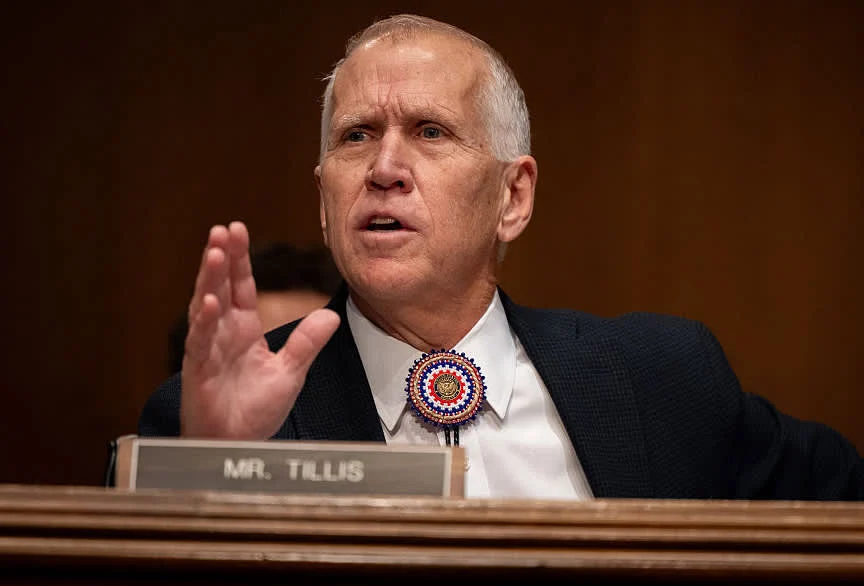
Republican Senator Thom Tillis of North Carolina has vehemently criticized President Donald Trump’s controversial appointment of Bill Pulte as acting Director of National Intelligence (DNI), labeling him an "incendiary attack dog" whose lack of qualifications and contentious record render his Senate confirmation virtually impossible. Tillis, a prominent voice within the Republican party and a member of the Senate Banking, Housing, and Urban Affairs Committee, made his remarks during an appearance on CNBC’s "Squawk Box" on Wednesday, intensifying the growing bipartisan backlash against Pulte’s dual role. The senator’s comments underscore a significant rift between the White House and the legislative branch, threatening to derail critical national security legislation and further politicize the nation’s intelligence apparatus.
The Controversial Appointment and Its Immediate Fallout
President Trump officially appointed Bill Pulte as acting Director of National Intelligence on Tuesday, June 2nd, 2026. This move came despite Pulte concurrently serving as the head of the Federal Housing Finance Agency (FHFA) and chairman of mortgage giants Fannie Mae and Freddie Mac. Pulte is slated to succeed outgoing DNI Tulsi Gabbard, who announced her resignation last month, effective June 30th. The DNI position, established in the wake of the 9/11 attacks, is designed to oversee and integrate the U.S. Intelligence Community’s 18 elements, ensuring that policymakers receive timely and accurate intelligence. It demands a leader with extensive intelligence, national security, and geopolitical experience, along with a temperament suited for managing highly sensitive information and diverse agencies.
However, Pulte’s appointment immediately drew sharp criticism from across the political spectrum. Senator Tillis was particularly pointed in his assessment, stating unequivocally, "I don’t think he has a prayer" of making it through the Senate and becoming the permanent DNI. This sentiment echoed concerns that Pulte, widely perceived as a Trump loyalist with no known prior experience in intelligence, had utilized his previous federal housing role to target political adversaries of the president. Critics argue that his past conduct, coupled with a perceived lack of relevant expertise, makes him profoundly unsuitable for a role that requires impartiality, discretion, and a deep understanding of complex global threats.
Pulte’s Record: A History of Weaponizing Information
A significant point of contention revolves around Bill Pulte’s tenure at the FHFA. Numerous reports and observations by lawmakers suggest that Pulte leveraged his access to sensitive mortgage records to investigate and, in some cases, refer for prosecution individuals deemed political enemies of President Trump. These targets reportedly included Federal Reserve Governor Lisa Cook and New York Attorney General Letitia James, both of whom faced allegations of mortgage-related wrongdoing instigated by Pulte’s office. This alleged pattern of "weaponizing confidential information" has deeply alarmed intelligence analysts and members of Congress, who warn that granting Pulte access to the nation’s most sensitive secrets as DNI poses an unacceptable risk.
Senator Tillis elaborated on his concerns regarding Pulte’s temperament, drawing attention to aspects of Pulte’s personal and professional history. Tillis referenced reports that Pulte, a scion of the PulteGroup homebuilding empire, was removed from the family’s corporate board in 2020 following disagreements with other directors. The senator also cited a public statement from the Pulte Family Charitable Foundation clarifying that Bill Pulte, known for his active social media presence, does not speak for the family "in any capacity." Tillis argued, "Why do I bring that up? I bring it up because it suggests a temperament that’s probably not right for the DNI role." This background, Tillis suggested, paints a picture of an individual prone to conflict and lacking the gravitas and collaborative spirit essential for leading the intelligence community.
Furthermore, Tillis highlighted Pulte’s apparent lack of core qualifications for the DNI position. "I don’t believe he’s ever had a security clearance. He clearly has no experience in intelligence, he has no geopolitical experience, no international connections — the sorts of things you would look for" in a DNI, Tillis asserted. These fundamental deficiencies, according to the senator, create a "structural problem" that makes his confirmation in the Senate an insurmountable challenge.
Bipartisan Condemnation and Legislative Gridlock
The outcry against Pulte’s appointment has transcended partisan lines, a rare occurrence in the current political climate. Senator Tillis’s Republican colleagues have joined the chorus of disapproval. Senator Bill Cassidy (R-La.), who recently lost his primary election despite Trump’s endorsement of a rival, publicly questioned Pulte’s competence, stating during a CNBC CEO Council Summit interview that Pulte does not appear "competent" to serve as acting DNI. Senate Majority Leader John Thune (R-S.D.) also weighed in, telling reporters on Capitol Hill, "We don’t need a weaponized DNI, we need professionals there." These statements from leading Republicans signal a deep unease within the party regarding the White House’s decision-making and its potential implications for national security.
Democrats, predictably, have also voiced strong objections. Senator Mark Warner (D-Va.), Vice Chairman of the Senate Intelligence Committee, expressed profound concern, stating that Pulte’s appointment gives him "pause." Warner specifically highlighted the dual issues of Pulte’s lack of qualifications and his documented history of "weaponizing confidential information." He questioned the administration’s expectation of trust, asking, "The idea that you put in somebody unqualified, who also has a record of weaponizing confidential information, and I’m supposed to ask, ‘just trust us?’"
The timing of Pulte’s appointment is particularly precarious given Congress’s ongoing deadlock over the reauthorization of Section 702 of the Foreign Intelligence Surveillance Act (FISA). This crucial surveillance law, which governs warrantless surveillance of foreign targets overseas, is considered vital by intelligence agencies for national security. However, it has been a contentious issue, with lawmakers grappling for weeks to find a bipartisan path to extension amidst concerns about civil liberties. Senator Tillis warned that Pulte’s promotion could imperil these efforts, further exacerbating the legislative logjam.

Senator Warner went a step further, urging Senate Majority Leader Thune to help convince President Trump to reverse Pulte’s appointment. A person familiar with the matter confirmed to MS NOW that Warner warned that if the reversal doesn’t happen, "all options are on the table," including potentially tanking a bipartisan deal to extend FISA Section 702. This threat underscores the seriousness with which congressional leaders view Pulte’s appointment and its potential to disrupt critical legislative functions. The DNI is meant to be a non-partisan coordinator of intelligence, and installing a figure perceived as highly partisan and unqualified risks undermining the very foundations of intelligence gathering and analysis, thereby jeopardizing legislative cooperation on related matters.
White House Response and Internal Discord
In response to the mounting criticism, the White House maintained its stance. White House spokesman Davis Ingle reiterated a statement from Tuesday, asserting, "The President chooses the best and most talented people to serve in his Cabinet. Bill Pulte is a great selection and he will do a great job on behalf of the American people." This official response suggests the administration is unlikely to back down, at least publicly, from its decision.
However, the internal dynamics within the administration itself appear fraught. An anecdote that surfaced during a Senate Finance Committee hearing further illuminated the contentious nature of Bill Pulte. When Senator Tillis questioned Treasury Secretary Scott Bessent about reports that he had threatened to punch Pulte in the face, Bessent candidly replied, "I actually said I was going to kick his ass." Bessent attempted to downplay the incident, adding that "that was last summer… many teams have fights in the locker room, and then go out and win for the team on the field." While Bessent tried to present it as a common workplace disagreement, the vivid language and public admission underscore the significant friction Pulte has generated even among his administration colleagues. Such open hostility among Cabinet-level officials is highly unusual and reflects poorly on the administration’s cohesion and decision-making processes.
Senator Tillis did acknowledge the possibility that the Trump administration could attempt to circumvent the Senate confirmation process entirely by simply leaving Pulte in place with the "acting" title indefinitely. This strategy has been employed by administrations in the past to install preferred officials without facing Senate scrutiny, though it often leads to accusations of executive overreach and can create instability within agencies due to the temporary nature of the leadership.
Broader Implications for National Security and Governance
The appointment of Bill Pulte as acting DNI carries profound implications for U.S. national security and the delicate balance of power between the executive and legislative branches.
Firstly, the potential politicization of the intelligence community poses a significant threat. The DNI is expected to be an objective arbiter and synthesizer of intelligence, providing unbiased assessments to the President and other policymakers. Placing an individual with a documented history of targeting political opponents and a clear lack of intelligence experience in this role risks undermining the credibility and integrity of intelligence products. Career intelligence professionals, whose work relies on their non-partisan status, may face morale issues or perceive pressure to conform to political narratives, thereby compromising the quality and impartiality of intelligence analysis.
Secondly, the ongoing deadlock over FISA Section 702 is a critical concern. This authority, deemed essential for counterterrorism and counterintelligence operations, faces expiration. If Pulte’s appointment leads to a complete breakdown in bipartisan negotiations, the U.S. could lose a vital tool for monitoring foreign adversaries, creating a national security vulnerability. The DNI’s role in advocating for and overseeing such surveillance programs is paramount, and an unqualified or controversial leader could hamper these efforts.
Thirdly, this move further exacerbates a simmering rift between President Trump and the Senate. The Senate’s constitutional role in "advice and consent" on nominations is a cornerstone of checks and balances. By appointing highly controversial figures or relying heavily on "acting" designations, the White House can be perceived as disrespecting the Senate’s oversight responsibilities. Senator Tillis’s frustration was palpable when he stated, "Whoever told the president to go ahead and commit to this publicly before vetting it should lose their jobs, because they should know that the math just works against Pulte being confirmed." He added, "I am tired of amateur hour," and called for those responsible for such poor decision-making to "get the hell out of the White House." These strong words reflect a deep frustration among experienced lawmakers with what they perceive as chaotic and ill-considered personnel decisions.
The use of "acting" officials to bypass Senate confirmation, while legally permissible for a limited time, has become a recurring point of contention in recent administrations. While it offers flexibility, prolonged reliance on acting leaders can destabilize agencies, deter top talent from seeking permanent roles, and limit accountability to Congress. In the context of the DNI, an acting chief might lack the long-term mandate and institutional support necessary to effectively lead and coordinate the vast and complex intelligence community during a period of heightened global instability.
In conclusion, Bill Pulte’s appointment as acting Director of National Intelligence represents a high-stakes gamble by the Trump administration. While the White House defends its choice, the bipartisan chorus of condemnation, led by figures like Senator Thom Tillis and Senator Mark Warner, highlights profound concerns about Pulte’s qualifications, temperament, and past conduct. The controversy threatens to impede critical national security legislation, further strain executive-legislative relations, and potentially politicize the U.S. intelligence apparatus at a time when objectivity and expertise are paramount. The coming weeks will determine whether the administration attempts to push for Pulte’s full confirmation, leaves him in an acting capacity, or ultimately yields to the overwhelming pressure from Capitol Hill.
