

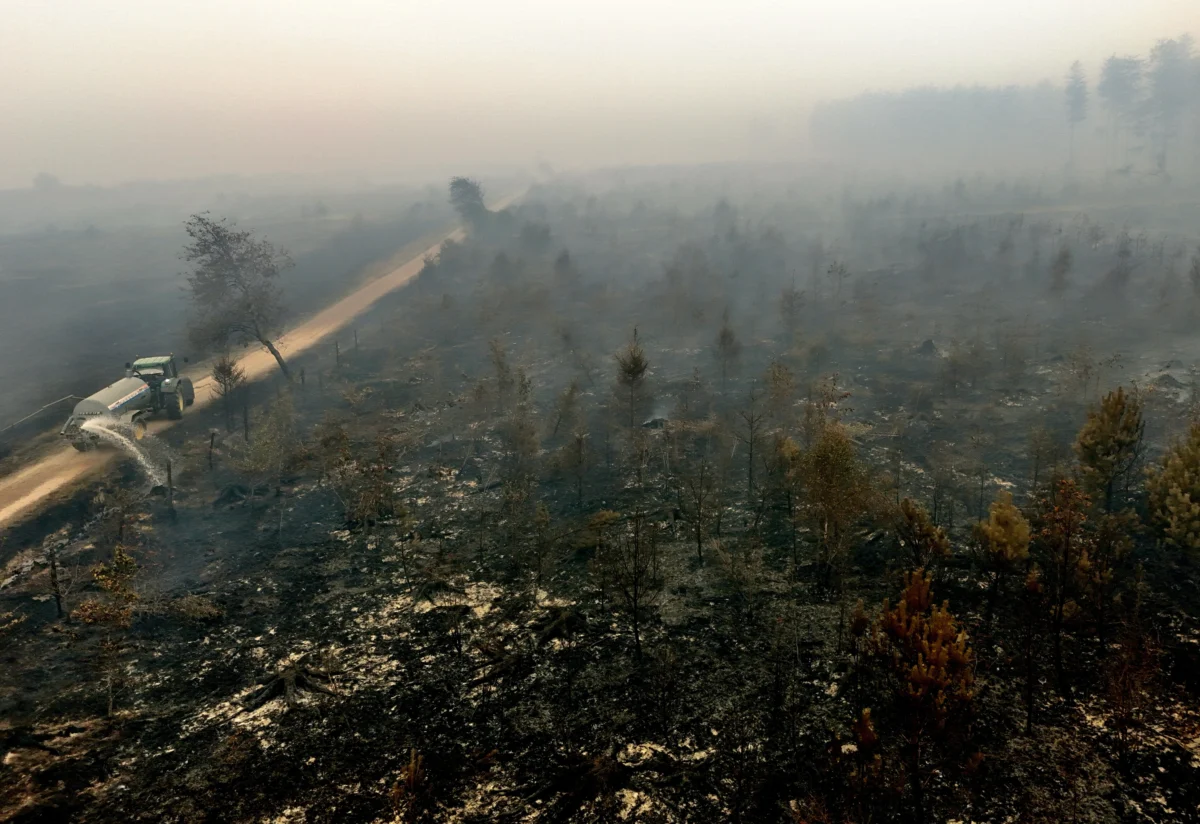
The kingdom of Belgium is currently grappling with the most extensive wildfire in its recorded history, as a massive blaze tears through the High Fens nature reserve in the eastern province of Liege. Emergency services from four different nations have converged on the region to prevent the fire from leaping across the border into Germany, marking a critical moment in what has become an unprecedented summer of extreme weather for Western Europe. As of Sunday evening, the fire had laid waste to more than 27 square kilometers (approximately 10.4 square miles) of protected moorland and forest, effectively doubling the previous record set during a catastrophic blaze in 2011.
The High Fens, or Hautes Fagnes, represents one of the last remaining wilderness areas of its kind in Europe, characterized by its unique peat bogs and high-altitude plateau. However, the very characteristics that make the park an ecological treasure—its thick layers of carbon-rich peat and dense vegetation—have turned the landscape into a tinderbox following weeks of relentless drought and record-breaking temperatures.
Chronology of the Disaster
The crisis began on Friday afternoon when the first plumes of smoke were detected deep within the Liege province’s forested zones. While the exact cause of the ignition remains under investigation by provincial authorities, the environmental conditions were optimal for a rapid escalation. By Friday evening, local fire brigades realized the scale of the incident surpassed regional capabilities, prompting an emergency call for reinforcements.
Throughout Saturday, the situation deteriorated as shifting wind patterns fanned the flames eastward. What began as a localized brush fire quickly transformed into a multi-front conflagration. By Saturday afternoon, the smoke became so thick that visibility in nearby municipalities dropped to near zero, prompting the first wave of evacuations. As the sun set on Saturday, the fire had already eclipsed the 14-square-kilometer record of 2011, moving with a speed that surprised even veteran forestry experts.
By Sunday morning, the fire front had advanced to within three kilometers of the German border. The town of Monschau, a historic destination in the German Eifel region, found itself directly in the path of the advancing smoke. While the flames had not yet crossed the national boundary, the intensity of the heat and the volume of particulate matter in the air forced German officials to issue localized evacuation orders for three districts.
International Mobilization and Tactical Challenges
The scale of the High Fens wildfire has necessitated a massive cross-border humanitarian and emergency response. More than 250 personnel are currently deployed on the front lines, representing a coalition of Belgian, German, Luxembourgish, and Dutch emergency services. This level of international cooperation is facilitated by the European Union’s civil protection frameworks, allowing for the rapid movement of assets across borders during environmental catastrophes.
Stephanie Ernoux, a spokesperson for the government of Belgium’s Wallonia province, confirmed that the primary tactical objective remains the containment of the fire’s advancing front. "The terrain is our greatest enemy right now," Ernoux stated in a briefing. "The High Fens is not just a forest; it is a complex bog system. Access for heavy machinery is limited, and the fire can often smolder underground in the peat layers, only to resurface several meters away."
Firefighting efforts have utilized a combination of aerial water drops and ground-based containment lines. Helicopters have been drawing water from nearby reservoirs to dampen the perimeter, while ground crews work in grueling conditions—often in temperatures exceeding 35C (95F)—to create firebreaks. The use of thermal imaging drones has also become essential, allowing commanders to track the movement of the fire through the dense smoke that blankets the plateau.
The Ecological Toll on the High Fens
The High Fens nature reserve is a site of immense ecological significance, protected under the European Union’s Natura 2000 network. It is home to several rare species, including the black grouse, which is nearly extinct in other parts of Western Europe. The destruction of 27 square kilometers of this habitat represents a generational blow to local biodiversity.
The peat bogs of the High Fens act as a significant carbon sink. When these bogs burn, they not only destroy the immediate flora and fauna but also release massive amounts of stored carbon dioxide into the atmosphere, creating a feedback loop that exacerbates the very climate conditions fueling the fire. Experts warn that the recovery of the peat layers could take decades, if not centuries, as the mosses and specialized plants that form the bog grow at a rate of only a few millimeters per year.
Furthermore, the "zombie fire" phenomenon is a major concern for the Wallonia forestry department. Because peat is highly flammable and oxygen-porous, fires can burn deep into the earth, surviving for days or weeks even after the surface flames have been extinguished. This requires constant monitoring and "soaking" operations that drain local water resources and exhaust personnel.
Human Impact and Evacuations
The human cost of the wildfire has been felt most acutely in the Belgian border municipalities of Waimes and Butgenbach. On Saturday, authorities ordered approximately 600 residents to evacuate their homes as the wind shifted, pushing a wall of acrid smoke into residential areas. While no homes had been confirmed destroyed as of Sunday morning, the threat of ember attacks and respiratory distress remained high.
In Germany, the response has been equally urgent. The town of Monschau, located just across the border, has advised residents in the districts closest to the High Fens to seek temporary shelter. Local gymnasiums and community centers have been converted into reception points for those displaced by the smoke.
"We are watching the horizon with great anxiety," said one resident of Waimes who was evacuated on Saturday. "The sky turned a bruised orange, and you could feel the heat on the wind. We’ve had fires before, but nothing that looked or felt like this. It feels like the land is simply giving up."
Authorities have urged the public to stay away from the entire High Fens region, citing both the danger of the fire and the need to keep roads clear for emergency vehicles. Several major hiking trails and tourist routes, which are usually bustling during the summer months, have been indefinitely closed.
The Broader Context: A Continent in Flames
The High Fens wildfire is not an isolated incident but rather a symptom of a broader climatic crisis gripping the European continent. Belgium’s record-breaking blaze occurred immediately following a severe heatwave where temperatures peaked at 37C (98.6F) in Liege. This heat followed a prolonged period of drought; meteorological data indicates that rainfall in the Ardennes region has been 60% below average for the last three months.
The United Kingdom recently recorded its hottest day of the year, with temperatures in London hitting 38.1C (100.5F), while France and Spain have battled dozens of "mega-fires" that have displaced tens of thousands of citizens. According to the European Forest Fire Information System (EFFIS), approximately 500,000 hectares (1.24 million acres) have burned across the European Union this year—a figure that far exceeds the annual average for the last decade.
Climate scientists argue that the "fire season," which was once largely confined to the Mediterranean countries like Greece, Italy, and Spain, is moving northward. The occurrence of a record-breaking wildfire in Belgium—a country known for its temperate, maritime climate—serves as a stark warning of the shifting environmental boundaries in Europe.
Analysis of Implications and Future Outlook
The scale of the High Fens fire will likely prompt a significant review of land management and disaster preparedness in Belgium and its neighbors. For decades, northern European forest management has focused on conservation and timber production, with fire prevention often being a secondary concern compared to the strategies employed in Southern Europe.
There is now a growing call for the "Mediterraneanization" of northern fire services. This includes the acquisition of dedicated firefighting aircraft, the creation of wider permanent firebreaks in protected reserves, and more rigorous training for local volunteers in wildland firefighting techniques.
Additionally, the economic impact on the region cannot be ignored. The Ardennes and the High Fens are pillars of the Belgian tourism industry. The closure of the park and the damage to the landscape will likely result in a significant downturn in visitor numbers for the remainder of the season, impacting local hotels, restaurants, and outdoor equipment retailers.
As of Sunday night, the battle continues. Meteorologists are forecasting a slight dip in temperatures over the next 48 hours, which may provide a window of opportunity for firefighters to gain the upper hand. However, without significant, sustained rainfall, the risk of reignition remains high. The international teams currently stationed on the Belgian-German border remain on high alert, aware that they are fighting not just a fire, but the consequences of a rapidly changing global climate.
The government of Wallonia has announced that once the fire is fully suppressed, a comprehensive ecological assessment will be conducted to determine the extent of the damage to the Natura 2000 site. For now, the focus remains on the "advancing front," as 250 men and women stand between the record-breaking flames and the communities that call this border region home.
