

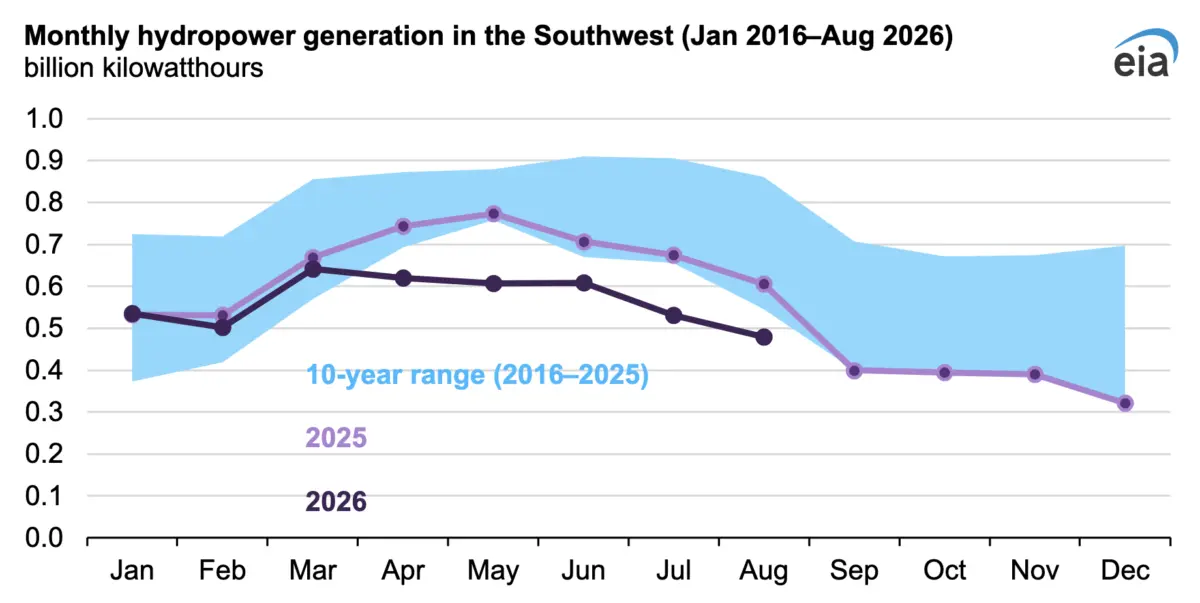
The Southwestern United States, an arid region increasingly defined by its vulnerability to climate volatility, has reached a critical inflection point in its energy landscape as hydropower generation plummeted to historic lows during the summer of 2026. Data released by the U.S. Energy Information Administration (EIA) indicates that a relentless, multi-year drought across the Colorado River Basin has severely curtailed the output of iconic hydroelectric facilities, forcing regional grid operators to grapple with a dwindling supply of carbon-free baseload power. From April through August 2026, hydropower generation in the Southwest power region—encompassing Arizona, New Mexico, and portions of Nevada and California—fell 19% compared to the same period in 2025. More strikingly, the output represents a 28% decline from the 10-year seasonal average, underscoring the systemic degradation of the region’s water-to-energy pipeline.
This downturn is the direct result of hydrological exhaustion at the nation’s two largest reservoirs, Lake Powell and Lake Mead. These man-made giants, formed by the Glen Canyon and Hoover Dams respectively, serve as the primary batteries for the Southwest’s electrical grid. However, as water elevations hover precariously close to "minimum power pool" levels, the physical capacity to generate electricity has been compromised. The crisis has prompted unprecedented federal intervention, including mandatory water consumption cuts and strategic reservoir releases, as the Department of the Interior attempts to prevent a total collapse of the Colorado River system’s power-generating capabilities.
The Hydrological Crisis: Lake Powell and Lake Mead at the Brink
The technical stability of the Southwest’s power grid relies on maintaining specific water elevations at Glen Canyon and Hoover Dams. When water levels drop, the "head"—the vertical distance the water falls to reach the turbines—decreases, which reduces the efficiency and total capacity of the generators. If levels fall below the "minimum power pool," the intake structures can no longer safely draw water without risking cavitation or mechanical damage, effectively halting power production entirely.
As of late September 2026, Lake Powell’s elevation stood at 3,518 feet. While this is technically above the minimum power pool threshold of 3,490 feet, the margin of safety has evaporated to less than 1%. This precarious position follows years of below-average snowpack in the Rocky Mountains, which provide the vast majority of the Colorado River’s inflow. Downstream, Lake Mead has fared only slightly better, reaching an elevation of 1,038 feet by the end of September. Although this is 9% above its 950-foot minimum power pool, the interconnected nature of the river system means that Mead’s stability is entirely dependent on releases from Powell.
To mitigate the immediate risk of Glen Canyon Dam going dark, the U.S. Bureau of Reclamation initiated emergency protocols earlier this year. This included the strategic release of water from the Flaming Gorge reservoir, located in the Upper Colorado River Basin, to bolster Lake Powell’s levels. Simultaneously, the Bureau reduced downstream releases from Lake Powell to maintain a buffer elevation of 3,510 feet. While these maneuvers saved Lake Powell’s turbines in the short term, they created a deficit for Lake Mead, illustrating the "zero-sum" reality of modern water management in the West.
Federal Intervention and the 1.25 Million Acre-Feet Mandate
Recognizing that emergency reservoir transfers are a temporary fix for a structural problem, the Department of the Interior has finalized aggressive conservation plans for the 2027–2028 period. In a landmark decision aimed at stabilizing the system, the federal government has mandated a collective reduction in water consumption of 1.25 million acre-feet per year for California, Arizona, and Nevada.
This reduction is not merely a water-security measure; it is an energy-security necessity. By keeping more water in the reservoirs, the Department hopes to maintain enough "head" to continue generating electricity during the peak summer months, when air conditioning demand puts the greatest strain on the regional grid. State officials in Arizona and California have expressed a mix of resignation and urgency, noting that while the cuts will be painful for the agricultural sector, the alternative—a total loss of hydropower—would lead to skyrocketing electricity prices and potential reliability issues.

Shifting Energy Mix: The Decline of Hydropower’s Dominance
The decline of hydropower in the Southwest is not a sudden phenomenon but the acceleration of a decade-long trend. In 2011, hydropower accounted for approximately 8% of the region’s total electricity generation mix. By 2026, that share is expected to dwindle to just 4%. According to the EIA’s November Short-Term Energy Outlook (STEO), total hydropower generation in the Southwest is projected to reach only 6.13 billion kilowatthours (BkWh) for the full year of 2026. This represents a 9% year-over-year decrease.
The vacuum left by hydropower is being filled by a combination of natural gas and rapidly expanding solar and wind capacity. While the Southwest has some of the best solar resources in the world, the loss of hydropower is particularly felt during the "net load" peak—the hours just after sunset when solar production drops off but cooling demand remains high. Hydropower has traditionally been the "flexible" resource used to bridge this gap. Without it, regional utilities must rely more heavily on gas-fired "peaker" plants or expensive battery storage systems, the latter of which are still being scaled to meet the immense needs of the desert states.
Chronology of a Megadrought: 2000–2026
The current crisis is the culmination of a 26-year period characterized by experts as a "megadrought," the driest period in the region in over 1,200 years.
- 2000–2010: A decade of fluctuating but generally declining inflows began to deplete the massive storage buffers built up in the 1980s and 90s.
- 2011: A rare high-snowpack year saw hydropower reach its modern peak of 8% of the regional mix, providing a false sense of security.
- 2012–2021: Persistent dry conditions led to the first-ever official shortage declaration on the Colorado River in 2021, triggering Tier 1 mandatory water cuts.
- 2022–2025: Reservoir levels continued to set record lows. The Bureau of Reclamation began implementing "extraordinary actions," including the 2023 agreement between Lower Basin states to conserve 3 million acre-feet through 2026.
- 2026: Record-low summer generation occurs as Lake Powell nears the 3,500-foot mark, leading to the current emergency releases and the new federal 1.25 million acre-foot mandate.
The El Niño Factor and Long-Term Uncertainty
Climatologists are closely monitoring a developing El Niño pattern, which historically brings increased precipitation to the southern tier of the United States. While a wet winter in 2026–2027 could provide a much-needed reprieve, the EIA and the Bureau of Reclamation remain cautious. For 2027, the STEO forecasts Southwest hydropower generation to remain essentially flat at 6.1 BkWh, a 0.5% decrease from 2026 levels.

The consensus among climate scientists is that "one good year" cannot fix the Colorado River. The soil in the Upper Basin has become so desiccated that a significant portion of snowmelt is absorbed directly into the ground or evaporates before it ever reaches the river channels—a phenomenon known as "aridification." Consequently, even average snowpack years are resulting in below-average runoff. This structural change in the water cycle suggests that the Southwest must prepare for a future where hydropower is a marginal, rather than central, component of the energy portfolio.
Economic and Social Implications
The implications of record-low hydropower extend far beyond the utility sector. The Bureau of Reclamation manages dams that provide water to nearly 40 million people and irrigate 5.5 million acres of farmland. The seven states dependent on the river—Arizona, California, Colorado, Nevada, New Mexico, Utah, and Wyoming—are now facing a period of intense economic realignment.
Lower hydropower output typically correlates with higher wholesale electricity prices. Hydroelectric power is among the cheapest sources of energy to produce once the infrastructure is built. Replacing 6.13 BkWh of low-cost hydro with market-rate natural gas or new renewables increases the cost of living for residents in Phoenix, Las Vegas, and Albuquerque. Furthermore, the 1.25 million acre-foot water cut will likely force fallowing in major agricultural hubs like California’s Imperial Valley and Arizona’s Yuma County, potentially impacting national produce prices.
Conclusion: A New Era for Western Energy
The record-low hydropower generation of 2026 serves as a stark warning of the limitations of 20th-century infrastructure in a 21st-century climate. As the Southwest electricity supply region adjusts to a 4% hydropower share, the focus of regional planners has shifted toward "drought-proofing" the grid. This includes aggressive investment in long-duration energy storage, geothermal energy, and enhanced grid connectivity with the Pacific Northwest and the Great Plains.

While the Colorado River Basin remains a vital artery for the West, its role as a reliable powerhouse is being redefined by the reality of water scarcity. The data from 2026 suggests that the era of "big hydro" dominance in the Southwest has ended, replaced by a complex, high-stakes effort to balance the competing needs of a growing population, a vital agricultural industry, and a fragile environment in an increasingly thirsty landscape.
